Having worked in small firms, I’ve always been the young guy. Even that time I went corporate, I ended up being the junior staff member on a major project.
That’s fine. I learn more from the experienced folks.
So it was a bit odd turning Owner and suddenly becoming an old guy. In the few cases where I’m younger, it was by a year or two, not decades.
Middle age is odd. They say architects don’t blossom till they are fifty. That was forever away, now just three years out.
I’ve gone through the stereotypical “now what” moment, but I’m also comfortably confident in my skills. There’s still plenty to explore, but I have much to share with the next generation.
Maybe this OPM letter was a my way to share some notes along this journey.
~
Some Links
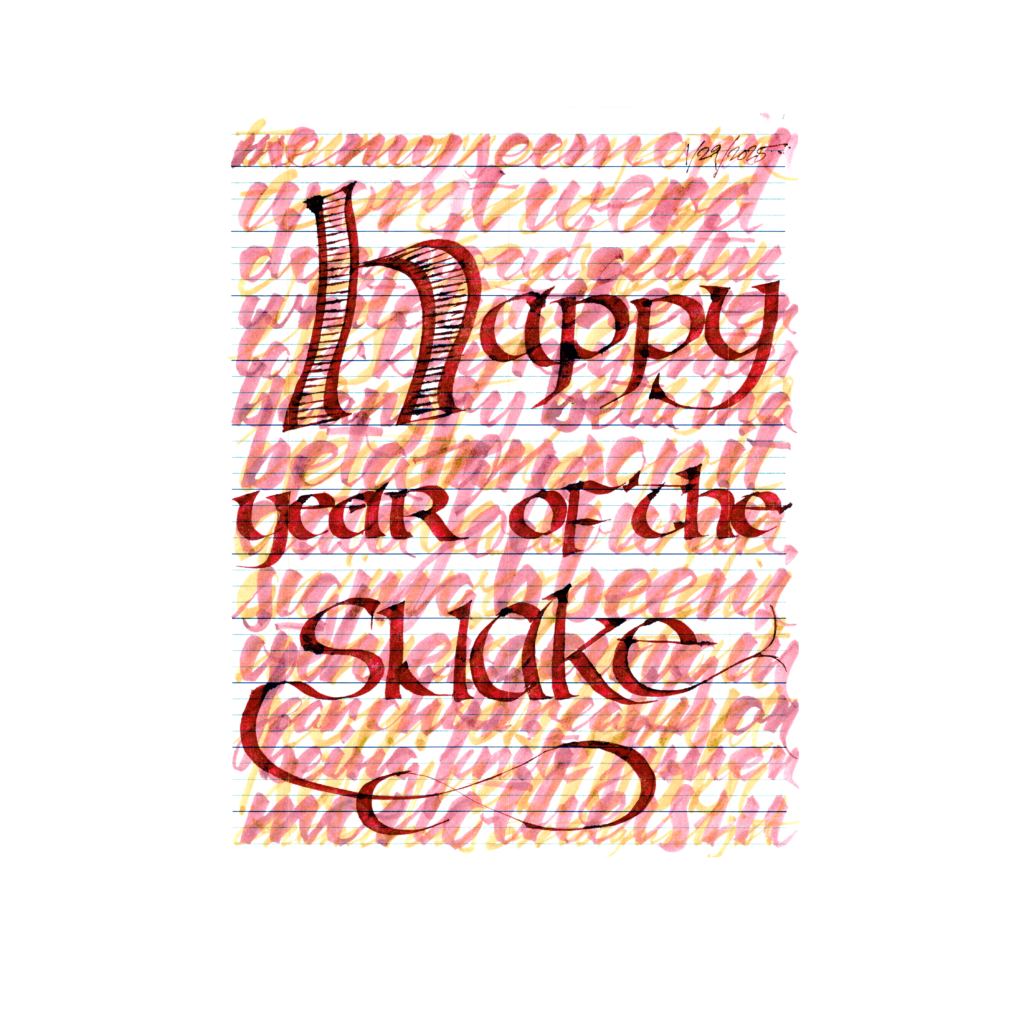
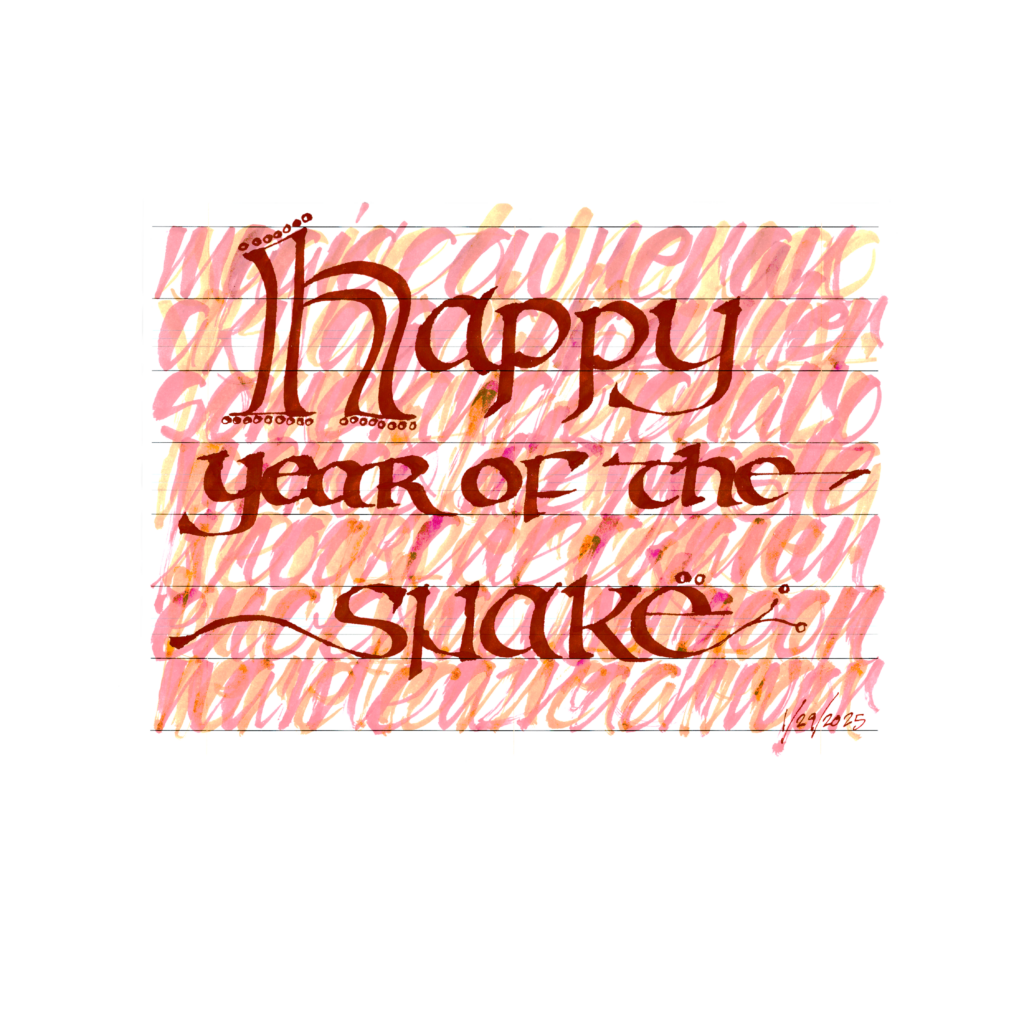
Over the past few years I’ve fallen hard for calligraphy. It’s why this letter took a long hiatus. You can graph with the most simple of materials, but here are some things that stand out.
The Pilot Parallel was my introduction to calligraphy. As a lefty, I had long thought it impossible, but once I got my hands on one of these pens, I just had to try (with the help of YouTube). It’s an inexpensive pen with none of the hassle of dip pens. If you’re not sure what size to get, go big with the 6.0mm.
What to graph on? Anything will do, but normal printer paper will bleed, as will binder paper. The best value I found was acid-free sulfite paper from Blicks, which is usable on both sides.
If you get deeper into the hobby, then splurge with the Brody Neuenschwander Handwritmic Ruling pen. I also enjoy the Dreaming Dogs ruling pens (especially for alternative shapes), but the Handwritmic has the best build quality with a nib that can handle a variety of scripts.
LED light tables are super cheap now. Mine is just a non-name brand from Amazon. Print out guidelines on paper and now you won’t have to rule your sheets all the time.
And finally books, books and more books.
Any edition of the Speedball Textbook is a good start (I’ve got 12, 16, and 20-25).
I’m fond of Arthur Baker’s Foundational Calligraphy Manual because he elucidates a technique of twisting the nib, which feels really weird until it’s natural. At this point I’ve picked up all of his books.
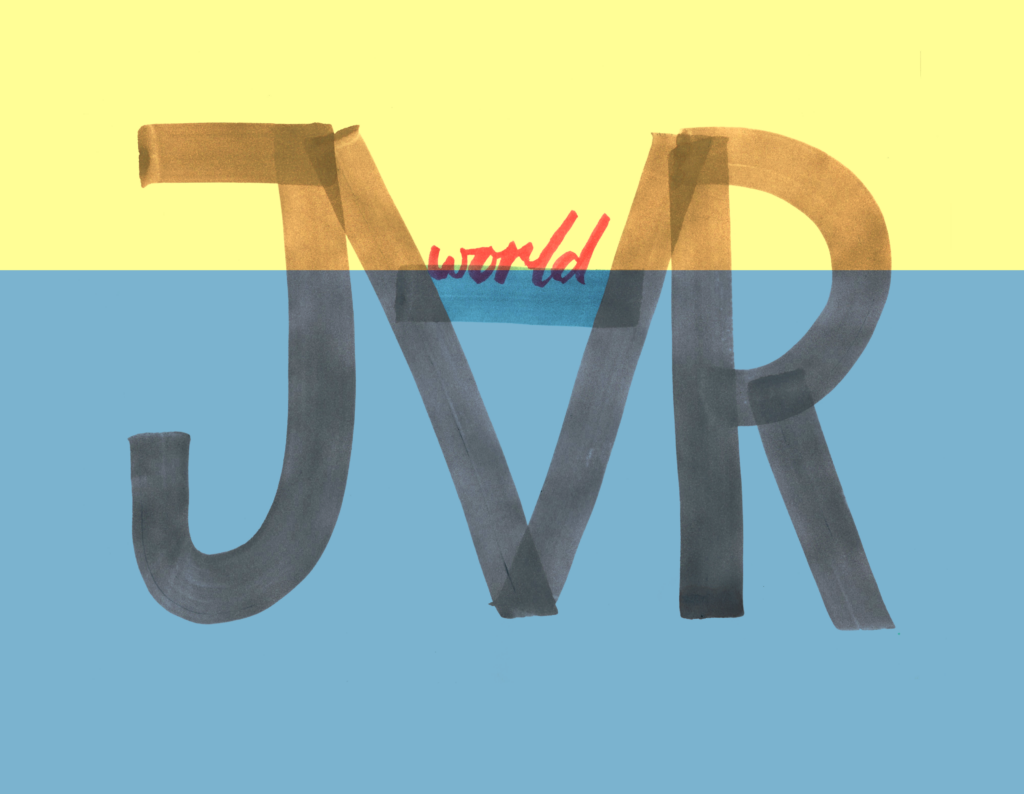
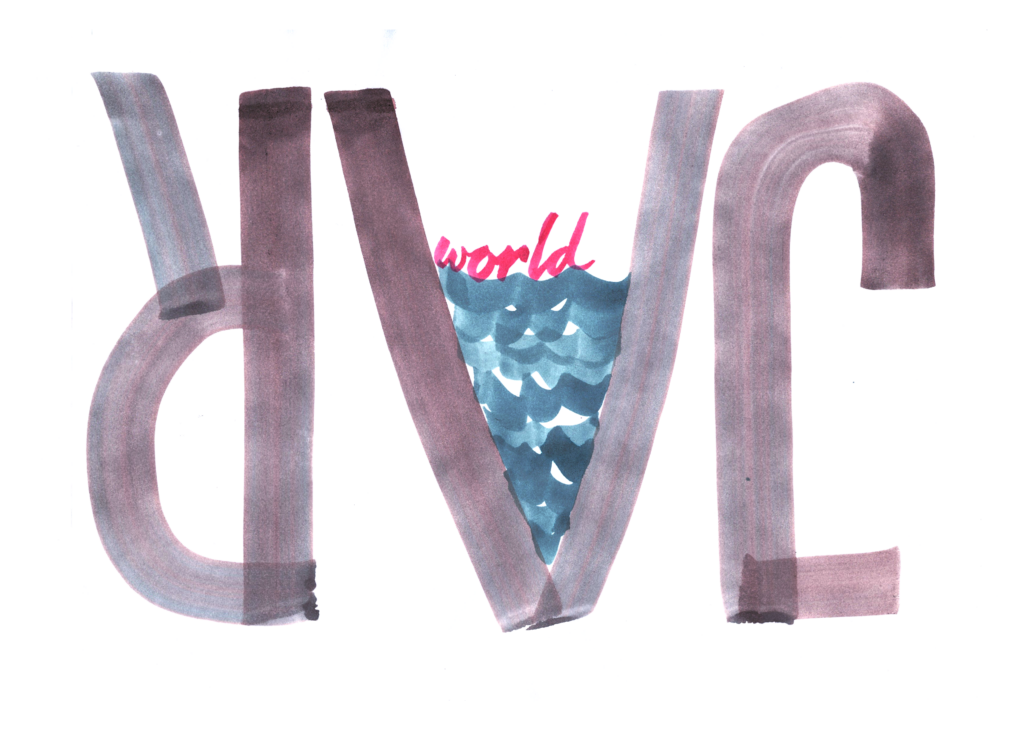
A wild card, out-of-the-box gem is Scott Kim’s mind twisting Inversions.
And no list of books would be complete without grand matron Sheila Water’s epic Foundations of Calligraphy. I find this one intimidating—high standards are great, but for a hobby, fun comes first. But when you get serious, it’s a must-have.
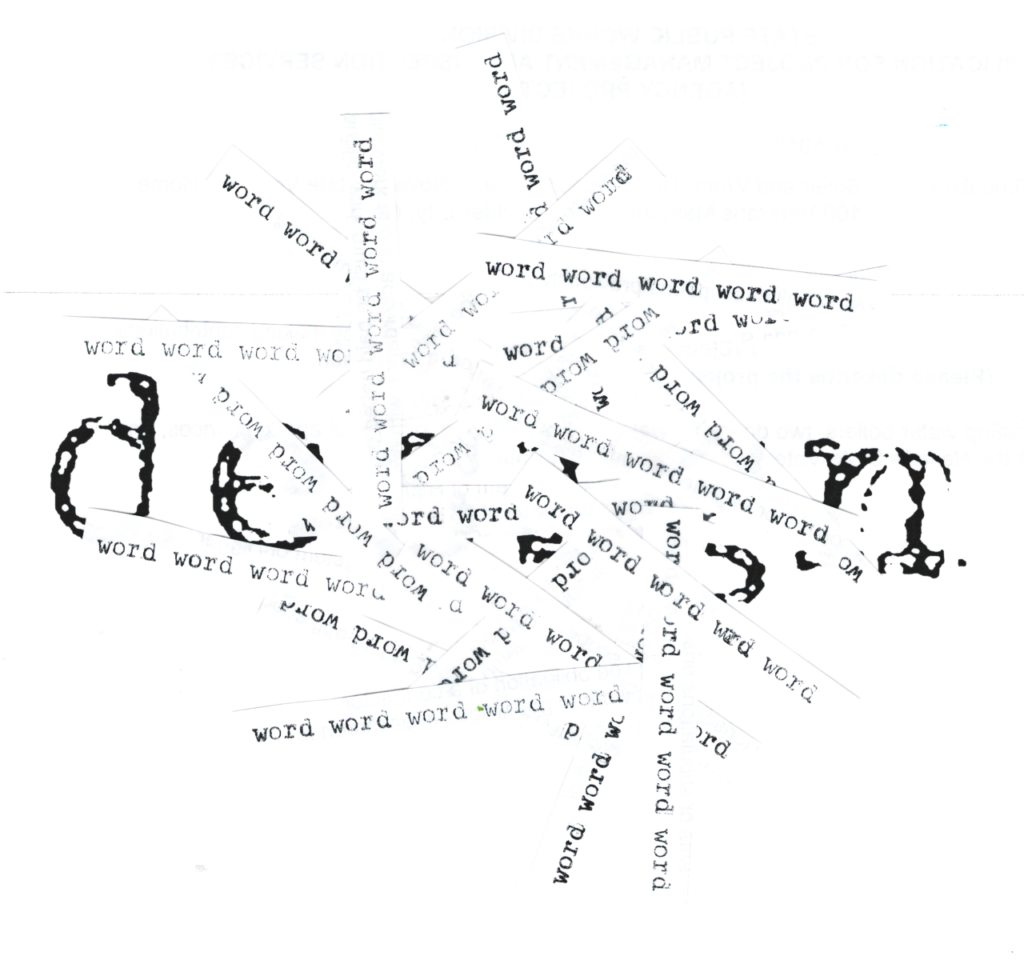
I cheated a little in this one, moving some of the words in the box to fine tune the composition. I never feel great about digital manipulation, but as time passes, I feel less guilty about it.
,
3/6
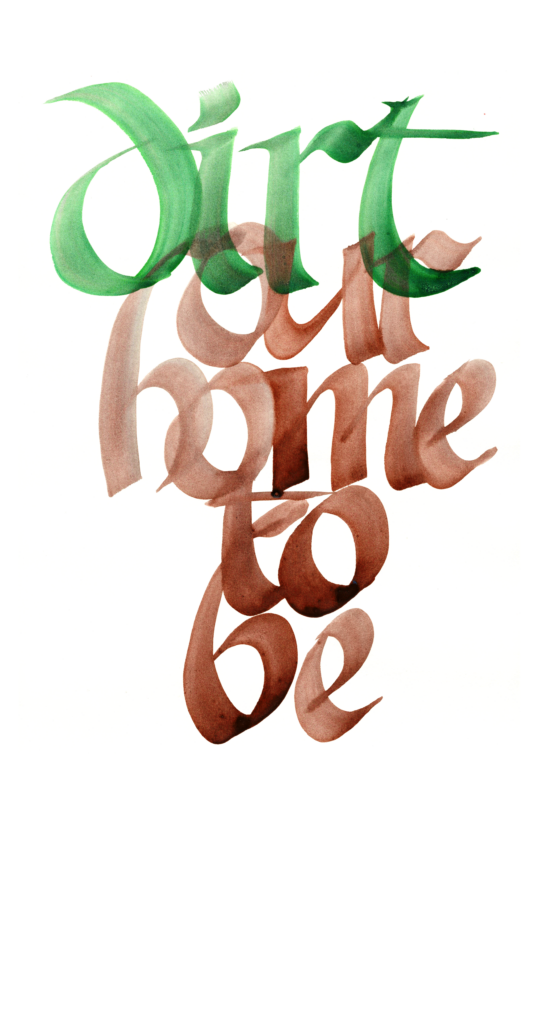
dirt our home to be
I love how the colors came out on this one, especially the inversion of the colors with the words.
,
3/8 Inktober 52 (2025), week 10
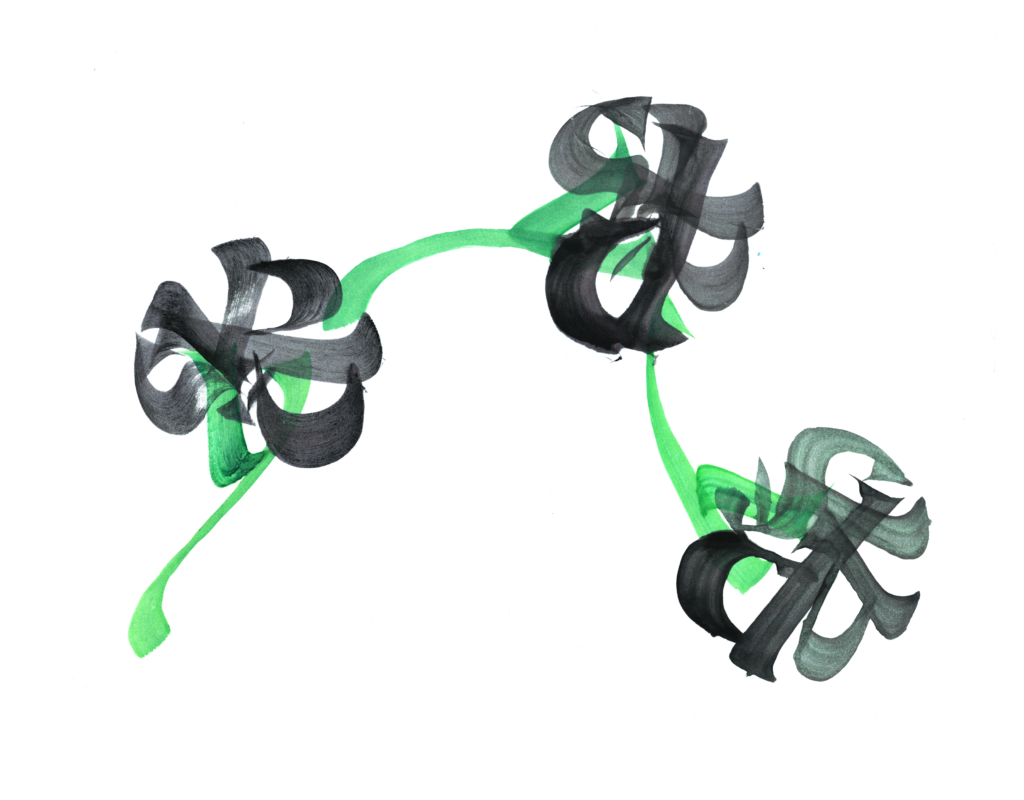
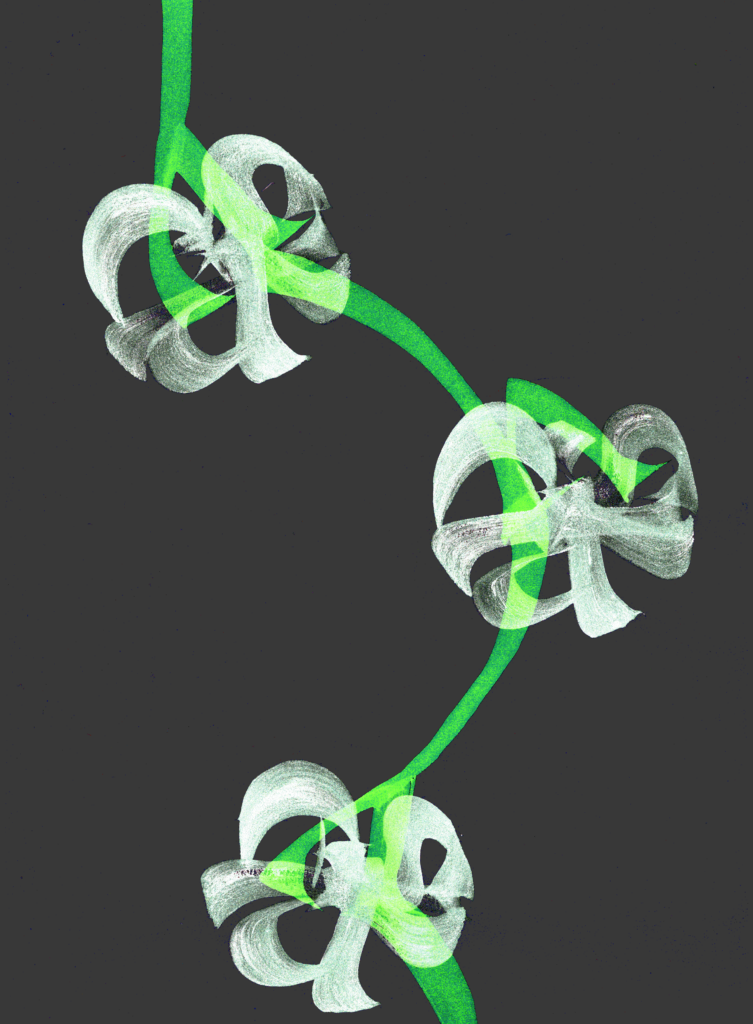
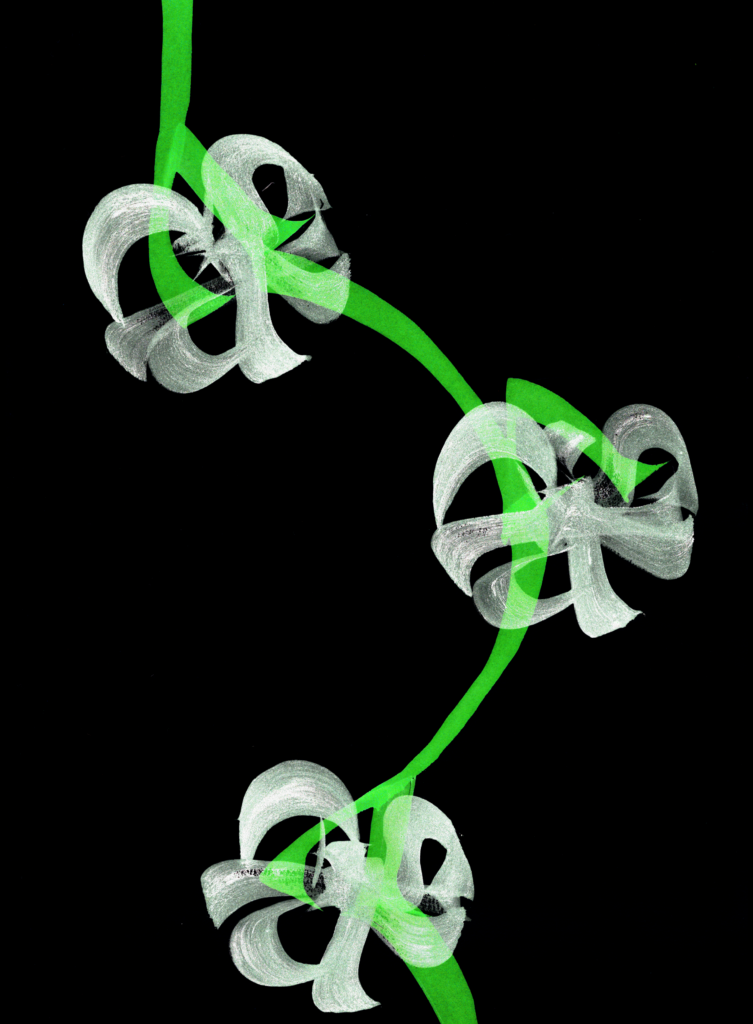
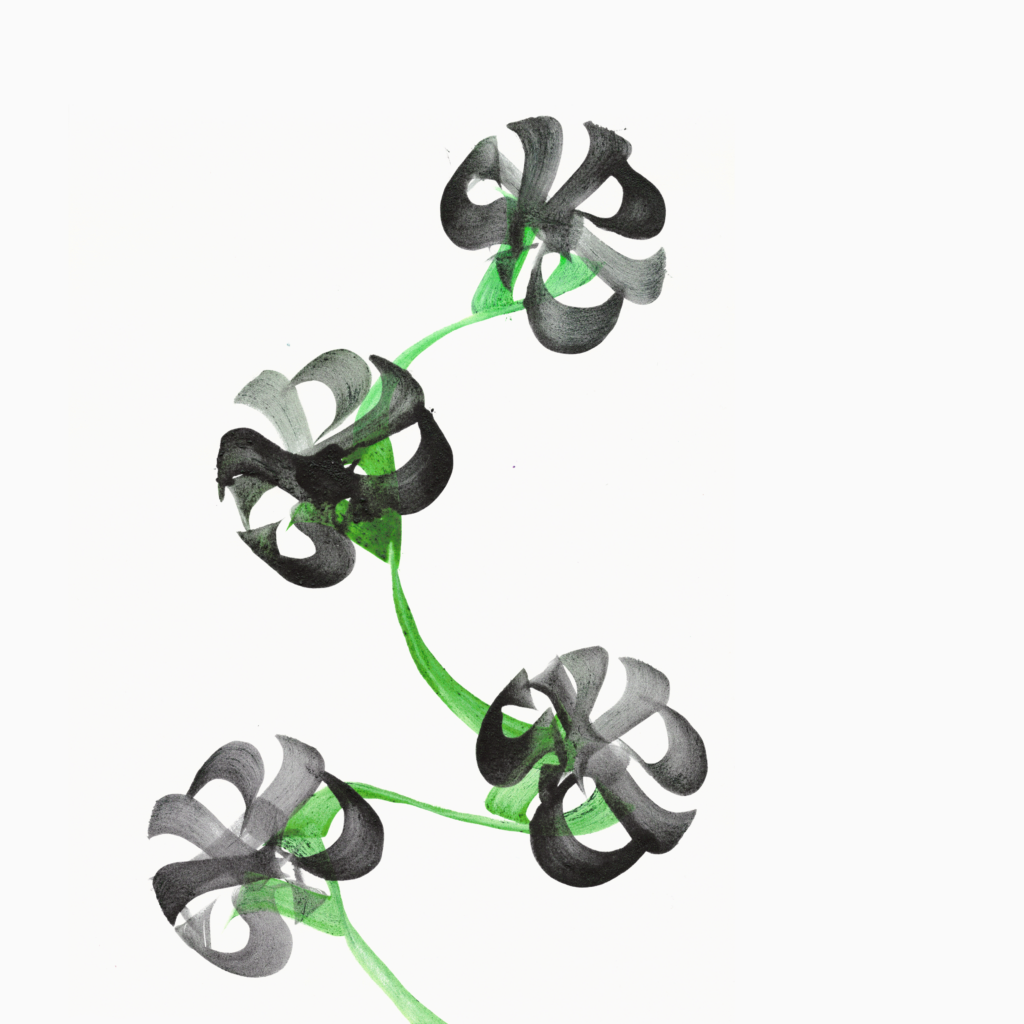
a chain of black daisies
This 5WP was banked on inverting colors in the computer, but the image of a black daisy won out.
,
3/9 Inktober 52 (2024), week 12
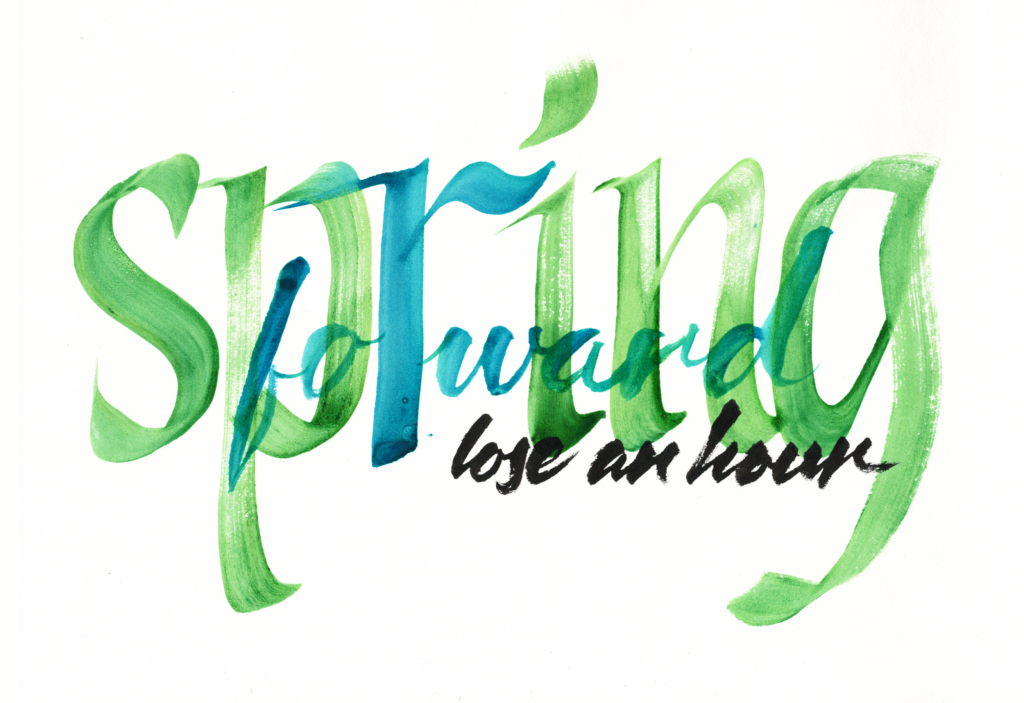
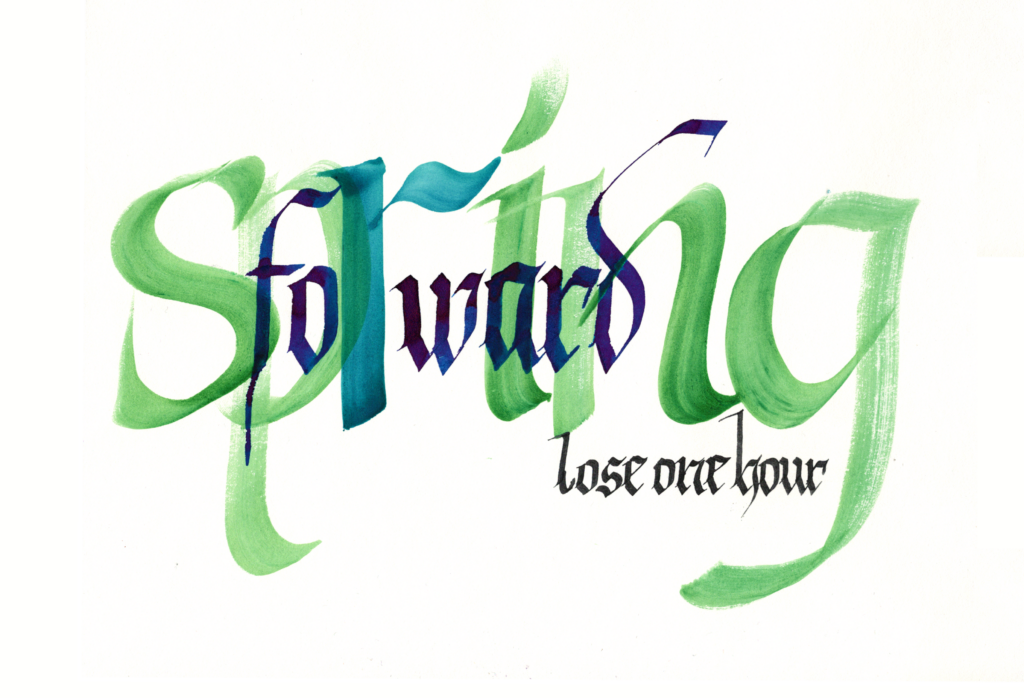
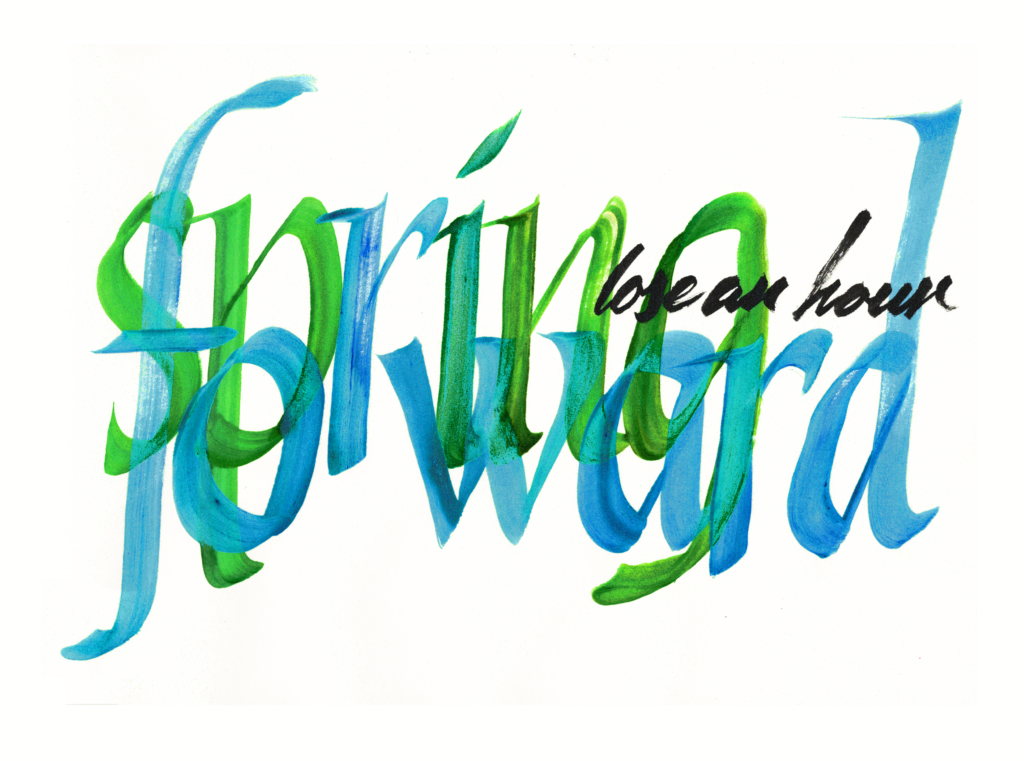
spring forward lose an hour
It’s interesting to revisit the layering of colored words months after graphing the pieces.. Clearly the top example was the best, but it took a few shots to explore the possibilities. I often compare calligraphy to hitting the slots.
The greatest thing about the constant practice is that once I land on a good composition, I am supremely confident than I can get it right. Unlike the previous Inktober, I don’t worry about whether I can replicate a good turn of hand from a practice sheet onto the final sheet.
,
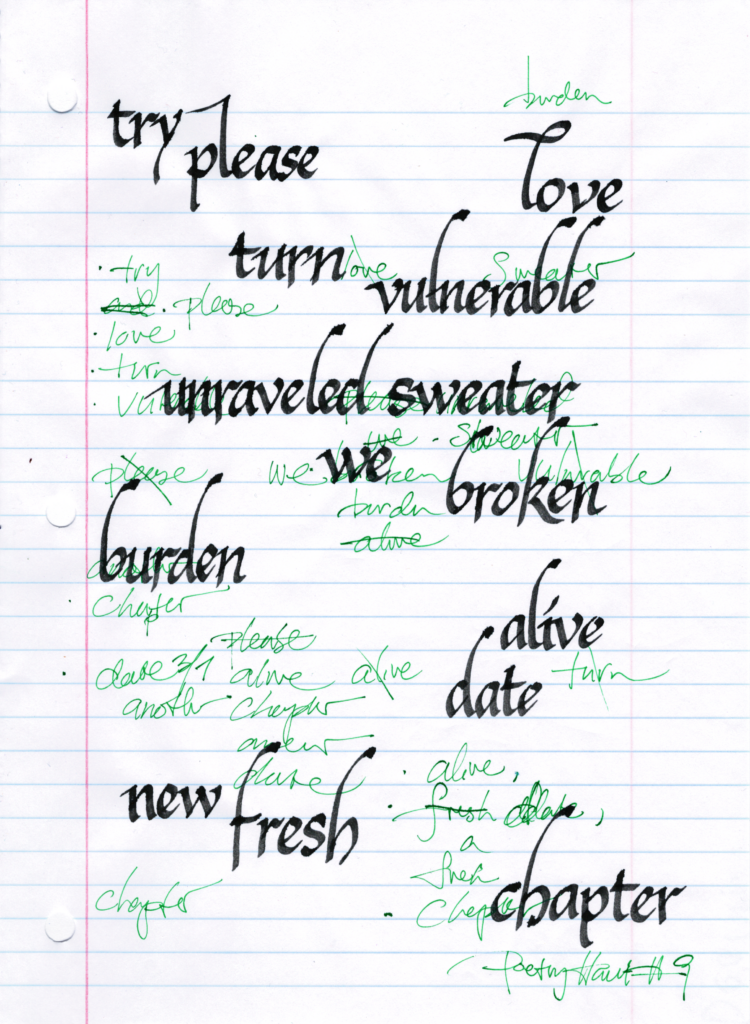
3/10 Poetry Haul #9
try please love turn vulnerable
unraveled sweater we broken burden
alive date new fresh chapter
More play with italics.
,
I am constantly in awe of the Monkey King. I never thought I had any affinity to superheroes until I saw my kids watch old Sun Wukong videos and read the books myself.
Then I realized I did have a favorite superhero all along, planted when my mom would read stories from old Chinese picture books to me and my sister when we were little kids.
Cya next time!
,
PS—Monkey King, Wu Cheng’en, trans. Julia Lovell, 2021
I’m typically too snobbish to read abridged versions, and now I’ve gone through two of them with the Walden audiobook and this Lovell translation.
In some ways it hearkens to the proscribed system in How to Read a Book where one takes multiple passes at varying levels of detail. I’m pretty good at skimming books, but it certainly helps when someone has done that work for you.
As for this book itself, it’s one heck of a story. The introduction warns you that this is satire, and it follows through on the promise. The Taoists are venal, the heavenly bureaucracy is minimally competent, the Buddhists aren’t much better, and I don’t think there is a single happy marriage in the book. Our gang of pilgrims are least dysfunctional bunch of the lot, which isn’t saying much.
As an abridged book, some of the stories are cut as was most of the poetry, which seems to be a distinctive aspect of the original novel. But that’s all good, it’s a fun read and it enticed me to read an unabridged version. Hard to give it higher praise than that.
After reading an unabridged translation by Anthony C. Yu, I must admit that cutting out the poetry quite impoverishes the experience. As much as I appreciate that this abridged version introduced me to the original, without the poetry it’s like reading a screenplay and ignoring the movie.
,
PPS—A Field Guide to Roadside Wildflowers at Full Speed
Any excuse to bring up this gem makes it a good day.
,
PPPS—New Tales of the Monkey King
I guess this TV show was a fun romp.
I don’t particularly mind the cultural appropriation because it’s way different than the original book and it’s Australian. I got enough problems in my own continent, I can’t get bothered over what they do on the other side of the globe.
But the first season was just OK. It certainly wasn’t anything that I would have watched without its nominal relationship to the 西遊記.
Yeah there’s a monk and his/her three disciples. The disciples are all gods in exile, and there are demons in this world, but then it goes off into its own universe.
Unlike the clear heavenly imperium of the original, the screen writers went for a good versus evil mega-battle—the bane of all superhero comic book movies. It’s a complete change from the original book. Instead of four folks on a long journey, they’ve been dumped into a Manichean struggle.
Even so, I enjoyed watching how they took an old story and modernize it to a contemporary popular medium. I can’t fault them for taking inspiration from the source and blazing their own trail.
But I must quibble with their depictions of Monkey and Tripitaka.
Monkey is depicted as a vain illiterate creature in this show. He’s certainly vain, but he’s a fucking badass. He’s quite literate, he should always be depicted as a Superman.
I’m fine that they recast Tripitaka a woman. One of the problems in the original story is that it’s a sausage fest. However, the screenwriters are much too kind to Tripitaka whose defining feature should be his helplessness. I dislike that she even learned kung fu in this show. I get that they are trying to avoid the damsel in distress, but if so, they should have chosen a different character to gender shift.
My the ultimate judgement?
I never watched Season 2.
I don’t regret the time spent on the first ten episodes, but if I want to know what happened on this TV show, I’ll just read the Wikipedia synopsis.
The Portland trip took a lot out of us. The trip was great, but planning and then recovering took a bunch of extra time before and after the actual time off. And then we followed it with a jaunt to San Diego right before school started. Travel is fun, but it eats into “free” time for sure.
,
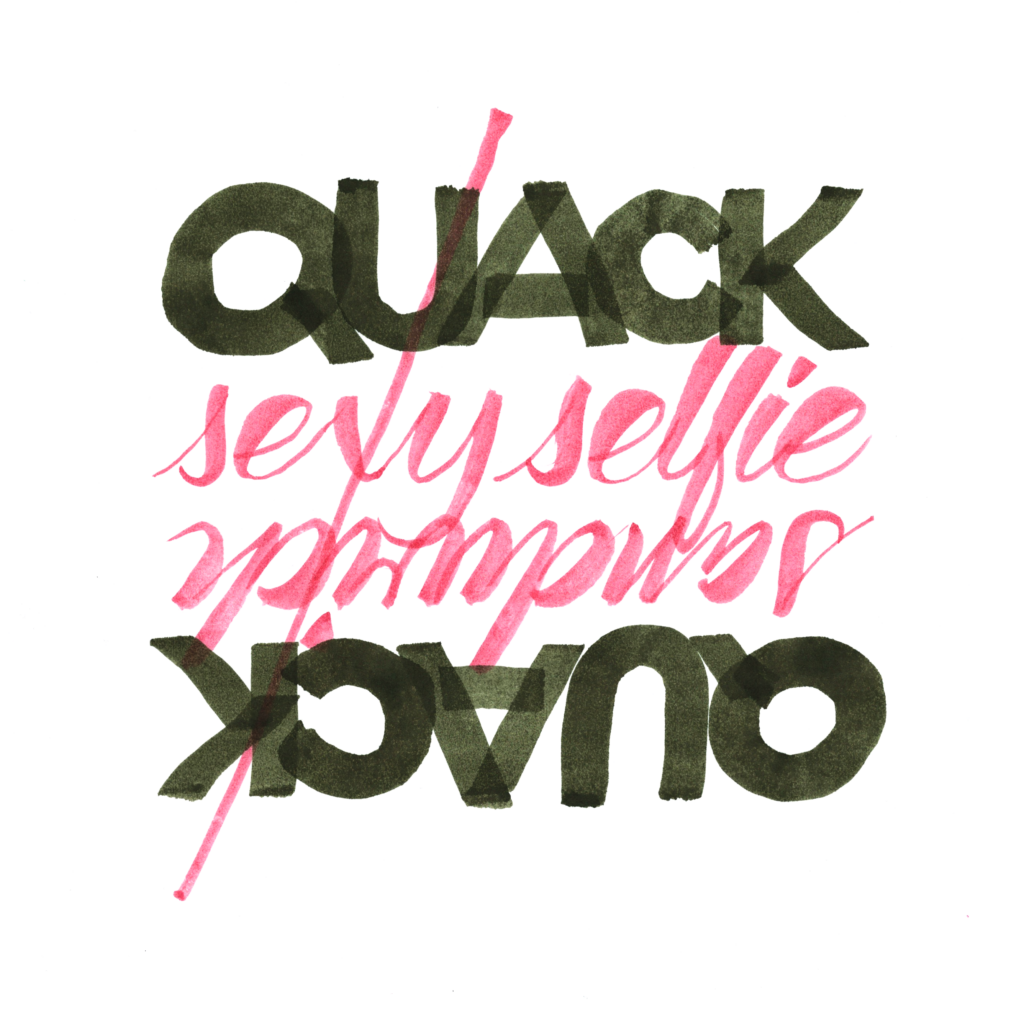
2/25 Inktober 52 (2024), week 21
quack quack sexy selfie sandwich
How did duckface became a social media phenomenon? I guess every era needs its thing.
,
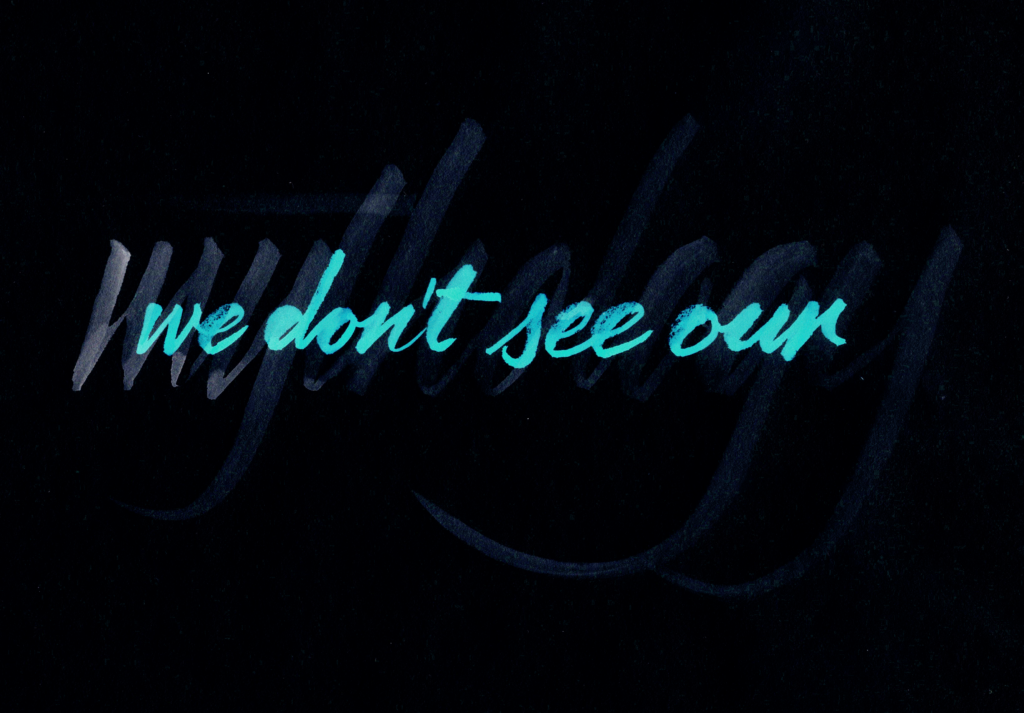
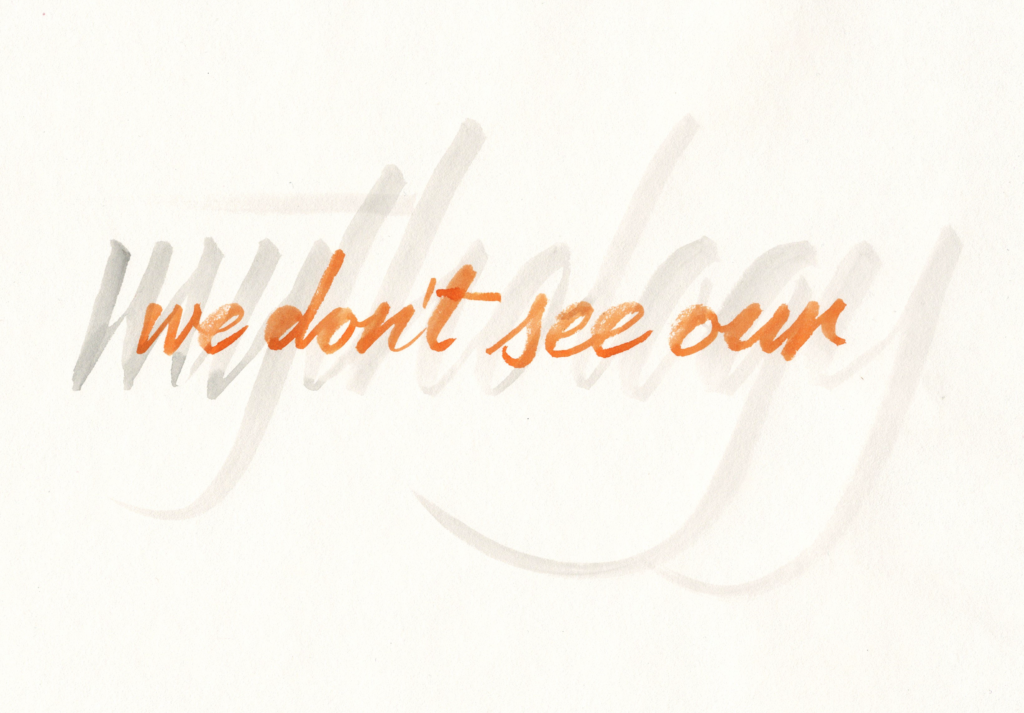
2/28 Inktober 52 (2024), week 20
we don’t see our mythology
I went light for a white on white vibe. Then reversed it.
,
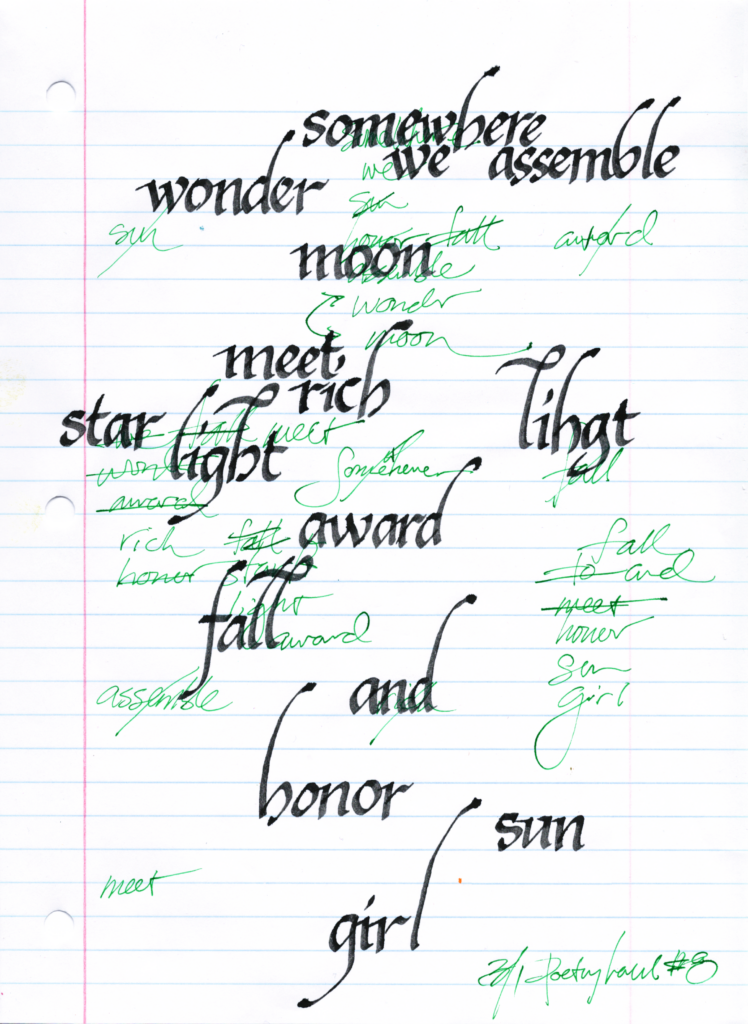
3/1 Poetry Haul #8
somewhere we assemble wonder moon meet rich star light award fall and honor sun girl
I had some fun with extended italics as I wrapped up February.
,
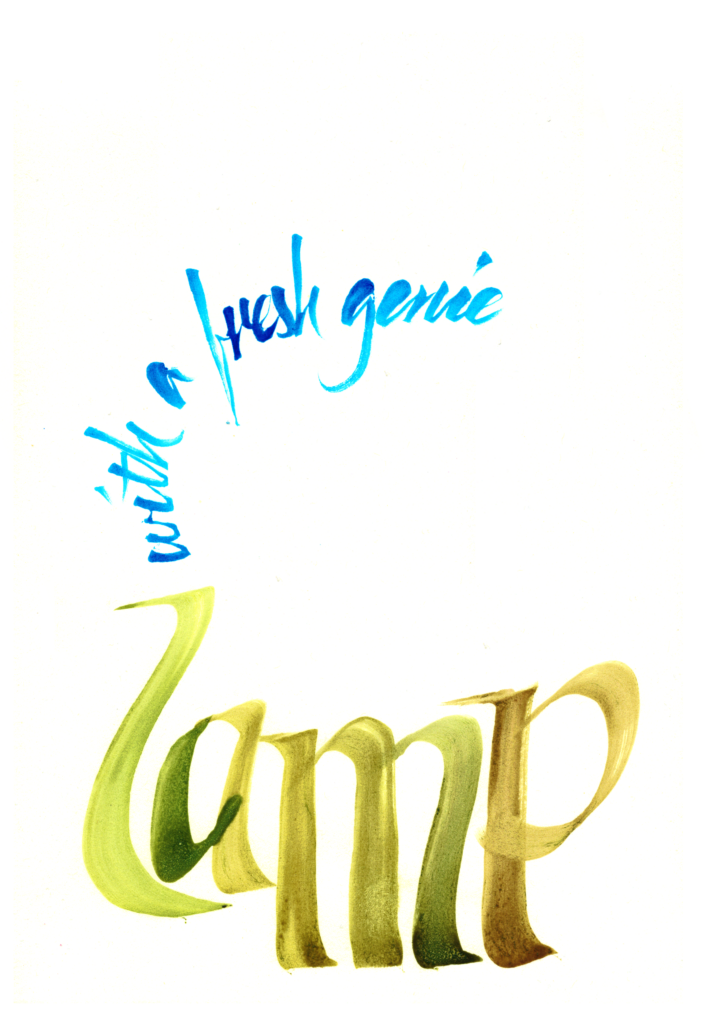
3/2 Inktober 52 (2025), week 9
lamp with a fresh genie
The flat brush runs fine, but I’ve continued to have trouble with cursive with a pointed brush. The Pentel brush pen works great, but I’ve never gotten the hang of normal pointed brushes.
,
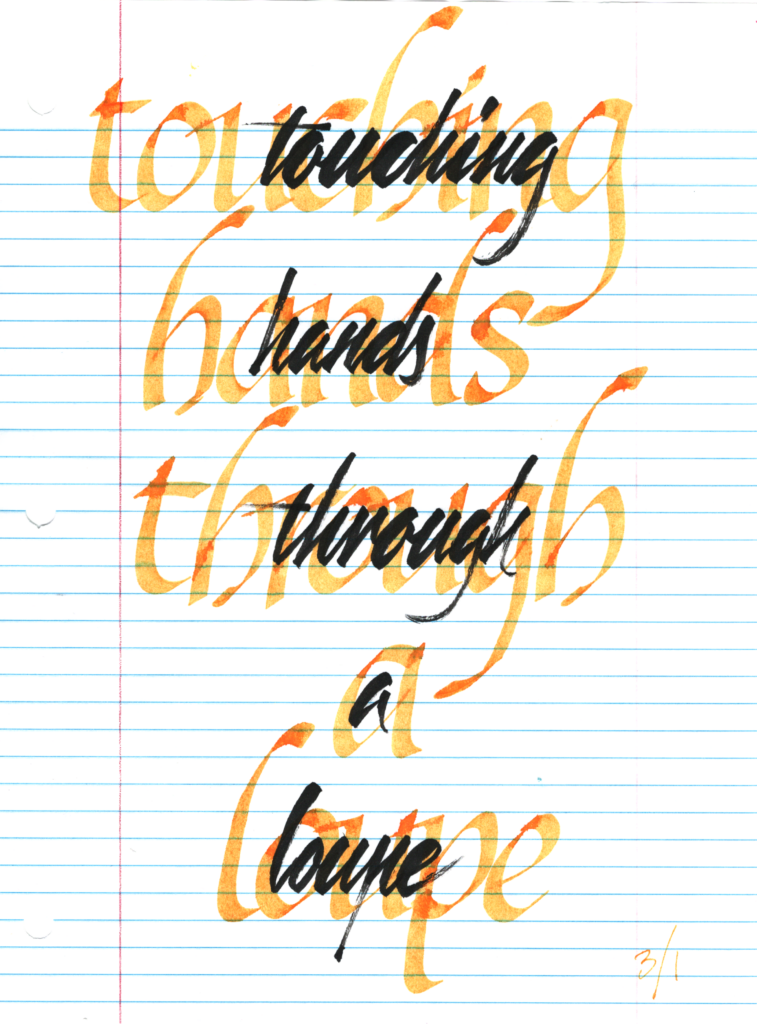
3/3
touching hands through a loupe
I had purchased a collage by Duane Toops and zoomed in with a jeweler’s loupe. Collage is a tactile art, I could see his hand in the cuts and ridges of paper on paper.
The cursive looks like it has regressed, it might be time to add it back on the list as a monthly focus.
,
Again, it feels like I’m trying to just get something in before another month disappears. Things have been super busy at work. But it’s a good busy. I’m doing good work on great projects.
I just need to slow down the pace. As much as I hate to admit it, things at the airport can wait, especially as time with the wife and kids continues to drip away.
I didn’t get this posted in time for August, and then my body revolted to put September on hold for three weeks.
Even worse, after returning from the hospital with my liver abscess, another family member went to the ER after dropping a bunch of weight and experiencing serious discomfort in the gut.
The family is going through a bout of organ revolts. We’ve had a good run, so I guess we were due.
Health shouldn’t be taken for granted, and yet, that is exactly what we do during the good times. One can’t live on permanent high alert, but I need to cultivate a practice of gratitude to savor the quiets between the storms.
Cya next time!
,
PS—The Mentor Leader, Tony Dungy, 2010
In 2021, I stopped reading self-help books—I got what I needed out of them.
After starting a work-related newsletter, I tried to restart the habit to grab some professional ideas to go with my artistic interests.
Naww, I’m past peak Self-help.
There’s nothing wrong with this book. This book matches Tony Dungy’s public persona—a quiet dude who makes everyone around him successful.
I blasted through the book at 2x speed. His main point is that a mentor leader should be humble. Being humble means receding into the background; success is found in elevating those around you.
I dig it! I bet I’m less humble than I’d like to believe, but I appreciate the appeal of his message.
Tony goes heavy on Christianity, but given my recent forays into ancient wisdom literature, that’s fine, even as an atheist.
Worth a quick listen if you’re in the mood for a generic leadership book, though you might remember nothing from it four years hence.
,
PPS—The Subtle Art of Not Giving a F*ck, Mark Manson, 2016
It’s kind of amazing to listen to a self help book and have nothing to say about it, even after trying to come up with an interesting take for a few days.
Just standard tough love, self-help fare, with a lot of F-bombs. The title is perfect for this book. If you pick it up, you’ll most likely dig it.
I didn’t disagree with Manson’s main points. There are only so many ways to approach life and his recommendations match how I see things, in spite of his crass delivery.
Pick your priorities (chose your f’s).
Control your reactions.
Owning your world is better constantly being the victim of your own psychodrama.
Avoid highs—chemical, relational, any type. They’re temporary and the crash only gets worse the longer you delay.
Commitment is freedom. It creates depth versus breadth.
Don’t pursue the results, pursue the process. Or if you don’t enjoy the process, give up on the results and chase what you enjoy doing.
The unconvinced will not be persuaded, but the book is fine if you want another take on such riffs. Another listen for 2x speed.
I’m procrastinating on taxes by compiling this post. Taxes are a cost of society and a lovely spring buzzkill. On the bright side, we’re about to head out to an airshow at Nellis, so I’m getting our fair share of entertainment (and propaganda) for these taxes.
,
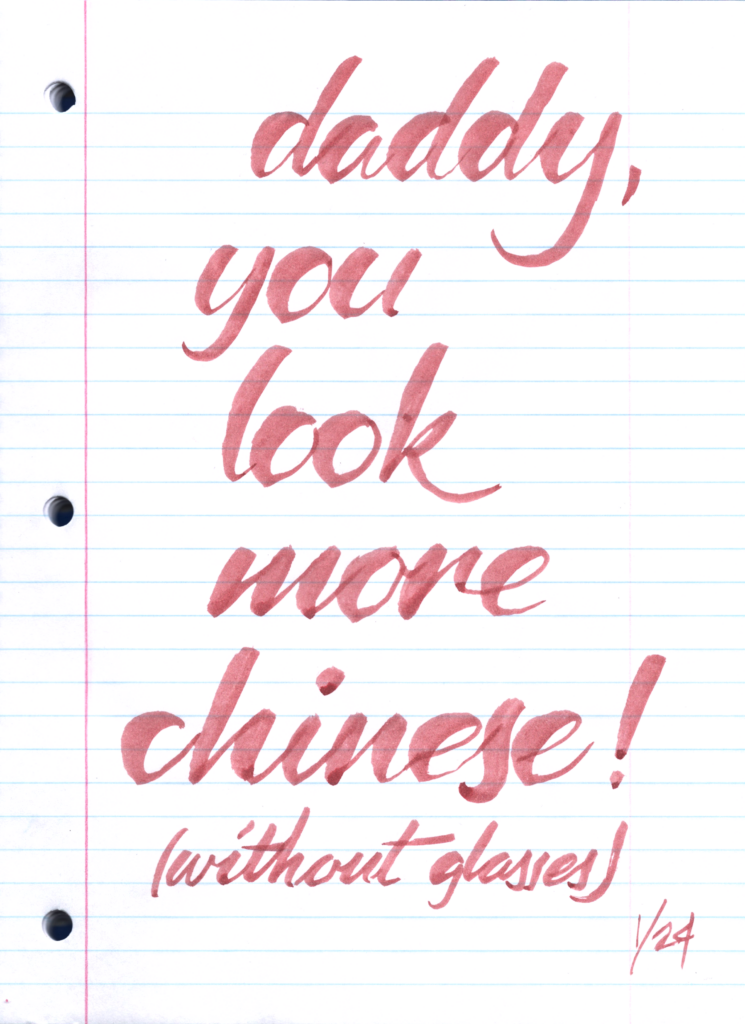
1/29
daddy, you look more chinese! (without glasses)
The boy is still earnestly drops lines of joy. I wonder how much longer it will last; it’s all so fleeting.
,
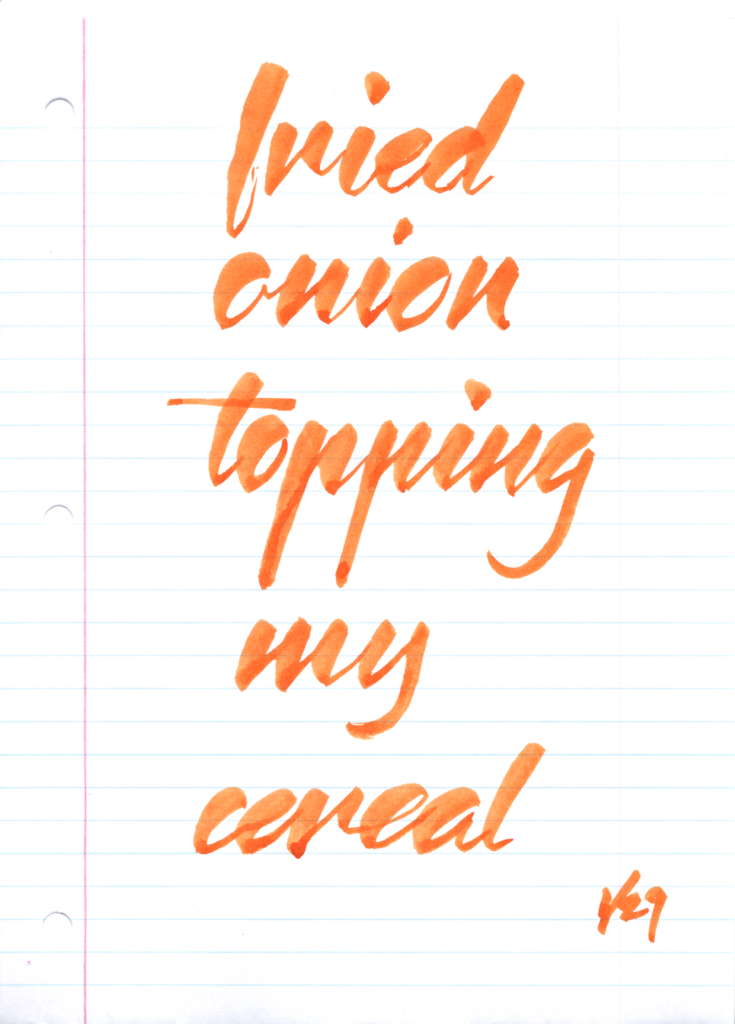
1/30
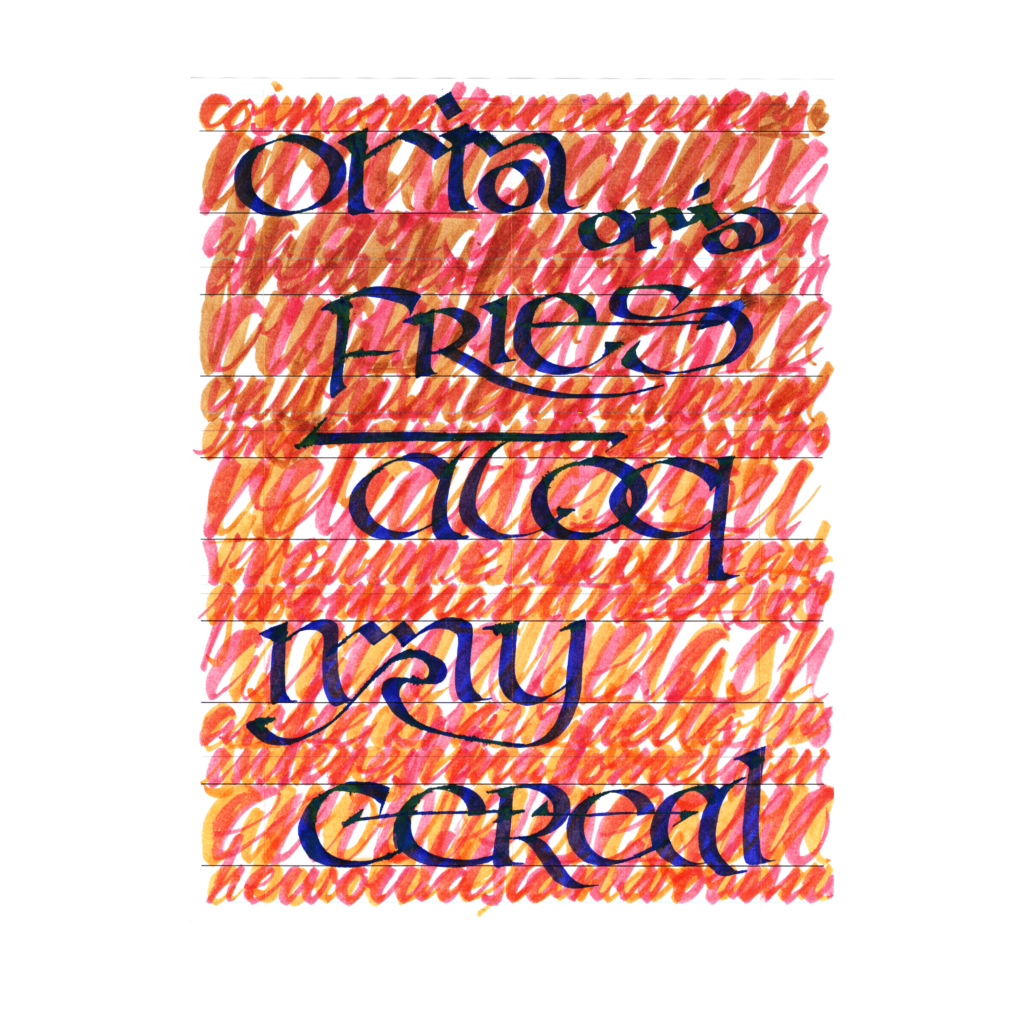
fried onion topping my cereal
I do love fried onions.
For a week in January, I played with funky Uncials, and it’s on the list to revisit for a full month. I wonder if I will ever stumble into a particular script that “is it“. Likely not—I’m a too into variety and impatient for perfection.
,
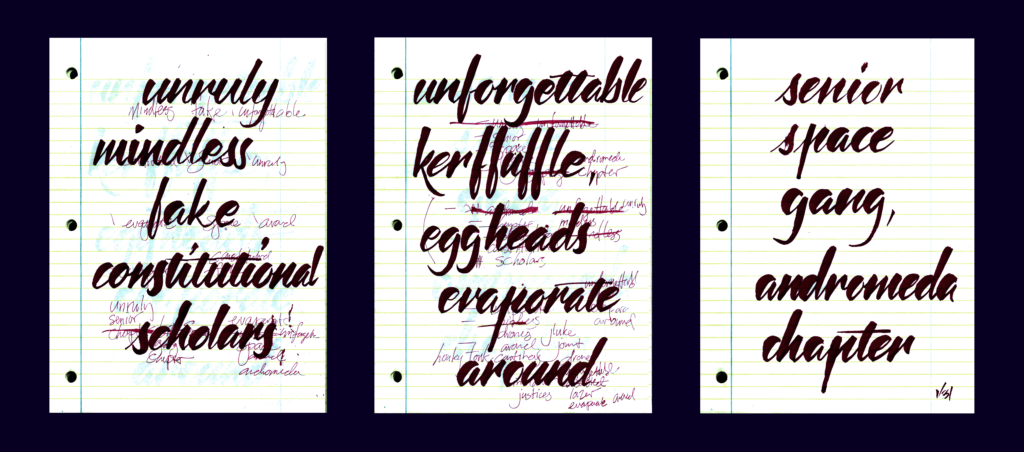
1/31
unruly mindless fake constitutional scholars
unforgettable kerfuffle eggheads evaporate around
senior space gang, andromeda chapter
These poetry hauls can be challenging! But it’s always fun to make them work. I love the mental picture of an alien biker gang who faux-studied our founding fathers.
,
2/5
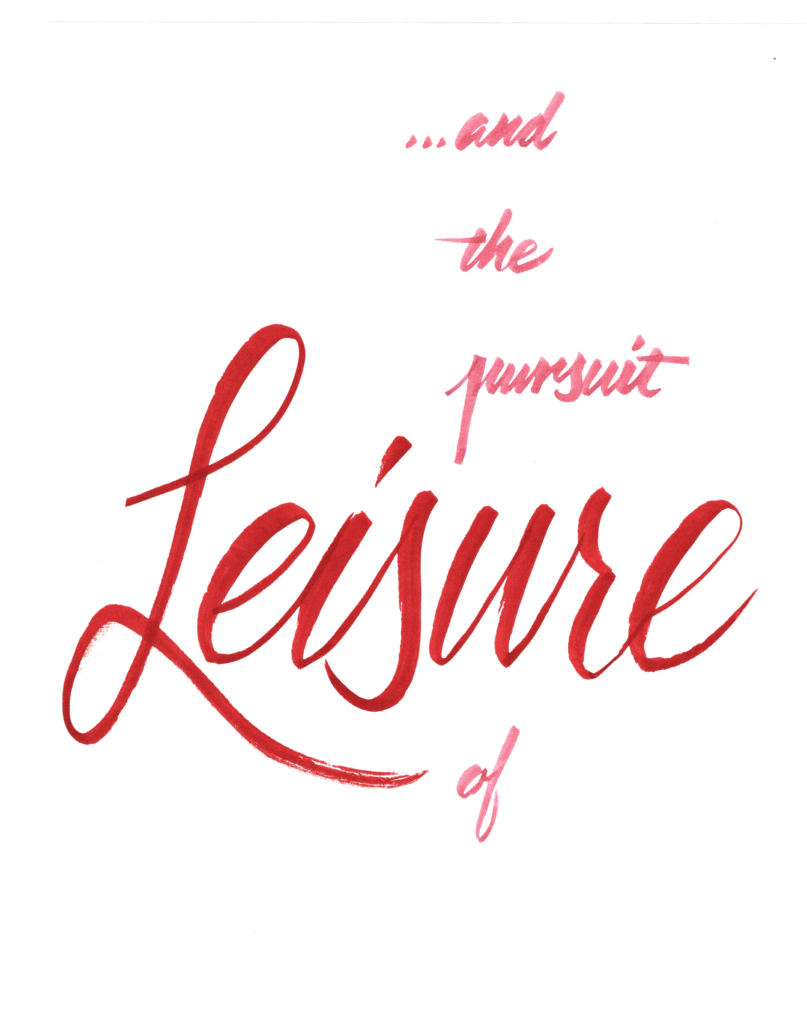
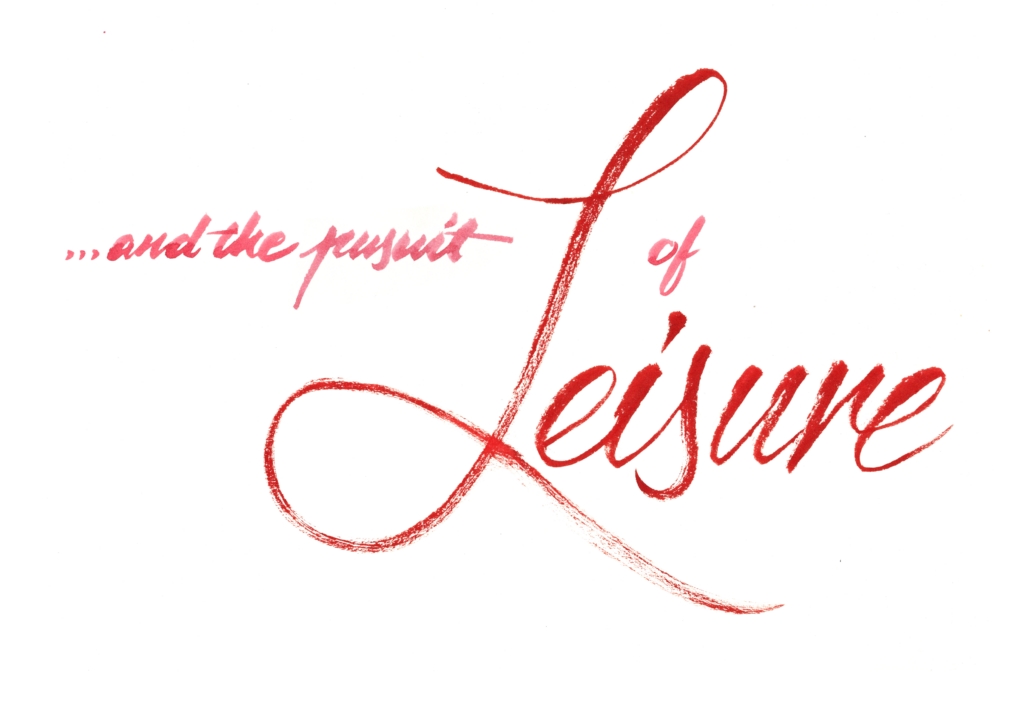
… and the pursuit of Leisure
This was inspired when Thomas J Bevan announced a Symposium on Leisure. I’m super happy with both of these. A couple months later, I’m not confident if I could do this today. The downside of picking up new scripts is losing old ones along the way.
,
2/9
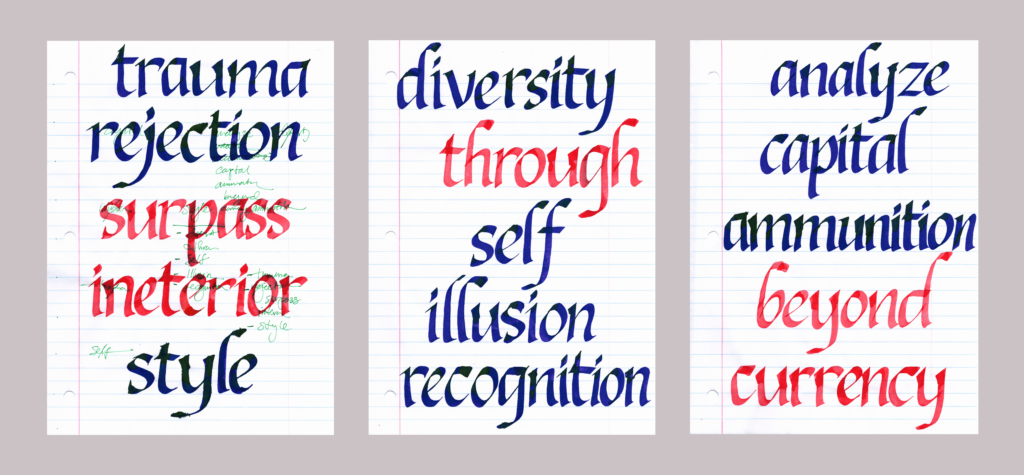
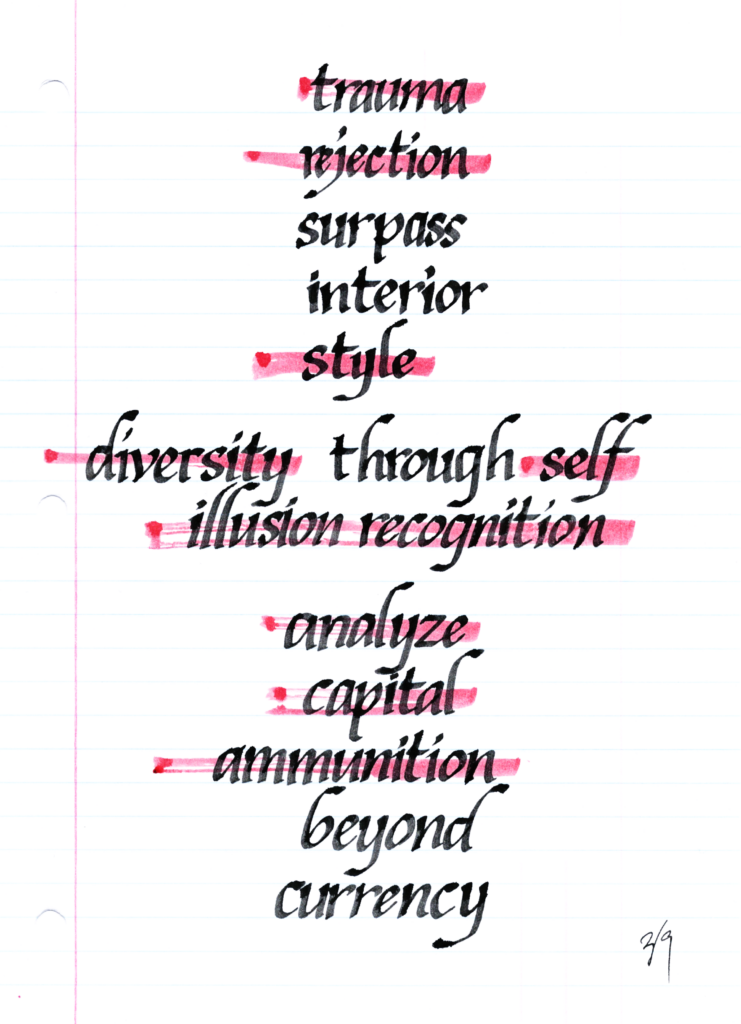
trauma rejection surpass interior style
diversity through self illusion recognition
analyze capital ammunition beyond currency
I made a mistake on “interior” so I rewrote the poem on a single page—which I immediately recognized was the right format for these poetry haul exercises.Sometimes you gotta keep doing something until the right format arrives. Repetition is the heart of process.
,
Between commenting on two-month old 5WP’s and editing four-year old blog drafts, these newsletters have become an exercise in archeology.
I do appreciate each of y’all who read and comment on them. Thanks for joining my delve into the past!
Cya next time!
,
PS—Word by Word, Ann Lamott, 1996
Bird by Bird is such a classic that the library has a long wait for the audiobook. So I started with this recorded seminar that she gave in Austin.
I dig it—I’ll be reading Bird by Bird.
Three key takeaways.
If you’re gonna be a writer, then write. Getting published is only a result of writing.
Find a writing group to work through this all together.
Draw deeply from reality.
I appreciate her suggestion for writer’s block. Give yourself permission to think. If you can’t write, then maybe force yourself to not write for a while. Sometimes your brain needs space to recharge.
,
Here are a few other exercises that sounded fun (though I haven’t tried them in the four years since I listened to that workshop).
List 10 favorite words.
Spend 300 words on someone you truly hate.
Describe yourself in detail five and ten years from now.
Where you would want to live, do it in exquisite detail.
Why you are here, why do you insist?
,
PPS—Bird by Bird, Anne Lamott, 1995
Vulnerable, crass, funny. Brilliant! I see why it’s a classic writing workshop in a book. Anne explores the difficulty of the process, and exhorts the reader to do the work.
She doesn’t shy from the benefits of the writing life, but reminds us that outside success isn’t all that special. Our personal problems don’t disappear after our shell gets polished.
So, it’s about sitting down and writing. Work and make it happen. Taking things one “small assignment” at a time. Finding a cohort to work with.
Don’t be disappointed when a project always ends with a whimper. (They all do.) Life keeps moving. The process stays going.
TLDR: Sit down every day, jump in, flail around, do a bit at a time, gut yourself to examine the innards, deliver, and do it again tomorrow. It’ll add up to a good life.
,
Speaking of Process, a friend and I started a journal of student work at Berkeley that lasted for two issues. It darn near killed me both years. For the longest time I thought it was a waste (aside from meeting one of my best friends). As a middle-aged man, I’ve learned that friends are rare. A buddy is one helluva a haul for a project.
,
This book is nominally about writing, but her subtitle is perfect: “Some Instructions on Writing and Life”. Her notes on completing a book mirror too closely to the work I’ve done as an architect. Writing might be her profession, but this book transcends her medium.
,
It is refreshing to read a self-help book by a great writer. The book shines; you don’t have to trust claims of her excellence in some other field—the proof is right here, page by page. Her display of craft makes her advice all the more visceral as she bares her soul and wrestles with the difficulty of life.
I’m now distant enough from these pieces they’ve become surprises to revisit. I should to accelerate the release of these five-packs, but things are about to crazy at work. If I fall further behind, that will let them age longer as old surprises to uncover.
,
2/6 Inktober 52 (2024), week 19
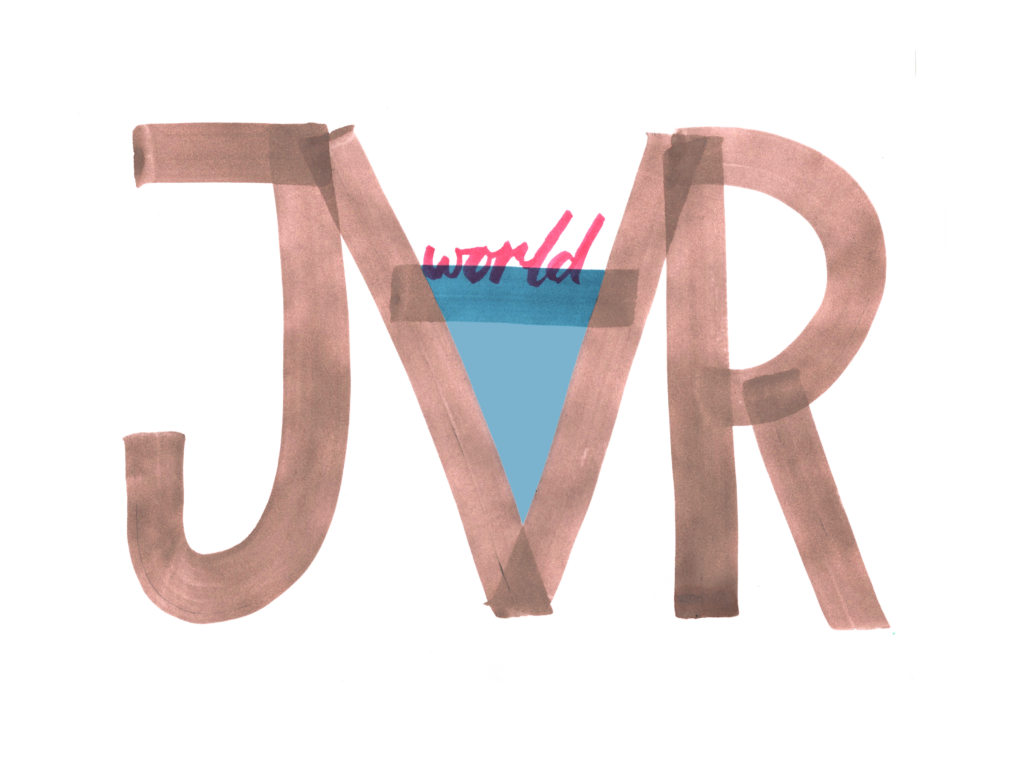
world floating in a jar
I had a rough time with the composition, and I need to take a month to practice the sign painting script to hit right.Even so, I’m happy with this final version, even if it took a little computer magic to make it work.
,
2/7 Inktober 52 (2022), week 9
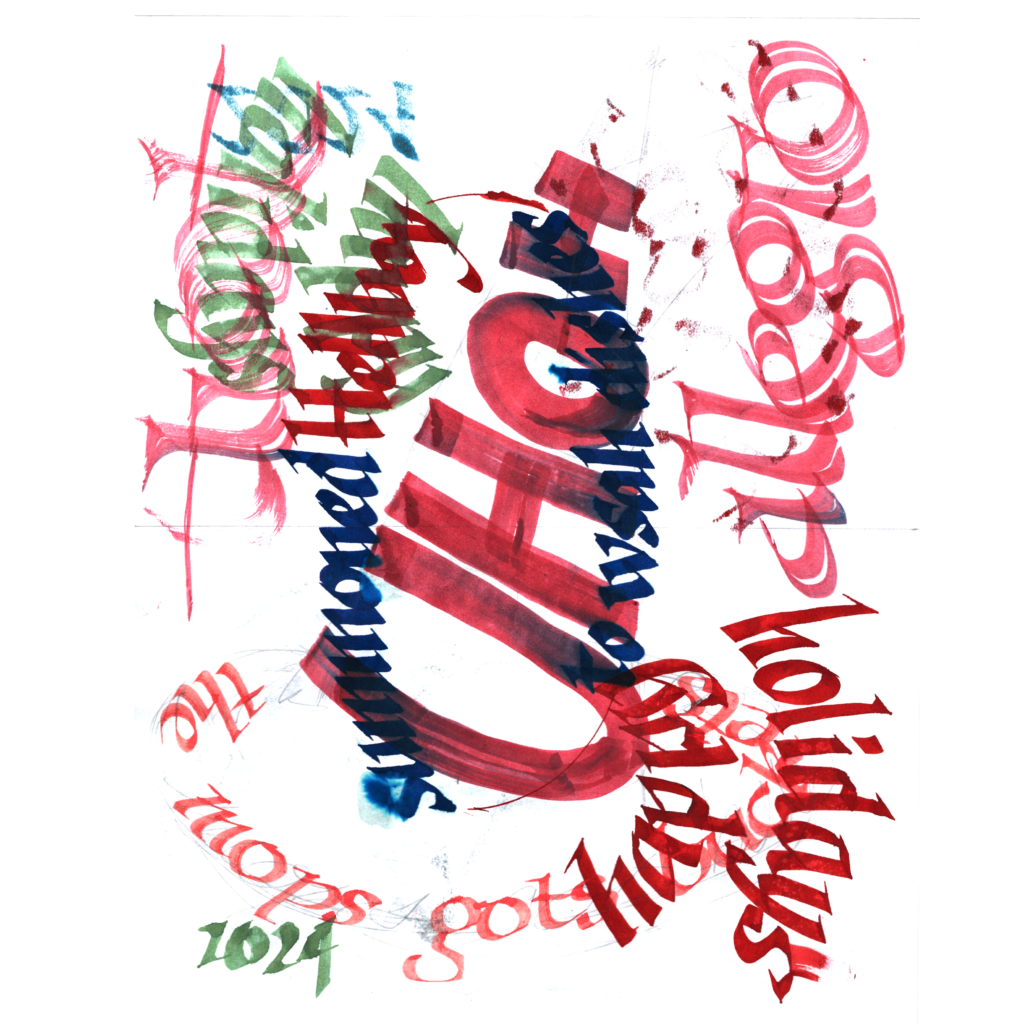
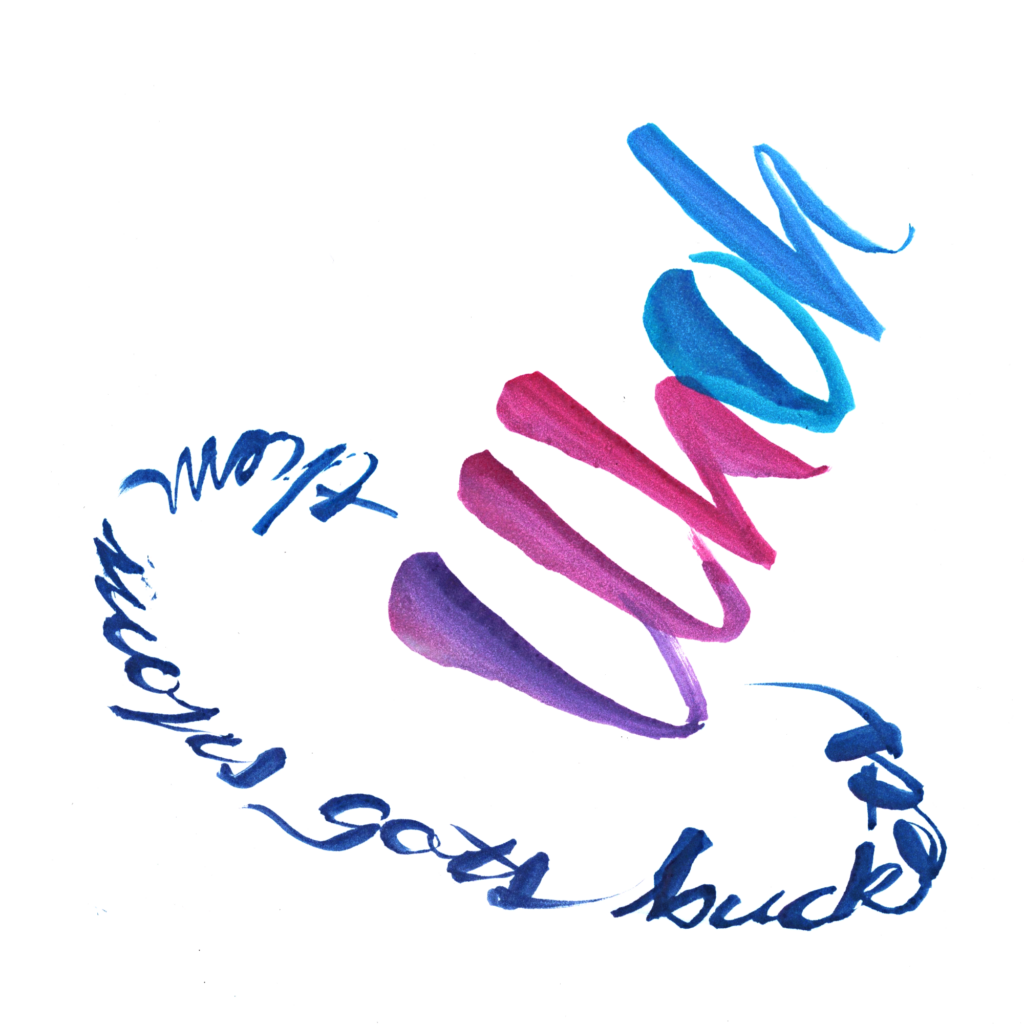
uhoh them mops gots buckets
In retrospect, I the sign painted UH-OH would have worked better, but in the moment I pushed the cursive in the finished versions. I’m looking for a good pointed brush outside of my Pentel pens, but it will take a few tries to get right. That’s gonna be an expensive exercise since it requires buying individual brushes.
,
1/25 Inktober 52 (2025), week 4
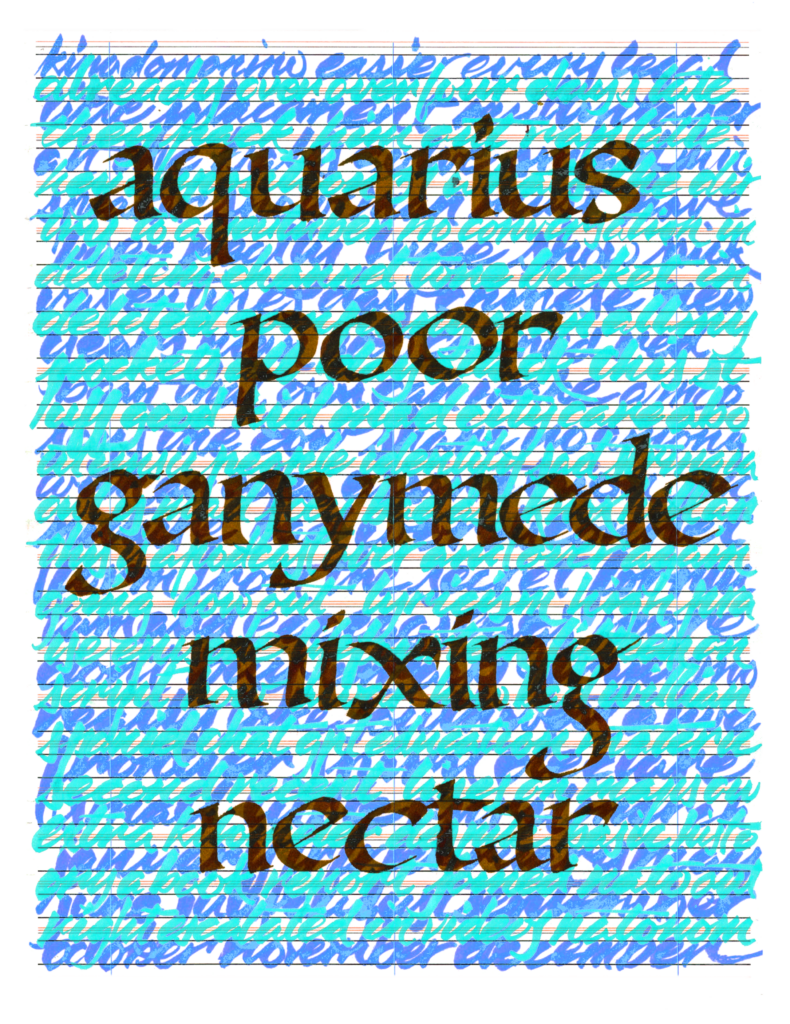
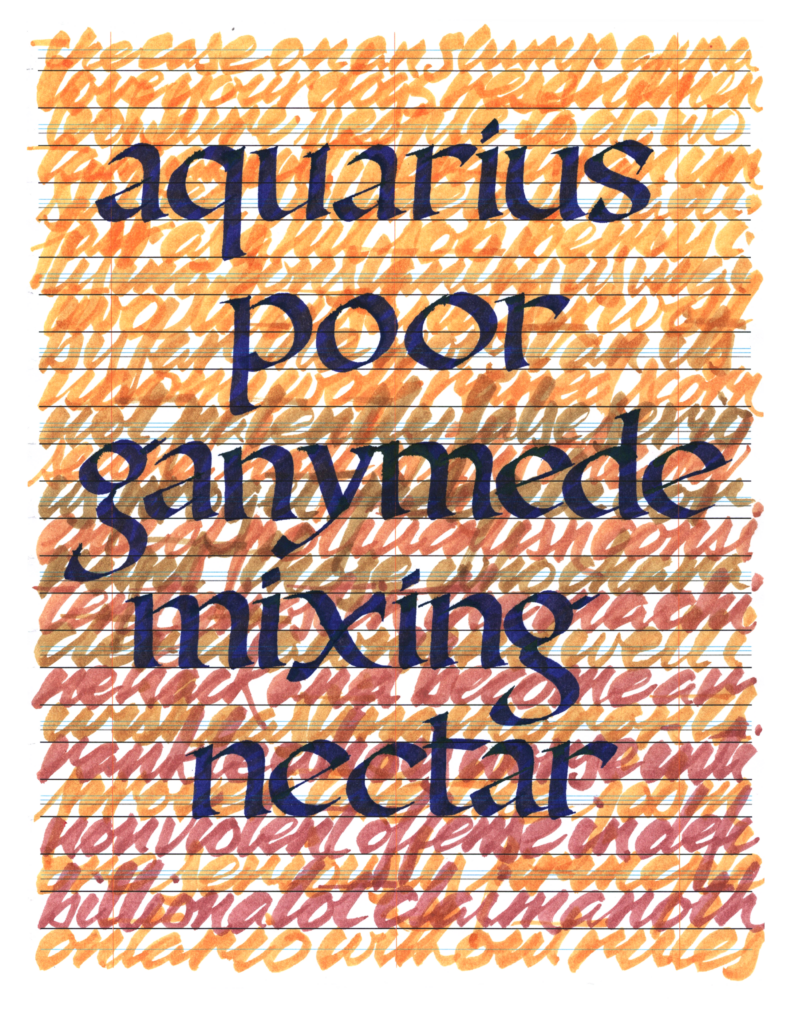
aquarius poor ganymede mixing nectar
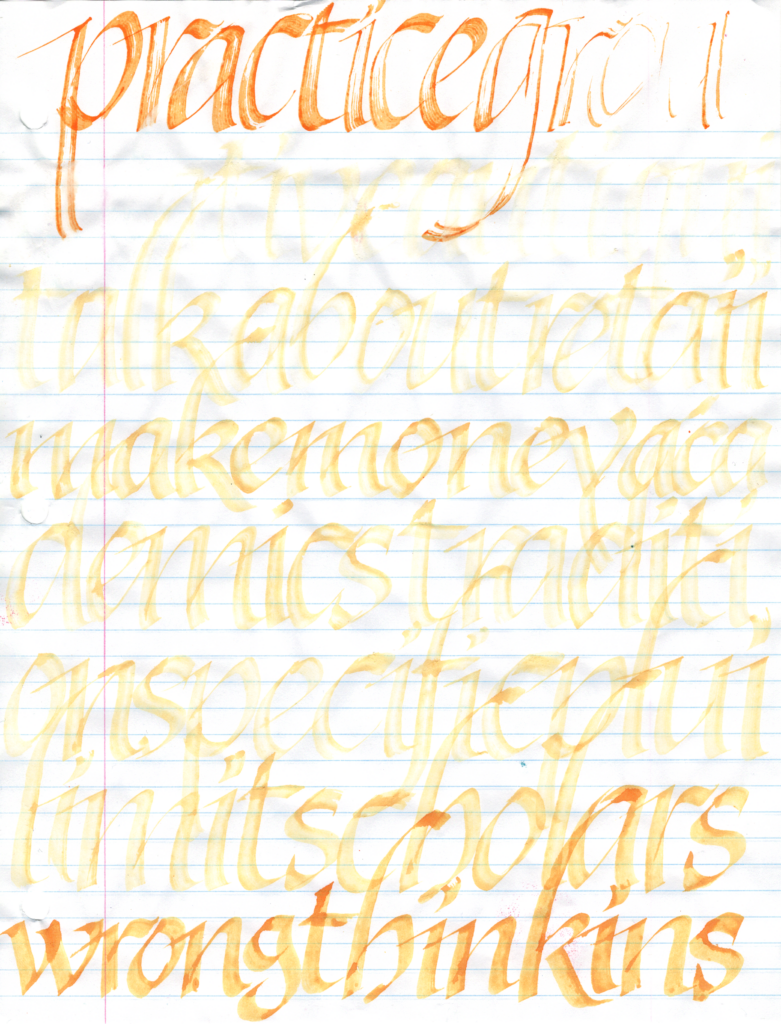
I’ve been starting my mornings by practicing the my script of the month. Pushing the finished piece with the hue function gave it a nice watery feel, by changing the colors. My main practice inks are yellow and pink because they are quite dry (so they don’t heavily on cheap paper).
BTW the original Aquarius myth is sad, if not traumatic. Them Greeks told things real. Same for the Bible, even if we normally gloss over those parts.
,
2/1 Inktober 52 (2025), week 5
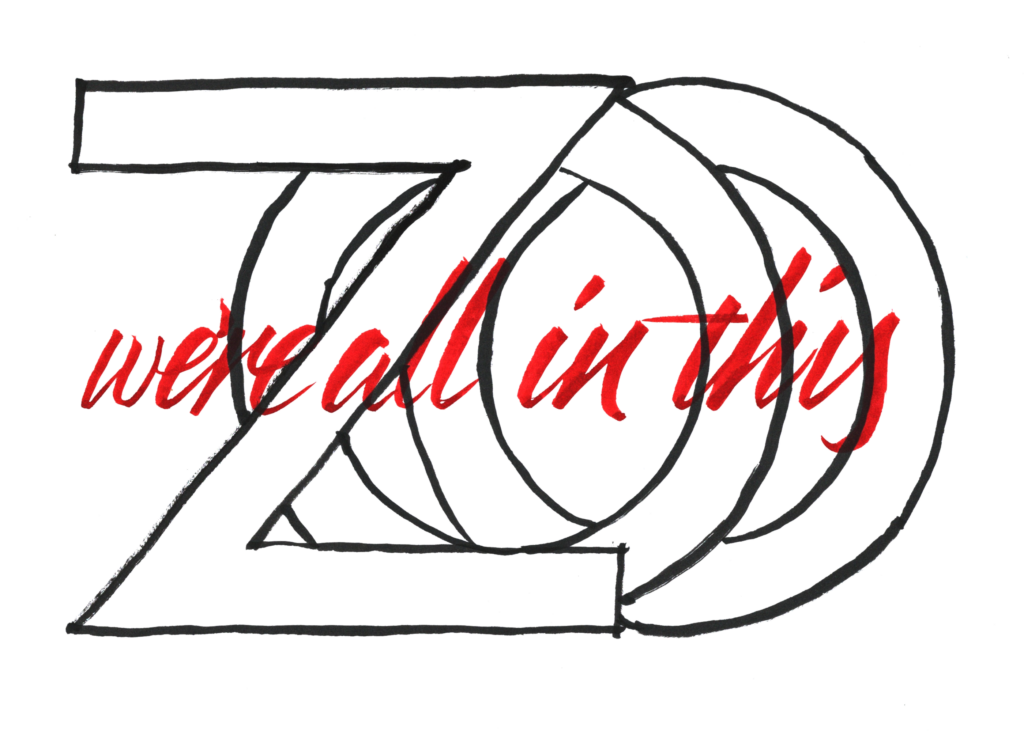
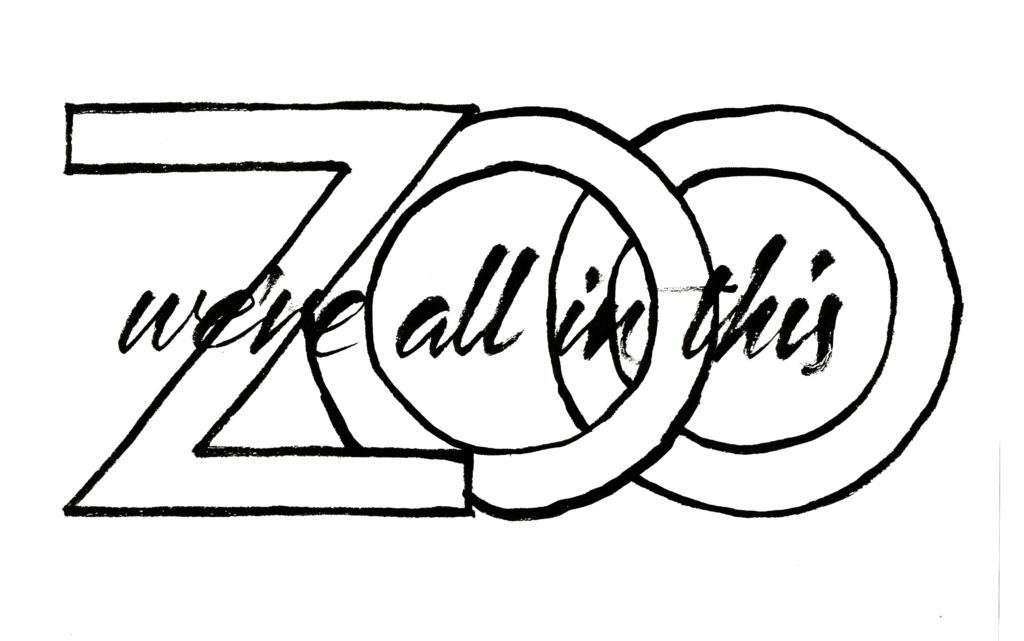
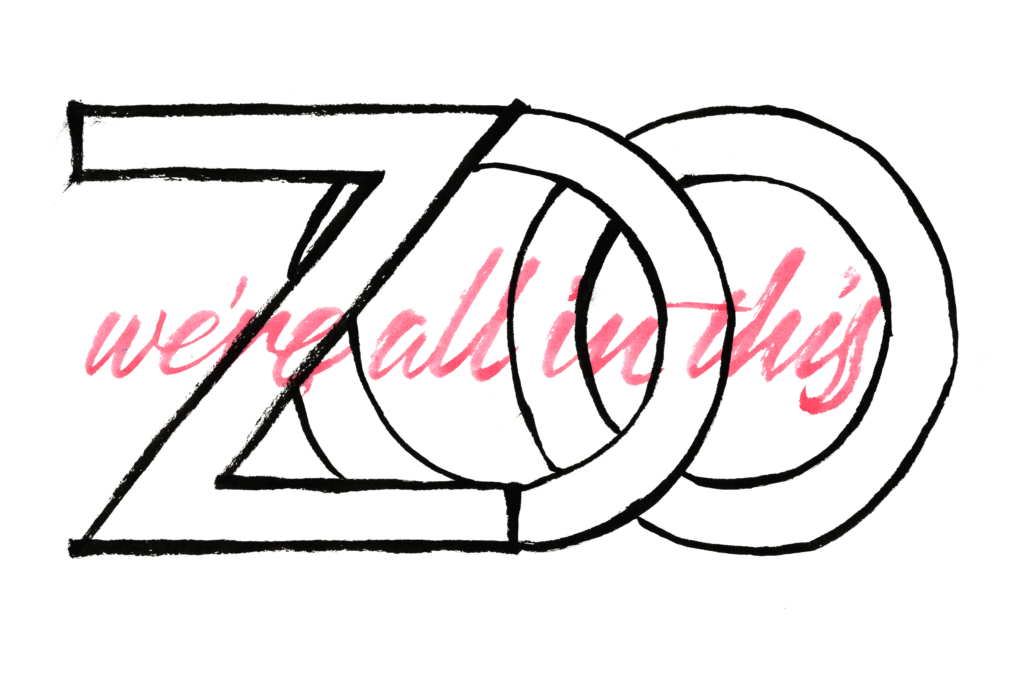
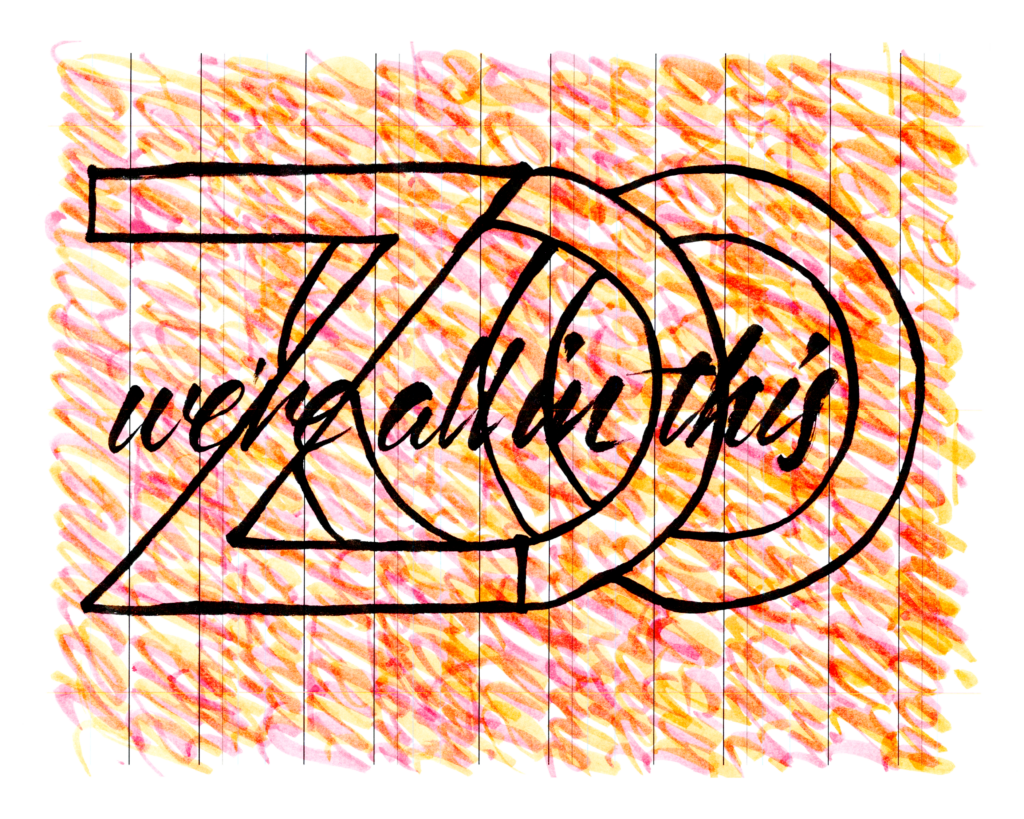
we’re all in this zoo
As always, there are so many little decisions that must be made after the overall concept. Again, the practice sheet came to the rescue, adding a little extra noise to give the composition presence.
,
2/8 Inktober 52 (2025), week 6
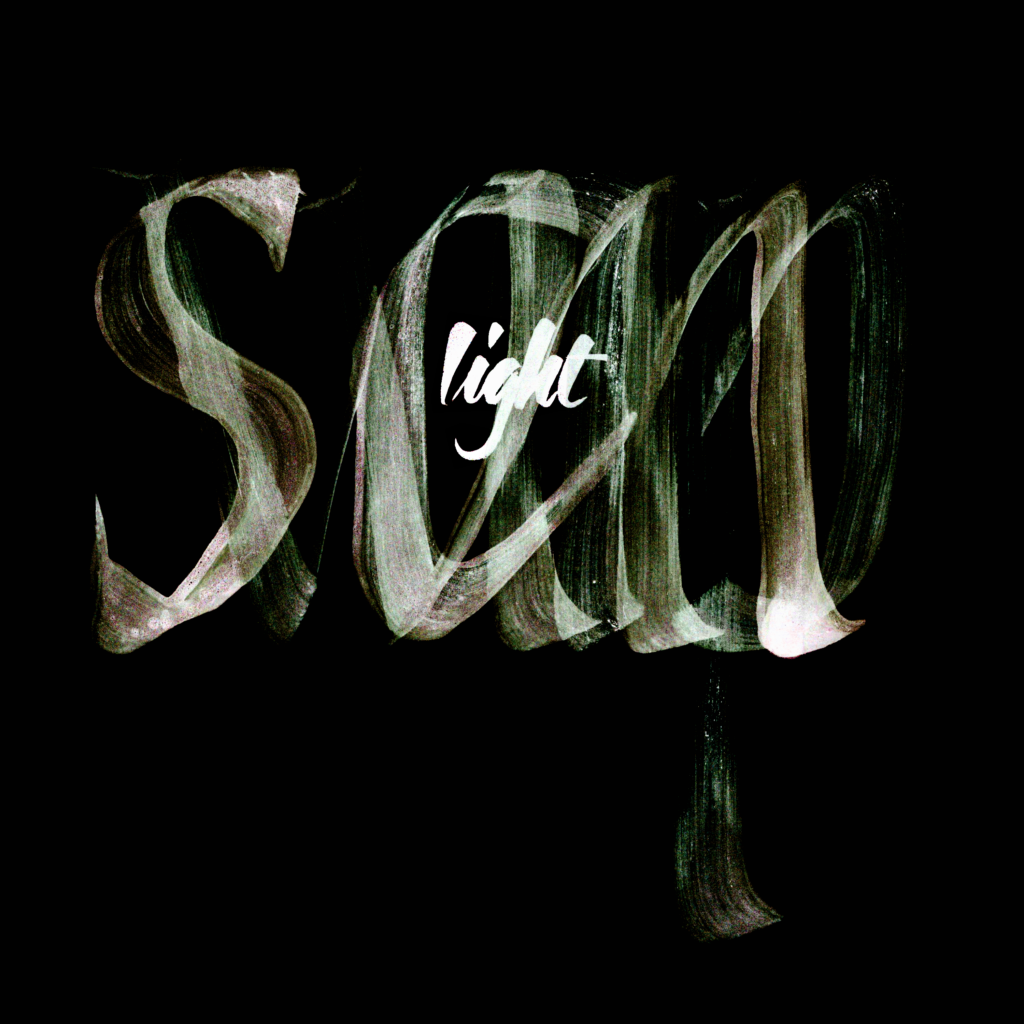
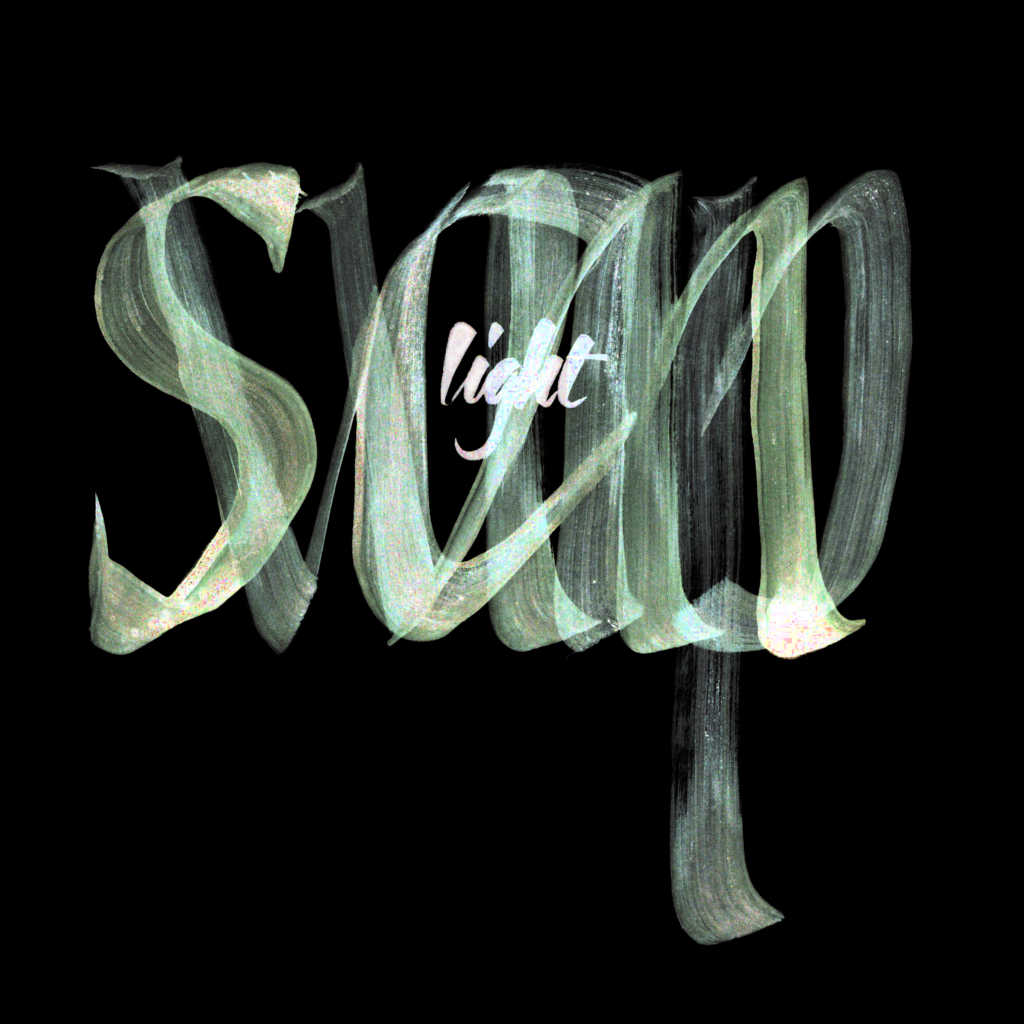
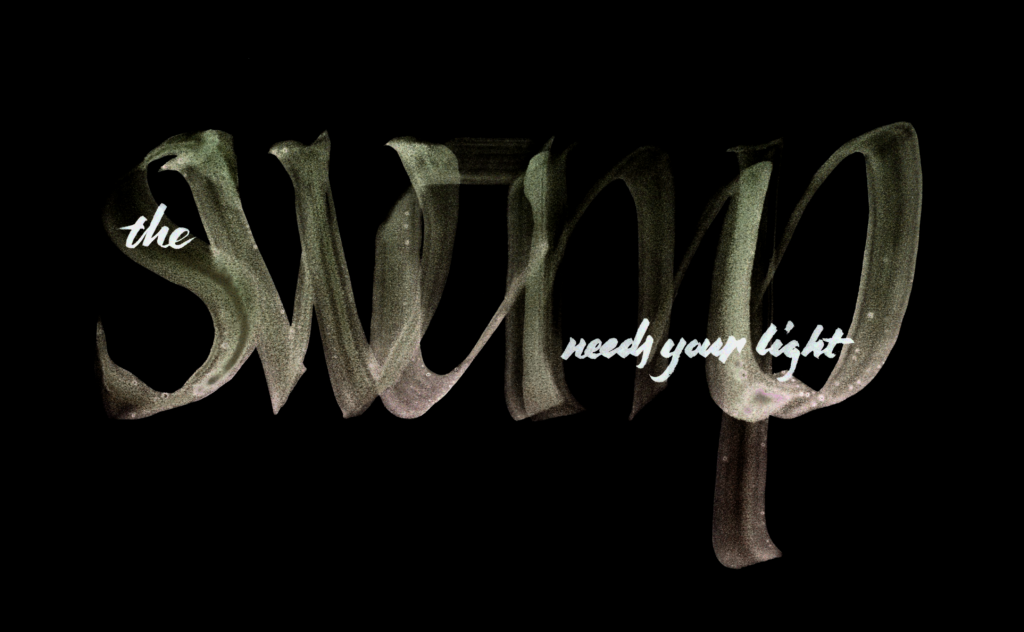
a light in the swamp
The top two versions are tweaks of the same scan. All versions were done as black/grey ink on white paper and then inverted in GIMP. After that, it’s about how hard to push the dials.
,
As much as I’d prefer to do it all perfectly on the page, the computer is an integral part of my process. These discussions about process are my penance for relying so much on the box.
Similar to the writing seminar in undergrad, I suspect my most influential class in grad school was the digital photography course with Frank White. As an architectural photographer, he unapologetically embraced the computer as part of the process.
Of course, the process is a lot harder if you don’t start with good inputs, but the final piece is the final piece. Excuses about what happened along the way don’t matter for the deliverable.
That’s how I do it here. I’m not above the occasional process photo to flashthat I can do most of it in real life. I’m not hiding anything, whether it came from the pen or was pushed in the computer.
It just is.
Cya next time!
,
PS—10 Bits For a Creative Practice
I wrote this as a response to someone’s post in early 2024, but the records have been drowned in the endless feed of content. I liked this enough to save it as a draft and it’s finally time to reshare it.
Show up every day.
Jump in! FFS just start.
Study the greats.
Celebrate your peers.
Don’t freak out about bad work.
Tension is the trigger to breathe. Relax.
If you can’t do it slow you can’t do it fast. No rush.
Pivot freely.
If the crop feels wrong, the crop IS wrong. (Trust your gut)—an aphorism I learned in that photography class.The concept of trusting default triggers has served me well over the decades for many things beyond images.
Do it again tomorrow!
.
PPS—Self Help Junky
Another response to someone else (exactly who lost in the endless feed).
As a former self-help junky, I’m a big fan of the anti-self-help movement. Of course, a moderate approach is generally best in life, but if you could only pick path I’d recommend skipping self-help.
But I’m moderating this reactionary stance after reading Kenny Werner’s Effortless Mastery.
I wonder if the question for judging a book is “how” versus “what”. Don’t invest in books that tell you what to do (or avoid). But there might be value in books that explore how to get somewhere that you already want to reach.
In that spirit, here is a quartet of self help books that might be of use:
Fail-Safe Investing, Harry Browne (great life-finance advice, though do your own research on portfolio composition because the specifics are dated)
So Great they Can’t Ignore You, Cal Newport (good compilation of career advice for someone entering the workforce)
Several Short Sentences about Writing, Veryln Klinkenborg (this book goes beyond writing to life, even if a bastardized version of his advice has infected LinkedIn with punchy shallow drivel.)
Effortless Mastery, Kenny Werner (a slow approach to practice, nominally about music but it applies to anything. It’s a distant second best to Tai Chi training at a good school.)
All that said, the Bhagavad Gita would trump all of these books, even if it’s profane to place this text next to self-help fare. May the gods forgive me.
But always be ready to ignore anything that you read in these books. Never confuse the author’s confidence in their advice for it’s applicability to your wild and wooly reality.
.
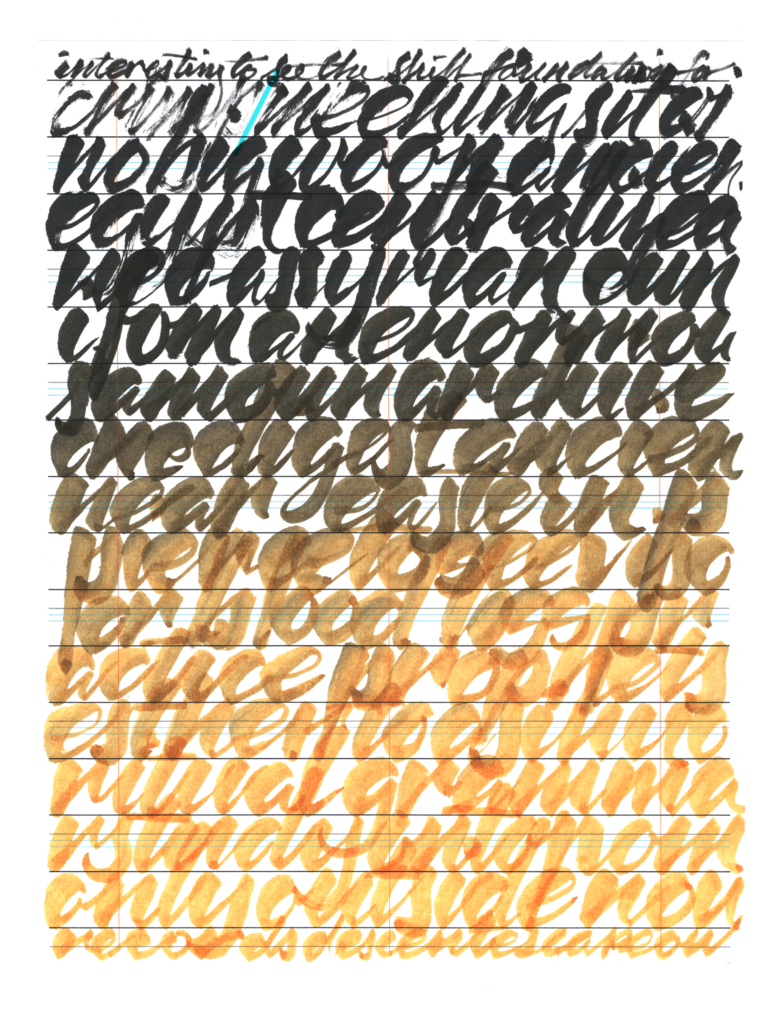
PPPS—Black to Yellow
For giggles I took a brush pen with black in and put in a cartridge with Lamy Mango Yellow. The first sheet shows the transition from pure black (marked with the cyan slash on the second line) to yellow.
1/24
Interestingly, when I went back for more practice, there was still some more black that came out of the brush.
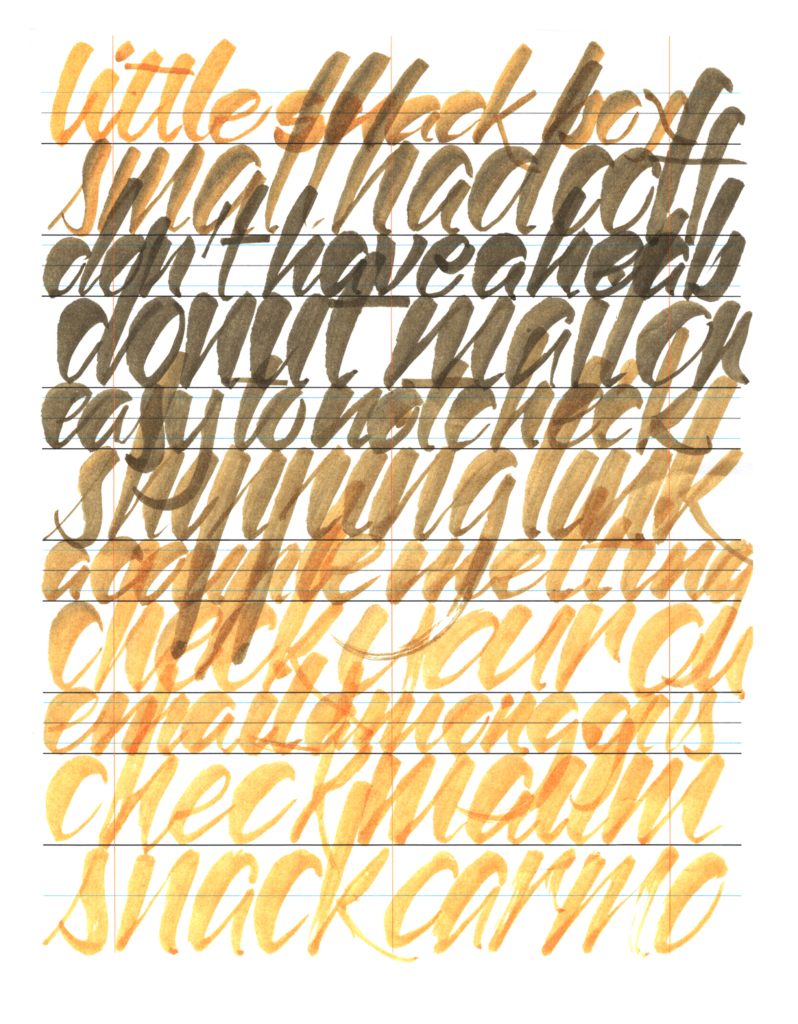
1/24
The next morning I made the “aquarius” 5WP (above), which had more black sneaking out (every other line was made with that black-mango ink, the other lines were made with the former mango pen, now filled with a pinkish ink).
Funny how these things play. The joy of the real world!
It’s fun to revisit old 5WP’s in these compilations. Some of them far back enough that I’ve forgotten that I made them!
,
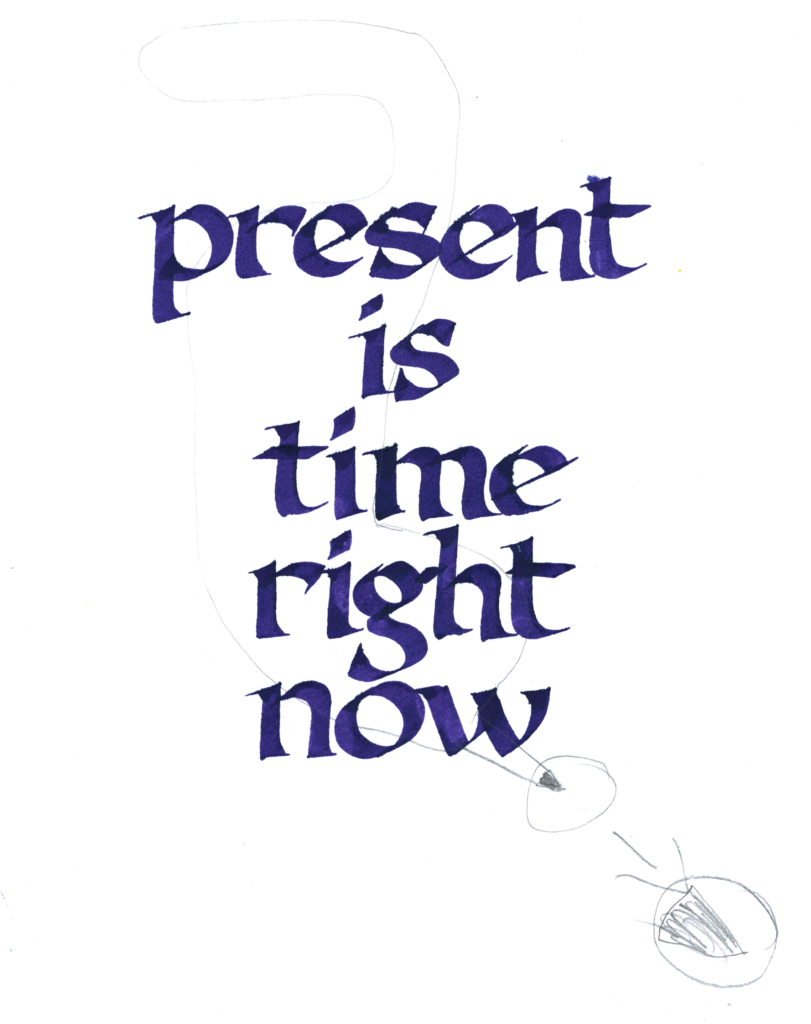
1/14
present is time right now
Decades ago, I watched Mike Ditka spout “Yesterday is history. Tomorrow is a mystery. Today is a gift—that’s why they call it the Present.” I usually quote it ironically, but I can’t deny that it stuck.
,
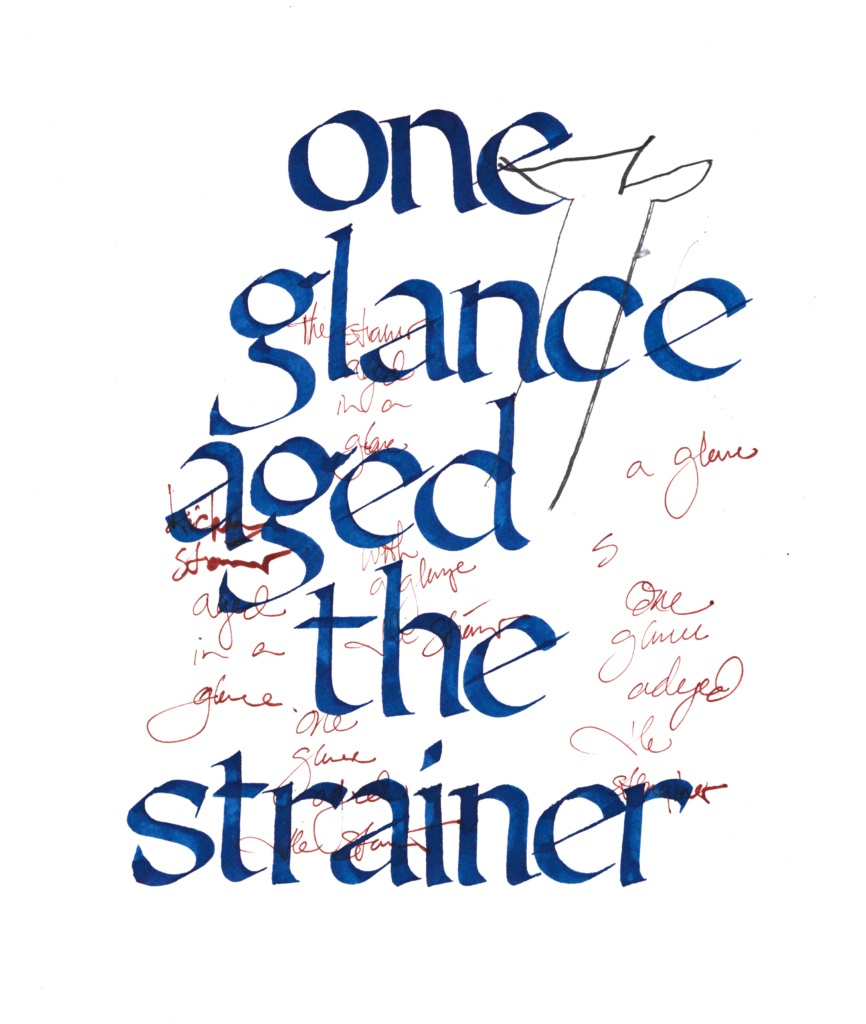
1/16
one glance aged the strainer
One afternoon, I looked at our metal kitchen strainer and realized that it had been thoroughly beat up over its years of service. I never noticed the kinks and divots in the frame, and I’m back to being blind to it. The power of the thing overwhelms the thing of the thing.
,
1/19
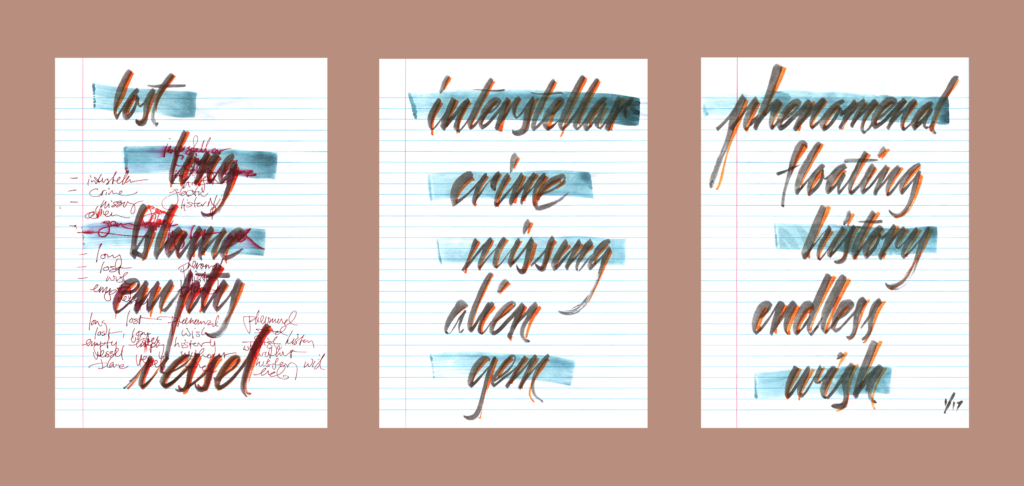
lost long blame empty vessel
interstellar crime missing alien gem
phenomenal floating history endless wish
More fun with the pointed brush cursive and the Artstack Poetry Haul challenges. Between February (italics) and January (pointed brush) it seems that it takes about two weeks of practice to get confident in running a new script on the 5WPs.
,
1/21
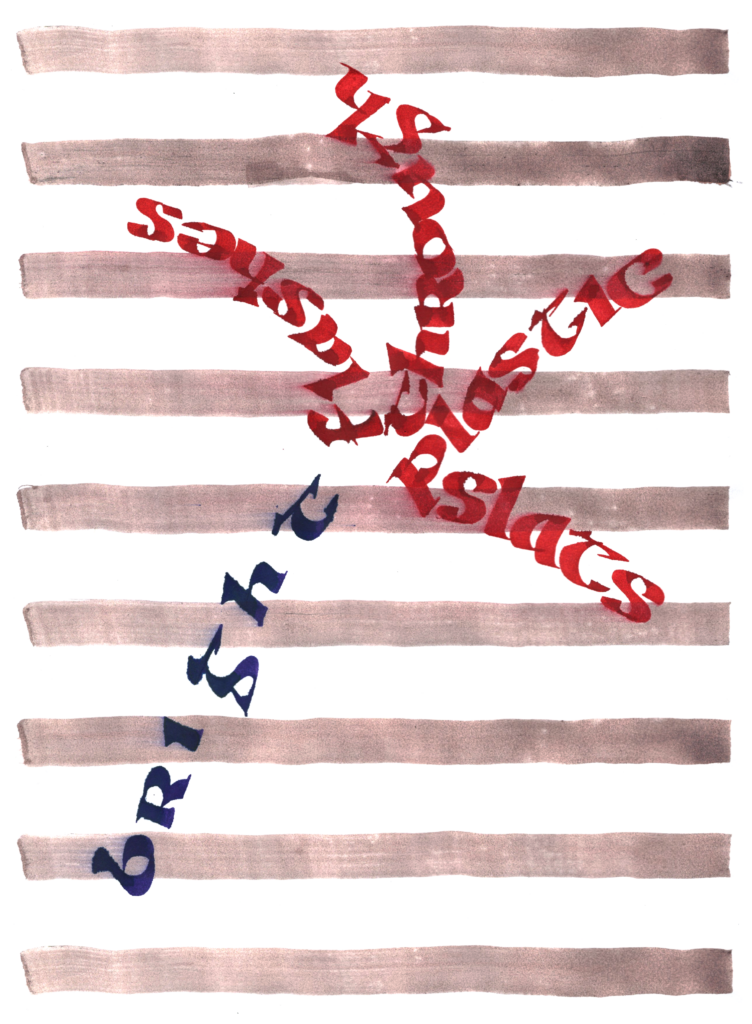
bright flashes through plastic slats
Las Vegas lights up with illegal fireworks on July 4th and New Years Eve. This 5WP was surprisingly tricky. I tried a few arrangements that fell flat, including this one. It was rescued by my old axiom “when in doubt, add noise” with the wash lines for slats.
,
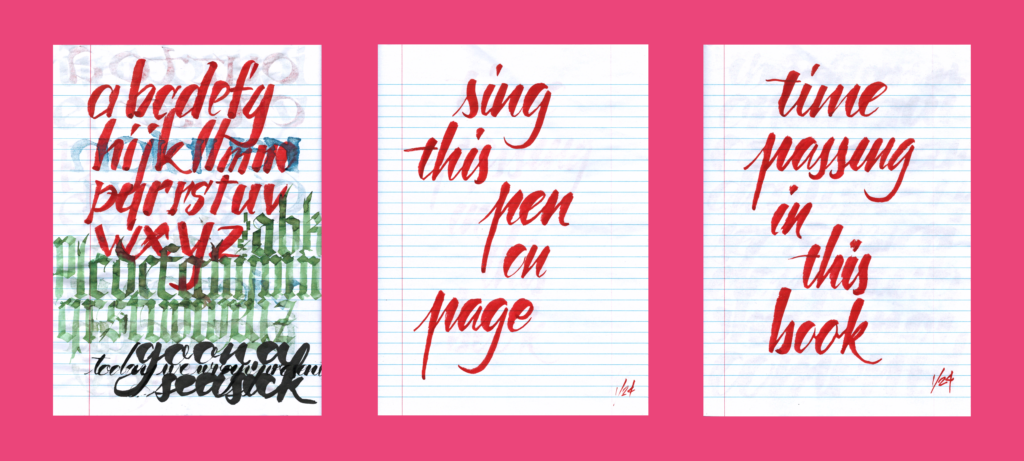
sing this pen on page
time passing in this book
I finished another notebook on 1/24/2025 (started 10/14/2024).Turns out that bound composition books are not fun to graph on, especially at the end when everything feels wrinkled.One day I’ll find at good use for the ones still at home. Until then, I’m sticking to spiral notebooks for quickly graphed 5WPs.
For this psuedo-triptych, I included the back page of the journal where I had started practicing with the brush around November. I’m really happy with the refinement that happened over three weeks of daily practice.
It wasn’t fun to start with the pointed brush, so it’s a nice reminder to get uncomfortable because that’s where the new growth is hiding.
,
I am finally finishing my Alphabet Magic series. The sketches were completed in 2023, but the publishing of those sketches and photos has dragged on (the calligraphy detour didn’t help!)
Last week, I made a big push to edit the images. I had been annoyed by the Windows photo editor but I’m super happy after using GIMP (which I learned due to the calligraphy detour.) Plus these posts pair great with new and ancient drafts of those Penny Delight poem-proses.
It’s awesome to close out a long unfinished project. I am a firm believer in just pushing stuff out there. In the process of publishing, synchronicity swoops in and creates connections that can’t be planned in advance.
Keep exploring and cya next time!
,
PS-The Wisdom Books, Robert Alter
As part of my wisdom kick, I picked up a copy of Robert Alter’s translation of Job, Proverbs, and Qoholet (Ecclesiastes).
Job is an enigma. A good dude gets crushed, argues about whether he deserved it, and God pops in to yell at everybody.
In a world with a human-ish diety, it reads weird. This book makes more sense for an atheist. We might have some agency, but we’re buffeted by the whims of grand forces beyond our control—society, fate, nature. We don’t matter. We’re fleas on the tiger, hopefully it takes us to a good place, but there ain’t no guarantees.
Arguing about fault is fruitless. The competing monologues between Job and his accusers are just Tweet-storms between opponents talking past each other.
I respect canon and the filter of time. Anything from the ancients that made it to the present must have something worth reading, even if I reserve the right to pick and chose what to believe from the good book. One day, I should read the rest of the Bible without god. I wonder if I will enjoy it more.
Robert Alter’s introduction and commentary helps make sense of an otherwise befuddling text. I really enjoy his opinions on the development of the text. It’s hard to kick the reflexive perspective of hardcore divine inspiration, so it’s nice to have someone say, “yeah the text is corrupt here.” The confusion isn’t all on me as a puny reader. At a practical level, the formatting (using the main text over footnotes on the same page) is superb, the information is always immediately at hand.
~
Unlike Job, Proverbs did not hold up, in spite of fond memories reading this book many times as a kid.
It did not utterly bore me as the “Wisdom of Solomon” (all sizzle and no steak), but there was more noise to signal than I had remembered. The memorable images are still there (the lazy man rolling back and forth on his bed like a door), but I had forgotten all the chaff that came with this book. It burns pages selling the beauties of wisdom. Bro, I wouldn’t be here if I didn’t already buy in!
This time, I was struck by it’s optimism—do good and good stuff will happen. Maybe that was a better fit three decades ago, with America as the global hegemon and an apparently principled Christian conservatism on the rise. But such sunny optimism doesn’t feel right in the wake of two failed wars, a mismanaged epidemic, bipartisan ineptitude in federal power, and the flagrant cruelty of the evangelical church.
I suspect the reception of these ancient works are intimately tied to current events. Maybe I’ll find more resonance in old testament prophets, demanding repentance and a return to righteousness….maybe Proverb’s calls to wisdom weren’t misplaced after all.
~
Ecclesiastes is beautiful.
I never noticed this before, maybe because this book demands that you age into its reading.
Robert Alter’s prose certainly helps, as well as the formatting of the page as a true prose essay. However, I checked my King James Bible and noticed that it read great as well, even though the copy was chopped into verses and was full of anachronisms breaking up the flow.
Growing up, I primarily read Proverbs. That might be right for a young mind, keeping them on the search for wisdom and avoiding laziness. But after hitting a certain place, it’s impossible to avoid the bigger things in the world. It’s not so sunny out there.
If wisdom is the way, how do we explain this insanity?
Strangely enough, the gentle hedonism of this book is one way through. Pursue the wisdom, but don’t expect it to work out. Enjoy the fruits of your labor if it comes, but don’t kick yourself if it don’t.
Years after reading the bible, I did not expect to have a fully aesthetic moment in reading this book. Other parts of the Bible must hit such heights. Maybe the Sermon in the Mount. Is it hiding in the minor prophets?
Time to start digging.
,
PPS—Nothing deep here, just messing around with the banjo and recording it for giggles (January 13).
,
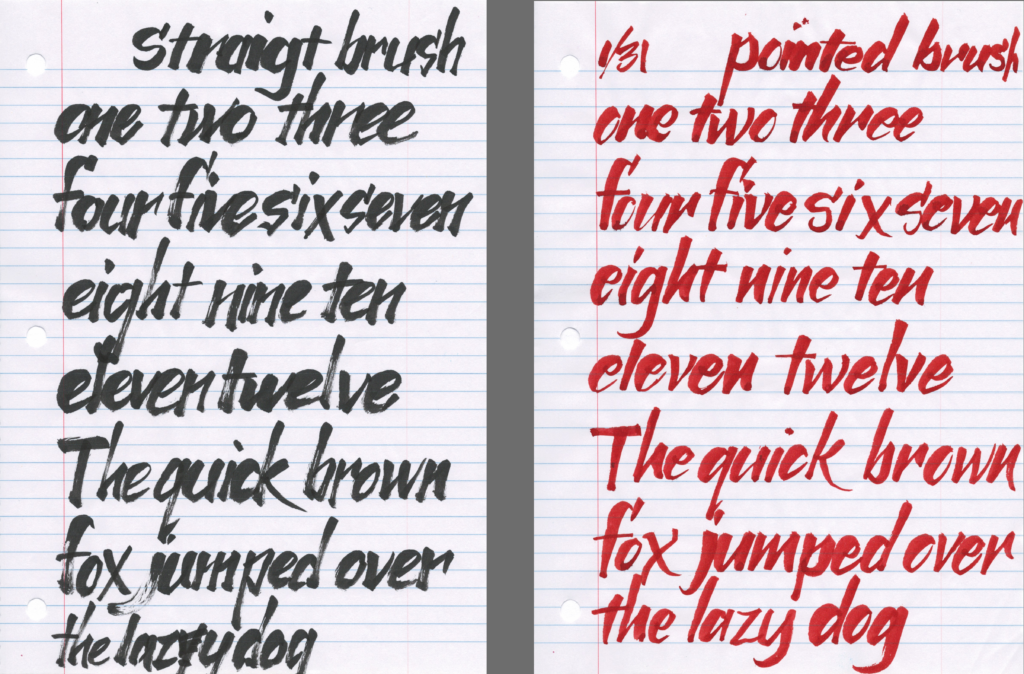
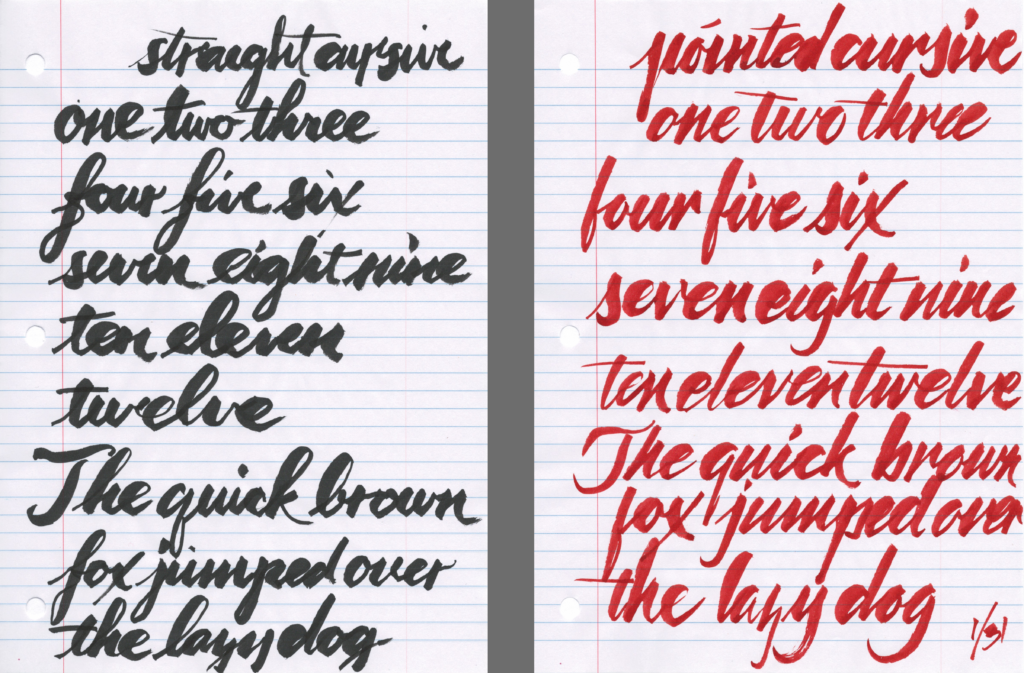
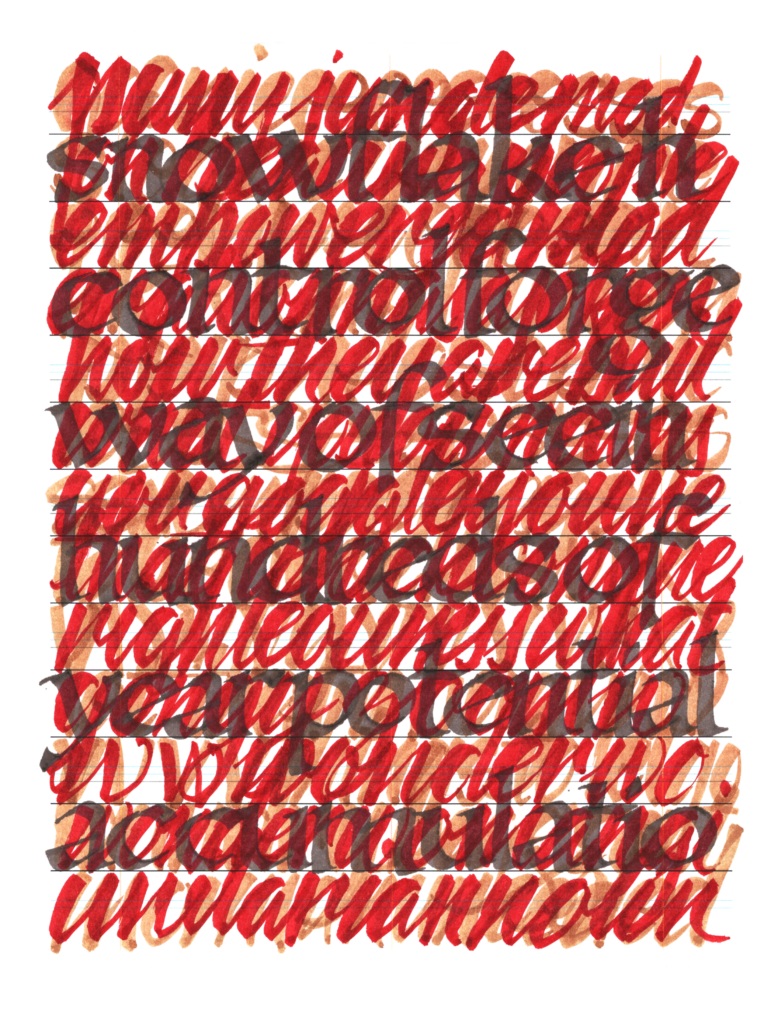
PPPS-Pointed Brush Progress (February)
At the start of the year, I went through all my scripts and put them in a book (black ink). After January, I ran the pointed brush to see how it improved (red ink).
I don’t think the printed text improved much, but that’s because I got totally sidetracked into the cursive, which I adore. I don’t think my pointed brush cursive here was the best, but I guess it’s good to have an “average” example.
That said, there is no greater feeling of flow than graphing with the brush pen while feeling the “edge”.
Catching up with old Inktober52 challenges from 2024.
,
1/20 Inktober 52 (2024), week 22
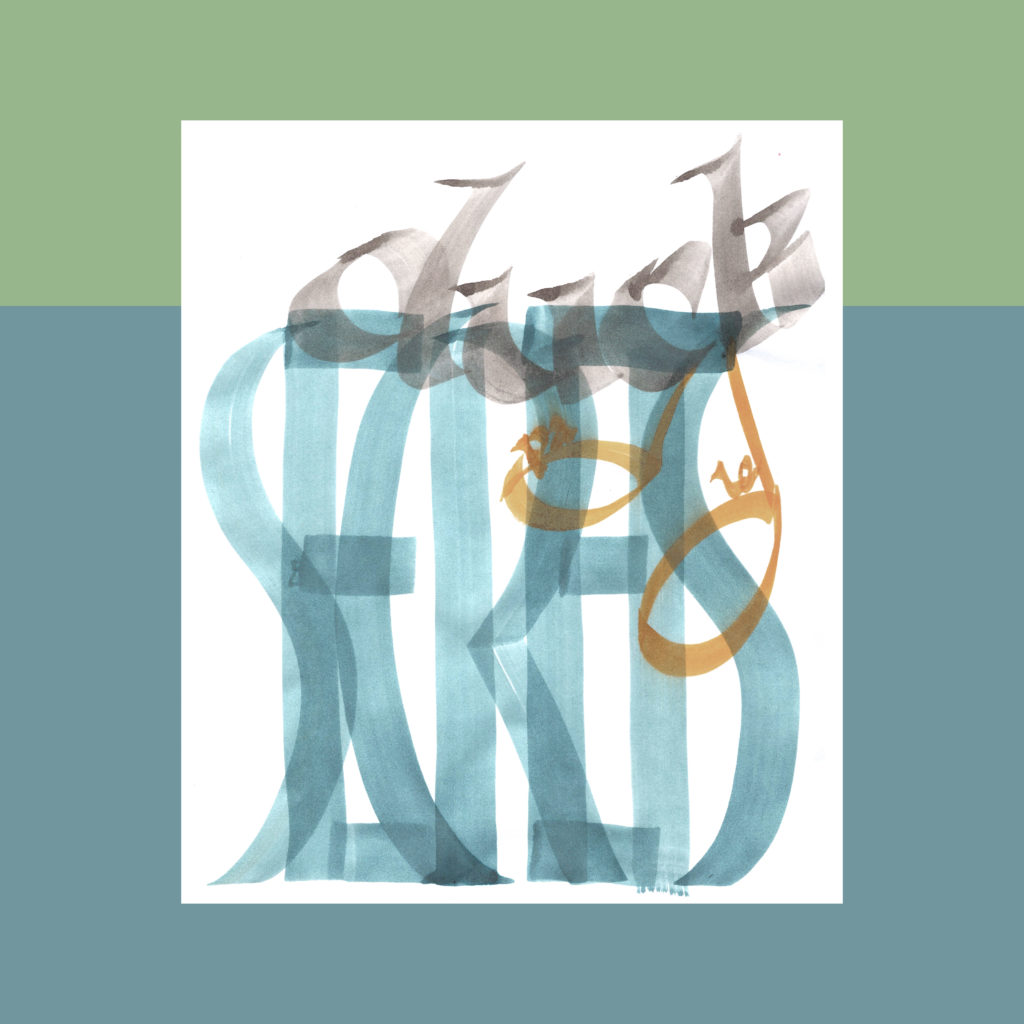
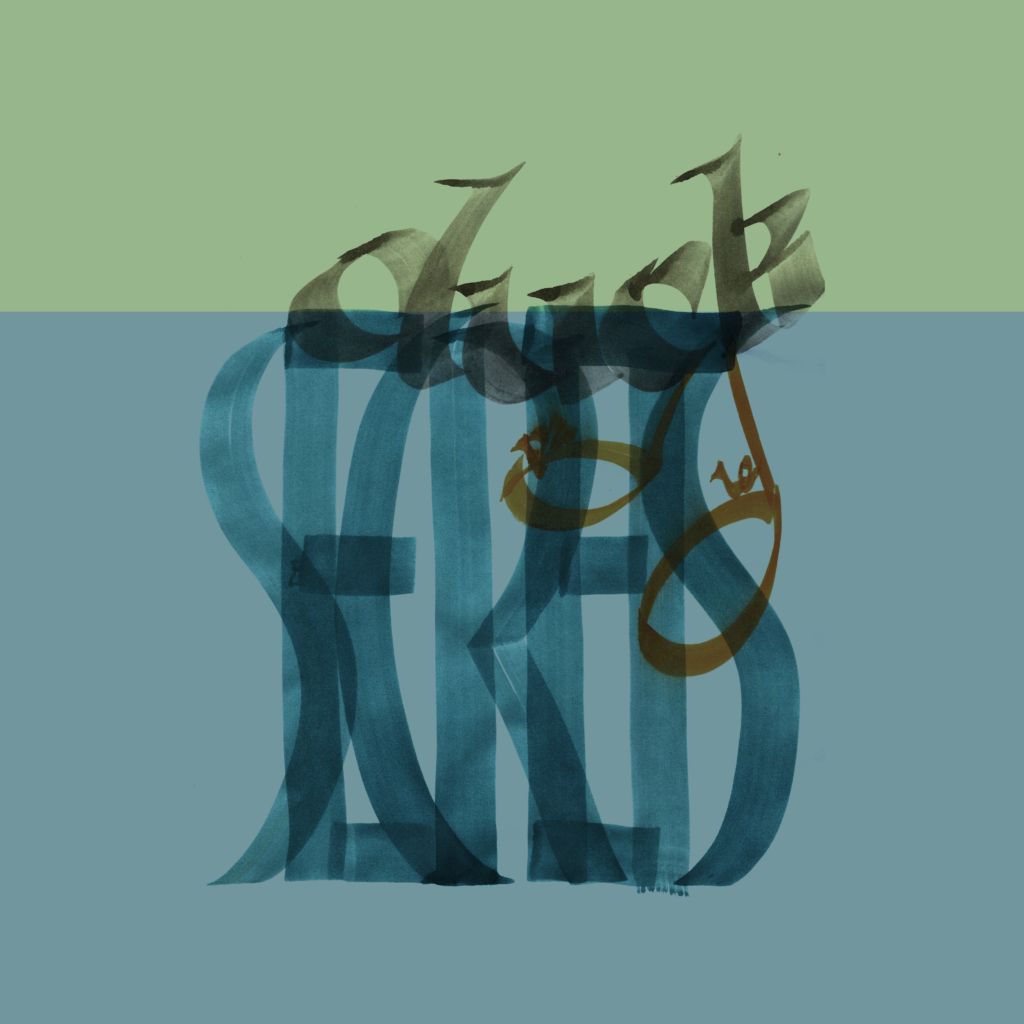
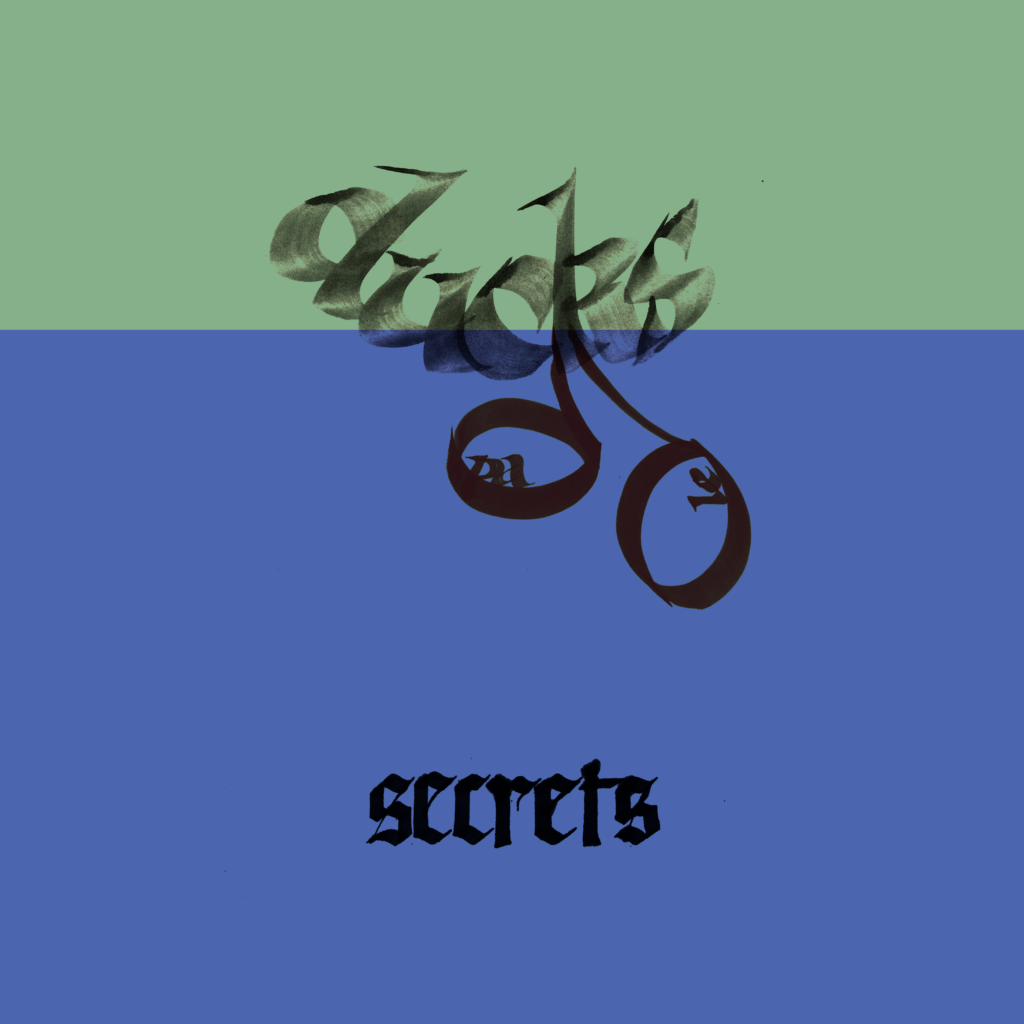
duck paddling into murky secrets
ducks paddle over dark secrets
I uploaded the one on top, but was not happy with how it looked. I messed around a little in GIMP, adding a duo-tone background and then changing the opacity to multiply. Now I’m really happy with both versions!
,
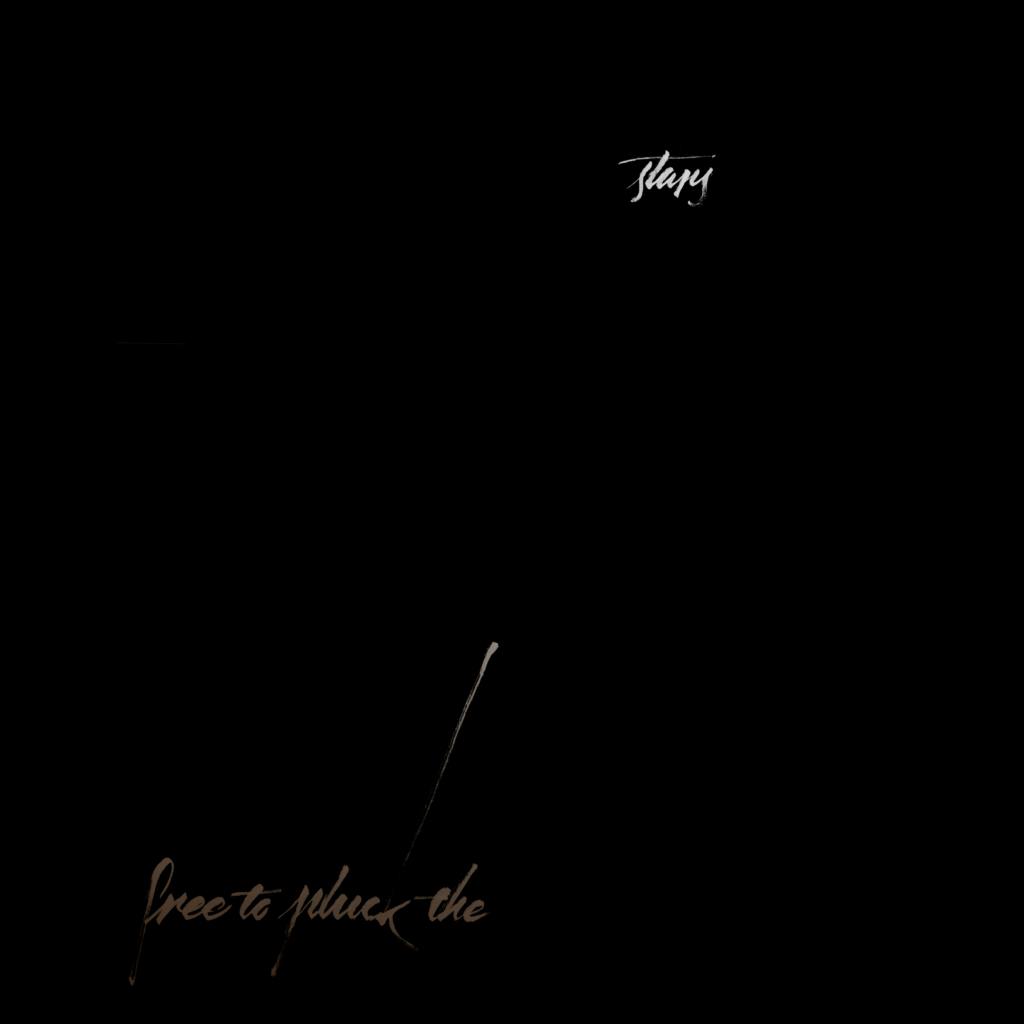
1/23 Inktober 52 (2024), week 27
free to pluck the stars
This was inspired by Ann Collin’s post with collage artist Duane Toops, a beautiful pairing of poetry and collage. Check it out!
Their collaboration was bouncing in my head as I tried to fall back asleep while also mentally imaging the Inktober52 prompt “free”. This line slid into my half asleep mind and I snapped awake.
The original graph was black ink on white paper. In the computer, I inverted the color, pulled “stars” way up into the sky, and added a little brown to emphasize the earthiness of the starting line.
Even though I don’t prefer relying upon the computer, I do it when it makes sense. At the very least, rightsizing the white space around conventional pieces. And sometimes it’s nice to envision a piece and hit it out of the box.
,
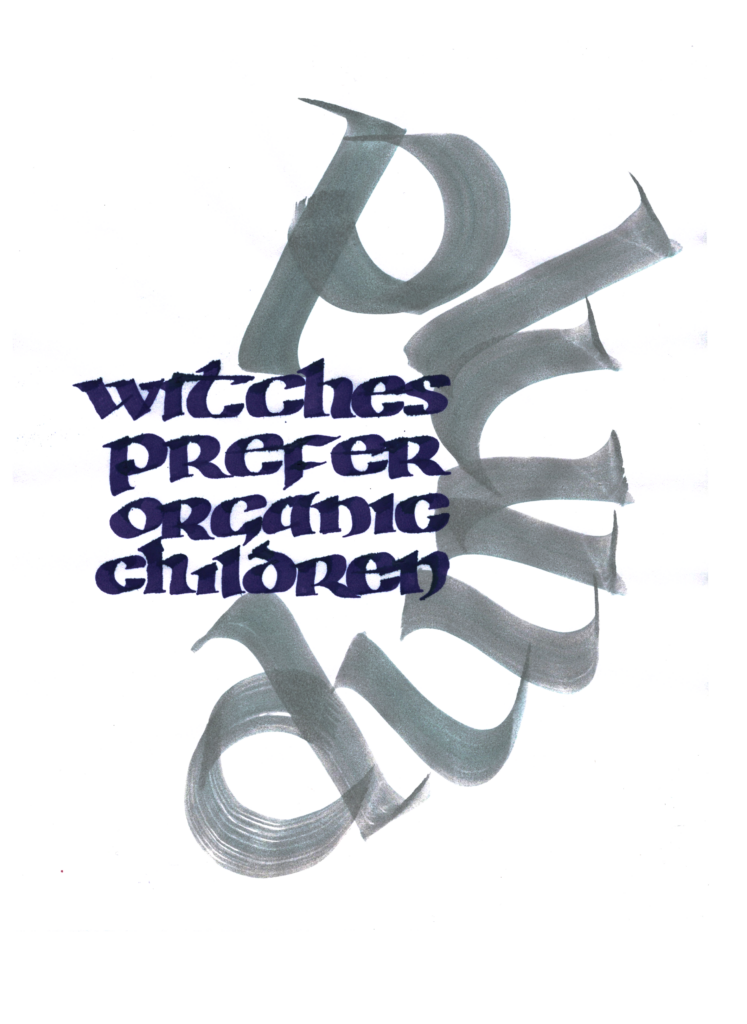
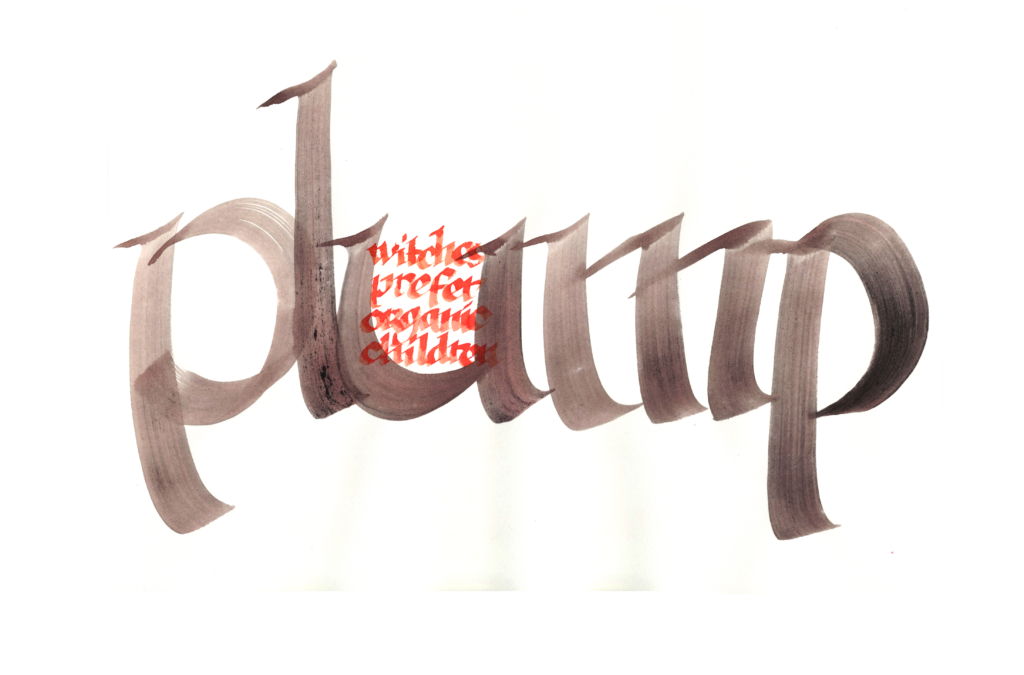
1/28 Inktober 52 (2023), week 42
plump witches prefer organic children
This one turned out to be wicked hard. Even though I envisioned both of these concepts fairly easily, they both took multiple attempts and I’m not happy with any of them.
Sometimes you just throw your hands up and say “this is all I got with today’s skillz!” And move on.
,
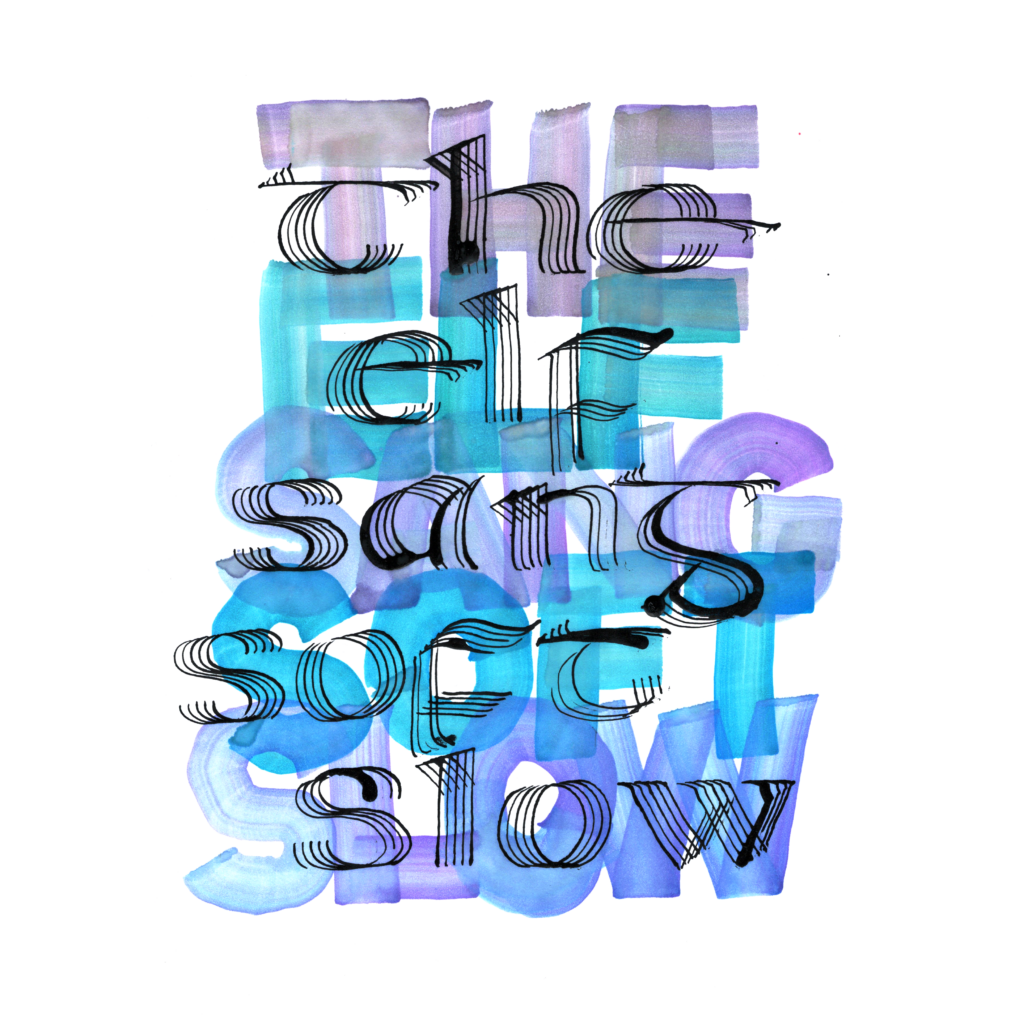
1/29 Inktober 52 (2023), week 51
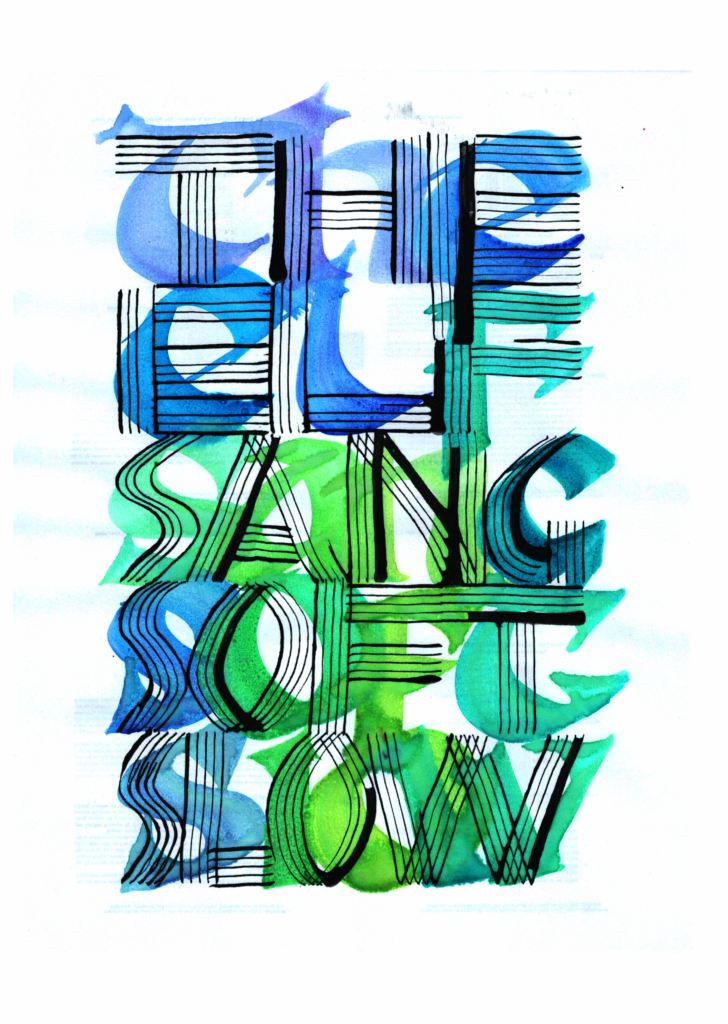
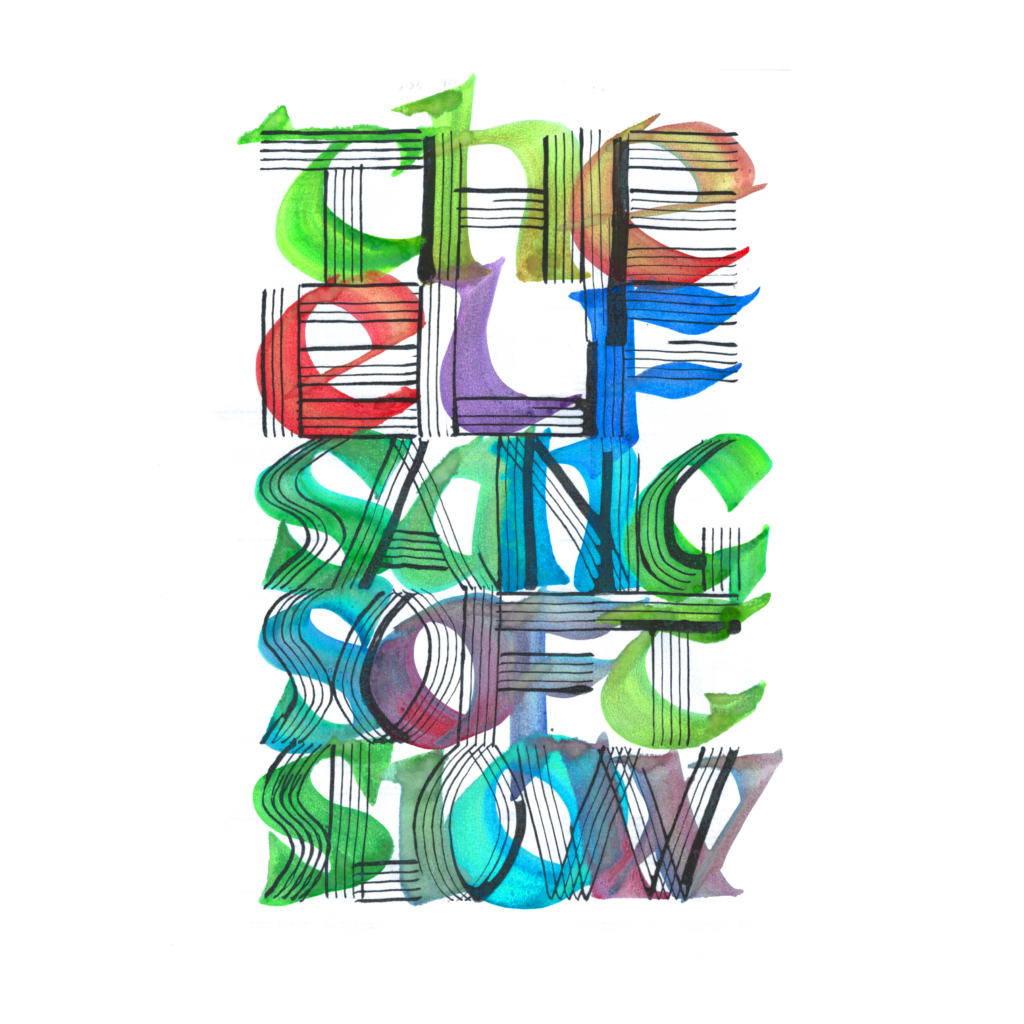
the elf sang soft slow
I’m still figuring out how to use that music nib. This was inspired by a glorious piece by totemspoems on Instagram.
,
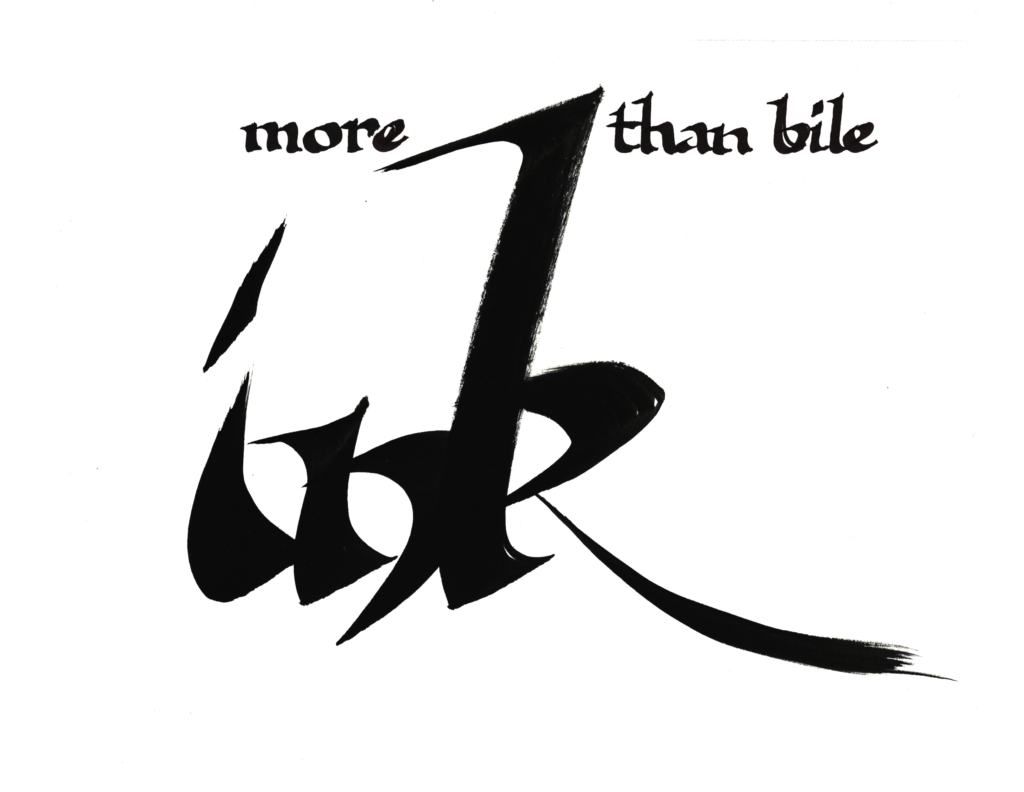
2/3 Inktober 52 (2021), week 30
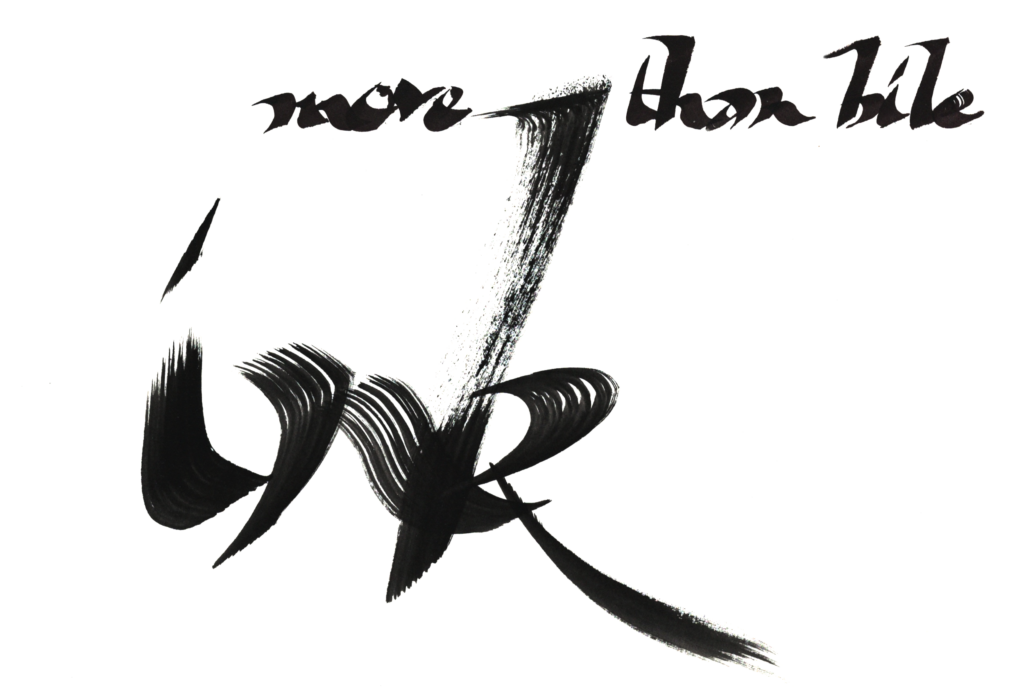
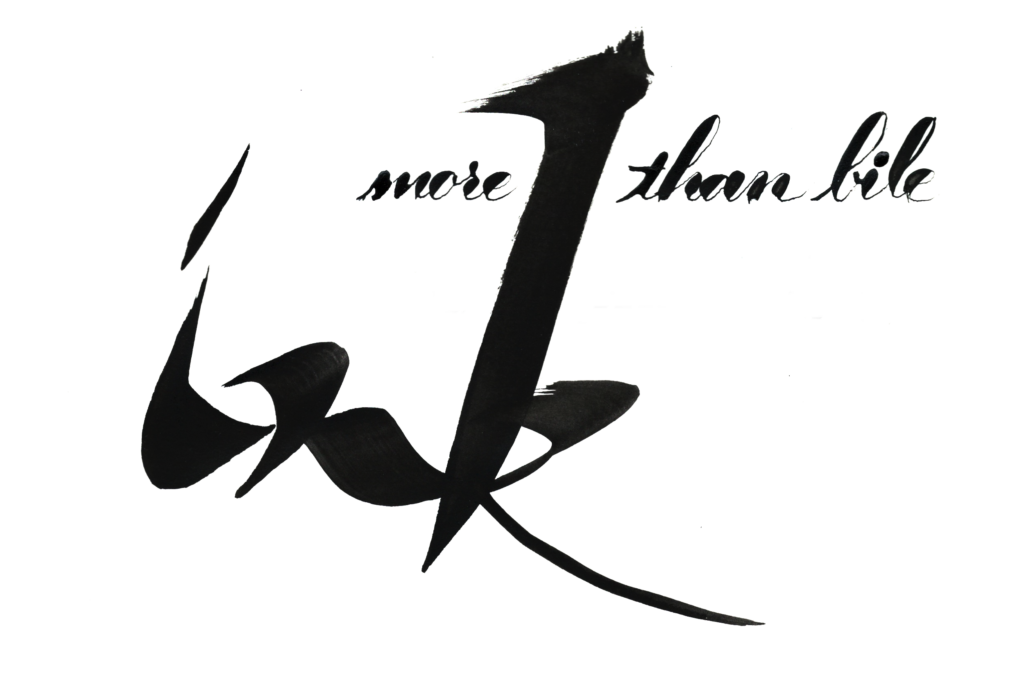
ink more black than bile
A lot of times I’m using greys, washes, or watercolor. It was fun to just use a pure black india ink.
,
At the start of February, I showed my wife some awesome calligraphraphers on Instagram. She was reasonably nice about my work too =).
But we agreed that the borders was limiting the punch on the 5WPs.
So they’re gone.
As an architect, there are some perks to being married to another architect.
Cya next time!
,
PS-Bhagavad Gita
I spent the month of April 2021 reading and listening to all the books in the library about the Bhagavad Gita. I thought about doing a series of separate posts, but I’m not sure I have that much to say, so listicle time!
Let’s start with a free copy, translated by Sir Edwin Arnold. As with all public domain books, the language is dated, but nothing beyond the King James Version of the Bible. It doesn’t come with commentaries, which are essential for understanding what’s going on—especially for us from the West where Hinduism is an exotic oriental religion, but the price is right for a decent introduction to the Gita.
I listened to Jack Hawley’s Bhagavad Gita, A Walkthrough for Westerners which is a translation where the commentary is mixed into the writing, resulting in a version that is three times as long as the original poem. It’s an interesting concept that reminds me of the Living Bible paraphrase of the Bible published in the 1970’s. But I was reading the original at the same time as listening to this book, so it felt strange to have Hawley’s parentheticals inserted into the flow of the text. And it was unsettling to never be sure what was textual and what was explanatory. I don’t think it’s a horrible idea, but I prefer the streamlined punch of the original.
I also listened to Ram Dass’s book Paths to God which takes the opposite tack from Jack Hawley. This is a series of lectures nominally around the Gita, but really about Hinduism and spirituality in general. I first came across Ram Dass in the documentary Fierce Grace (as part of a double header with Winged Migration in a movie theater that was about to be demolished). I’ve always been skeptical about white dudes who are into eastern spirituality, but I could sense a good spirit in the film. One interesting aspect of this book is that Ram Dass effortlessly utilizes the language of the 60’s (freak, trip, etc) in a way that makes one understand how that vocabulary came about. Of course it has become a caricature through the intervening decades, but the body of language met a need that was lacking in standard English. In all, I really liked this book.
The library has a straight audiobook reading of the Gita translated by Barbara Stoler-Miller. The reader, Jacob Needleman, has a copy of the audio posted on his own website. The free version online is of inferior audio quality to the version on Overdrive, but it is free.
Eknath Easwaran has a popular translation, but he relies a bit too much on sanskrit terms which makes it hard to follow at times.
When Love Comes to Light, by Richard Freeman & Mary Taylor is a two part book, with an extended ten chapter commentary of the Gita followed by a translation of the book in the second part. Having read and listened to a few books about the Gita, I’m at that point where I’m no longer a complete stranger to the work, but I am still such a novice I can’t really judge the quality of the commentary. Nothing seems out of line with what other people say about the Gita. One nice feature about this commentary is that it generally follows the flow of the Gita. While the essays don’t shy from pulling quotes from the entire book, the flow of the ten chapters covers the themes in the order that they were presented in the original. As such, it may be a good introduction to the Gita.
The Great Work of Your Life: A Guide for the Journey to Your True Calling, by Stephen Cope is a self help book based around the Gita. Like any self help book it is digested in to four digestible “pillars”:
Look to your Dharma
Do it Full Out!
Let Go of the Fruits
Turn it Over to God.
I enjoyed being introduced to the biographies of the great individuals who were discussed in the book, but the criticism on Amazon that the author never dealt with the the conundrum of familial obligations is absolutely on point. The Gita is all about following your duty, which is an easy concept if one has only one single overarching dharma. But what if you have multiple obligations? This book falls short for us normies. I understand why Cope streamlined the biographies to focus on their pursuits of their dharma, but this reduced applicability of these stories for our messy lives. I get that the greats are great because they are different, but if the author doesn’t draw a connection between their lives and our reality, then their biographies become irrelevant. As such, the book is simultaneously too long and too short.
I read the Stephen Mitchell translation, which is in Modern English. Unfortunately I can’t remember anything about this translation. Stephen Mitchell has translated so many different texts, I’m always a little worried about whether he has the expertise to do it right whenever it comes to a specific book.
I’ve ultimately settled on Laurie Patton’s translation. I enjoy her tight structure, capturing a poetic pithiness of the original that the other translations don’t. I read this after my initial explorations, so having some of the concepts telegraphed is not a problem.
Given that I’ve read more about this text than any other text from the last twenty years you could say I dig the book. Its appeal to duty resonates with the cultural Confucianism of my upbringing and my intellect is tickled by the exotic foreign spirituality in the rest of the book.
Naturally, the Gita has ended up in the top tier of wisdom literature that I would like to revisit for the rest of my life, along with the Daodejing, Analects, Havamal, Zhuangzi, and the book of Ecclesiastes.
Here are the last couple of Inktober 52’s from 2024 and the first three for the new year.
,
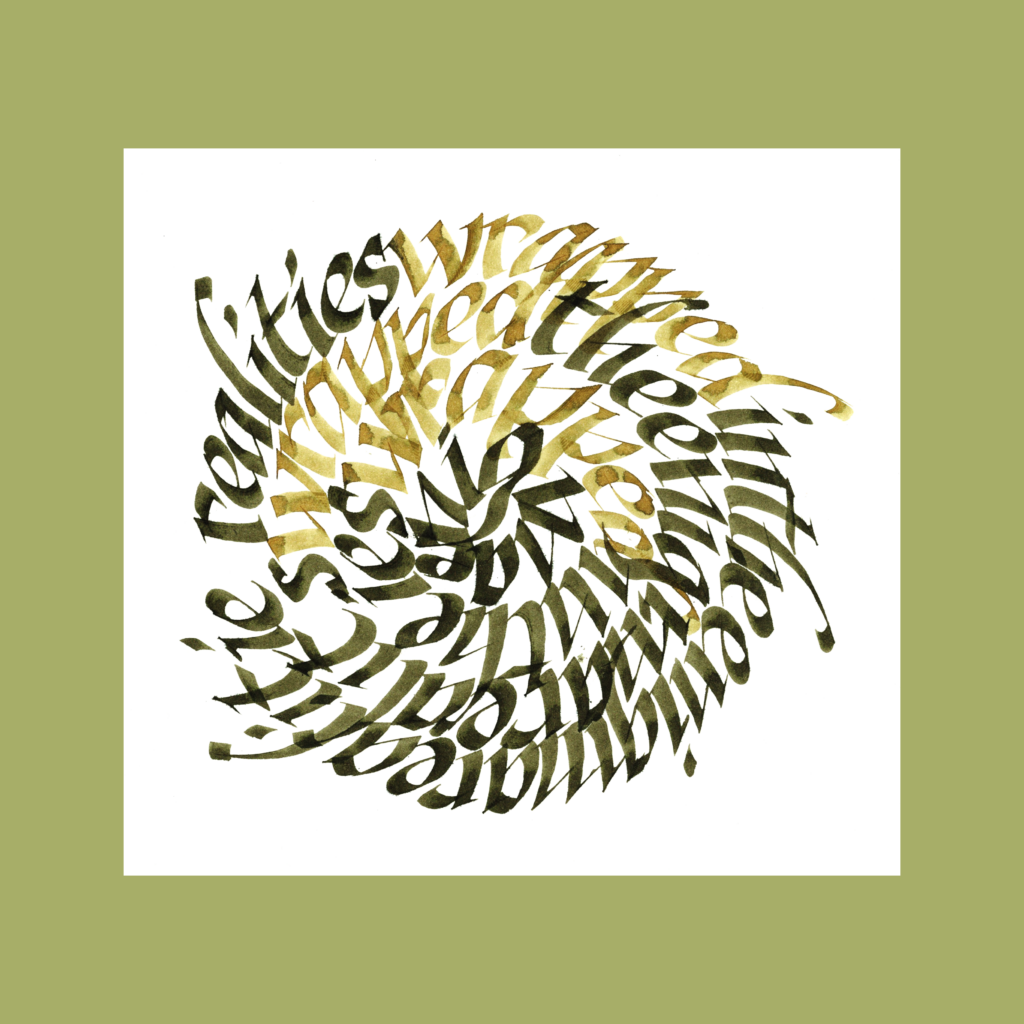
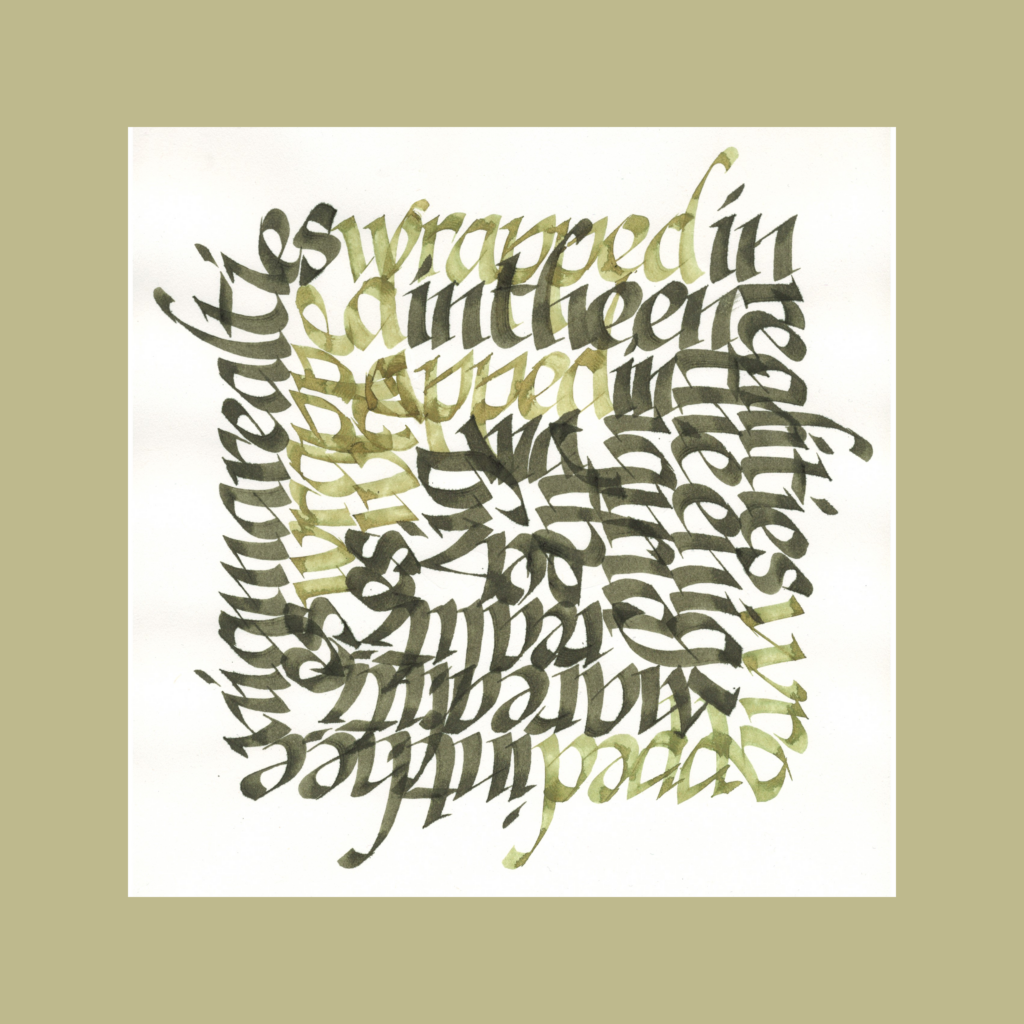
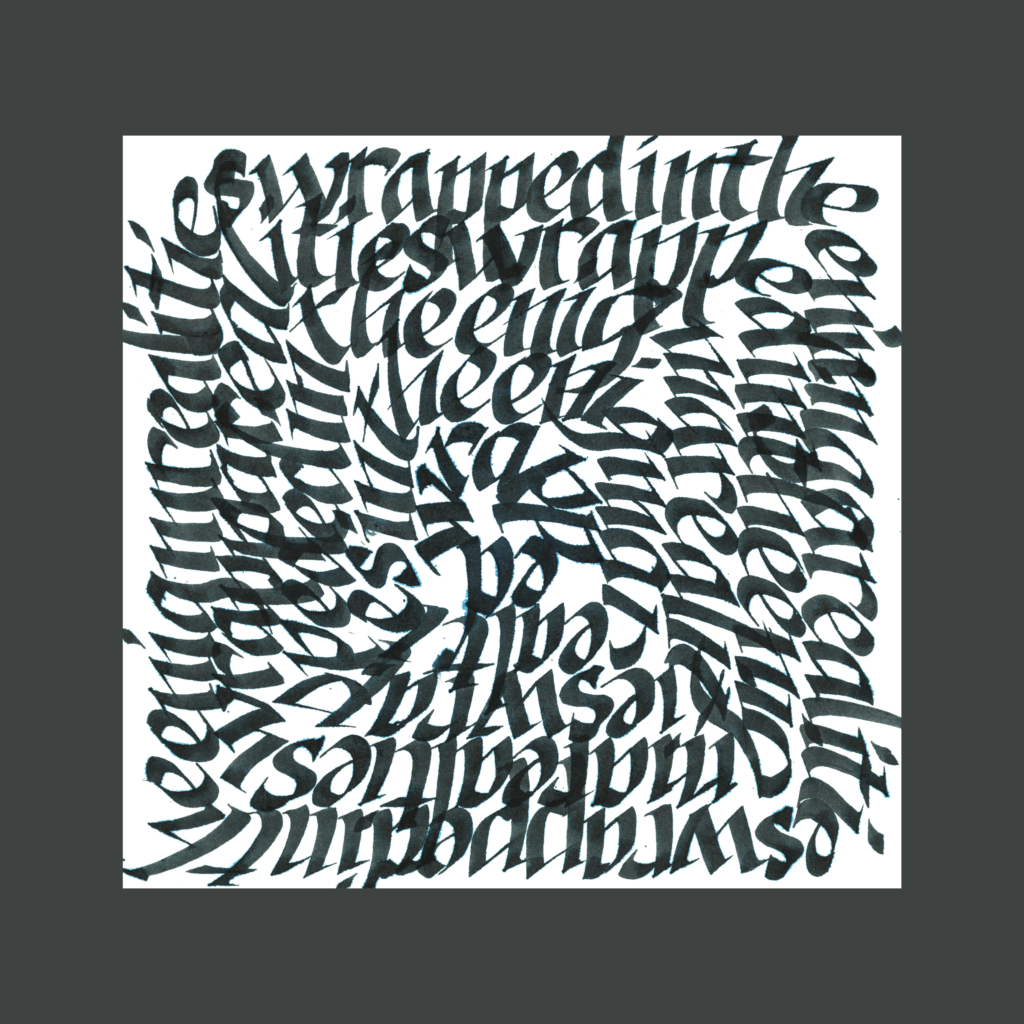
12/23 Inktober 52, week 51
realities wrapped in the enigma
I tried going with a square for this is play on “enigma wrapped in a riddle”. The corners felt awkward so I went to the old standby—a big circle.
,
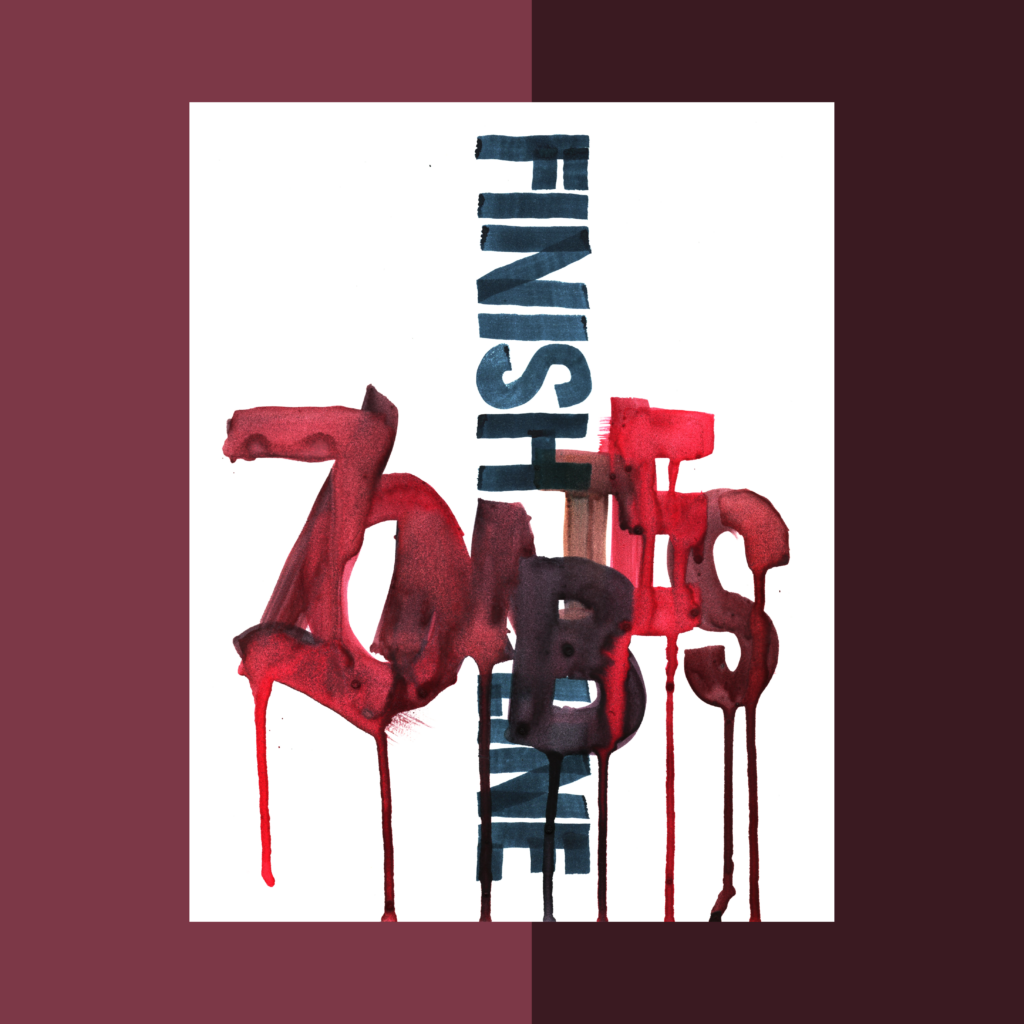
12/30 Inktober 52, week 52
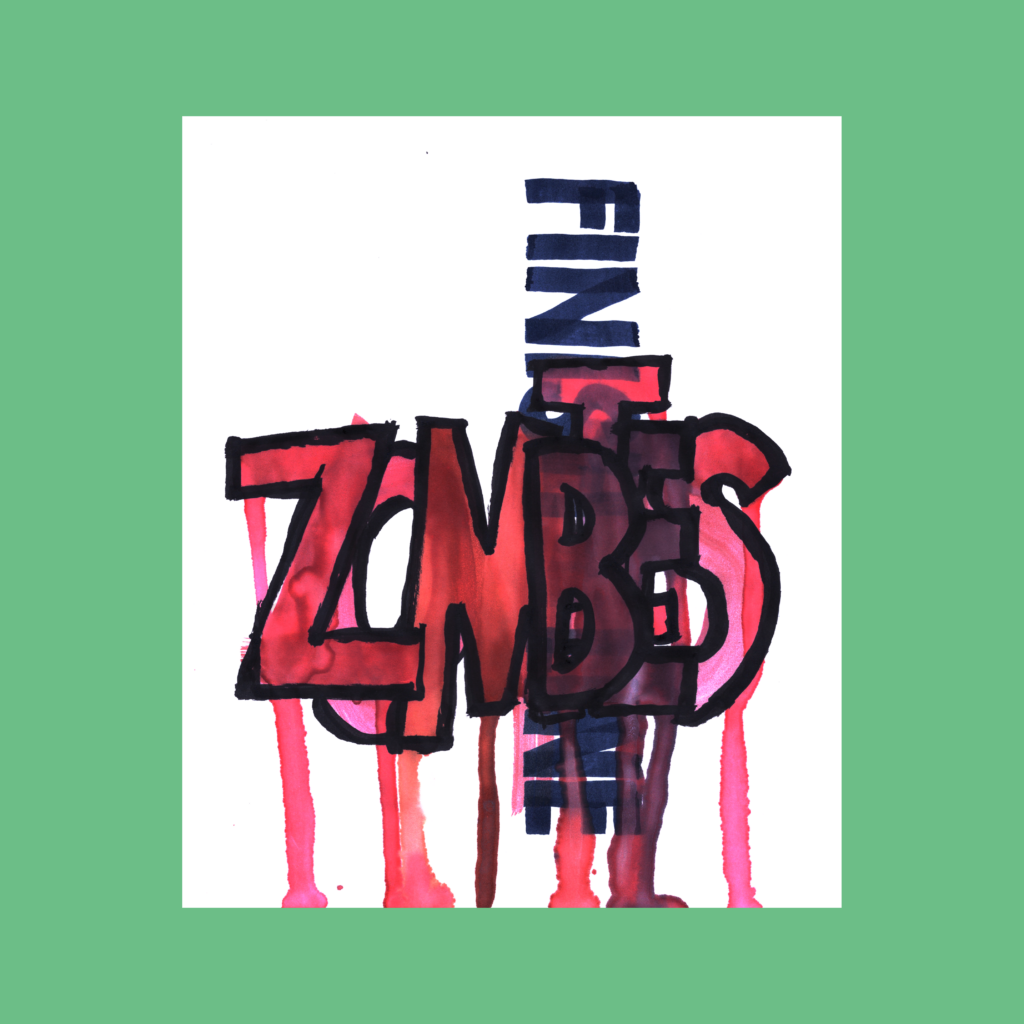
zombies cross the finish line
Always a little scary to give up control, letting gravity have a say.
I’m not sure if outlining was better or worse. It makes it a bit cartoonish, less bloody.
,
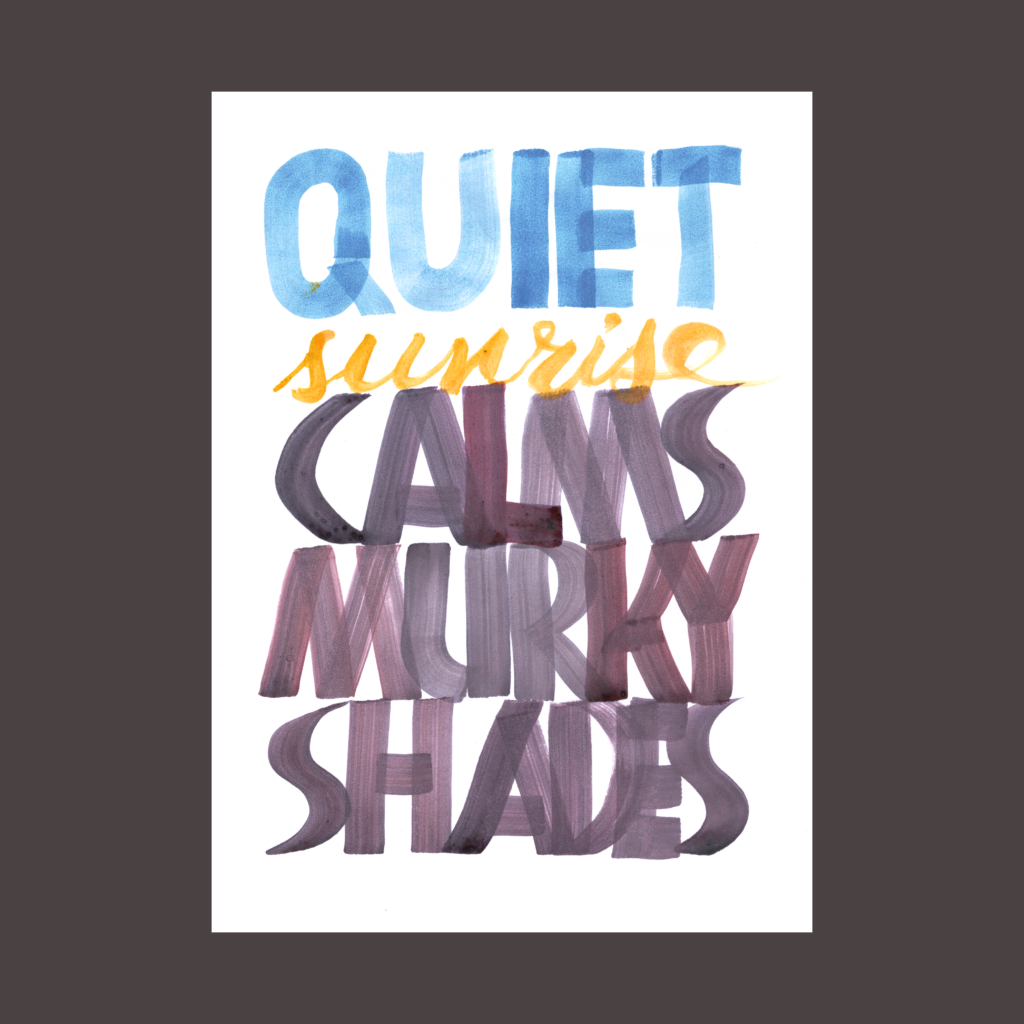
1/4 Inktober 52, week 1
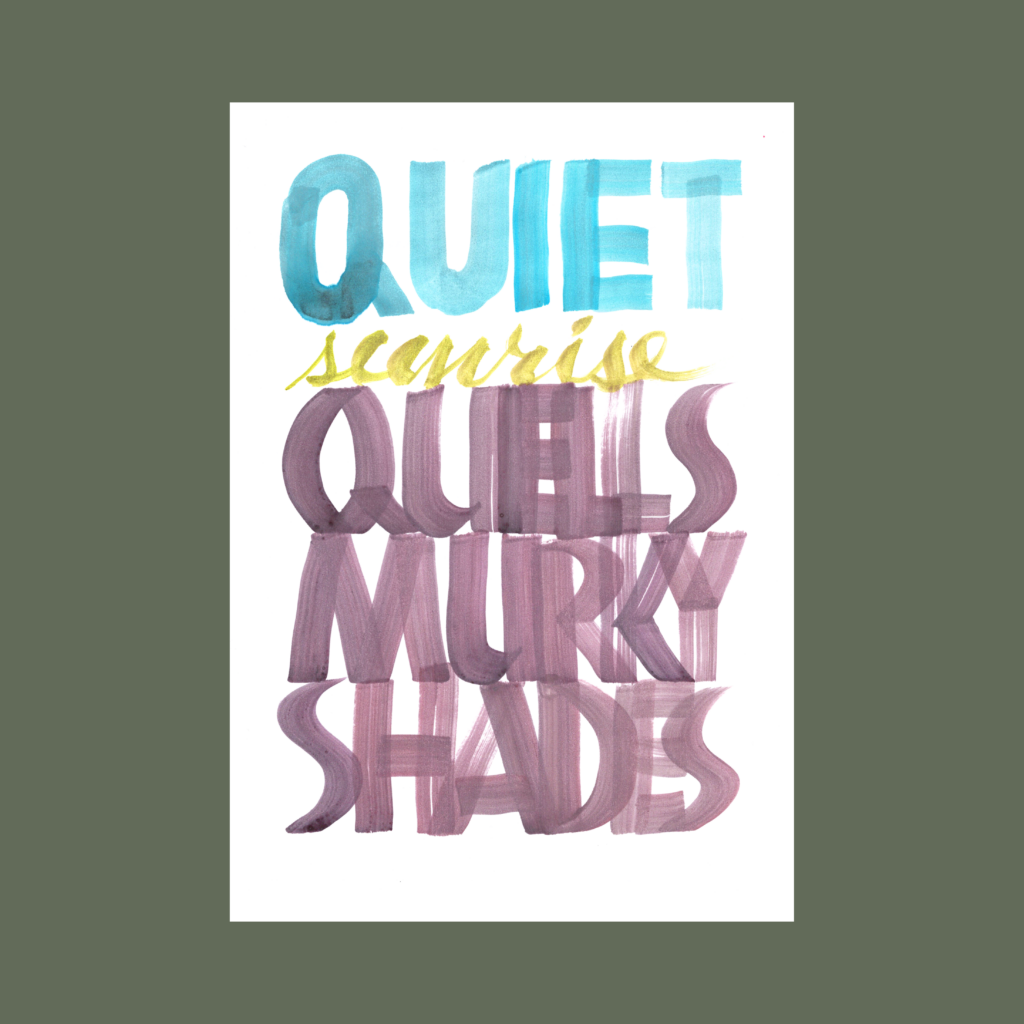
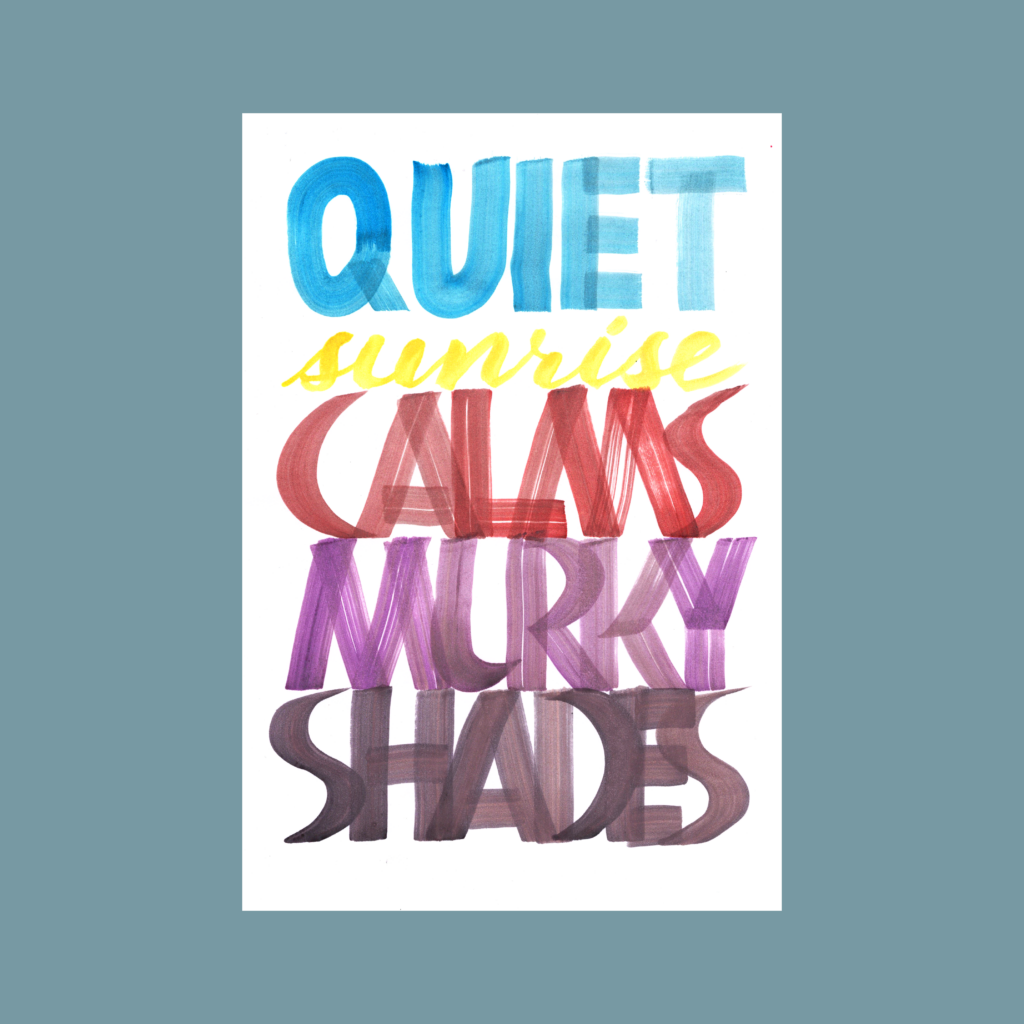
quiet sunrise quells murky shades
The pointed brush and copperplate cursive came together in “sunrise”. I’m unhappy with my dip pen copperplate—it needs a ton more practice to look good for these 5WP’s. But all that December work set me up for pretty good cursive with the pointed brush.
So it worked out after all. Shouldn’t plan too much for these these creative meanderings. Just peek far enough to keep doing.
,
1/12 Inktober 52, week 2
perky shrimp pound pearly xylophones
After finding the big concept, one must still wrestle with a bunch of little decisions. It turned out the last slant was best.
,
1/18 Inktober 52, week 3
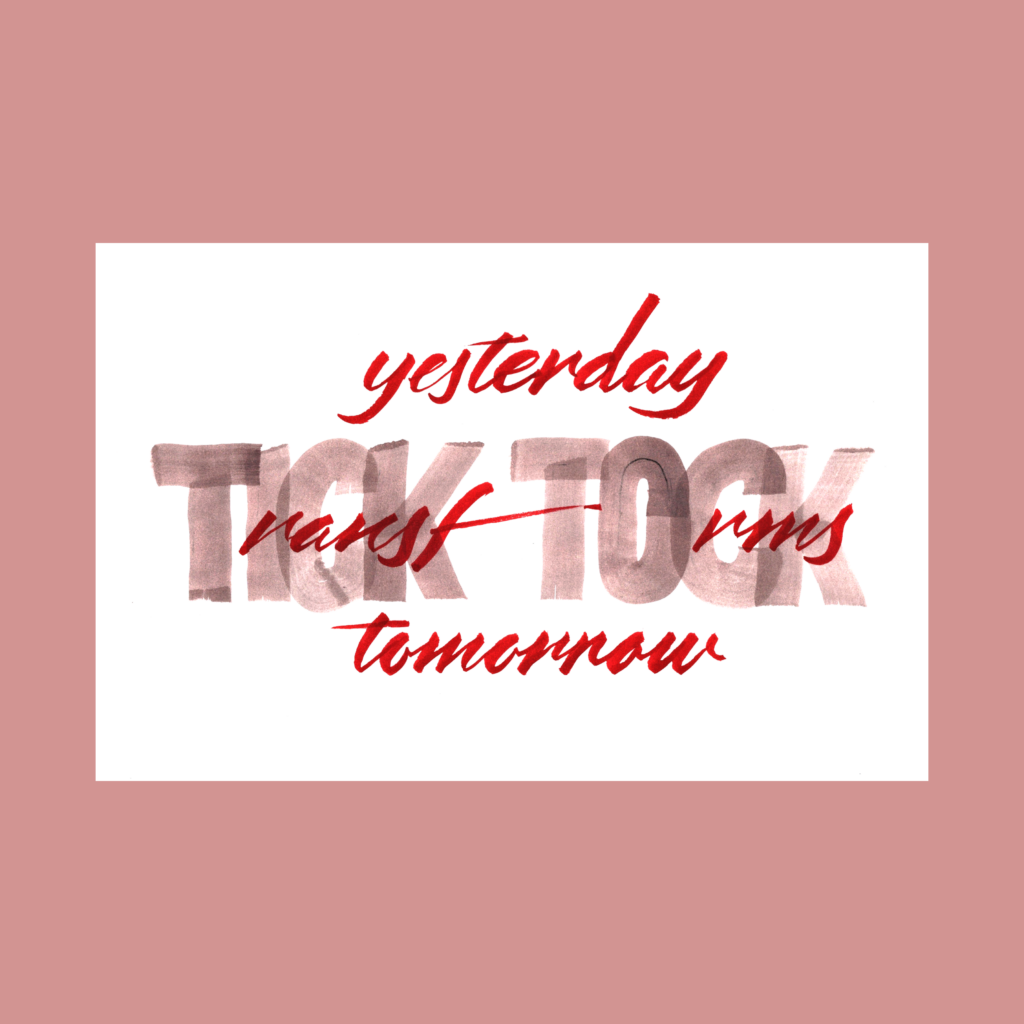
tick tock yesterday transforms tomorrow
I finally learned how to properly spell “tomorrow”.
,
I can’t believe we’re 8% through the year!
Cya next time!
,
PS—Books that Matter: The Analects of Confucius, Robert Andre LaFleur, Great Courses, 2018
This excellent audio course covered the Analects and its outgrowth in Chinese history. It provides a conceptual framework for reading the text as a series of conversations between the teacher and his students. LaFleur then covers key themes, such as filial piety and remonstrance, and finally closes with a discussion of Confucius’s long legacy in China and East Asia.
After four years, it might be time to revisit this course. Like most Westerners, I have an affinity with quirky individualism of Daoism as a reaction against fundamentalist Christianity. However the ideas centering social relationships and mutual bonds as discussed in this lecture series are attractive, especially as our nation continues to rattle itself apart with irresponsible leaders and citizens.
Beyond these lectures, just finding this course is a reminder of how much info is just out there. Here’s a free 12 hour lecture series! what else is hiding on Overdrive? And the library’s physical stacks? Add Kanopy.com and the publisher’s own streaming service? Finally podcasts and YouTube!
I wonder what Confucius would say about drowning ourselves with information.
,
PPS-Confucius: And the World He Created, Dan Schulman, 2015
This book was a good rejoinder to the Great Courses lecture series, which had taken a positive spin on the philosophy. This book focused on the real-world history of Confucianism, which was quite detrimental by the end of China’s imperial age.
Such is the fate of any philosophy that becomes calcified. American Christianity’s obsession with being right has created an political religion that has forsaken Jesus’ true core of love. The ineffable concept of the dao became a collection of wild superstitions in religious Taoism. And the vision of a well ordered society metastasized into a harsh top-down hierarchy that perpetuated stagnation and cruelty.
These loose philosophies started out kindly enough but lost their heart as they became systematized. Certainty killed the animating force that gave them life.
An organized religion builds a magnificent intellectual edifice by losing the point. One must always be free to pick what works today and ignores that which is irrelevant to the moment.
For that reason, I suspect Confucianism is making a comeback. With the destruction of the formal, governing, imperial ideology, the writings of Confucius and Mencius are available for a fresh rereading. It took two centuries of chaos in Asia to exorcise the old ghost of Confucianism. Master Kong is free to ascend again.
Schulman notes in his epilogue that we are at a crossroads where Confucius can be used to help form an orderly rich society. Or maybe it becomes the bedrock for a new authoritarianism. Let’s just hope we don’t screw it up as badly as last time.
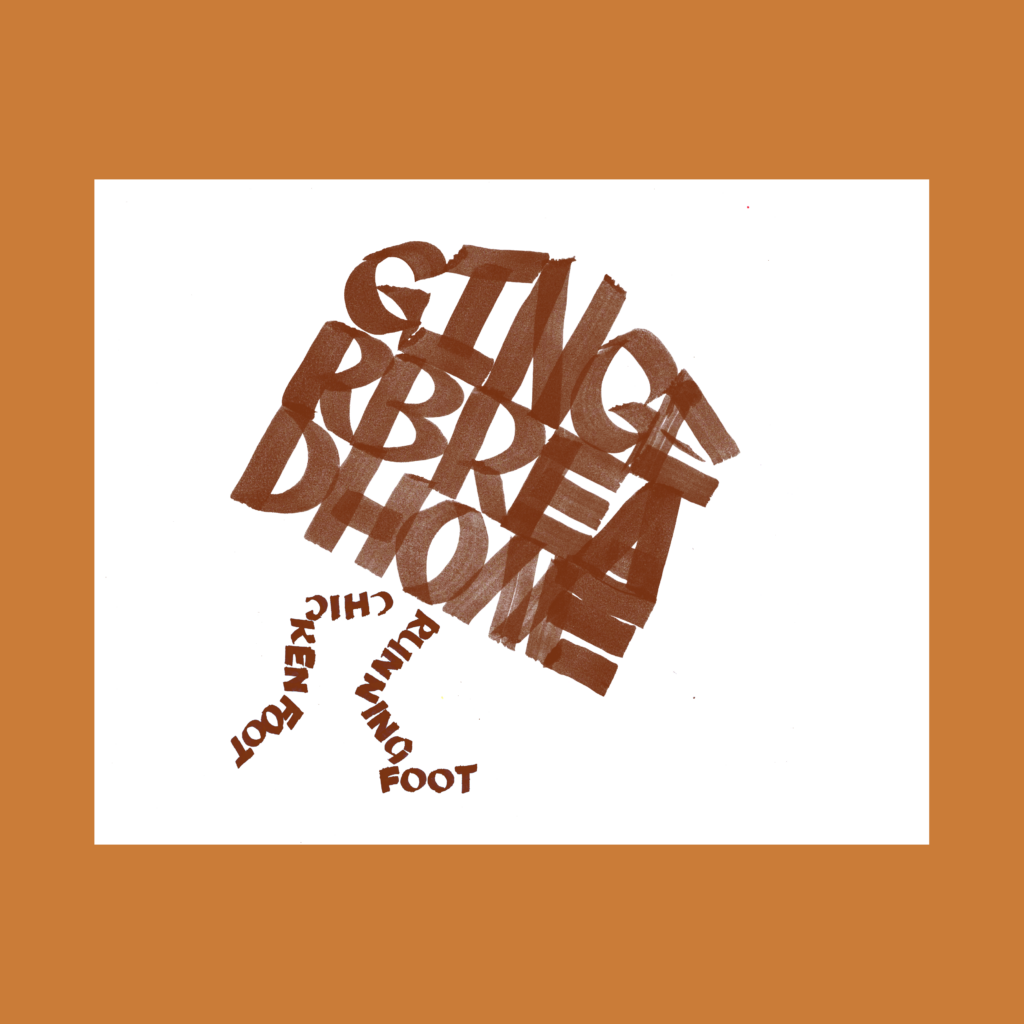
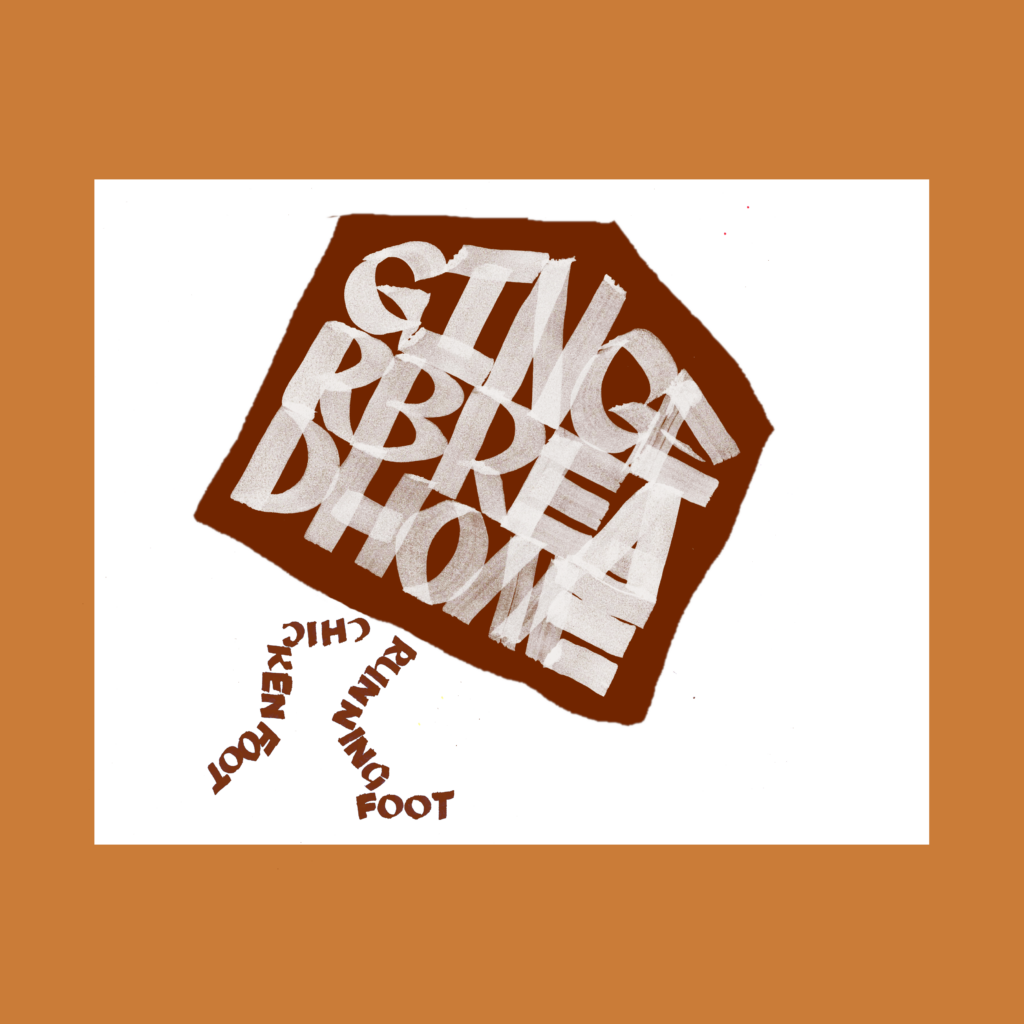
After the initial post, I thought it might be better with the gingerbread home inverted. But it just looks like a piece of toast.
In the past few months, I’ve gone native with GIMP. Its UI is not as intuitive as what I remember from Photoshop, but I’m able to produce quickly on the program, at least for the limited work that I do with it. I presume going back to Adobe would now involve an uncomfortable learning curve.
And yes, this piece is a reference to Baba Yega’s lovely home.
,
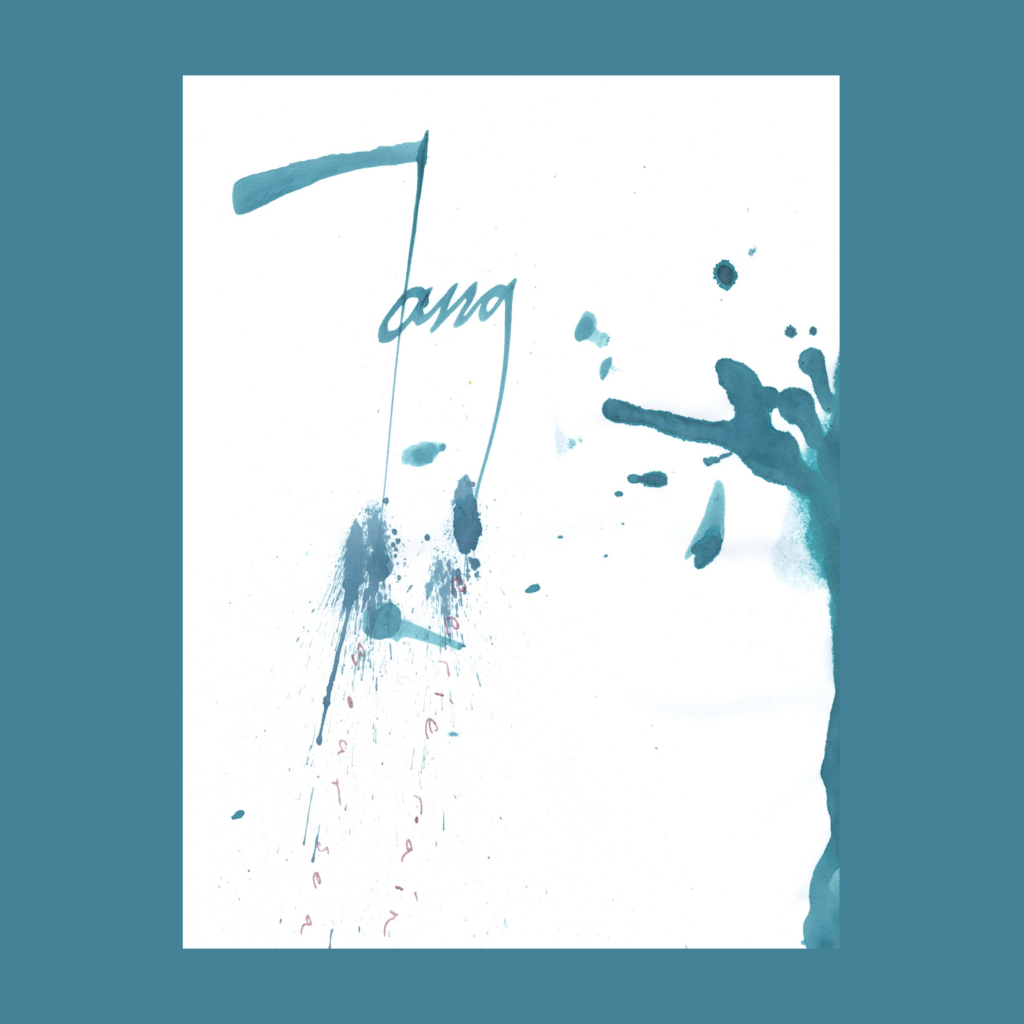
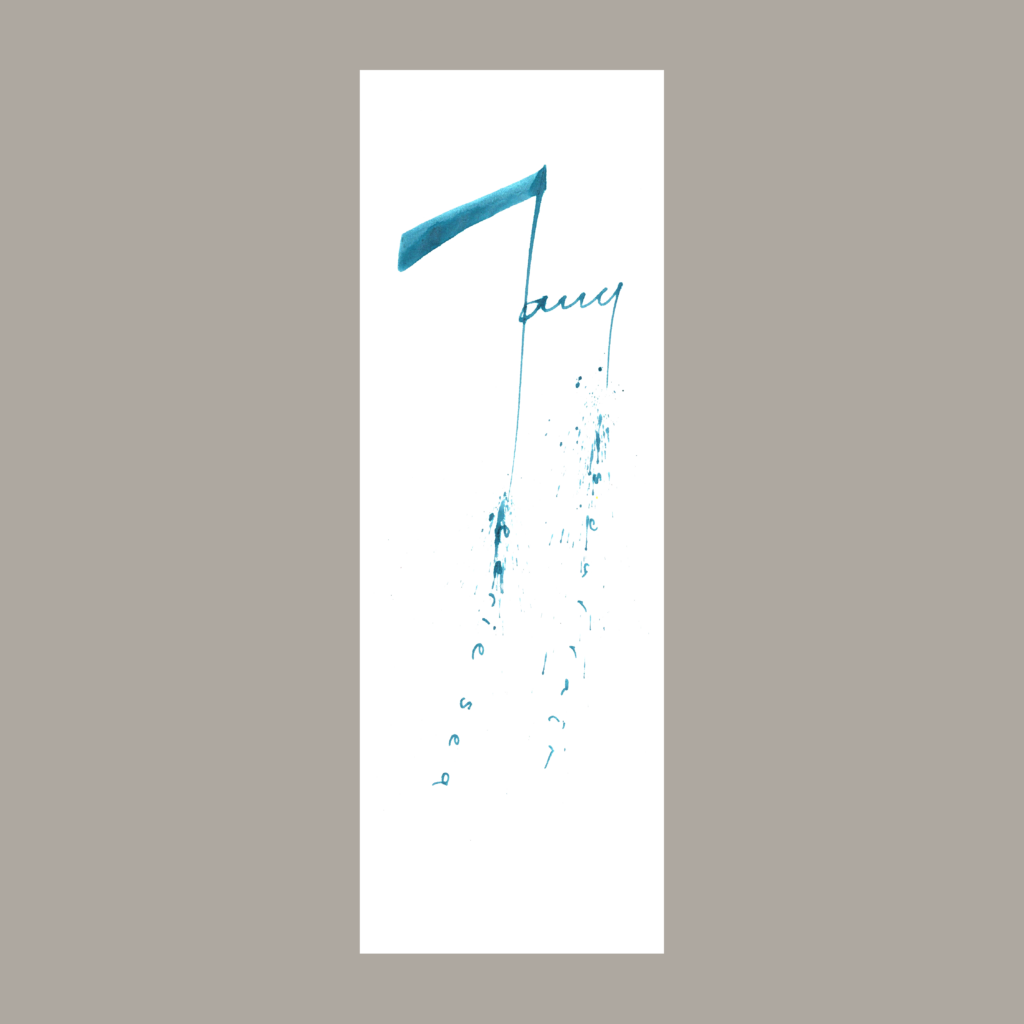
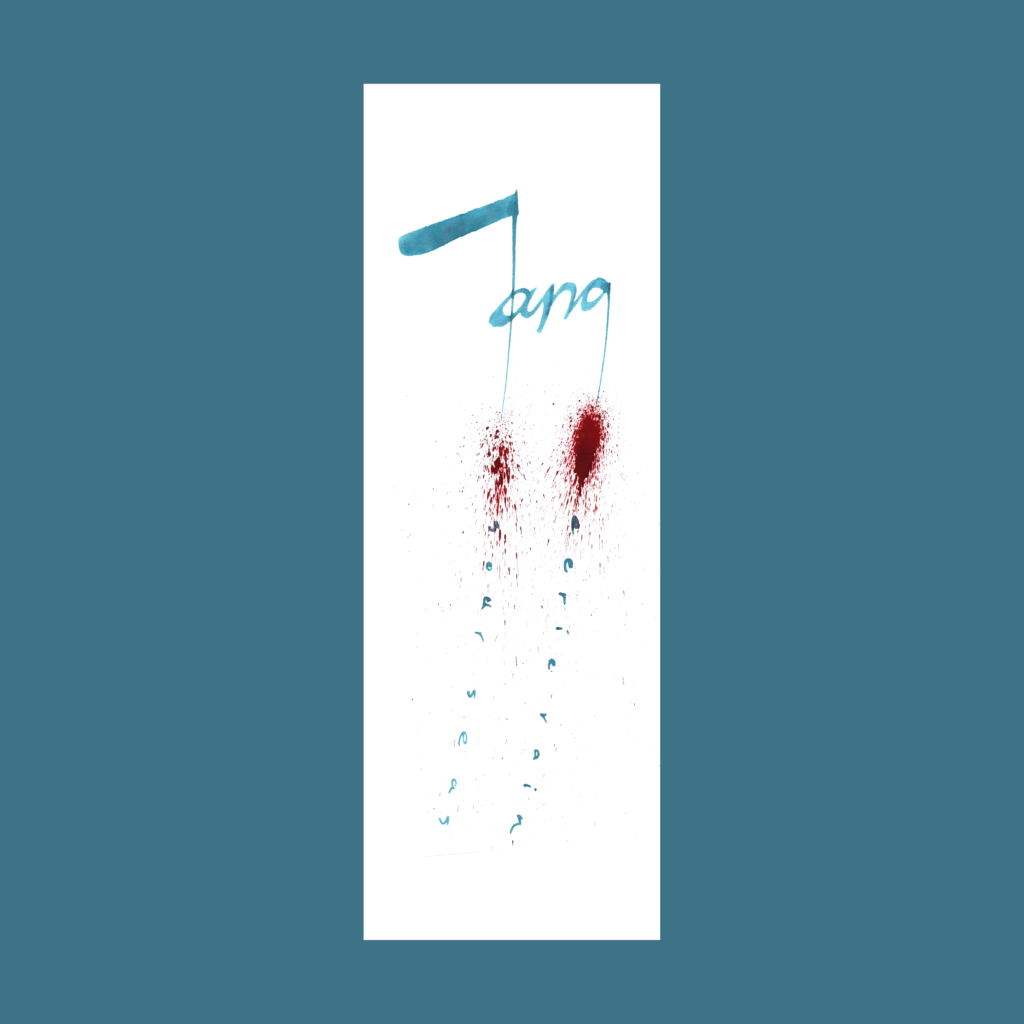
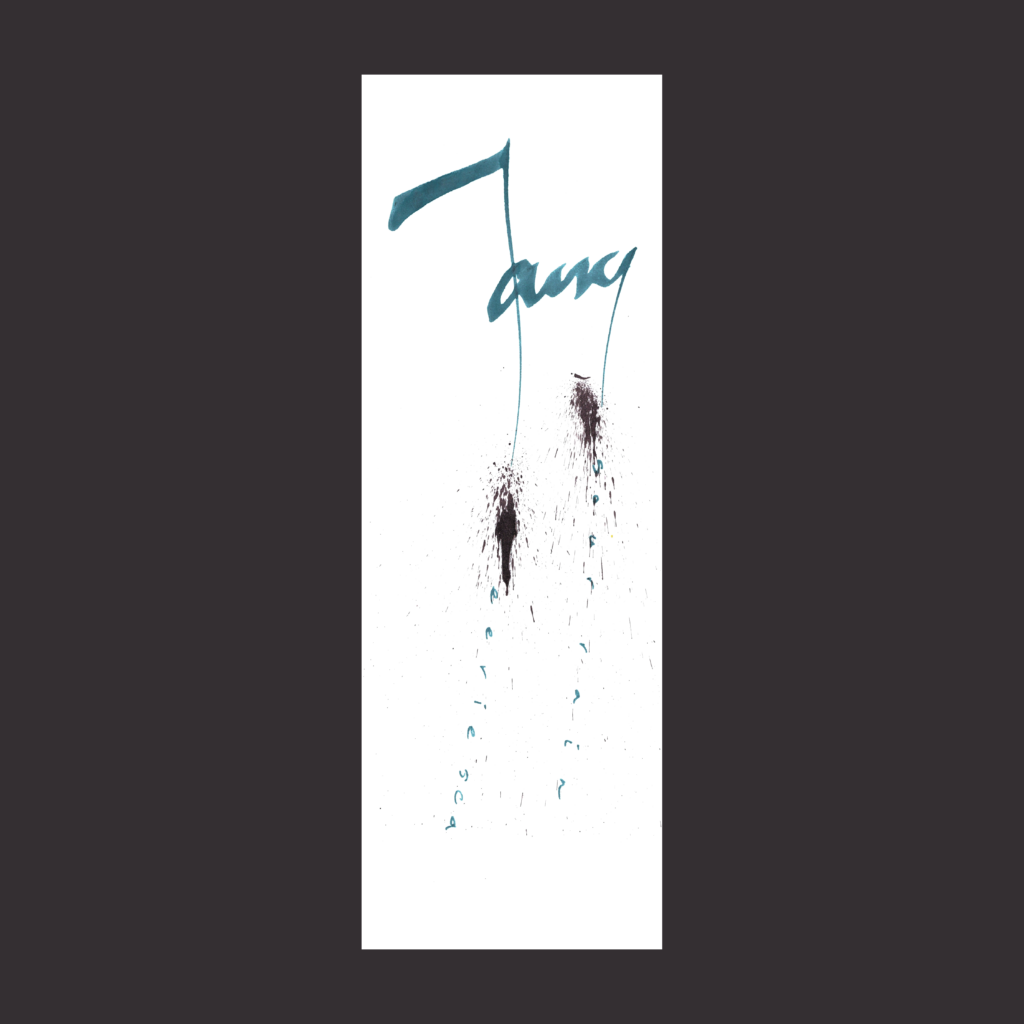
12/18 Inktober 52, week 32
fang sour rain eerie sea
This was partly inspired by the Fender logo, but it took a bit of finagling to get something that felt properly fangy. Even then, I had to add a bit of splatter to lock in the effect.
,
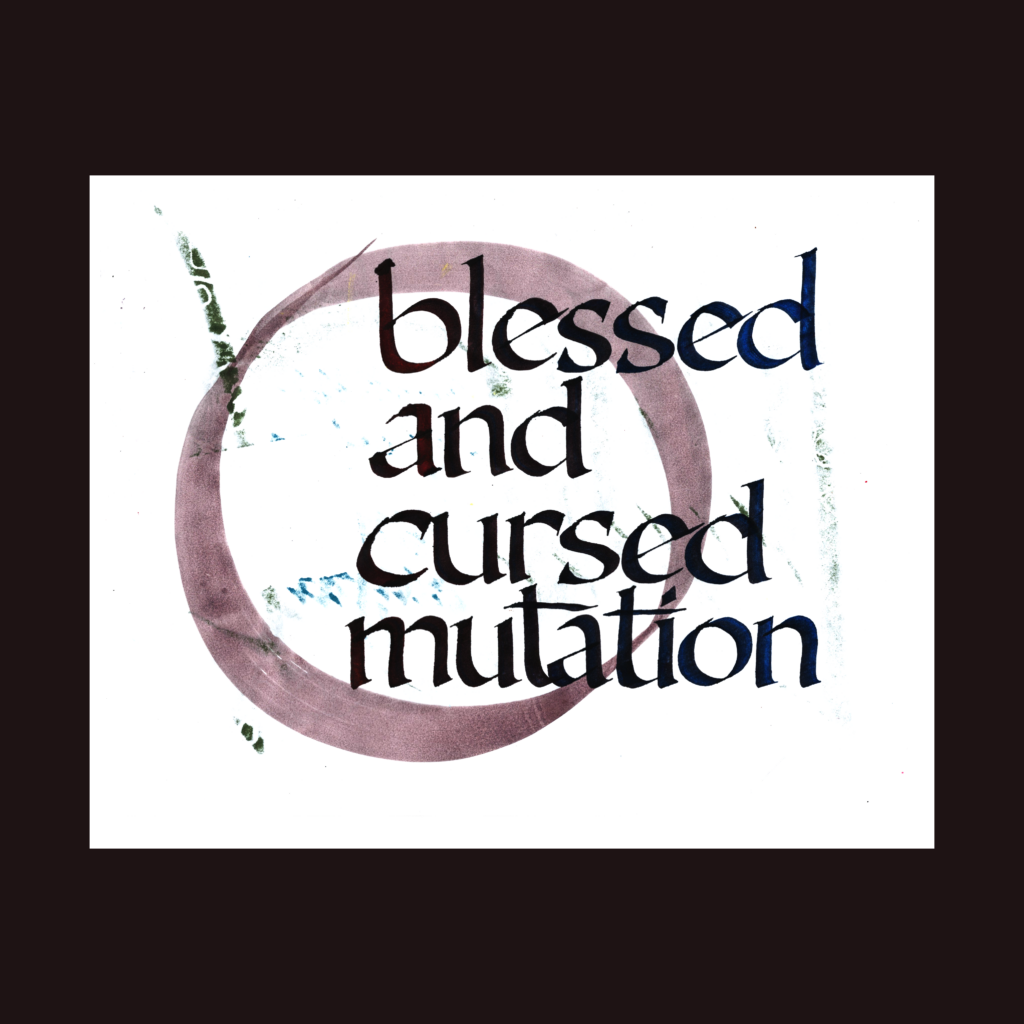
12/20 Inktober 52, week 30
O blessed and cursed mutation
There is a slight color shift in the four words because I was playing with the gradient effect by touching two Pilot Pens. Maybe I’ll spend a month really playing with that effect. Or maybe I just use watercolors.
,
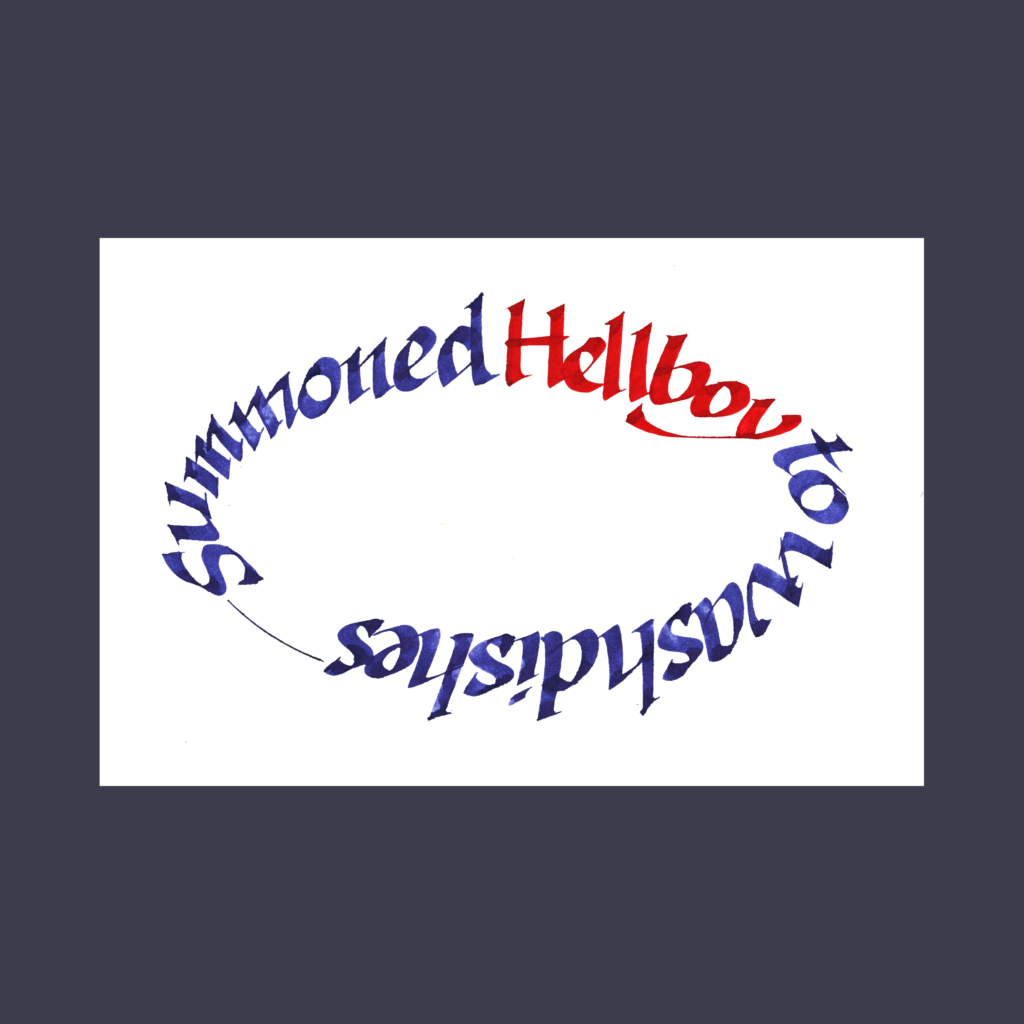
12/21 Inktober 52, week 29
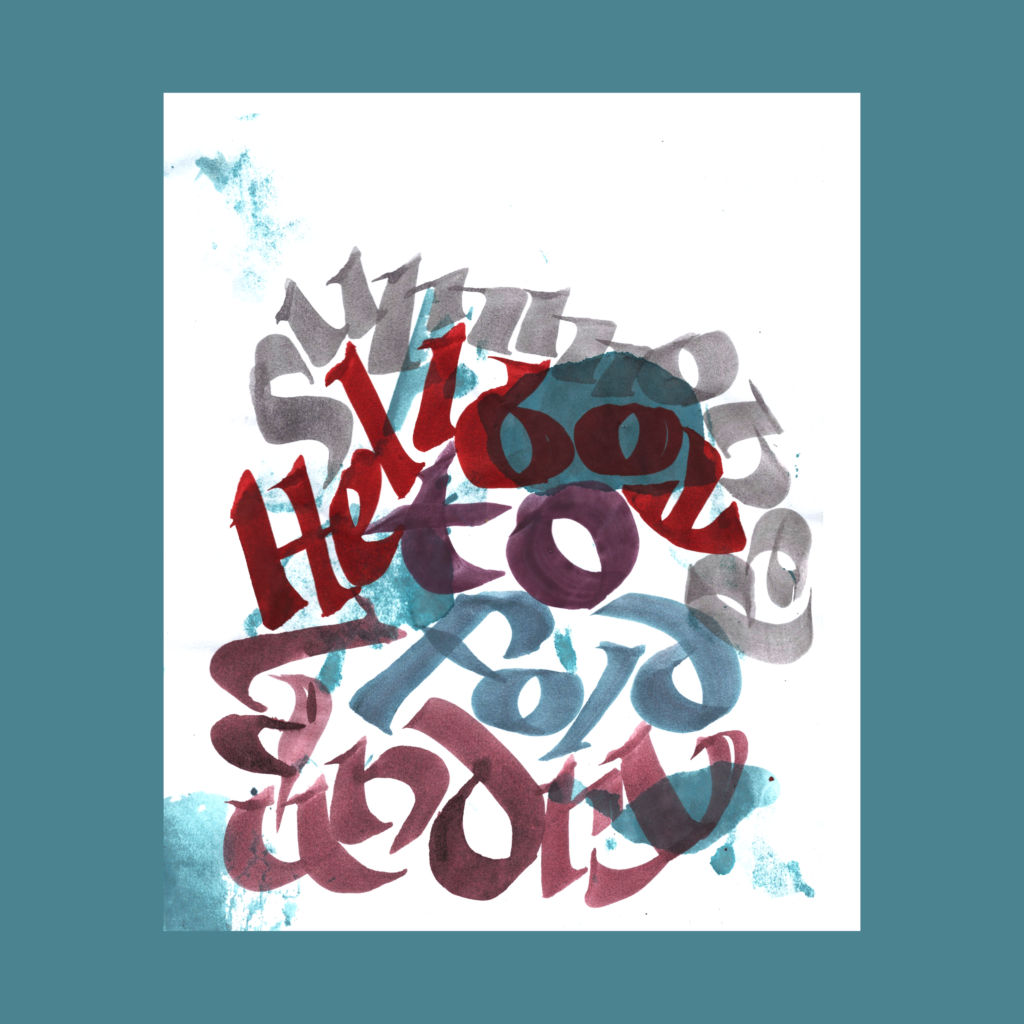
summoned Hellboy to wash dishes
Tried a couple versions of this poem but went with the mental image of Hellboy carefully soaping porcelain teacups. It was fun to learn how to draw an ellipse!
,
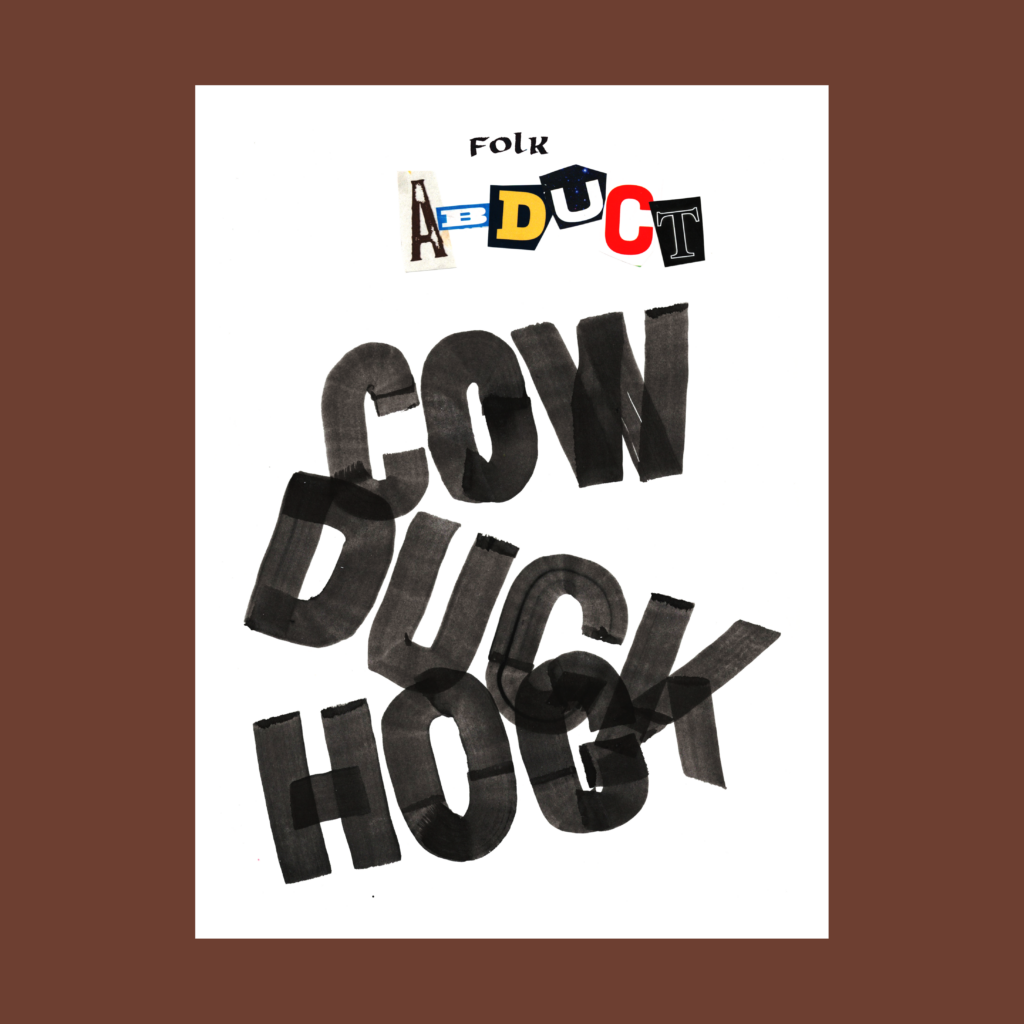
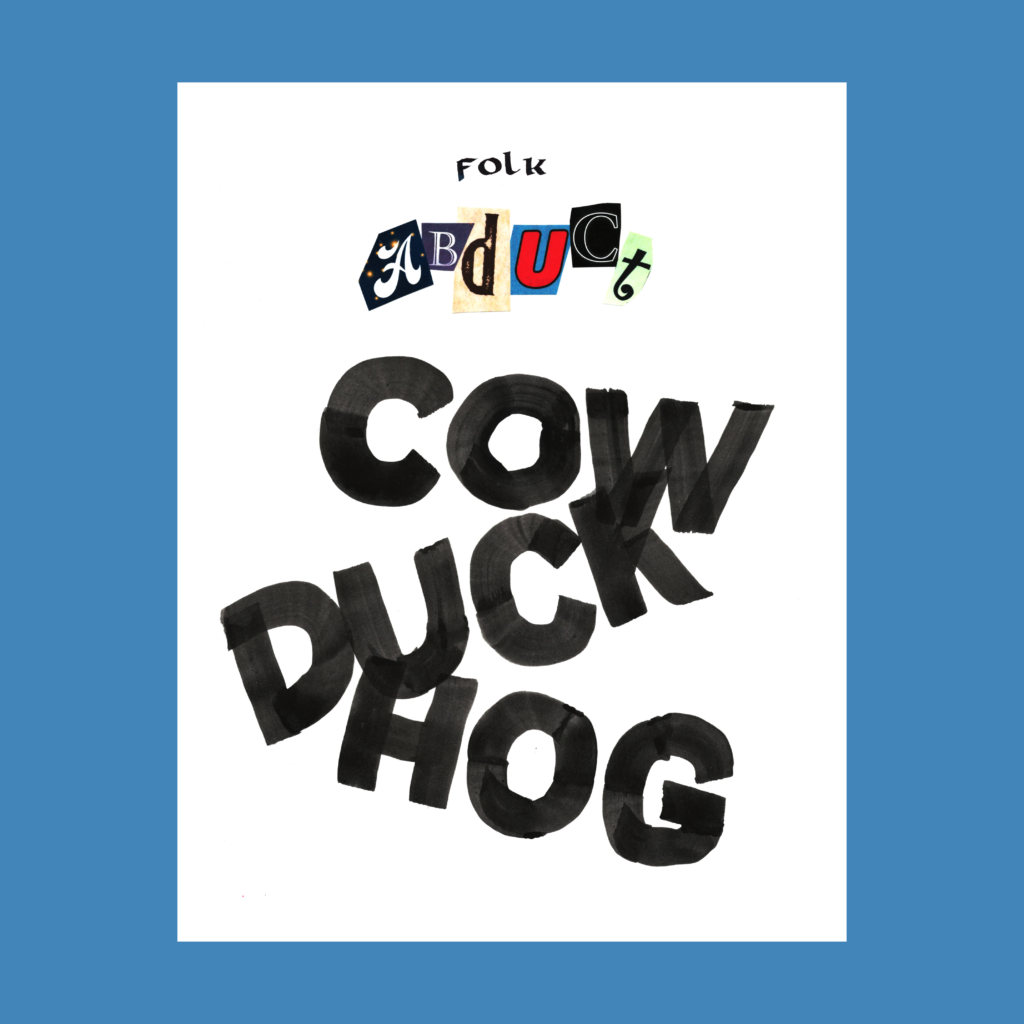
12/22 Inktober 52, week 25
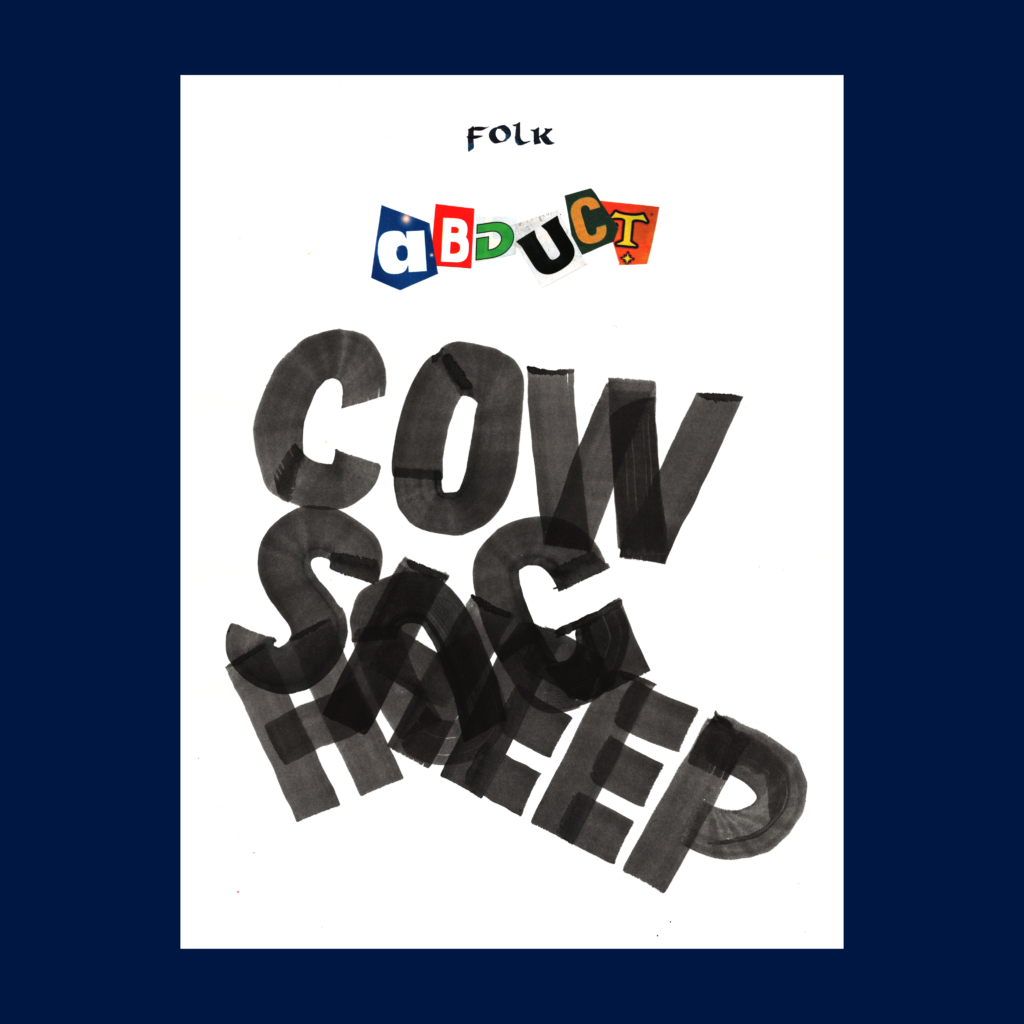
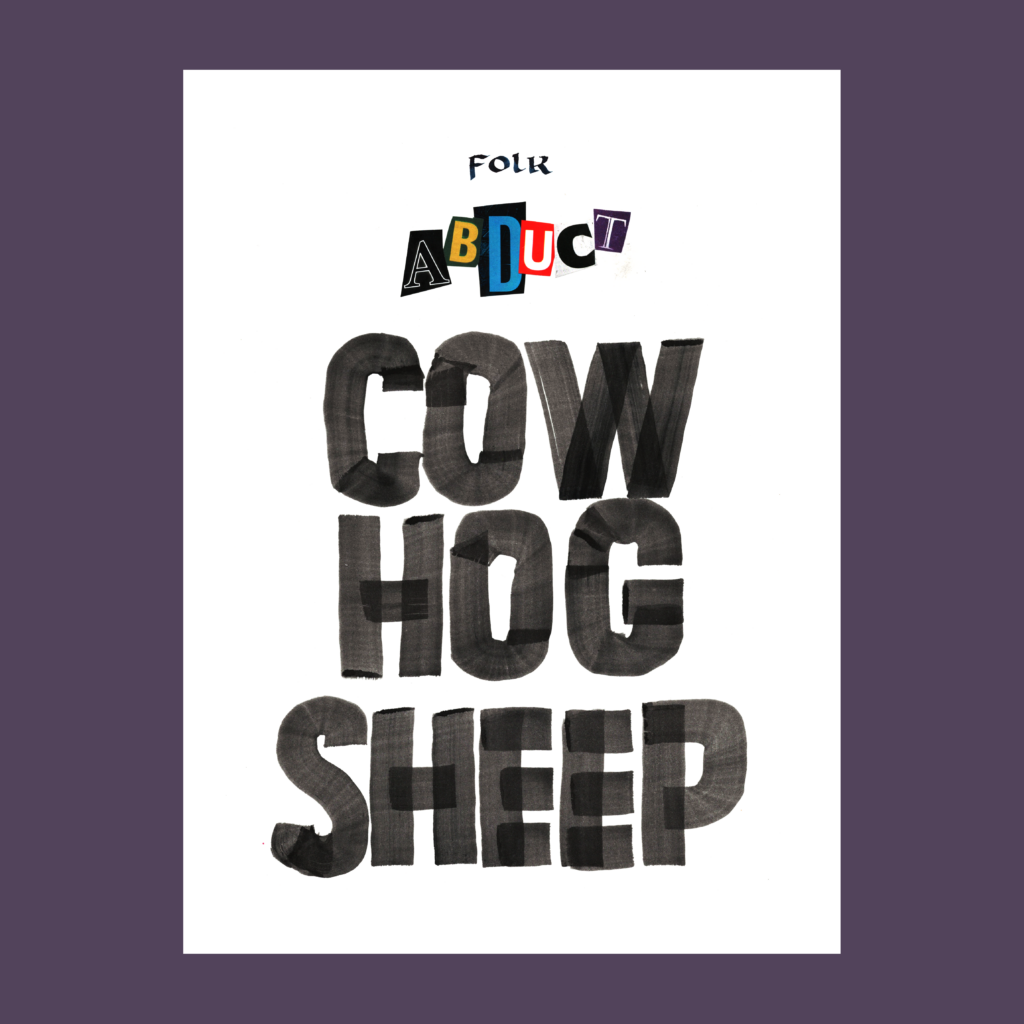
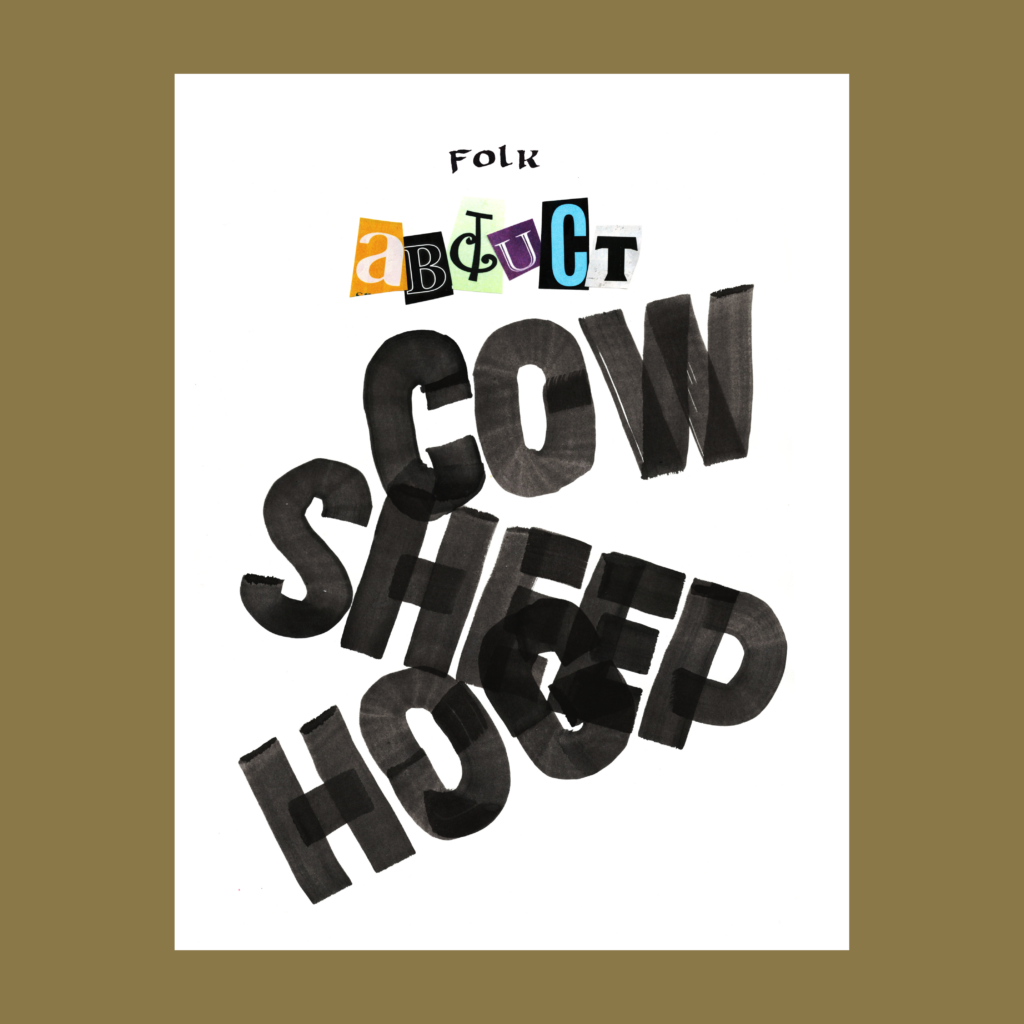
little folk abduct farm animals
After the time cutting out a pile of A B U D C and T’s from mailers and brochures, I had to show off all five attempts.
,
I’m trying to write these in advance, but it’s hard to keep up with the calendar. Time marches inexorably forward.
And commitments invariably multiply.
The doc just prescribed a half hour of aerobics, 5 days a week. It’s going to take every self-help hack I’ve collected over forty-five years to develop a positive mindset about this new 150 minute weekly time suck.
But I’ve been warned that heart drugs mean no more eating grapefruits.
So I must run and jump.
Cya next time!
,
PS—Analects of Confucius, translated by Robert Eno, 2015
The internet is a wonderful place.
When the pandemic hit, I finally started reading eastern philosophy. I can’t remember why I started with the Analects, but Robert Eno of the University of Indiana made it easy by freely sharing his translation of Confucius.
The Analects are a mix of history and proverbs, and Eno greatly aids the reader with a two column format that runs the commentary directly adjacent to the text It’s a brilliant layout to insert to add historical context and explain pithy sayings without interrupting the flow of the original.
I also enjoyed that Eno chose not to translate key words, such as ren, junzi, li, and dao. The transliteration allows these words to accrete their own meaning, separate from imperfect English analogues. Over time, these sounds become “real words” as you internalize this technical vocabulary.
In terms of thought, I’m temperamentally conservative so I naturally get along with this book even if the philosophy eventually calcified into an oppressive ideology of empire.
Confucius was merely trying to restore order in a dissolving society. These Analects are a collection of lively sayings, not a systematic philosophy. The flow is accessible, almost haphazard. This was a practical school, exploring the role of ritual, morality, and power in governance. As a bureaucrat, I feel an odd camaraderie with his students, through two and a half millennia from bamboo slats onto a printed PDF.
Even if you’re not a government drone, it’s worth a read. Daoism is more popular in the West, but one’s appreciation of Lao Tzu and Chuang Tzu will be enriched by better having a conversation with their stuffier sibling, Master Kong.
,
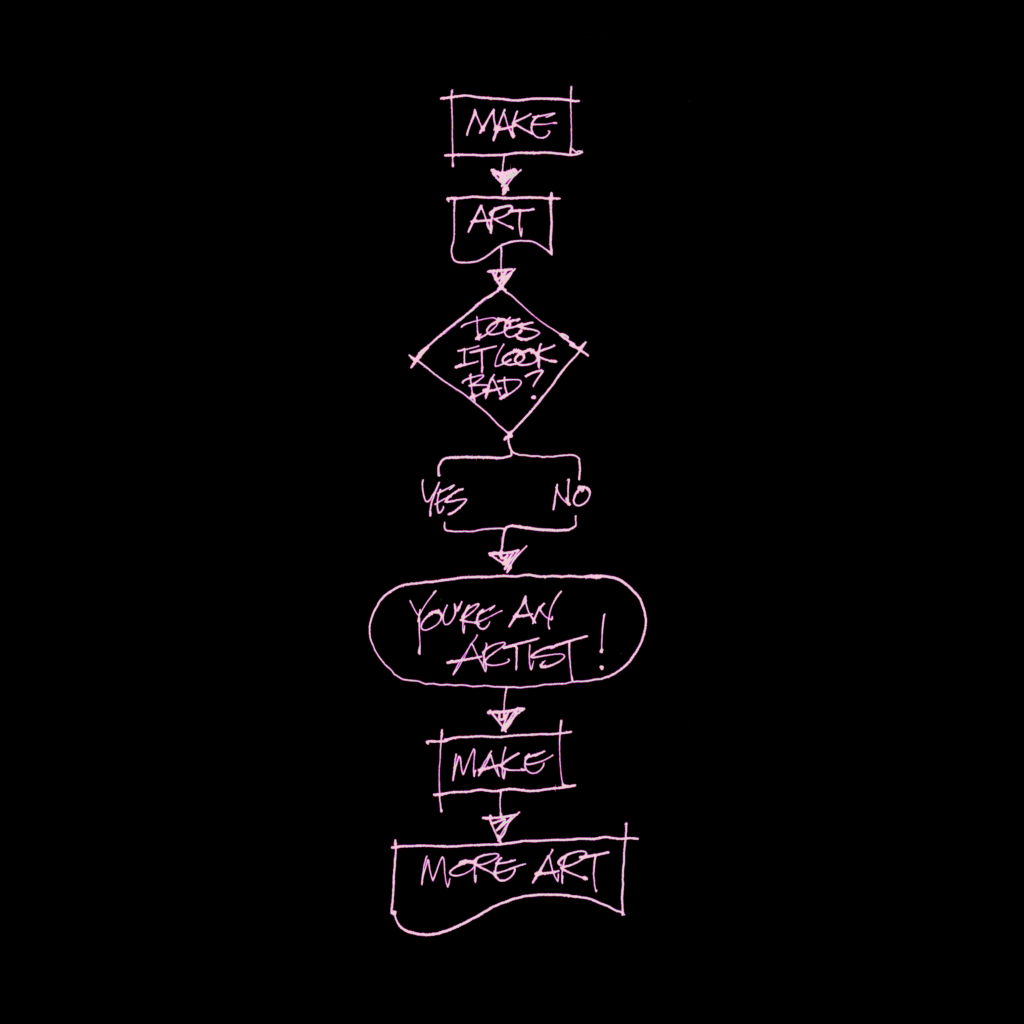
PPS—I doubt Confucius was into flow charts, but I think he’d dig this, courtesy of Miep, who shared a flowchart which I loved. I tweaked my version to utilize the shapes that are used at my government job.
Baron in the Trees, only took me forever to read this.
Like many foreign films, the novel is fun and quirky until but the real world intrudes.
Indeed, this impending sense of doom is why it took me months to finish.
But it was edifying. A brilliant display of sparse deep storytelling.
Jerusalem Windows, a killer $2 find at the library.
As with many mid-century monographs, it comes with a hagiography of the great artist. I kind of enjoy it, in a nostalgic way.
The colors are stunning, and it’s awesome to watch the process from sketches to finished window and detail.
But the allegory in the images are hard to grok, even for a kid who grew up as a hardcore Christian. I need to reread this book. Slower.
Genie’s Banquet, a filler with the kids.
A fine example of a sharp little Japanese card game, common in the 2010’s.
As a cooperative game, this it’s a perfect fit at this moment.
There are some translation glitches in the rules, but the joy of boardgaming is that you can make up the rules when you’re unsure. We made it work.
Dorfromantik, for my wife’s fake birthday, but really for the boy.
Charming and idyllic is exactly correct in describing this game. Normally I want a game to have an edge, but it’s the lack such an edge that makes this game. The SDJ is well earned.
This board game successfully imports the ubiquitous constant-unlock dynamic of the mobile gaming. However, I appreciate that this is non-destructive process (unlike the Legacy series). Most importantly, thank god, there’s no pay to win model with this thing.
I wonder if I should toughen the boy up by playing competitive games (winning, losing, manhood, and all that). In the meantime I’ll enjoy these team games with him. Who knows when he will phase out—they change so fast!
,
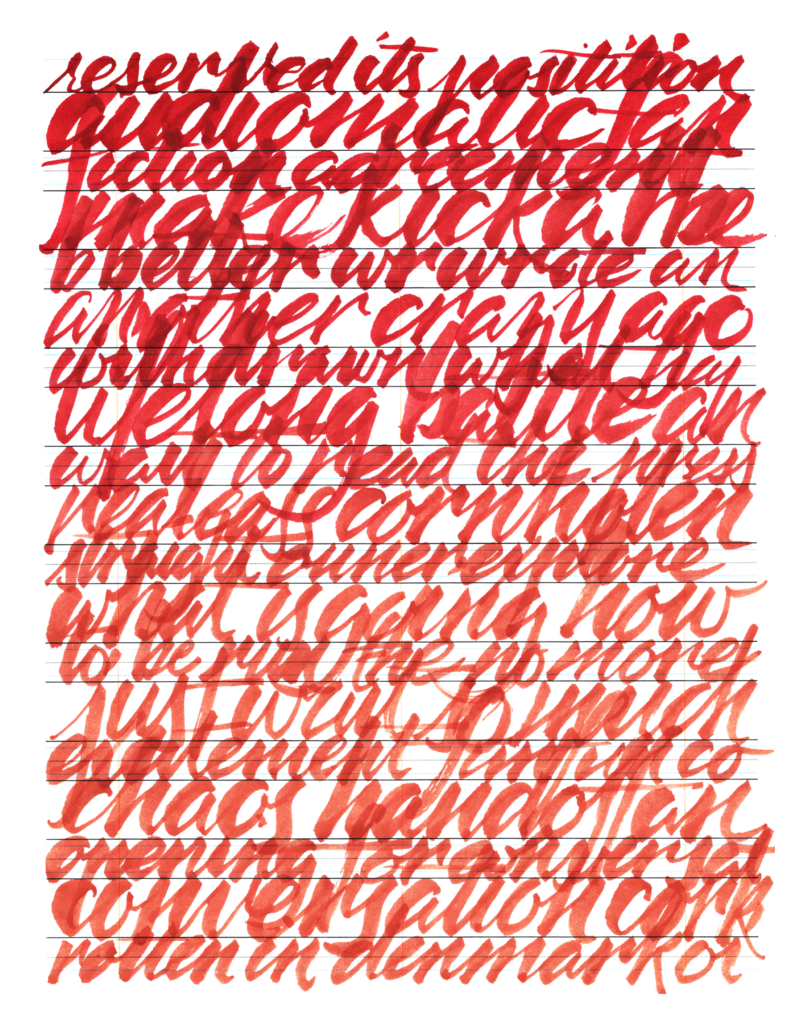
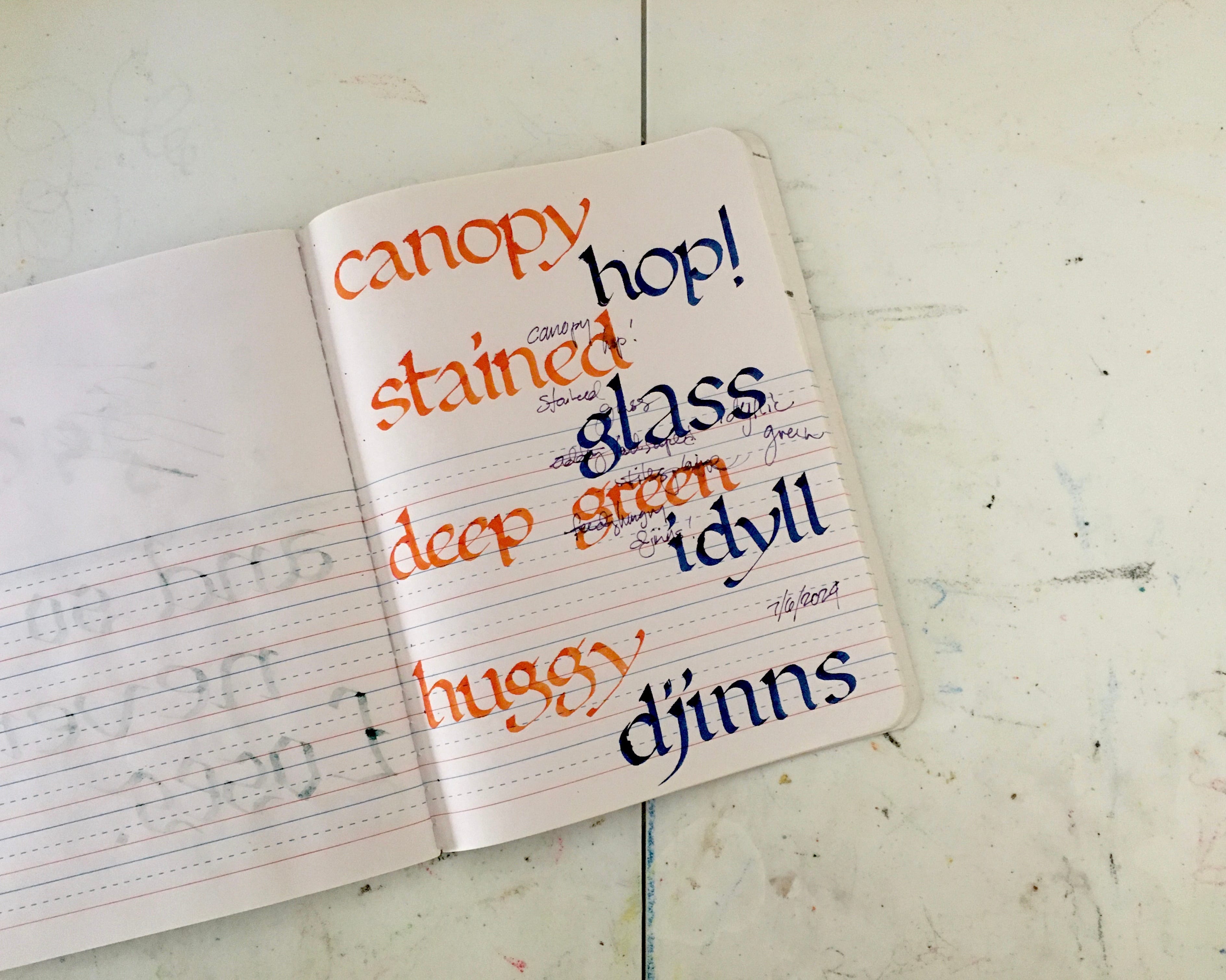
Having finished my calligraphy notebook last week, I started on our girl’s composition book from first grade. Might as well use up all the paper we got. It’s fun to add my practice with her old studies, and this means I’ll finish another notebook sooner rather than later!
(and yes…that should have been “hungry”, but sometimes you just roll with it.)