GRIZZLY PEAR

written snapshots

Category: Games

  • Innovation, Carl Chudyk, 2010

    I consider Carl Chudyk a minor diety in gaming. Of all his games, the one I have come to love the most is Innovation.

    I had a rotten introduction to the game, a 2v2 team game where it just seemed utterly uncontrolled random and chaotic.

    Which as any Chudyk enthusiast would recognize is pretty standard impression by the uninitiated.

    The second time wasn’t much better, a 5 player game with one of the expansions. Even now I couldn’t recommend such an experience.

    So I just ignored the game for a few years until I listened to an in-depth podcast extolling its virtues. I also had come to know too many respected gamers who spoke highly of the game. And by then, I had also finally come around to enjoying his other classic, Glory to Rome.

    So I bought myself a copy and the third time was indeed the charm.

    Chudyk excels at creating games with tight tactical play masked in a sea of seeming chaos. His games can require high skill to consistently play well, but the outrageousness of his card combos result the appearance of blind randomness.

    There are a lot of moving part to keep track of. It is cards, but it isn’t random. Chudyk gives you a lot of levers to dance with the crazy. All this takes a moment to grok.

    And when you do, it becomes beautiful.

    Once you know the landscape, moments of brilliant tactical play reveal themselves. Surprise and delight await you around the corner.

    Or sometimes you draw badly, and frustration gurgles in your chest as the draw hinder your progress.

    But experienced Chudyk fans would note, somehow it is the n00bs who always end up in an extended run of useless cards.

    There’s an awful lot of game here. You just need to learn to go with the flow. Of course, you will plan ahead. But the beauty of the game is found when you’re forced to change your plans. The fun starts when your well laid plan falls apart one turn later.

    It is not easy to thrive in this chaos. But if you enjoy such a challenge, Innovation gives you both in spades.
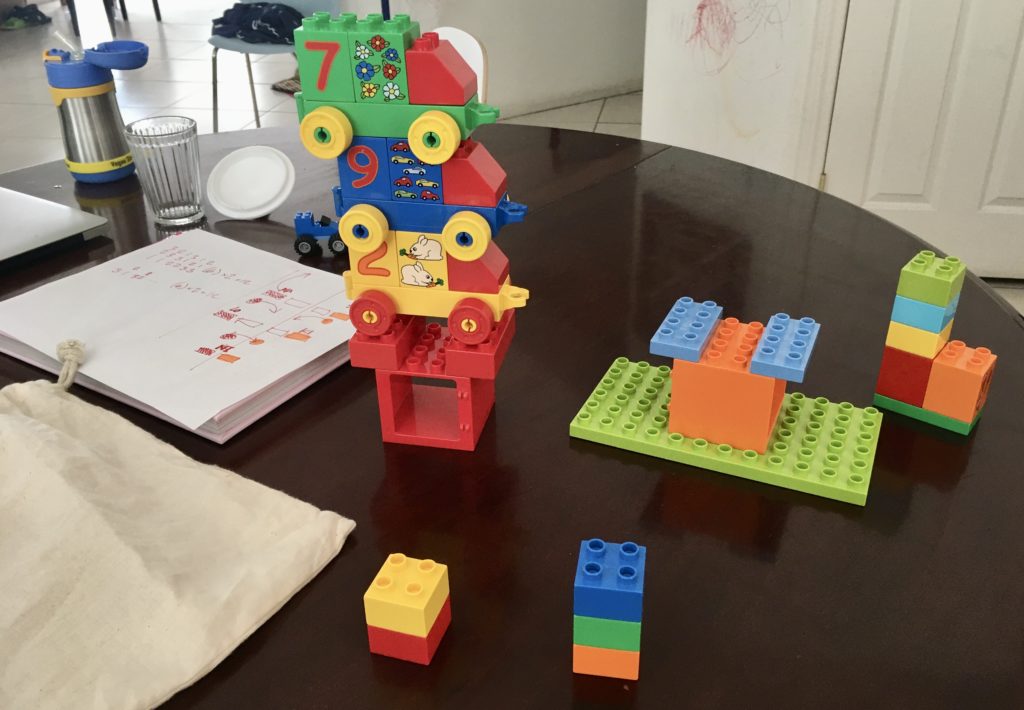
  • MaNiKi (Crazy Car variant), Dominique Ehrhard, 2002

    This morning I slammed together a DIY set of MaNiKi (also called Jungle Smart and Crazy Circus) using Duplo Blocks.

    I made three different colored cars (green, blue, and yellow) and put them on red and orange Duplo Houses. I wrote up a cheat sheet using the MaNiKi commands.

    So the only thing that didn’t match the published game was determining the goal for the round. Instead of having the 24 cards as in the published game, I took 5 pieces and put them in a bag, green, blue, yellow for each car with red and orange for each of the houses.

    To set the goal, I draw one piece at a time. All of the car color tiles are stacked in order and then placed on the first house tile that came up. After the second house tile comes up, any further car tiles (if any) are placed on that second house.

    This system worked well enough, though the cards in the published game make for better gameplay, since the goal is immediately revealed and the game can proceed without the drawing process.

    That said, this makeshift set worked quite well in teaching my five year old the game. She’s not ready to play competitively since she can’t work out the order of operations in her head, but she caught on surprisingly fast.

    It’s definitely a sharp little game, one worth trying, and possibly buying as well!

    One last note. In the photo, you will see a little tower to the right. I used that tower to keep track of the starting setup for a round. If there were any mistakes we could easily go back to the beginning to work out the correct answer. It’s not necessary for the rules as written, but a nice accessory for beginner games.

  • Kingdomino, Bruno Cathala, 2016

    With the two little ones, I haven’t been gaming much. In this time away, I’ve allowed theories kind of harden into preferences, and one of my favorite things to hate is multi-player solitaire.

    So let’s say you make a game of four people building their own little board with zero interaction outside of drafting tiles.

    Yeah f’ that…and the committee who gave this game THE award.

    But Kingdomino is an SDJ and it was being sold at half off at Target.

    So I picked it up.

    And damn, it’s a nifty little game.

    I still doubt I would enjoy its more complicated sibling Queendomino, but the committee still knows what it’s doing.

  • Visit from the sister (games!)

    My sister and brother-in-law visited Vegas this week so it gave me a chance to play some games between chasing the kids around.

    Innovation (twice)
    Circus Flohcati
    Aton
    No Thanks (twice)
    Times Square

    When you have a limited time budget, it’s interesting what came out to be played.

    I’ve always acclaimed Carl Chudyk, the designer of Innovation, as a “minor deity”. And this assessment hasn’t changed. His ability to have a completely chaotic game result in a memorable gameplay experience, is really something to behold.

    As for the other games, Aton and Times Square are both excellent, albeit slightly 2 player fussy games.  Aron is a gridded area control game and Times Square is a linear tug of war, but both games have multiple levers to push and pull constrained by the card draw making for great 2 player experiences.

    It was also a lot of fun to introduce No Thanks and Circus Flohcati to my sister and brother in law. Just fun light fillers, easy to teach but with meaningful decisions.  Both well designed games, also by Thorsten Gimmler and Reiner Knizia respectively. My daughter even joined in for No Thanks and enjoyed it well enough.

    Interestingly, all of them were card games, as were almost all the other games I would have thought to pull out. Amongst the board-dice-cards categorizations, I definitely lean towards cards.

    But honestly, my daughter had the most fun of all when we played hide and seek in the house.

  • Weiqi (Go)

    No that I taught my girl Xiangqi (Chinese Chess) I’m getting greedy and I want to teach her Weiqi (Go).

    I guess I need to be careful that I’m not transmorgifying my general acquisitiveness for games into forcing her to play different new games all the time.

    That said, I think she did enjoy playing Xiangqi. She didn’t really enjoy the initial teaching part, but she did like moving pieces around and eating my pieces that I offered up to her by purposely bad plays.

    Even though I’m naturally quite bad at Xiangqi, at least I’ve played it quite a bit and know how it works. But Weiqi is not a game I’ve played much, so I guess I need to play a bit online and then once I’ve at least gotten the rules worked out, then I’ll drag out a chess board (9×9 vertexes) and we’ll see where it goes.

  • Xiangqi

    A few weeks ago, we went up to Mount Charleston. On the way there we picked up some sandwiches at Dakao while my wife and daughter got veggies at the little grocery store next door. When I mentioned that there were some guys playing Chinese Chess at the sandwich shop, our daughter really wanted to watch but we were already on the road. So I promised I’d teach her the game instead.

    The next day I picked up the set at my parents house and we sat down to play. She played in her usual silly, amusing way. I’m not even so sure she played as much as moved the pieces according to my advice. But even so, I think we had fun messing around.

    My philosophy is that games are for playing, not winning, so I’m OK with that.

    When she was born five years ago, I had two games I wanted to teach her – Xiangqi and Mahjongg. I’ve played MJ with her a couple times, and now I’ve introduced her to Xiangqi. Who knows if she’ll really get into either game, indeed I would prefer that she doesn’t become super serious about either game.

    But at least this pair of games have now been given flight. Now I’m the one along for the ride.

  • Kahuna, Günter Cornett, 1998

    We bought the game Kahuna on a sale the other day.  I had not researched it thoroughly but the price was right and I had heard good things about it.  Even if the game itself is a little to complex for my daughter’s age, I knew the rules were very simple so we started playing it anyways.

    A few plays in, a chain reaction revealed itself on the board.  At that moment, I was reminded why I love boardgames, especially the old german style games that was popular in the late 1990’s and early 2000’s.

    For me it’s not about winning, even though the fact it is a competition does sharpen the mind.  The true joy in boardgaming is found in these moments where the game mechanics come together to create an emergent moment you couldn’t easily envision after a straight reading of the simple rules.

  • On Boardgaming

    I was asked on a photography forum to say a little more about the boardgaming hobby. Here was my response:

    How do I start? Well, one could go to the website boardgamegeek.com, but that place is UI disaster until you get used it (totally designed by engineers!)

    The best way to describe modern boardgaming is that it is an outgrowth of a lot of European (especially German) boardgame design from the 90’s and 00’s. Key features include a limited time length, no player elimination, and controlled interaction. In a word, anti-Monopoly (especially Monopoly as with its common house rules).

    The top standard of German family boardgaming is a prize called the Spiel Des Jahres (SDJ) and which judges games at a medium light weight level of complexity. Unfortunately the crowd in hobby sites (like Boardgamegeek) tends to favor niche stuff so their database rankings favor heavy complicated stuff (similar to how photographers lust over L glass even though most other humans would be more interested in the latest bedazzled iphone 6s case).

    Even though I consider myself a “serious” boardgamer, I personally don’t enjoy complicated fare. I grok the joy of a good brain burning puzzle, but I prefer the elegance of a pared down game where the interaction is the emergent outgrowth of an carefully curated set of simple rules.

    Modern classics for people looking to get into the hobby would be Settlers of Catan (the big hit kickstarted this whole eurogame trend), Carcassonne, and Ticket to Ride (which got me back into the boardgaming hobby after a decade long hiatus). I would also want to point out Pandemic and Hanabi which are both excellent cooperative games (where everyone plays together as a team to beat the game system).

  • My old and new boardgamegeek profiles, 2015

    Here is my new profile on boardgamegeek.com

    I’m an architect in Las Vegas, with my wife and daughter.

    I like asymmetry and systematic variety.  A saber and a box of chocolates.

    This is the old one, a big sprawling mess and in serious need of editing.

    I’m an architect now living in Las Vegas. I used to think I was into intense games, but I’m starting to make peace with the fact that I’m more of a fluffy gamer. I like games that become relatively mindless with practice (such as Tien Len or Mah Jong). I enjoy heavier games, but they aren’t “relaxing” in the same way (duh?). I can put up with a lot of luck in my games, most likely why I don’t mind Risk or Monopoly (played per original rules).

    For what its worth, I just switched my rating system to the BGG standard. I don’t like the 10 point granularity, but I’ll live with it and I’m tired of trying to keep track my own stupid system. The only difference is for expansions, which are judged in how well they enhance the base game — which means I am kind of liberal with 10’s, even if I might not like playing the game or expansion all that much.

    It has been was kinda rough over the years…there are games that I’m supposed to enjoy that have dropped down lower and lower. On that note, my Top 10 list takes “nostalgia” into account – I’ll acknowledge the fact I don’t think it’s a great game in my ratings. However making me feel warm and fuzzy inside is part of the top 10 calculus.

    I have typically enjoyed elegant, streamlined, lighter games, but lately found myself interested in heavier games. I don’t mind a bit of randomness and chaos in my games, but I find myself liking it less and less. What I really love is controlled chaos, instead of pure strategy, I like directed improvisation. I think that is why I have enjoyed Troyes more than Caylus (I learned both games this year). A better example may be my love of climbing games such as Tichu and Tien Len. There are definitely times when you get dealt a crap hand and there’s nothing you can do about it, but in most games there is something you can do, even with a weak hand…or something you can screw up, even with a really strong hand. One thing I absolutely really dislike is having to plan too far into the future, chess being a prime example. This also includes most worker placement games such as Dungeon Lords, Glenn Drover’s Empires: The Age of Discovery, and Dominant Species all of which utilize the “place a bunch of workers first, then resolve everything at once” mechanism. Caylus gets a pass because of its elegance.

    Things I dislike in games: lots of moving parts, memory, and simultaneous action selection where there are dire consequences for guessing wrong (ala Witches Brew or Dungeon Lords). I suspect that I like auction games way more than I ought and dislike worker placement games more than necessary. I appreciate games with a strong spatial quality…maybe something coming from my architecture background – and I certainly love sleek “elegant” game mechanics and interesting graphic design.

    10 – I love it love it love it!!
    9 – I love it love it!!
    8 – I love it!
    7 – I really like it!
    6 – I like it!
    5 – Meh.
    4 – I don’t like it!
    3 – I really don’t like it!
    2 – I really really don’t like it!
    1 – I HATE it!

  • A Toolkit for 2-Player Gaming

    After my daughter was born, I have not had many opportunities to attend gaming events, so my life is now centered on two player games. This made me rediscover some old games and look at them in a new light. It might not be the same experience with two, but they can be fine games in their own right.

    This past week I drafted a conceptual toolkit for retrofitting multiplayer games to play well for two players. Not all the examples are super successful, but they were all successful enough for someone to propose on a forum, if not publish in the rulebooks.

    The toolkit can be broadly divided into two categories, SETUP CHANGES and MECHANICAL REVISIONS.

    SETUP CHANGES

    One Less Chair: This most basic of this category, almost not worth mentioning, is to just deal one less hand, such as in Poker…or Glory to Rome, Dominion, Hanabi, etc.
    Setup Mechanical Twist: Sometimes a game uses the same components and plays the same as the original game but includes a slight mechanical twist in the setup, for example, Spades for two which adds a drafting mechanism. Another example (though not for two) is in three player Tien Len where the last card dealt is thrown face up on the table and the player with the lowest card may trade for it.
    More or Less: Some games pretty much use the same components but deal out a slightly different amount of goodies, such as money in Caylus or the amount of available goods in Puerto Rico. Pandemic:OTB reduces the quantity of event cards. Hanabi changes the quantity of hand cards between 4/5P games and 2/3P games.
    Reduce Components: Sometimes you take out specific items from the multiplayer games as in Agricola, or in Hansa where you remove some colors of goods altogether.
    Add Components: And sometimes you add something totally new, such as in China: Das Duell. The original Mamma Mia! plays fine for two, but I’ve found the game greatly improved by playing Mamma Mia Plus, where the the expanded card mix compensates for the reduction of players.
    Modify the Map: And sometimes you change the board. Ticket to Ride does this by disallowing parallel track lays. Ra reduces the Ra Slot, TransAmerica only deals out the cards with the border. Power Grid reduces regions. Only one of each violet building is available in Puerto Rico.

    MECHANICAL REVISIONS

    Dummy Player: Though much reviled in general, it seems to work fairly well in some games. Dirk in Alhambra with is a primary example. Its also been proposed with positive reactions for Trias. And its been way too long since I played Nefertiti to comment knowledgably, but the official 2P rules in the expansion include a Dummy player. This unofficial Niagara variant proposes adding a third paddle (along with reducing the gems in the setup).
    Play Two!: This is the other obvious drastic mechanical revision fro 2P games. There are some strong proponents of playing Puerto Rico with two boards and its even been tried in Chudyk’s new game Impulse. The official Hare and Tortoise variant also does this (in my opinion it is brilliant, but it is not liked on BGG). This was also proposed for Trias, as well as High Society with a slight twist when a bad card comes up. I guess you could say this is also the way you would modify the number of players in Scotland Yard, though its core essence is a two player game that was designed to accommodate multiple players.
    Remove Mechanisms: Sometimes a mechanism is just unnecessary, Caylus dumps the turn order Mechanism.
    Add Mechanisms: I don’t think its particularly successful in Bohnanza, Uwe essentially added a new phase in the game to simulate trading. Also not particularly successful is the variant of Acquire where you draw a tile during a merger to simulate a dummy banker (this differs the main “Dummy Player” tool because it is random and is an instant non-permanent effect). I haven’t played it myself, but a promising Dixit Variant has the storyteller selecting a card, drawing five more off the top of the deck and adding three to the tableau along with throwing in a random card. And I’ve heard two player Niagara is playable by merely adding the Beaver Mechanism that comes with the Spirits of the Niagara expansion.
    Tweak Existing Mechanism: Fairy Tale has a billion variants proposed because the base two player game is unsatisfying. Most of them tweak the number of cards drawn and almost all of them involve discarding a card during each phase of the draft before giving the hand to your opponent. The most recently proposed Fairy Tale Variant involves drawing cards off the top of the deck each round. This unofficial variant for Basari (along with modifying the length of each round) does this by conflating the Jewels and Points actions to force more bartering.
    Action Quantities: The official rules for Trias reduces the number of actions a player may take from four to three. And Puerto Rico gives each player multiple actions before the round ends (and the official variant is structured to create a particularly significant change by removing the craftsman angst).
    Modify the Game Length: This was a simple variant proposed for Fairy Tale. And is also the source behind some of different variants for Puerto Rico, since the quantity of Colonists and VP’s affect the length and thus balance of the game. Love Letter changes the number of hearts you needs to capture before victory. And Troyes does this very neatly with their event card reveals.
    Change the nature of the game: Dixit isn’t really that competitive so someone decided to make it fully cooperative.

    I’m not particularly versed in boardgame theory so I’m certain there is a lot rough edges and maybe even a complete conceptual realignment in order before everything is said and done.

    If I’m going to be playing primarily two player for the next few years, this might be fun to explore. I know there is a good two player game in the Bohnanza deck, just waiting to be designed.