GRIZZLY PEAR

written snapshots

Category: Games

  • Why everyone should try their hand at game design.

    A few months ago when I was on an indie RPG kick, I came across the lovely forum story-games. Its a great place. One of the first posts I did there was part of a “5-minute” RPG challenge. Just come up with a new game…Quick!

    The game I came up with is not worth mentioning (few 5-minute ideas are) but I wrote a couple posts that rehashes things I talk about regularly in real life but I don’t mention much online. Because of the length of the posts I am breaking them into two blog posts. This first one deals with the importance of playing with game design but though a very meandering path beginning with ruminations on my profession. The next post deals with why I so greatly value design development.

    Late in the discussion TomasHVM, the initiator of the 5 minute challenge wrote:

    I have the impression that a lot of those posting a game in the challenge, “published” their first game in that thread. And that too, to me, is significant. Putting a game out there is something very special to do. Having finished and published a game, however small, brings you to a new level of thought as a game-smith.

    From this I take that a bunch of game-smiths have taken a small, but significant, step further by meeting the challenge. And that makes the challenge a small part of the greater movement of developing role-playing games for the future. To make role-playing games grow as a form, we need to have a good supply of new blood. Challenges and competitions are ways of inviting new blood into the ranks. Having more game-smiths actually turning out games for people to see, is great for the culture. It infuses it with new thoughts and greater confidence, and helps raise the intellectual level of discussion. Being peers with hands-on experience in design, is a good fundament for constructive dialogue.

    Here was my initial post to the discussion:

    Like all architects, I have an tortured relationship with my own profession . On the one hand, I have a very strong professional pride, with specialized skills and knowledge which I utilize to proudly earn a living. On the other hand, there are enough atrocities in the built environment, usually by architects, that I question the value of our profession when it comes to pure design. If you boil things down, the government recognizes us as a special profession because they think it is important that buildings are designed in a way to give its inhabitants an opportunity to safely escape the structure in the event of a fire. Officially, aesthetics isn’t a factor.

    But still, I want to think that all my years in school and aesthetic training means something more than expeditious fire escapes! In my travels I have been to some awesome spaces designed by justly famous architects…but I have also been to some awful spaces designed by equally famous architects. My current office is in a skyscraper by I. M. Pei with cramped lobby and an insipid urban plaza! When I think about the built environment, the places that evoke my fondest memories are organic vernacular growths – the market street near grandma’s apartment in Hangzhou, a quiet residential street in Berkeley, the surging density of Manhattan, a nondescript cafe in Paris.

    What’s missing in architecture school – and thus in much of our professionally designed environments – is a healthy respect of the fabric of our environments. The occasional iconic structure is important for our civic pride, but a city of icons is nothing but a jumbled mess – a jumbled mess that suppresses the expression of a vital social life.

    However, other arts are not concerned with the vernacular fabric that surrounds it. We go to an art museum to experience great iconic paintings, not to ponder the torrents of mediocre visual productions that fill our dentists’ office. You don’t need to worry about audience participation, you don’t want the fat drunks in the stands to actually affect the results on the basketball court. It means nothing to the great artist when the random plebe dabbles in their art, Kobe doesn’t give a shit if you shoot hoops in the driveway after a long day at the office. In some ways, games fit in this type of individual art. There are great iconic games with great designers, and it doesn’t really affect their lives nor change their art if their audience occasionally dabbles in game design.

    Then again, story games are not a passive art. This is a social activity, you don’t sit there and just watch pixels dancing on the monitor, you have to get in and participate to make it worth everyone else’s while. A great movie is still awesome in a half empty theater, but with these games, if the audience is flat the end product will be weak – no matter matter how awesome, how elegant, how conceptually beautiful the game design. Understanding rules and mechanics is merely scratching the surface, and the beauty of these games is found in the moment of emergent wonder when everything snaps together to create a memorable experience. For that to best happen, you need an active, educated and involved community of people who invest themselves into the art.

    I presume that the most important way to become a good game player is to practice gaming, but I also believe that it is a useful exercise for everyone to dabble in game design. Instead of working with material that is handed to you, one should occasionally confront a blank page and be forced to come up with something, anything! You learn through designing; things you can’t notice by just playing games. The act of design is a powerful exercise, and even if someone decides that game designing is not to their liking, at least they will walk away with some insight into what it takes to create a game.

    I think the difference between some of the earlier, downer comments and Tomas’s enthusiasm boils down to this. Yes, ideas are cheap, and if one was to look carefully at the actual 5-minute games I’d suspect most of them are pure crap. It takes a lot of work to turn an idea into a decent game and even more to turn it into a product worth publishing. But to completely dismiss the exercise is overstating the case. Very few people have the dedication to go through the effort to become an accomplished game designer – this comes with real personal cost. However there are valuable lessons to be learned in designing a game, even in just a few minutes.

    This paradox is the essence of the exercise, let’s make the act of designing a game as non-intimidating as possible in order to encourage people to play with the process of designing game. Of course one will earn more valuable lessons with sustained effort, but you gotta start somewhere, and the 5 minute game design was about exactly that.

    Also posted on Boardgamegeek.com
  • Hare and Tortoise (2 player), David Parlett, 1973

    For context, I’ve only played this game twice on my homebrew set, and only with my girlfriend. I rarely write reviews unless it has been bouncing in my head for a few days, so I think there is something here.

    This game won the first Spiel des Jahres, way back when there weren’t any other SDJ winners. However most folks don’t recommend this game for 2 players, even though the box says 2-6. Even David Parlett thinks his game is best with 4-5. Here is the two player variant on Parlett’s website.

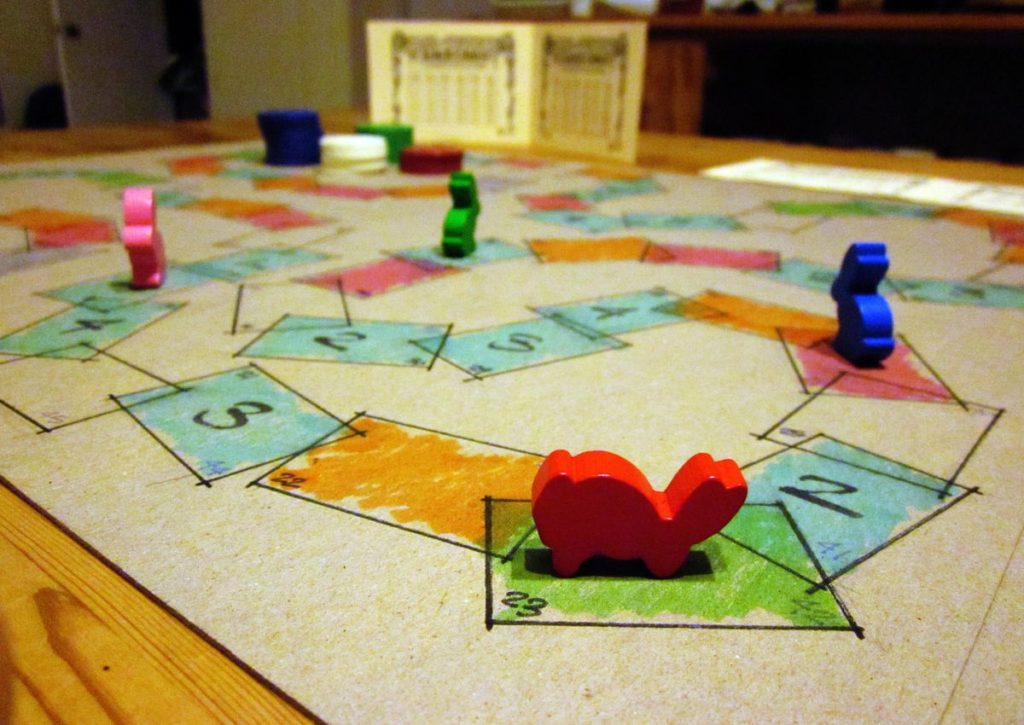
    You each start with 95 carrots and 5 lettuces, and move two runners round the board. The winner is the first to get both runners home.
    You each play in turn, and at each turn are free to move either one of your runners, but not both. When one of your runners lands on a lettuce square, however, you must use your next turn for chewing a lettuce and the turn after that for moving it away. When bringing your first runner home you may have any number of carrots and lettuces left over, but the usual rules apply to bringing your second runner home. That is, all five lettuces must have been chewed, and the number of carrots left over must not exceed 20 if it comes home second or 30 if third.

    I cringed when I read that variant. I hate two player variants that include dummy players or playing two “sides”. It’s inelegant and almost insulting – you’re too lame to get more buddies over so we’ll cobble together this variant for you! Spare me your pity and just print 3-6 on your box! Even worse, two player Hare and Tortoise is anti-thematic. The multiplayer race makes simple sense – get in as early as possible! … But goal of this two player game is to get your second guy in before the other guy gets his second guy in. So first place doesn’t matter?*

    *This brings up an idea. What if there was a series of races and you scored points for the position? Whoever had the most points after a set number of races wins. Maybe 5 points for first, 3 for second, 2 for third. Or to go with the race idea, whoever gets to set number of points (31?) wins.

    But once you get past all this, you’ll find a game that works very nicely with two players. Let me reframe 2P Hare and Tortoise as a highly tactical resource management, action selection game with a slight chance element. The board is made up of a limited number of action types, mirroring the limited number of action types available in typical action selection game. Each turn, a player choses an action, resolving any resources they may collect from their previous action, moving their piece, paying for the movement costs, and then resolving any actions that are activated upon to their arrival in the new space. During the race, fighting for race placement can have significant effects on your resource generation. There is no engine building, but this game is all about carefully timing the production and expenditures of resources. Instead of racing for the most victory points, you are racing to get your two pieces to the end as quickly and efficiently as possible.

    I think that the game’s two player reputation has been hurt by earlier versions of the Hare event cards (unfortunately including the current the Rio Grande release). However, the latest incarnation of the event cards (published in 2008, 2010) has eliminated random movement of pieces – you won’t land on hare space and then get thrown away somewhere else. For a multiplayer game, this type of randomness can be overlooked since you only have one bunny and it’s a more “social” game, but the two player game is all all about manipulating your two bunnies to be in the right spots to cash in on their race order positions. Furthermore, a two player game is directly confrontational and you must be able to get in there and mess with the opponent’s plans. If you cannot predict where your piece will be after it lands on a space, then you can’t plan ahead and there goes the game.

    For those with the older version of the game I would suggest using the Parlett Strategic variant where landing on a Hare space results in losing a turn. This is a high price to pay, but it may be worth it to mess up the race order and force the other guy to adjust his plans. Please note that this variant turns the game into a perfect information abstract. As such, I prefer the new cards since I like little lighter games and I appreciate how the hare cards have a slight catch the leader mechanism baked in.

    After a couple plays, I can confidently say this game is a great two player game that fits perfectly in that SDJ sweet spot. Sometimes the committee goes heavier and sometimes much lighter, but Hare and Tortoise was well deserving of the honor of being the first SDJ winner and holds its own even after thirty years of game design innovation. For those who have played this game with many players, I hope to join your ranks soon.

    Until then, I contend this is a perfectly fine two player game. It is a tight tactical game: it forces you to make tough decisions, gives you room for dramatic moves, but is balanced enough to keep the game close. It doesn’t outlast its welcome, just the right length for its medium low weight while still rewarding skilled play. I might not know how well two player Hare and Tortoise stacks up against its multiplayer version, but I’ve played plenty of two player games and this is a great one.

    Update
    I have now played a few multiplayer games and find it quite good. I’ve also developed my own variant for the hare cards, using a six sided die instead of cards.

    1. Give 10 carrots to each player lying behind you in the race (if any) If you haven’t enough carrots, give them five each; if still not possible, one each. A player who doesn’t want extra carrots may throw them to the carrot patch.
    2. If there are more players behind you than in front of you, miss a turn. If not, play again. (If equal, play again)
    3. Restore your carrot holding to exactly 65. If you have more than 65, pay extras to the carrot patch; if fewer, draw extras from the carrot patch.
    4. Draw 10 carrots for each lettuce you still hold. If you have none left, miss a turn.
    5. Free ride! Your last turn costs nothing. Retrieve the carrots you paid to reach this square.
    6. Lose half your carrots! If an odd number, keep the odd one.

    Originally posted on Boardgamegeek.com

  • Hanabi, Antoine Bauza, 2010

    Believe it or not the player count of two through five is actually true!

    I pulled it out at my weekly gameday after letting it sit dormant it in my bag for the past three months. My game group is into heavier games, so I had not opened up the game because the rules are so darn simple.

    Last night, I wasn’t interested in the open games so I started playing 2P with another player who also likes lighter games with a backup plan sliding into Jambo if it doesn’t work. Jambo didn’t have a chance! We played it a few times 2P. Then we dragged in another player for a couple rounds 3P. And then someone joined for a 4P game and then a 5th player to round out the night.

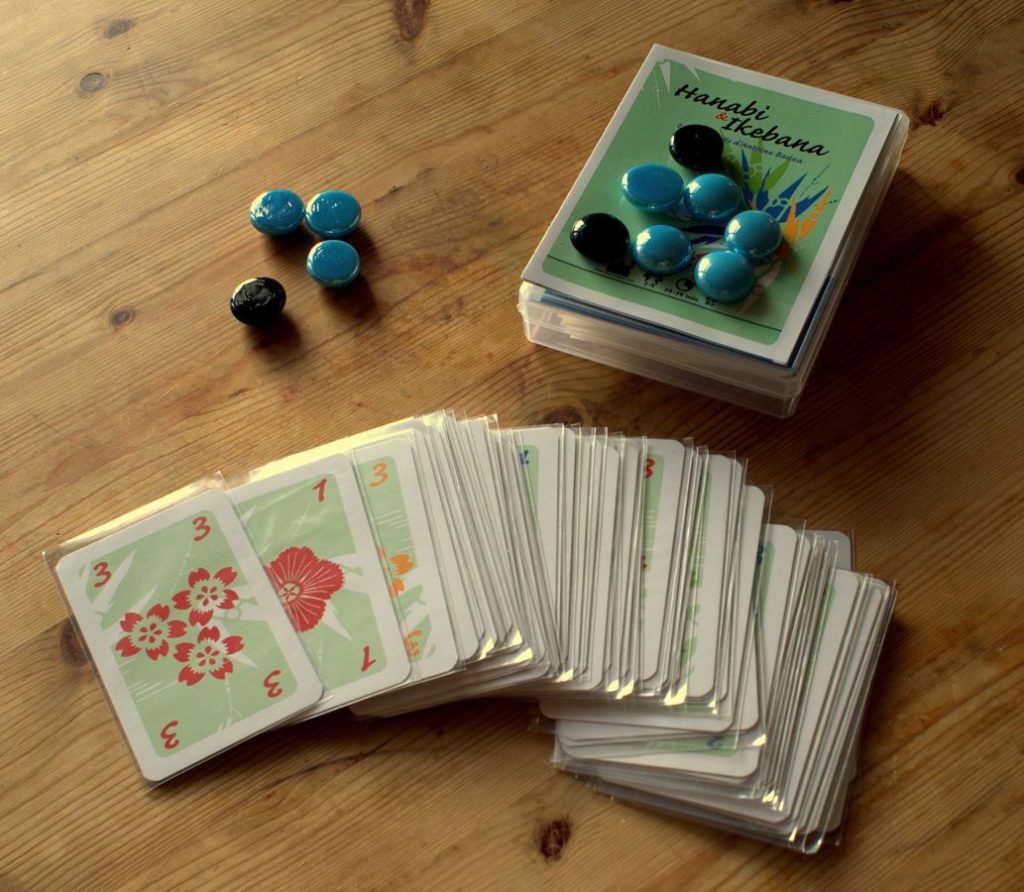
    A quick overview of the game: Hanabi is a cooperative card game with has a specialized deck of five suits: three 1s, two each of 2-3-4s, and one 5 of each suit. The goal of the game and team is to build five straight-flush piles in the center of the table (one for each suit, 1-2-3-4-5 with no duplicates nor jumps in the straights). You hold your hand of cards facing away from you and on your turn you can either tell one of your partners information about her hand, discard a card (to later have the right to give information), or play a card to the table (and hope it is playable cause you only get 3 mistakes before you lose!). The game ends when you either complete all 5 straights (absolute awesomeness), you make 3 mistakes (utter catastrophe), or the deck runs out at which point each player gets one last turn (inform, play, discard). If the game ends with the deck running out, you add up the top cards on the deck to see how well you did.

    We had an absolute blast. It is obviously not heavy and dense like Automobile or Caylus, but it is a great card game and a great coop game. It will definitely make you think! Easy simple ruleset, tight complex game.

    Because you only have one action a turn (discard, play, inform), turns fly by and because those clue tokens are so damn precious, things get pretty tight after the initial few turns. Even though I generally hate games with a memory element, Hanabi was designed just right and the memory aspect did not bother me at all!

    What surprised me is that the game tightens up quite differently with the varying player counts. One reason is because the game clock (the deck) remains the same length no matter the number of players. So if things re developing methodically like a 2P game – but you’re actually playing a 4P game – you’ll get totally blindsided with the deck being emptied out before you know what happened!

    It’s also more than game speed – player interaction actually changes with the number of players. For example, the clue tokens run out very quickly in a 5P game, so immediately actionable information and turn order becomes critical. However 2P game can leave you in stuck with a situation where there is nothing to tell the partner and they have nothing to tell you but you’re both too chicken to throw things away, or you get into cycle where you tell your partner something, she acts on it, which draws another card for you to inform and her to play….back and forth and all the sudden its your turn again, there are no beads on the box and you have no idea what’s in your hand either.

    I suspect the best way to enjoy this game is to do a straight explanation of the rules and then play a few games with the table developing your group’s own conventions as you go. I wonder if getting 15-19 pts (as we did) is fairly common, but to get past it you’re gonna have to take some risks or else you risk running out of the deck before you’re ready.

    Knizia in his heyday had a knack for developing complex games with a simple ruleset (Schotten Totten comes to mind) and this game falls in line with that heritage. Clearly 2010 was Bauza’s year, and while I have been lukewarm on 7 Wonders, if you like traditional-ish card games and you like co-op play, this is certainly worth trying out!

    originally posted on Boardgamegeek.com

  • Decktet

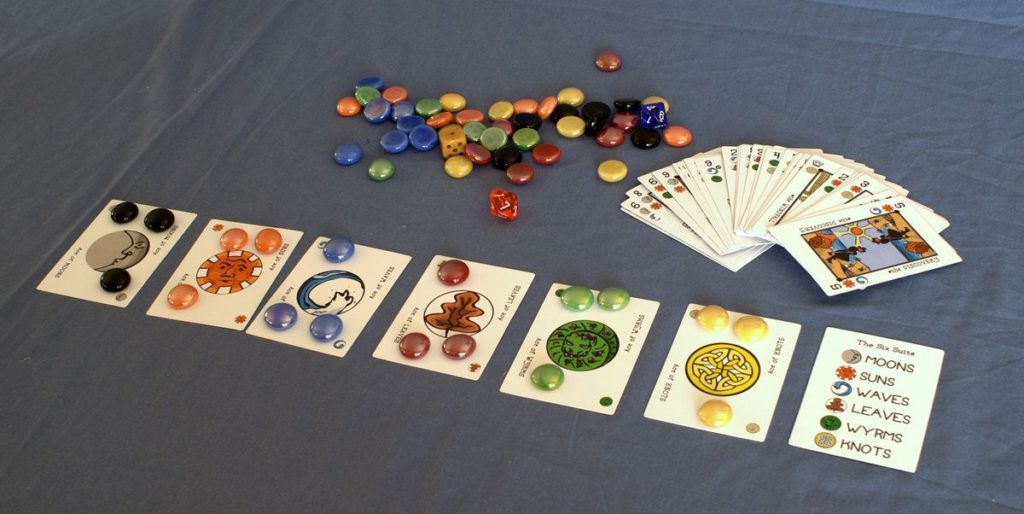
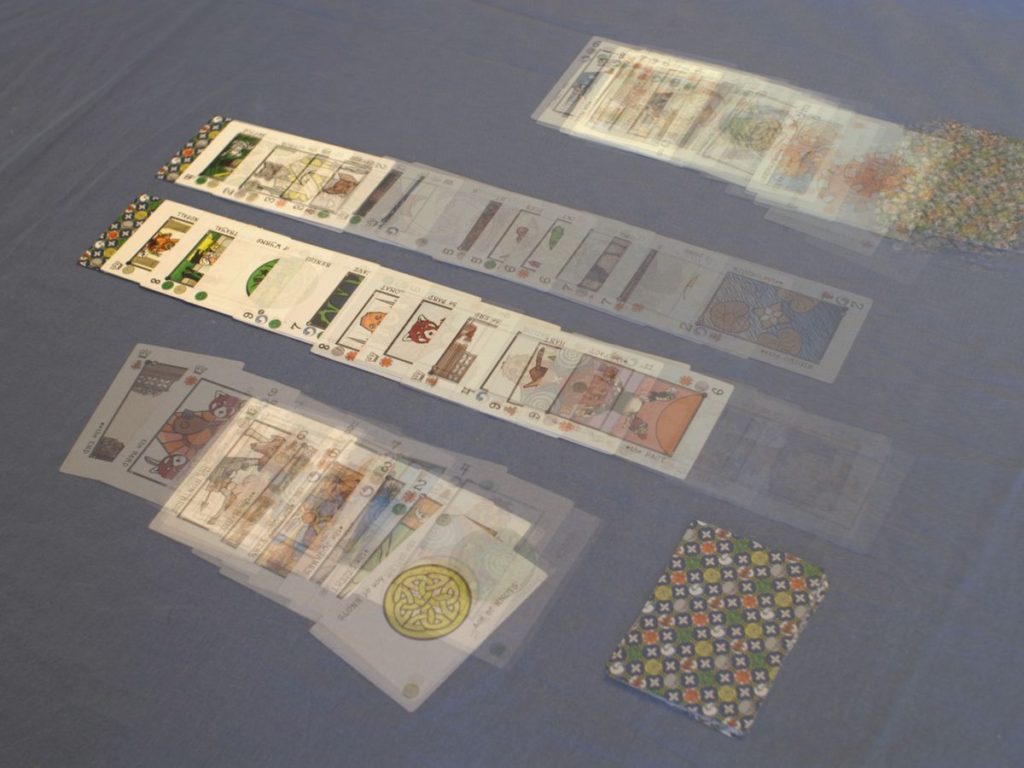
    I’m an unabashed fan of Print and Play versions of both published and unpublished games. Most of these handmade editions get played a couple times and are never touched again, so usually I’m better off spending the money, instead of wasting the time crafting the set. However, I am the happy owner of four commercially produced Decktets, a set of beads to match the suit colors and the book – conducted over four separate purchases.

    How did that happen? About a year ago, I stumbled across this curious little deck. The art was well done and the deck had an interesting backstory. I read a few game rules, put it on my wishlist, and then dropped the subject because it seemed pricey for just a pack of cards. Over the past year the Decktet kept popping up among the people I enjoy following. So when the game Magnate had a crescendo of recommendations, I finally dragged out my markers and drew up a deck to see what the hullabaloo is about.

    What took me from my DIY handdrawn deck to buying all that Decktet gear? To be honest, it wasn’t Magnate, I can see the greatness of the game but I didn’t fall in love it. Same with Jacynth or Quincunx, which are pleasant mind benders of the tableau variety that also play well solitaire. Nor the best solitaire game, Adaman, which fully utilizes all three card aspects (numbers, suits, and types).

    Even though there are good games for the Decktet, the reason I fell in love with the Decktet was because it is it is a fertile playground for designing new games. There are three major reasons that makes it work – it is different, open, and closed. A deck doesn’t need to be all three for it to be the basis of a some good games, but it needs to have all three aspects for it to work as game system that is a fertile basis for new designs.

    With any card game, the standard is the 52 card Poker deck with cards ranked 1-13 in four suits (one instance of each card). As Reiner Knizia has shown throughout his career, certain games could use a few extra ranks, maybe a couple more suits, and sometimes a duplicate rank here or there. But four suits times thirteen ranks has created a deck that has kept an awful lot of people entertained over the centuries. If you follow boardgamegeek.com, there are a couple other proposed non-single game specific decks out there – the Rage Deck (1-16, six suits) and the Rainbow Deck – but neither of them have been particularly intriguing because they don’t offer something fundamentally different from a poker deck. It doesn’t help that neither of them are nearly as well drawn, but more importantly, neither of them have the idiosyncratic double suited card system.

    Because the 2-9 ranks in the Decktet are systematically suited in a not particularly rational fashion, the deck has a strong personality. However this personality does not exclude visitors, instead it creates limits and boundaries, which allows other people’s creativity to flourish within its confines. The poker deck had created a very nice walled garden for people who wanted card games with systematic comprehensive decks – which is why it is the de facto standard. So if you’re gonna develop a new walled garden, it needs to be something more compelling than a couple extra ranks and few extra suits.

    Even though it seems counter-intuitive to combine limits with creativity, as an architect I’ve come to realize that problems are often the best tools in focusing one’s creativity. Boundaries cause problems which force you to tap your ingenuity. Without these limits, your creativity can freeze up and settle for mediocre solutions.

    A prime example of too much openness is the Looney Icehouse system. If you look at the Icehouse system there are very few “pure” icehouse games. My favorite pure icehouse game is Tic Tac Doh! which requires no additional components, and does not have a defined board. Aside from that great little game, most Icehouse games include external components or has a fairly complicated ruleset to imbue complexity into the game. The proliferation of external components for that game implies that the system does intrinsically have enough structure that designers need. My lukewarm response to the Icehouse system be mainly due to my strong preference for card games over perfect information abstracts, but the elegance of the Icehouse system and beauty of the physical pyramids becomes muddled by all the other stuff you need to keep handy.

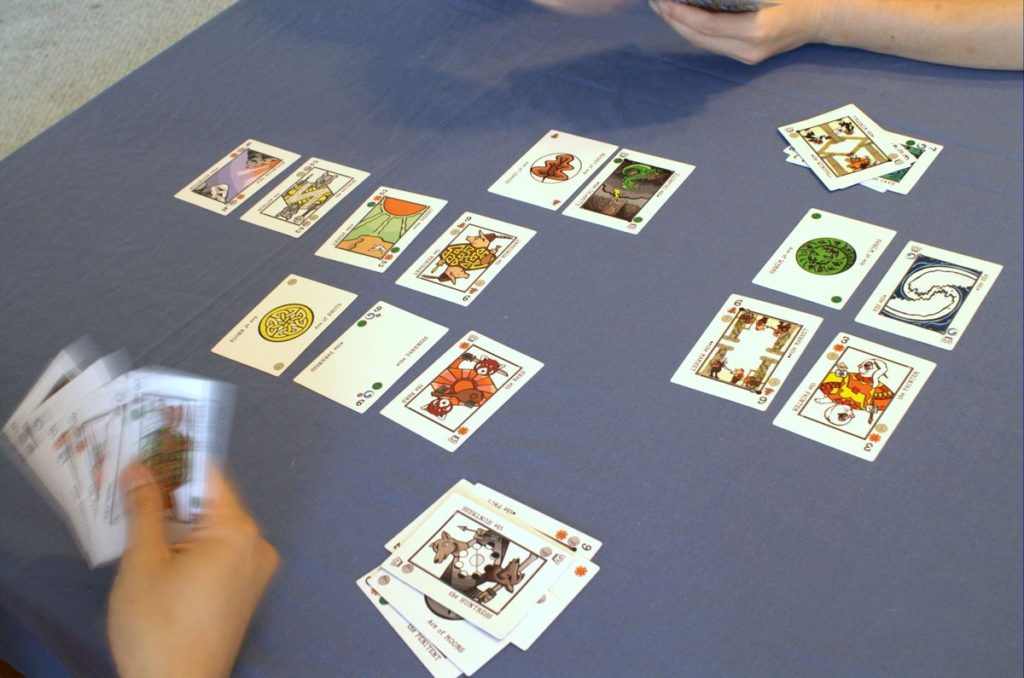
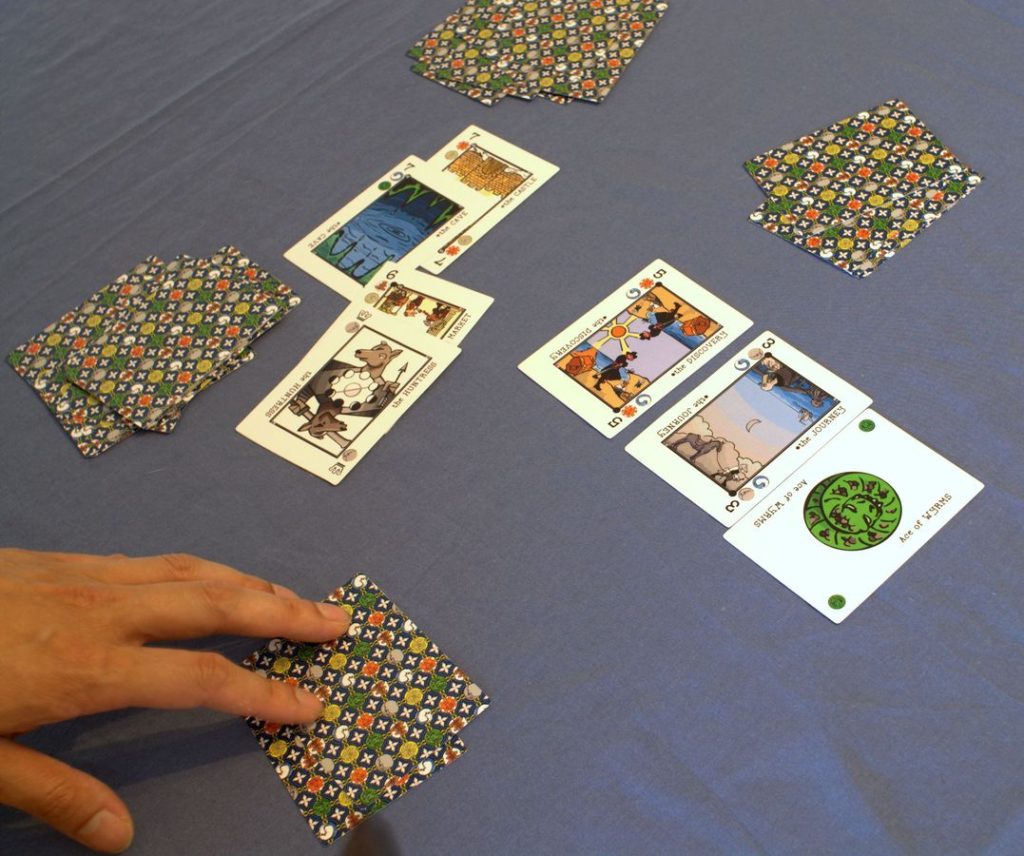
    Even though the ranks of the Decktet are simple – six aces and crowns with three instances for ranks two through nine – the asymmetric combinations of suit, ranks, and card types creates a enough variety in the landscape for designers to work without constantly incorporating external elements.

    However, a bounded world still needs to be large enough for exploration. Mahjong is basically a cardgame (though much richer experientially with the hard tiles). This funky three suited set with two special suits and four instances of each tile makes for a tight rummy game which deservedly has an intense following in America and in Asia. Even though there are noticeable differences between continents (if you’re familiar with one kind of Mahjong you owe it to yourself to see how nutty the other ways that people play it) all the versions are basically variations on the same rummy game. You just collect tiles into sets and score it when you fill up your hand with melds. Aside from the computer solitaire game, there hasn’t been a proliferation of alternative games that use a Mahjong set. It is just too damn perfect for this one game; it doesn’t suggest anything else. On the other hand, the Decktet is the home to some great games but it is not the perfect medium for any one type of game. It’s got some quirky boundaries and it still has some unexplored corners for people to find some games – it’s open for exploration, but not too open to be uninspiring, and it is certainly different from other decks on the market.

    It wasn’t until after a game of Quincux that it struck me why I really love this deck. Playing with the Decktet brought me back into the world of being a kid wasting a summer afternoon away. The internet has been great for people who love card games, but it also made the world smaller and a little less exciting. If there is a good card game to be figured out, odds are someone has done it – and the rules right there on pagat. I love pagat.com, but I noticed that it dampened my interest in coming up with variants to card games just because I can’t shake the nagging feeling someone has already figured it out better. But that’s certainly not the case with the Decktet. The Decktet’s funky structure reinserts just enough uncertainty to reopen the world of playing with designing games. There are already a lot of very good games in on the Decktet Wiki, but who knows, you might just come up with the next one.

  • Pepper. Corn!, 2011

    A feeding frenzy for two bunnies.

    Introduction

    This is a light fishing game of capturing cards off the tableau. After the tableau is cleared, the players add up the values of their captured cards to determine the winner.

    The game was inspired by my pet rabbit who is by far the most enthusiastic and fastest eating bunny I’ve seen. She has no problems yanking food right out of her partner’s mouth, but is readily aggrieved if she does not get her fair share of the produce.

    Setup

    Start with a standard deck and deal 24 cards face up to the table in 3 rows and 8 columns.

    To ensure a fair start, the starting hands are determined using a “split the pie” mechanism. Each player is dealt 6 cards which they will divide into two piles to offer the the opponent. The division of cards does not need to be equal in either points or in the number of cards. After deciding the split, the players simultaneously reveal the cards face up to analyze. After the players have decided which pile they will take from their opponent’s offerings, they simultaneously reveal their selection.

    Each player then combines the pile they have taken from their opponent and with the pile that the opponent did not take from their own offering. They then add up the ranks of the cards in their starting hands (aces are worth 1, crowns worth 10). The player with the fewest points will be the start player. If they are tied for fewest points, the player with the fewest cards will start. If they are still tied, then determine the start player randomly (start position is really not that important).

    Play

    Each turn a player will play one or more cards to capture a single card on the tableau. A capturing card must share a suit with the card being captured. If several cards are played to capture a card, the played cards do not need to share a suit with each other, but each capturing card must share a suit with the captured card. The rank of the card (or the sum of the ranks of multiple cards) being played must be equal or higher than the captured card. The captured card is then placed in the player’s hand and the capturing card(s) discarded into the player’s own discard piles for scoring at the end of the game.

    Aces are worth 1 point but they are wild cards to be used in capturing cards of any suit. However, when they are on the tableau they are still of their own suit and may only be captured by cards showing the suit of the Ace (or by another Ace).

    At the beginning of the game, each player will only have access to the cards on their side of the table – the eight closest cards of the eight columns of the tableau. As the players capture cards, they will be able to capture any cards they can access orthogonally starting from their side of the table. After enough cards have been captured, there will be an open path from one side of the table to the opponent’s side of the table. At that point the players will have the same access to the cards on the tableau.

    Turns alternate between players. If a player is unwilling or unable to capture a card they may chose to pass, however the game will only end when both players are unable or unwilling to make any further captures The remaining cards on the tableau are removed from the game.

    Winning

    The players then add up the ranks of the cards in their discard piles and in their hands. The player with the most points is the victor.

    If they are tied for points then the game is a draw. We’re looking for calories consumed, the number of bites it took is irrelevant.

    Variants

    There are different ways to arrange the tableau. I started with a 5×5 grid and also tried a 4×5 grid but I like getting to the point where each player has the same access to the tableau more quickly. A 2x grid was considered but it is too wide for most tales and it merged the playing field too quickly. And yes, the 3x grid was the most “corn looking” of the arrangements.

    A variant rule of determining access to cards is to assume that players may not go through the opponent’s side to get to a card. Thus when the path is cut through the tableau, it is not immediately opened up for both players – a player must still be able to chart a path originating from their side through the grid to a card to be captured. However, this approach limits the interaction (limited as it is) and dampens the urgency of the game.

    P.D. Magnus has proposed a variant which starts with the center row (of the 3X8 grid) face down. This would certainly help keep the game lighter and avoid analysis paralysis as the original ruleset is a perfect information game!

    The extended deck

    Unplaytested. One could add cards in and play with a 7X5 grid (5 cards to each player for the initial split). Then the Pawns and Courts could be used either as initial gaps (taken away immediately after setup).

    Unplaytested. Using a 8X4 grid (7 and 6 cards to the players for the initial split) you can keep them in the tableau but they are to be played as “converters” with other cards. They would have a value of 0 and would still need to be captured off the board. However, they convert all the cards of a given play into one of the suits on the pawn or court card. If you wanted it to be more complicated you could add the additional restriction that the cards being converted need to share a suit with the pawn or court card.

    Thanks

    A very serious thanks to my girlfriend who helped me in working out this game. From the beginning I wanted to design a game that included the “split the pie” mechanism (ala San Marcos and Biblios) and I wanted to simulate my rabbit’s frantic eating frenzy. However it took several very different iterations to the two to work together and I certainly would have never gotten there without her critique and pointed questions.

    And thanks to P.D. Magnus cause I think that makes him the first to try out one of my decktet games apart from my involvement!

    Links

    BGG database entry
    Initial announcement of Pepper. Corn! on BGG

  • Blulu, a Decktet Game, 2011

    An arithmetically paired fishing game with the Decktet.

    In the Eastern Deserts, the jackrabbits are regarded as a pest and a delicacy. Lesser known is that between eating (and being eaten) they while away their time with a simple fishing game.

    As a fishing game, the goal of the game is to capture cards. Each player will play two cards every turn, capturing cards using either the sum or difference of the played cards. The players that captures the most cards scores points for the round. The first player to reach twenty-two points wins the game and is granted the privilege to be the first bunny out for dinner.

    The game is a reinvention of the classic Moroccan fishing game Ronda. Aside from using the Decktet instead of the Latin Deck, the game is also played with two cards at a time and bonuses are given for suit combinations played.

    Setup

    Shuffle the basic deck and deal four cards to each player and four face up to the table. After the initial deal, no further cards will be dealt to the table, but there will be three additional deals during the round (emptying the deck). The same player will be the dealer during the entire round, and the dealer switches each round.

    Only the two player version has been playtested, so the two player game is the basis of these rules.

    Gameplay

    A player will play two cards on each turn.

    If the sum OR the difference between the played cards equal the rank of a card on the table, the player captures the card on the table along the pair just played. If there are several cards of that rank on the table, then all cards are captured, a player may not leave any on the table. A player is restricted to capturing only ONE rank per turn, even if a play could capture two ranks. (7 and 3 captures 4 OR Crown but not both).

    If the cards played are a pair (of the same rank) they will capture all the cards of the rank just played. (7 and 7 would capture a 7).

    If a player cannot make a capturing play, then he or she must place two cards on the table.

    When both players are out of cards (after two plays each) the dealer then deals out four more cards to each player. At the end of the game, the last player to capture cards takes the remaining cards on the table.

    Bonuses

    There are two possible bonuses during gameplay.

    Flush – each of the cards (played and captured) share a same suit. The capturing player scores 2 points. (eg 7 wave/wyrm 3 moon/wave = 4 wave / leaf).

    Sextet – the group of cards (played and captured) show one of each suit between them without duplication. A sextet must have exactly one instance of each suit. The capturing player scores 4 points. (eg 4 wave / leaf + 5 wyrm / knot = 9 moon / sun, or any triplet of the 2 through 9 rank cards)

    Some warrens will exchange captured cards to keep track of bonus points (ie if you score a flush, the opponent will place two of her captured cards in your capture pile), thus the bonus points are not “scored” until the end of a round. Some warrens do not exchange cards but keep a running tally, thus scoring bonus points immediately and ending the game as soon as a player reaches 22 points.

    Scoring the Round / Winning

    At the end of a round, each player will count their captured cards. The player with more than 18 cards (half the deck) will score a point for each card in excess (20 cards would score 2 points).

    As noted in the introduction, the first player to reach 22 points is the winner. If both players reach 22 points, then whoever has more points is the winner. If both players are tied, play additional rounds until the tie is broken.

    Variants

    There are several variants that were tested. The most promising one is to deal out six cards to each player per deal (none to the table). It may actually be a better game, but after designing and playing it with the four cards, it felt a little strange to me. It may be in part because I have a numerological a fondness for the current game with 2 pairs dealt, 2 plays per round, 4 deals per round, 22 points per game. However, one could easily construct a cohesive numerical system with 3 pairs, 3 plays per round, 3 deals per round, 18 card goal, and 18 or 36 point games. As such, I would not hesitate to switch numerological allegiances, if this variant is clearly the better game after further playtesting.

    A streamlined version (my original idea for the game) is to calculate only the difference between the cards. I think it works but is a little too constricted.

    A more complex version would be to allow a pair of cards to capture BOTH the sum and the difference of the two cards. However, I think it adds a little unneeded complexity to the calculations and detracts from the suit bonuses.

    Extended Deck (untested)

    There is no place for the excuse, but there could be uses for the Pawns and Courts. Both the Pawns and Courts are worth 0 points in summing cards. In all cases, scoring at the end of the round is based off of the deck size divided by the number of players.

    A 3 player game could add either the Pawns or Courts making a 40 card deck. Deal four cards to each player and four to the table. There will be three deals in a round. One could just use a standard deck and start with no cards dealt to the table.

    A 4 player game could also be played using the standard deck with two deals per round (four cards to the table during the initial deal) but I suspect each round would be a little short and unsatisfying. Maybe this will work better with a double deck.

    In a 2 player game, add both Pawns and Courts to the deck for a deck of 44 cards. Deal and play as in the main rules, but there will be an additional round.

    Many domesticated warrens are rumored to play a variant called Brulu, using a 40 card deck including pawns. There are no cards dealt to the table during the initial deal and they play to 41 points. Many aficionados consider this the purest way to play.

    Thanks

    The Blulu variant is a direct nod to the Moroccan card game Ronda which this game is based on. Let me start with my friend Margaret who gave me a Moroccan deck, inspiring me to look into the game and eventually develop a rough draft of the rules (Ronda is surprisingly hard to find on the English speaking internet). I sent these rules to John Pagat who then did an amazing job doing real research and completely rewriting the rules; thus publishing the only comprehensive Ronda rule set in English.

    Of course, many, many thanks to my girlfriend who helped me playtest the game – not only Blulu but also Ronda when I was trying to figure out how that darn game worked using fragmented descriptions found on different websites. And to my old bunnies Buster and Lulu, wherever they’re hopping now…

    Links

    BGG database entry
    Initial announcement of Blulu on BGG
    Rules of Ronda

    Boardgamegeek.com database entry

  • If Badger was a Bunny, 2011

    An asymmetric climbing race game for two.

    The tortoise and the hare are staging a series of races!

    To be the champion keep shedding your cards first.

    Setup

    The player who most recently held a bunny shuffles the basic deck, discards two cards (to introduce uncertainty) and deals one face up to each player to be their starting positions for their race tracks.

    Take the remaining cards and deal them face down equally to each player (sixteen each). The hare then draws the top eight cards off his deck, while the tortoise draws none (zero). The hare starts first.

    Game play

    As a “climbing game” the card play will consist of a player leading with a set of cards to his race course (the allowable plays are described in the following section). The second player may then play an equal or higher ranked set of the same type to her own race course. The second player must pass if she does not have a playable set. If the second player passes then the first player may then lead with a set of any type. If the second player follows with a set then the first player may then either play an equal or higher set or pass, giving the lead the the second player. Note: unlike most traditional climbing games, players are not restricted to playing the same number of cards as the previously played set to continue the series.

    Racin’
    There are three types of sets: Singles, Multiples (groups of cards with the same ranks), and Straights (ascending consecutive ranks of two or more cards). The hare may play as many cards as he desires, but the tortoise may play at most two cards at a time.Note: straights are not required to share a common suit

    A set must always be connected to the player’s race course. The first card played must either share a suit, or share the rank, or be of one higher rank than of the top card of his or her race course. Each player’s race course will always remain their own, they will never play cards on their opponent’s course.
    At the end of the race, each player’s course should be completely connected from beginning to end. It is suggested that the players announce their plays and mention how it is connected (such as “I play a 6,7,8 straight, the 6 is connected by the sun to the orange crown”)

    After the lead, the second player may either pass or play the same type of set and the final card must be of equal or higher rank than the first player’s final card (and yes, it must be connected the second player’s course). Only the final card matters in determining the rank of the set. When a player passes, the series ends and the other player may then lead with any type of set on their race course. The newly lead series does not have any relationship to the previously played sets, but it must still connect to the player’s race track. A player that captures the lead may pass his or her turn, and will still draw the appropriate number of cards from doing so.

    Because the hare and the tortoise may play different numbers of cards in a play, the amount of cards (aside from minimum of two(!)) in a multiple or a straight is irrelevant. Even though the hare must follow type, he may always play as many cards as he wishes to the play (ie 3-4-5-6 in response to a 5-6 straight played by the tortoise). Similarly, no matter how many cards the hare plays, the tortoise must merely follow type (ie she may follow four Aces with a pair of Aces or higher)

    Drawing cards
    As mentioned previously, the tortoise starts with an empty hand. However, she will draw two cards at the beginning of each turn until her deck runs out.

    The hare does not replenish his hand regularly, he will draw cards only in three situations:

    1. If he passes and has cards remaining in his hand, he will draw a single card.

    2. If he passes and has no cards remaining in his hand then he will draw the remainder of his deck.

    3. Finally, he will draw the remainder of his deck after the end of the series during which the tortoise draws her last card.
    The hare will never draw a card without following a pass. In the second situation, even if the hare won the series where he shed his last hand card, he will still have to pass the lead to the tortoise as he cannot play until he draws his cards. In the third situation, he will not draw the remainder of his deck until someone passes.

    Winning
    The first player to play all of his or her cards is immediately the winner of the race. If both players are unable to play their final cards, the winner will be whoever has the fewest cards remaining. If they are tied in remaining cards, then the race is declared a draw. The winner of the race scores 1 point for every card remaining in their opponents hand. In the case where neither player was able to empty their hand they score the difference in number of cards between the two remaining hands.

    A full tournament of races would involve four rounds with the players alternating as the hare and the tortoise, and see who has the best record. If after four races, the series is a draw, then continue racing and the next winner is the champion badger.

    Example 1: Jen plays her last card to her race track and is declared the winner. Brad has 3 cards left in hand so Jen scores 3 points.

    Example 2: Angelina and Brad both pass because they have no legal plays remaining. Angelina has 2 cards left while Brad has 4. Angelina is declared the winner of the race and scores 2 points. (4 minus 2).

    The extended deck

    The pawns and courts could be inserted in the deck, they would rank between the nine’s and crowns. As such the setup would still involve discarding two cards and starting with two cards, but instead of starting with eight cards, the hare would start with ten cards.

    If the Excuse has no rank and no suit and is considered lower than an ace. As such it can only be played as the very first card of a series (the one who plays it must have the lead) but it can be played onto any card and any card may be played to follow it. It counts as leading a series of Singles. If you use the Excuse you should discard 3 cards at the beginning of the game.

    Credits

    Playtested with Jing Gu.

    Thanks also to Kenny VenOsdel who reviewed the rules and suggested clarifications.

    Links

    BGG database entry
    Initial announcement thread on BGG

  • 3 Player Haggis, Sean Ross, 2010

    I am a big fan of the designer Sean Ross because of his awesome “Recommended/Best for Two” Geeklists and his active participation on BGG, so I will readily admit that if I did not enjoy Haggis I would have just kept my mouth shut.

    And I had planned on really disliking this game. As a fan of climbing games, particularly Tien Len, I am a little protective of this mechanic, so I get skeptical when the designer adds an extra suit, faceup wild cards, funky bombs, and awkward scoring. Furthermore I tried playing it 2 player with my girlfriend who was half asleep and we both came away with a very lackluster impression.

    But yesterday, I got a chance to play Haggis with a couple every experienced gamers and I was very impressed. It is not a perfect game (I don’t believe Tichu is either), but it is definitely a fun game, especially for gamers.

    I won’t go too deep into gameplay, but here’s a quick intro. The game is played with a custom five-suited deck of good looking, well designed cards printed on fairly nice stock, (a step below casino quality but fine for heavy use). As a climbing game, the primary goal is to shed all your cards.  However you have a secondary goal of picking up point cards during the play. A 3 player game will involve all five suits of cards (each ranked 2 through 10) with each player is given a JQK which are wild cards kept face up on the table (2P games involve only four suits). There are a variety of bombs, and each player actually starts with at least one available (using the JQK). For scoring, the 3,5,7 and 9 are worth 1pt each while Jack is worth 2pts, Queen worth 3pts, and King worth 5pts. When you shed of your last card you immediately score 5X points for every card in your opponent’s hand (in a 3P game whoever has more cards) and the last place player also gives his cards in hand to player who went out first. Each player keeps and scores the cards they captured during play. There is also bonus scoring if someone declares a bet that they’ll go out first. The game ends once someone suprasses 350 points.

    So what did I think of the game? Well let’s start with the criticisms. I still haven’t got over my initial lackluster 2 player experience and even though I like the 3 player game, I am very disappointed that the 2 player game involves taking out one of the suits – which diminishes one of the more distinctive aspects of the game, the ease of mixed 3579 bombs and the mind twister of having to keep track of that fifth suit. Furthermore, I still find the scoring more awkward than it should be. I’m not sure how to I’d fix it but  that there must be a better way because we just kept finding ourselves digging around for missing point cards.

    However, the primary reason I don’t plan on buying the game is because I feel that Haggis, like Tichu, are great gamers’ games but I don’t think either game is particularly suited for casual play. Just as I still prefer Tien Len to Tichu, I prefer Dou Dizhu as a lighter 3 player climbing card game on a standard deck that doesn’t involve nearly as much explanation. I fear that non-gamers will not get past the rough initial plays of Haggis to get to the zone where this design starts to shine.

    So why do I think it’s a great gamers’ game? First, there is a huge tension between getting rid of cards as quickly as possible while keeping the big boppers in hand so you can go out smoothly. Having cut my teeth on Tien Len, I have very strong instincts to hold back during play, letting the other players deplete their hands and then slamming them right before they can go out. Unfortunately with this strategy, if you misjudge your opponents in this game, they can pick up a ton of points when they go out.  Even if you win, you won’t capture many bonus points with such a strategy.  So this game makes me play more dangerously than I prefer, which makes it an exciting brain tickler – I almost never end my hand with a weak set in normal climbing games, but I found myself regularly stuck with a crap in Haggis.  Also, the plethora of wild cards and bombs in the game adds a nicely balanced wildness to the gameplay – you can’t just chart a path and roll the opponents when you get a great hand. Because the game does not have the partnership and passing of Tichu, Haggis produces its gamery complexity by giving each player three wild cards and the ability to make bombs with those cards.  In a 3 player game with 5 suits, the mixed 3579 combo is fairly common, but it’s not nearly as strong as one would wish since it’s weaker than the face card bombs. I really enjoy how the fifth suit forces you to think differently in keeping track of cards. And finally, because two players can try to sit on a player and keep him from that magic 350 threshold, there are some interesting temporary partnership dynamics that come and go in a course of a 3 player game.

    I really enjoy the multiple dilemmas that Sean has embedded in the game.

    The dilemma that if you use your wilds you’ll break up your bombs, and if you use bombs you’re burning crucial wildcards for the sets you just earned the right to play.

    The dilemma that you can see what wild cards/bombs your opponents have…and they can see yours too.

    The dilemma that the awesome hidden bomb in your hand often breaks up some sweet sets you’d otherwise be able to play.

    The dilemma that keeping your cards can let you unleash some awesome combos, but because everyone starts with wilds and bombs, an opponent can often suddenly dump their last few cards before you’ve made your move.

    The dilemma that you’re buddies with one guy now, and those points you let him take might just let him sneak past both of you.

    With all these dilemmas, Haggis becomes a dynamic game. While I really think that the game could use a little polishing at the edges, its 99% of the way there.  If you’re a fan of traditional card games, especially if you like them a little meatier, you won’t regret trying it out.

    Bonus: I came up with a scoring variant that I think could be pretty elegant. It’s very simple. Instead of scoring 5X points for cards, you score 1 point for each card in the (largest) remaining opponent’s hand. Also you score 1 point for each face card you capture. When you win a set with a 3579 bomb, the player you give the captures to sets it aside and scores 2 points for a mixed set and 3 points for a suited set. And instead of playing to 350, play to 70 points. That’s it….now lets see if I get a chance to playtest it!

  • The Big-2 I learned in San Jose

    As y’all may know, I have been on a big game kick lately and so I looked up one of my old favorites. Unfortunately, apparently the folks at Board Game Geek and Pagat.com (one of the best links for boardgame rules anywhere) haven’t heard of this version. If you can get four guys sitting around the table with a deck of cards, whether at the lunch room or in a train or really anywhere with a squarish table, this is the version of Big-2 I’d play. We used to play this in junior college and I’ve always tried to teach it to anyone I could. But when you get three other opponents who know what they are doing, it’s an amazing time! I learned the game from the Vietnamese kids at the college so the are the rules I prefer, and definitely much more than the ones that involve Poker hands.

    SETUP
    Deal out (a pack of 52 standard cards) evenly to each player (for 3 players, deal out 17 to each, the person with the 3-spades can exchange the remaining card).

    Winner of the previous throws out the first set. If there was no “previous round” then the player with the 3-spades may start by throwing out a set with the 3-spade or pass (play would pass to the next player).

    GOAL
    Get rid of your cards (first).

    The game ends when all but the last player has gotten rid of all their cards. When someone plays his last set, the next player continues to play, beating the set if she chooses to. If all the remaining players pass on that set, the next player just starts a new set (as if she had one the previous set).

    Etiquette has always dictated that you reveal the number of cards in your hand if asked.

    CARD RANKING
    3 (lowest)
    4 5 6 7 8 9 10 J Q K A & 2(highest) Aces are always “14” never “1” Note: runs end at Ace high (2’s may not be used in runs).
    The suit order is Spades, Clubs, Diamonds, Hearts. Hearts are the highest.

    In cases where there is a number tie the set containing the higher suit wins (ie a pair of 4-clubs&4-diamonds would lose to a pair of 4-spades&4-hearts)

    SETS
    Single Card
    Pair
    Three of a Kind
    Four of a Kind*
    Run of three or more consecutive cards (suit does not matter except for largest card, aces high, runs cannot include 2’s)
    Run of Three or more consecutive pairs (ie 44,55,66)*
    *these are sets are also called Two-Bombs

    TYPICAL ROUND
    Each player may play cards to beat the initial initial set or pass. As mentioned previously, the only card that matters is the highest card in a set. Note there is no “rank” between sets – if someone leads with a pair, the round ends with a pair – you can not beat a set with a differnt type of set. So if someone leads with a pair-3 and all you’ve got a J-Q-K in your hand, you get to sit helplessly by until the round ends.

    You may also chose to pass. However, if you pass, you must sit out the remainder of the round and may not jump back into this round.

    The round ends when three players pass (or have passed in previous turns). At that point, the winner of the set may “pile on” and play additional higher sets of that round (since the other players have passed, they can’t contest his higher sets). For example, the other three players had passed at pair-10, the winner may stack a pair-Jacks, pair-Kings, and pair-Aces before officially ending the round.

    The winner of the previous round then begins the next round by playing another set of his choosing. He may choose to play a different kind of set, or play the same type.

    TWO-BOMBS
    There is only one exception to the rules of “Follow Set Types” and “Sit out of a Round after Passing” and that is the “Two-Bomb”. There are two types of two bombs – a four of a kind and/or a consecutive run of three pairs. Of course a “Two-bomb” set could always be used to start a round, but they can also be played when someone lays a single 2. When that happens, a player (even if she had passed a previous turn in the round), may jump in and drop a two bomb to defeat the 2.

    Following players may then defeat the “Two-Bomb”. They must defeat the “Two-Bomb” with the same type of set as the first “Two-Bomb.” In other words, the singles set has now been hijacked by this “Two-Bomb” set and the following players must follow the initial bomb’s set.

    Since there are only four of the same number in a deck which limits four of a kinds to bombing a single 2, but one may have more than three consecutive pairs. As such, a run of four pairs would beat a pair-2, and a run of five pairs beat a three-2’s, and presumably a run of six pairs would beat a four-2’s though I imagine the odds are next to impossible for that to happen.

    VARIANTS
    If playing several rounds consecutively, we usually play that the worst loser has to give up their seat if there is a fifth player waiting.

    If people aren’t being shuffled in and out, we usually play that the worst loser has to give their highest card to the winner of the previous round (and the winner gives the loser a card of her choosing).

    There are times where we have played with 5 or more players using a combined deck. Generally we’ll deal out thirteen and 5 of a kind can bomb a pair-2.

    This game really shines with 4 players – and while I have not tried it yet myself, I’d suggest checking out Dou Di Zhu (Big 3) for three players. For some reason, Big 2 with 17 cards (in a 3 player game) just doesn’t feel right. If anyone has a good climbing Big-2 type game for two people, I’d love to hear about it!

    And finally, there are various ways to keep score, but our group never kept track. I heard of some of the guys playing for a 25cents a game, but I don’t gamble so I never played that way.

    LAST THOUGHTS

    What makes this game strong – and I admit that maybe this works best with me and my playing partners due to extreme familiarity – is that this game is light and fast. It is not a hard game, and you really don’t need to keep track of more cards other than the 2s and the red Aces which are not too many cards. Even so, the game provides situations where you have to make a “hard” decisions. And while individual decisions aren’t particularly hard (I’ve never played this game for money) there are plenty of times when you end up regretting a play because you’ll have to break up a good set to make a decent set.

    For example, if you have 4 10 J J Q K A(spade) in your hand and someone plays a pair – do you play the pair-J (which are relatively weak) or do you hang on and wait for someone to play a run? If you don’t jump in at some point you may never get to play a run. And even if you do win with a pair-J, you still have a 4 10 and a QKA(spade) run. If you play the run, there is a good chance that the run will be still be beaten since you have a low ace – if that happens you’ll be sitting there with a medium and really low card. If you play the 4 there’s a good chance that you can get rid of a couple cards, but you’ll most likely still be stuck with a single Q or 10 and watching the table mop up their hands with combo sets. And of course, your opponents are making similar types of choices at the same time. Of course, occasionally you’ll draw a hand that is pretty obvious and plays itself – but even then, there is a thrill of making sure you don’t screw it up.

    Unlike big-2 games with poker hands, you never get to just “dump trash” as part of a play – so you often get a great draw that will have just a couple crap cards that will end up forcing how you play your hand. Furthermore, the Two-Bombs create a constant level of uncertainty and surprise that can keep things interesting even if one player is running ahead. Being able to jump in and drop half your hand in one move is a nifty play – but even so, odds are that you had to screw up a couple sets to play the Two-Bomb.

    Once you get a group who knows what they are doing – and knows to play fast (and loud!) – you have the perfect recipe for a fun game that is stimulating in that sweet spot of being neither brainless nor brain burning. And I think that’s the definition of a great filler game.

  • A play session of Harry’s Grand Slam Baseball

    As I noted in my review, this game is an awesome simulation of listening to a baseball game.  You don’t have any control over the events in the game.  You are there to have it unfold in front of you!

    I loved this play, but I don’t think we’ll be playing it again anytime soon because my girlfriend felt it was too luck driven. Which is a reasonable criticism if one thought this was a baseball simulation. This is a game of your favorite baseball announcer calling an baseball game. Without the dulcet tones of Jon Miller in your mind’s year, Harry’s might seem capricious and dull.

    With that intro, here is a session report of the game we played.

    My girlfriend was the visiting team and I was the home team. It started a little slowly with a ton of outs played by each side, but I did score first with a single and a triple. The game was pretty even at the 7th inning stretch. But my girlfriend’s team broke down at the bottom of the 8th inning with a couple errors and so I was up 6-4 heading into the 9th inning.

    She led off the inning with a walk. Like any modern manager (and also realizing that she hated the game and most likely wouldn’t ever play with me again) I went to my Closer (relief pitcher card). Double! Then she dropped a single. 6-5, with men on first and third, no outs. Well it’s not his day, so let’s see what the next relief pitcher card had. Single! 6-6, first and second, no out. Then she drops a triple and its 8-6! Finally, my boys get their act together and the inning ends with a groundout, walk, and double play.

    Unfortunately my batters, who had been hitting well all game (a couple triples and a home run), just went quiet on me. She started with a strikeout. The next hitter saw a wild pitch (but no one was on base) and then grounded out. The last guy (going for a home run I presume) flied out on my card. A rough end for the home team.

    I love how this game simulates the ebb and flow of a baseball game, rolling in and out of your consciousness like a good game on the radio. However, if you aren’t in a lackadaisical mood, like my girlfriend by the end of the game, you won’t be able to enjoy the narrative.

    I had great fun but you need to love (listening to) baseball first.