GRIZZLY PEAR

written snapshots

Category: Notes

  • On Boardgaming

    I was asked on a photography forum to say a little more about the boardgaming hobby. Here was my response:

    How do I start? Well, one could go to the website boardgamegeek.com, but that place is UI disaster until you get used it (totally designed by engineers!)

    The best way to describe modern boardgaming is that it is an outgrowth of a lot of European (especially German) boardgame design from the 90’s and 00’s. Key features include a limited time length, no player elimination, and controlled interaction. In a word, anti-Monopoly (especially Monopoly as with its common house rules).

    The top standard of German family boardgaming is a prize called the Spiel Des Jahres (SDJ) and which judges games at a medium light weight level of complexity. Unfortunately the crowd in hobby sites (like Boardgamegeek) tends to favor niche stuff so their database rankings favor heavy complicated stuff (similar to how photographers lust over L glass even though most other humans would be more interested in the latest bedazzled iphone 6s case).

    Even though I consider myself a “serious” boardgamer, I personally don’t enjoy complicated fare. I grok the joy of a good brain burning puzzle, but I prefer the elegance of a pared down game where the interaction is the emergent outgrowth of an carefully curated set of simple rules.

    Modern classics for people looking to get into the hobby would be Settlers of Catan (the big hit kickstarted this whole eurogame trend), Carcassonne, and Ticket to Ride (which got me back into the boardgaming hobby after a decade long hiatus). I would also want to point out Pandemic and Hanabi which are both excellent cooperative games (where everyone plays together as a team to beat the game system).

  • the office restroom

    Lately I’ve been reading William Eggleston’s Guide and Stephen Shore’s Uncommon Places.

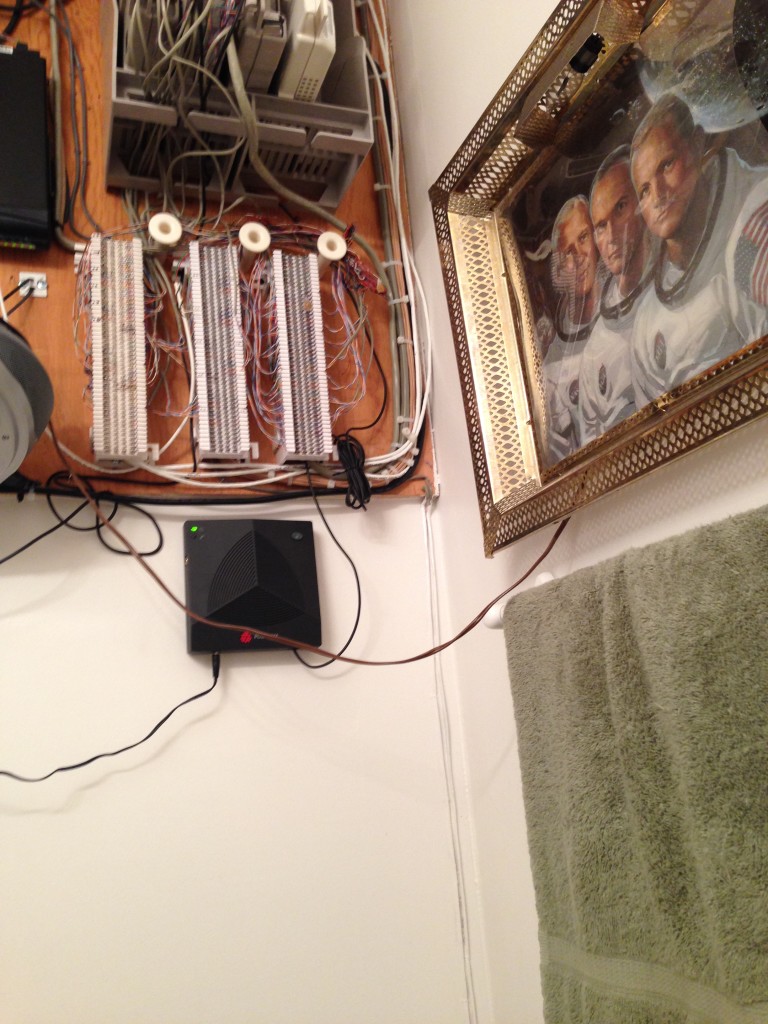
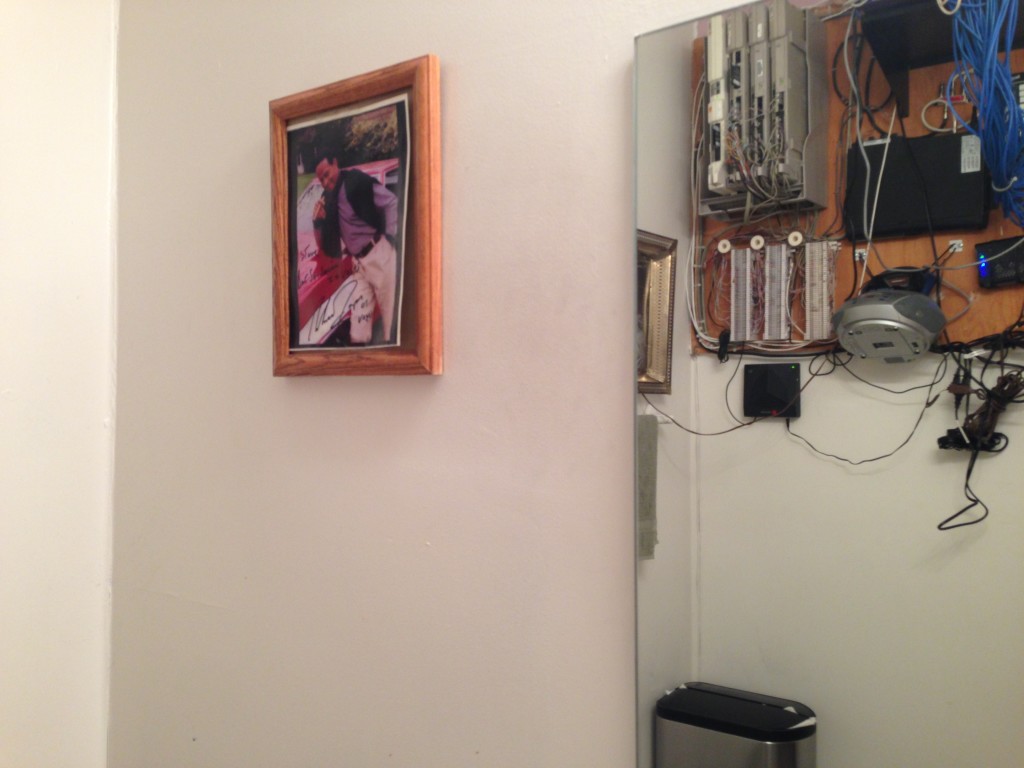
    Which led me to take a few photos that tried to capture that plainspoken ethos…from my office restroom.

    150821-i5c-5296
    150818-i5c-5218
    150818-i5c-5220
  • Tokina 500mm f/8, Cadatropic Lens

    When I first got my Nikon D40, I took a self portrait in the bathroom at Grant Street. I did the same when I got my manual focus 50mm lens. And then I got a 500mm f/6.3 lens which I’ve since given to my father. And thus ended that run of self portraits that was intended to celebrate each addition to the collection.

    But quite by accident I ended up taking a shot of myself with my Tokina 500mm f/8 lens. I had pulled out this lens due to the “watching/voyeur” assignment on OTP and I saw a glimpse of myself in the sliding glass door and took a couple shots of myself. Its not perfect, between the vanishingly thin DOF and the longish shutter speed, it wasn’t gonna be clean, but its good enough to kick up the collection again.

    Tokina 500mm f/8
    Tokina 500mm f/8
  • My old and new boardgamegeek profiles, 2015

    Here is my new profile on boardgamegeek.com

    I’m an architect in Las Vegas, with my wife and daughter.

    I like asymmetry and systematic variety.  A saber and a box of chocolates.

    This is the old one, a big sprawling mess and in serious need of editing.

    I’m an architect now living in Las Vegas. I used to think I was into intense games, but I’m starting to make peace with the fact that I’m more of a fluffy gamer. I like games that become relatively mindless with practice (such as Tien Len or Mah Jong). I enjoy heavier games, but they aren’t “relaxing” in the same way (duh?). I can put up with a lot of luck in my games, most likely why I don’t mind Risk or Monopoly (played per original rules).

    For what its worth, I just switched my rating system to the BGG standard. I don’t like the 10 point granularity, but I’ll live with it and I’m tired of trying to keep track my own stupid system. The only difference is for expansions, which are judged in how well they enhance the base game — which means I am kind of liberal with 10’s, even if I might not like playing the game or expansion all that much.

    It has been was kinda rough over the years…there are games that I’m supposed to enjoy that have dropped down lower and lower. On that note, my Top 10 list takes “nostalgia” into account – I’ll acknowledge the fact I don’t think it’s a great game in my ratings. However making me feel warm and fuzzy inside is part of the top 10 calculus.

    I have typically enjoyed elegant, streamlined, lighter games, but lately found myself interested in heavier games. I don’t mind a bit of randomness and chaos in my games, but I find myself liking it less and less. What I really love is controlled chaos, instead of pure strategy, I like directed improvisation. I think that is why I have enjoyed Troyes more than Caylus (I learned both games this year). A better example may be my love of climbing games such as Tichu and Tien Len. There are definitely times when you get dealt a crap hand and there’s nothing you can do about it, but in most games there is something you can do, even with a weak hand…or something you can screw up, even with a really strong hand. One thing I absolutely really dislike is having to plan too far into the future, chess being a prime example. This also includes most worker placement games such as Dungeon Lords, Glenn Drover’s Empires: The Age of Discovery, and Dominant Species all of which utilize the “place a bunch of workers first, then resolve everything at once” mechanism. Caylus gets a pass because of its elegance.

    Things I dislike in games: lots of moving parts, memory, and simultaneous action selection where there are dire consequences for guessing wrong (ala Witches Brew or Dungeon Lords). I suspect that I like auction games way more than I ought and dislike worker placement games more than necessary. I appreciate games with a strong spatial quality…maybe something coming from my architecture background – and I certainly love sleek “elegant” game mechanics and interesting graphic design.

    10 – I love it love it love it!!
    9 – I love it love it!!
    8 – I love it!
    7 – I really like it!
    6 – I like it!
    5 – Meh.
    4 – I don’t like it!
    3 – I really don’t like it!
    2 – I really really don’t like it!
    1 – I HATE it!

  • A Toolkit for 2-Player Gaming

    After my daughter was born, I have not had many opportunities to attend gaming events, so my life is now centered on two player games. This made me rediscover some old games and look at them in a new light. It might not be the same experience with two, but they can be fine games in their own right.

    This past week I drafted a conceptual toolkit for retrofitting multiplayer games to play well for two players. Not all the examples are super successful, but they were all successful enough for someone to propose on a forum, if not publish in the rulebooks.

    The toolkit can be broadly divided into two categories, SETUP CHANGES and MECHANICAL REVISIONS.

    SETUP CHANGES

    One Less Chair: This most basic of this category, almost not worth mentioning, is to just deal one less hand, such as in Poker…or Glory to Rome, Dominion, Hanabi, etc.
    Setup Mechanical Twist: Sometimes a game uses the same components and plays the same as the original game but includes a slight mechanical twist in the setup, for example, Spades for two which adds a drafting mechanism. Another example (though not for two) is in three player Tien Len where the last card dealt is thrown face up on the table and the player with the lowest card may trade for it.
    More or Less: Some games pretty much use the same components but deal out a slightly different amount of goodies, such as money in Caylus or the amount of available goods in Puerto Rico. Pandemic:OTB reduces the quantity of event cards. Hanabi changes the quantity of hand cards between 4/5P games and 2/3P games.
    Reduce Components: Sometimes you take out specific items from the multiplayer games as in Agricola, or in Hansa where you remove some colors of goods altogether.
    Add Components: And sometimes you add something totally new, such as in China: Das Duell. The original Mamma Mia! plays fine for two, but I’ve found the game greatly improved by playing Mamma Mia Plus, where the the expanded card mix compensates for the reduction of players.
    Modify the Map: And sometimes you change the board. Ticket to Ride does this by disallowing parallel track lays. Ra reduces the Ra Slot, TransAmerica only deals out the cards with the border. Power Grid reduces regions. Only one of each violet building is available in Puerto Rico.

    MECHANICAL REVISIONS

    Dummy Player: Though much reviled in general, it seems to work fairly well in some games. Dirk in Alhambra with is a primary example. Its also been proposed with positive reactions for Trias. And its been way too long since I played Nefertiti to comment knowledgably, but the official 2P rules in the expansion include a Dummy player. This unofficial Niagara variant proposes adding a third paddle (along with reducing the gems in the setup).
    Play Two!: This is the other obvious drastic mechanical revision fro 2P games. There are some strong proponents of playing Puerto Rico with two boards and its even been tried in Chudyk’s new game Impulse. The official Hare and Tortoise variant also does this (in my opinion it is brilliant, but it is not liked on BGG). This was also proposed for Trias, as well as High Society with a slight twist when a bad card comes up. I guess you could say this is also the way you would modify the number of players in Scotland Yard, though its core essence is a two player game that was designed to accommodate multiple players.
    Remove Mechanisms: Sometimes a mechanism is just unnecessary, Caylus dumps the turn order Mechanism.
    Add Mechanisms: I don’t think its particularly successful in Bohnanza, Uwe essentially added a new phase in the game to simulate trading. Also not particularly successful is the variant of Acquire where you draw a tile during a merger to simulate a dummy banker (this differs the main “Dummy Player” tool because it is random and is an instant non-permanent effect). I haven’t played it myself, but a promising Dixit Variant has the storyteller selecting a card, drawing five more off the top of the deck and adding three to the tableau along with throwing in a random card. And I’ve heard two player Niagara is playable by merely adding the Beaver Mechanism that comes with the Spirits of the Niagara expansion.
    Tweak Existing Mechanism: Fairy Tale has a billion variants proposed because the base two player game is unsatisfying. Most of them tweak the number of cards drawn and almost all of them involve discarding a card during each phase of the draft before giving the hand to your opponent. The most recently proposed Fairy Tale Variant involves drawing cards off the top of the deck each round. This unofficial variant for Basari (along with modifying the length of each round) does this by conflating the Jewels and Points actions to force more bartering.
    Action Quantities: The official rules for Trias reduces the number of actions a player may take from four to three. And Puerto Rico gives each player multiple actions before the round ends (and the official variant is structured to create a particularly significant change by removing the craftsman angst).
    Modify the Game Length: This was a simple variant proposed for Fairy Tale. And is also the source behind some of different variants for Puerto Rico, since the quantity of Colonists and VP’s affect the length and thus balance of the game. Love Letter changes the number of hearts you needs to capture before victory. And Troyes does this very neatly with their event card reveals.
    Change the nature of the game: Dixit isn’t really that competitive so someone decided to make it fully cooperative.

    I’m not particularly versed in boardgame theory so I’m certain there is a lot rough edges and maybe even a complete conceptual realignment in order before everything is said and done.

    If I’m going to be playing primarily two player for the next few years, this might be fun to explore. I know there is a good two player game in the Bohnanza deck, just waiting to be designed.

  • Wooden Spoon

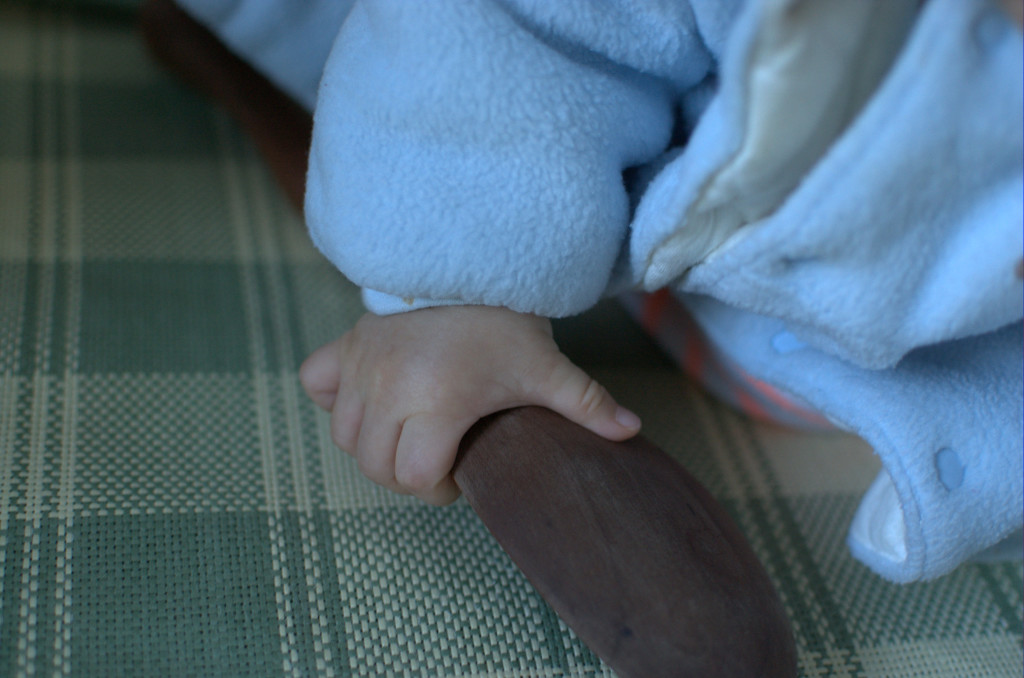
    The spoon was quite a luxury. I bought it on my wife’s fake birthday and it was a pricey little fellow hand carved from a tree in Jasper, Texas that had been taken down due to Hurricane Ike. It was a brutally hot July noon in Houston at the farmer’s market at City Hall, but an interesting conversation and a memory worth way more than $50.

    141122-d40-4871
  • Dixit 1, 2, Odyssey, Journey, 2012

    Me, the Reviewer

    I am a big Dixit fan. I’ve purchased six copies of this game, three that I have given away (a copy of Dixit 2 and Odyssey to my sister, and a copy of Journey to my game night host who introduced me to the game). I have not yet purchased Journey for myself, because I’m always playing the copy of at my host’s house.

    I originally did a quick write up of how I think the family interacts and I thought I’d turn it into a slightly longer review. As an architect I think about this stuff way too much….

    Initial thoughts that got derailed into the auxiliary stuff

    For me the original Dixit is the granddaddy and I still think it has the best art (I am particularly fond of the Cat and Fishbowl). Because Marie is the artist for Dixit 2, I think the two make the best pairing. For any normal human being that is just about right. You don’t need more cards than that. Since Dixit bogs with more than 6 players, you really don’t need the extra chits that come with Odyssey either.

    However, Odyssey’s score track is nice, and it is nice to be able to add a couple extra player bunny tokens if you want to have more players. However the voting placard stinks and we never use it. Instead we just use voting chits from Dixit 1, and if there are more players we use dice from other games (2+6=8).

    Journey has the nice “feature” of adding more voting chits, unfortunately they used the same colors as in the original Dixit. That was an unfortunate oversight because they could have been really nice supplemental voting chits for 7+ players. Even so, we’ll still use the Journey chips if we have more than six players. And of course we completely ignore the stupid plastic pawns of Jinx.

    So in summary we use the Odyssey score track and bunnies (since they sit better) with the Original Dixit and Journey voting chits. But really, who loves Dixit for the scoring?

    We love it for the Art.

    Journey has turned out to be an excellent expansion. If you are happy with your Dixit 1 and Dixit 2 cards and you don’t feel the need for more, then you should just stick with that pairing.

    However, if you’re a Dixit hoarder like me, then you most likely purchased Odyssey. Because the penciller was a different artist, the Odyssey cards really stuck out like a sore thumb, even though Marie was the colorist. I also think the depictions in Odyssey was not open ended as the other sets, which is why I consider it to be the weakest of the bunch.

    For Journey, they came in with with a completely different artist and art style. You might have a similar visual discombobulation if you slipped Journey into a 1+2 deck, but it works really well when you include it with Odyssey. The deck now has enough visual variety to eliminate the irritating uncanny valley-ness of the Odyssey cards.

    As for Journey on its own. The cards are quite excellent, though quite different from Marie’s original art work since it is all digitally painted. That said, the colors are gorgeous, the art is beautiful, and the depictions are open ended like the first Dixit. Our first couple plays of Journey were as a standalone game and we were “oohing and ahhing” all the new cards. If I had to judge each deck individually I’d put it just a hair ahead of 2 but behind the original (my absolute favorite). However, if you were to get two decks, 2 pairs better with original.

    Recommendations

    My base recommendation would be for the original plus the Dixit 2. It is nice to have two decks worth of cards and they make an excellent pairing. Any other pairing would make for an uncomfortable visual dissonance.

    If you want to add more cards, then you should get both Oddesy and Journey at the same time and really turn the deck into a variety pack.

    If you want only one Dixit, then just start with the Original, it’s got great art and bunny meeples. What else do you need?

    Postcripts

    If you need to have the game tonight, I suggest you go to your local big box Target or Walmart. They’ll almost certainly have Journey and you can’t go wrong with that. Maybe Barnes and Noble would have the Original Dixit?

    If you live with very conservative folks, I would recommend considering Journey because art is a less dark than that of original Dixit. This is quite subjective, but I remember someone watching us playing it a couple years ago and remarking how spooky it was.

    My host got a copy of Dixit Jinx for Christmas. I’m excited to try out the game but I have not done so. As an architect who has been brainwashed into Modernism, I suspect that I will quite enjoy the abstract art of Jinx, but would not be surprised that people who loved the rich art of Dixit find Jinx disappointing.

    Originally posted on Boardgamegeek.com
  • Five Worker’s Morris, Justus Pang, 2012

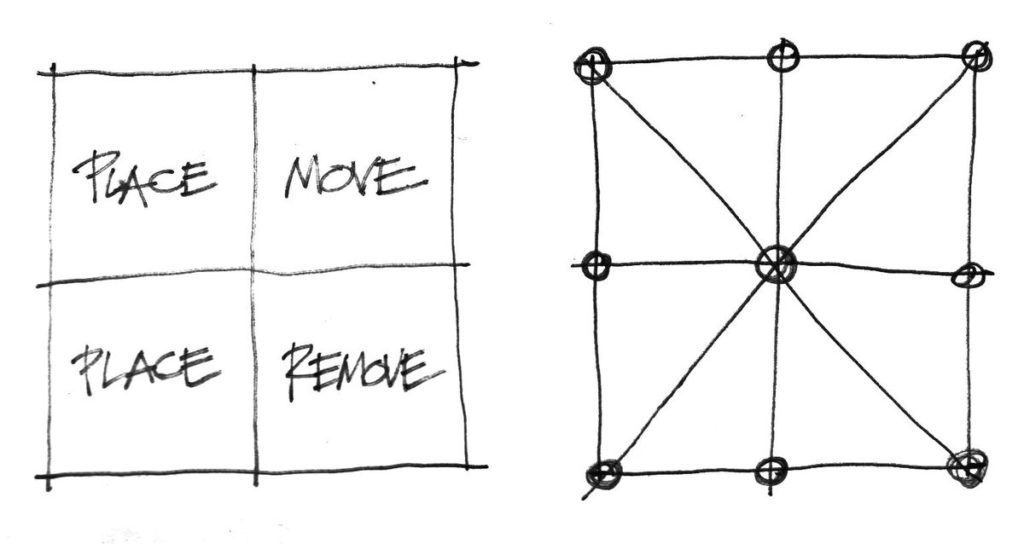
    This is an abstract game with two boards. The Action Board is a 2 by 2 square grid with four action spaces (Place (x2), Move, Remove). The Network Board is also a 2 by 2 square grid with the pieces are placed on the 9 vertices of the grid.

    Each player has five workers to take actions and/or place on the network board. Each turn a player has two actions per turn (except for the first player who only has one action on their first turn). To take an action a player takes one of their workers from their supply and places it in an empty space on the Action Board and resolve the action accordingly. Instead of taking an action they may they may pass and must remove one of their workers from the Action Board (if they have any).

    The three types of action on the Action Boards are:
    Place one of the activating workers in the Network Board. Take the worker from either the General Supply or the “Place” Space just activated.
    Move either player’s worker on the Network Board to an adjacent vertice or move either player’s worker on the Action Board to an adjacent space (do not activate the action under the moved worker).
    Remove either player’s worker from either the Network Board or the Action Board. That worker is returned to the player’s general supply.

    The game ends immediately when a player has three workers in a row on the Network Board.

  • Pandora’s Bedroom

    Or really, Peppercorn’s bedroom. She loves to sneak into the bedroom of our 1 bedroom apartment. Its her major project in life. She picked up this habit in our previous apartment and has continued it here.

    I’m not sure why she loves to get into the bedroom. There’s nothing special there for her and even though she likes to hang out under the bed, she splits out pretty quickly when we chase her.

    I guess she just likes to come in and inspect. You know, just to see what’s there, same as it ever was, but you never know…

  • Nefarious (2 player), Donald X. Vaccarino, 2011


    I purchased this game because it was accidentally shipped to me and Time Well Spent Games gave me a discount to purchase it outright instead of paying me to ship it back to them. It seemed like a nice light game that would fit in my sister’s wheelhouse and so it became an early Christmas gift when we had a mini-family reunion this past weekend. Since my girlfriend was a non-gaming mood, I ended up playing lots of boardgames with my sister. After about thirty 2P plays of this game, I think I am qualified to say something about Nefarious as a 2P game.

    Because my all the plays of this game were with my sister, so her preferences should be put up front. She and her husband (who did not come) are gamers, so she is perfectly capable at playing heavier games like Agricola, but she strongly prefers lighter games. Even a simple 2P abstract game like Let’s Catch the Lion was way too heavy for her tastes. She enjoyed Too Many Cooks (I think in part due to the art) but wasn’t totally enamored with it, nor with Indian Chief. Nor Parade, which can be a surprisingly thinky filler. I suspect No Thanks would have been played in regular rotation except we need a third player and my girlfriend was having none of that. The light Russian beating game Durak and Korean fishing game Go Stop both worked nicely as did Plato 3000 (which is a little too light for me).

    As for me, I typically prefer slightly meatier fare, but if I’m having fun why not? My 10’s are typically fillers because the great ones are reliably good in any situation where as medium / heavier games require the right crowd and mood. That said, my current hotness is Container, In the Year of the Dragon, Nefertiti, and Troyes.

    In Nefarious, each player is an evil genius trying to take over the world by creating new wicked inventions. Since this is a Eurogame, taking over the world means getting 20 VP’s before your opponents (of course!). Mechanically Nefarious is is a simultaneous action selection game where you collect money, draw invention cards into your hand, and gain VP’s by purchasing these cards in your hand and playing them to the table. You earn money by “Speculating” what actions your opponents will select (that is the only use of those minion meeples) as well as selecting either the “research “($2) or “work” ($4)actions. You gain cards into your hand by taking the “research” (one card) action. To play the invention cards to the table you “invent” them spending your money to get them into your tableau. Along with VP’s, most invention cards have instant effects on you and/or other players for good and/or bad

    This is a very nice clean design. Everything in this game has their place and there are almost no “exceptions”. Minions do ONLY one thing (earn you money through speculation). Inventions get played to the table ONLY via the “Invent” action. You gain VP’s ONLY through invention cards in your tableau. Effects from invention cards are ONLY instant and are not permanent. Effects from inventions affect you or ALL players (no selective attacks against other players). Money and cards in hand are more fluid, but of course these are the two resources you have to manage well to win the game

    The only thing that seems complicated is Invention Card effect resolution — but even then the rules are pretty clear. All players resolve invention effects simultaneously. Each player will resolve all personal effects (green arrow) first (from top to bottom). Then they will resolve effects from other players (red arrows) in player order relative to their own seat. It sounds complicated but it really isn’t. And of course in a 2P game this is completely not an issue.

    Of course, such a nice clean simple game can get pretty dull pretty fast. Even so, I think the first two or three plays with the base mechanics was still quite fun. But right as we began to tire of it, we opened up the pile of 36 “twist” cards that selectively modify the game slightly and every game should be played with two of these. Some of them are pretty simple, like giving you more money to start the game or increasing the victory VP requirement but some of them can make things pretty wild, like making the effects of your invention happen twice or letting you take two actions a turn. We played the twist deck once through and with two cards played per game there are definitely a lot potentially cool twist combos still out there (though of course there are also a few boring ones also).

    I’m by no means an expert Dominion player, but whenever I play with expert dominion players, they look at the table and they know what they want to do for the whole game, which thus essentially boils down to a shuffling exercise. There is a bit of that feeling in Nefarious once you get a little experience. At the start of the game you will you look at your hand, look at the twist cards, map out a strategy and execute. Ultimately, this is a race game to 20 points so messing around isn’t gonna get you anywhere but last place – and there isn’t that much game space to explore anyways. Maybe there is a bit more interaction with more players (I suspect the red arrow effects are a bit underpowered in a 2P game) but otherwise, it’s really is just a race to 20 points.

    As fitting a lighter game, there is a decent amount of luck of the draw which can doom you. But even then, it isn’t about getting the killer card XYZ, but a case of a series of bad draws that do not interact well with the initial strategy you chose to start the game. The deck is nicely balanced which gives you room to do some optimization and well as make make mistakes which will doom you. Then again being doomed isn’t that big of a deal, after a few plays, we were knocking out a game every 10 minutes.

    In short, Nefarious is a fun game and in the right crowd (such as say, hanging with your sister who doesn’t like heavy games).

    But do I love it? Not really. I don’t hate it, but I just don’t see much more there to explore, and I don’t usually find myself in a context needing a light multiplayer game. The multiplayer aspect sounds fun, but after a lackluster attempt at King of Tokyo, I’m not sure a lighter, silly, interactive game of this type is going to be normally a right fit for me. Currently I rate it a 6, however I suspect that it may slip down to a 4 as time slips by.

    That said, Donald X. has cemented himself as a top notch designer. His games don’t grab my attention, but he has two popular and critically acclaimed hits with Dominion and Kingdom Builder. For Nefarious he clearly wanted to design a lighter filler that was fun to play repeatedly. After thirty plays it’s hard to argue he did not succeed again, splendidly!

    One more note: I know it sounds like taking hatred of paper money to an absurd level, but this game is greatly improved if you replace the cardboard money tokens with full size poker chips. Once you get used to it, it’s easier to keep track of money with white=1, red=5, blue=10. During the game there will be a lot of single dollars coming into your system. In a 2P game you’ll be getting 2 or 4 bucks almost every round just due to speculation via your minions. Furthermore if you “research” or “work” you’ll get either 2 or 4 bucks. That’s a lot of singles, and it is a lot easier with poker chips to keep exchanging the big red and white chips instead of fiddling with the smaller cardboard money tokens.

    Originally posted on Boardgamegeek.com