Having worked in small firms, I’ve always been the young guy. Even that time I went corporate, I ended up being the junior staff member on a major project.
That’s fine. I learn more from the experienced folks.
So it was a bit odd turning Owner and suddenly becoming an old guy. In the few cases where I’m younger, it was by a year or two, not decades.
Middle age is odd. They say architects don’t blossom till they are fifty. That was forever away, now just three years out.
I’ve gone through the stereotypical “now what” moment, but I’m also comfortably confident in my skills. There’s still plenty to explore, but I have much to share with the next generation.
Maybe this OPM letter was a my way to share some notes along this journey.
~
Some Links
Over the past few years I’ve fallen hard for calligraphy. It’s why this letter took a long hiatus. You can graph with the most simple of materials, but here are some things that stand out.
The Pilot Parallel was my introduction to calligraphy. As a lefty, I had long thought it impossible, but once I got my hands on one of these pens, I just had to try (with the help of YouTube). It’s an inexpensive pen with none of the hassle of dip pens. If you’re not sure what size to get, go big with the 6.0mm.
What to graph on? Anything will do, but normal printer paper will bleed, as will binder paper. The best value I found was acid-free sulfite paper from Blicks, which is usable on both sides.
If you get deeper into the hobby, then splurge with the Brody Neuenschwander Handwritmic Ruling pen. I also enjoy the Dreaming Dogs ruling pens (especially for alternative shapes), but the Handwritmic has the best build quality with a nib that can handle a variety of scripts.
LED light tables are super cheap now. Mine is just a non-name brand from Amazon. Print out guidelines on paper and now you won’t have to rule your sheets all the time.
And finally books, books and more books.
Any edition of the Speedball Textbook is a good start (I’ve got 12, 16, and 20-25).
I’m fond of Arthur Baker’s Foundational Calligraphy Manual because he elucidates a technique of twisting the nib, which feels really weird until it’s natural. At this point I’ve picked up all of his books.
A wild card, out-of-the-box gem is Scott Kim’s mind twisting Inversions.
And no list of books would be complete without grand matron Sheila Water’s epic Foundations of Calligraphy. I find this one intimidating—high standards are great, but for a hobby, fun comes first. But when you get serious, it’s a must-have.
November and December 2025 turned into a crash course on estimating budgets and schedule.
Having gone through the crucible of three CIP seasons with the State of Nevada, I can quickly slam out numbers, but with multiple mega-projects on the horizon at the airport, I wanted to standardize our contingencies and develop a transparent process for turning a construction cost estimate into a project cost estimate.
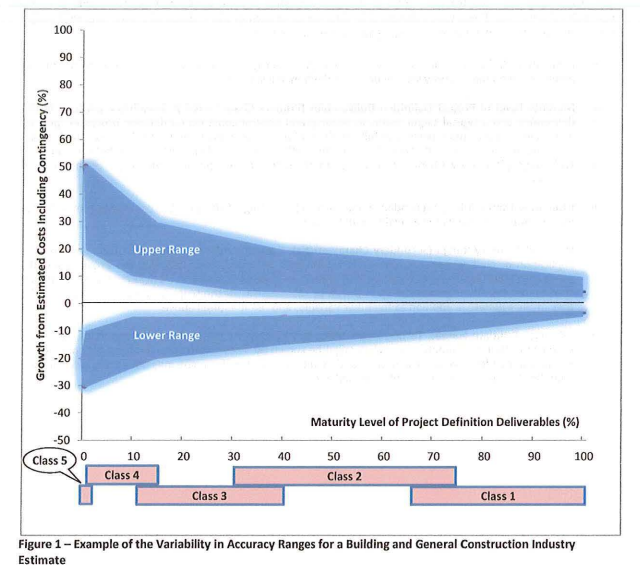
A while ago, I had pondered the question about desired accuracy for a project estimate. With a little research, I found a professional society who studied that exact problem—the Association for the Advancement of Cost Engineering (AACE). In their rubric, the roughest estimates are categorized “Class 5” with an 80% confidence of landing between -30% to +50% for construction projects (AACE 56R-08, adopted in ASTM E2516).
This range worked aligned with recommendations from our planning consultant for early cost markups. More specifically, we added a 20% Design Evolution markup to the Direct Construction Cost. This marked up cost became the basis of all the other costs in the project estimate, including a 20% Construction Contingency and a 10% Owner’s Allowance (because there are always changes after bid!)
Over the course of a project, the Design Evolution would drop to 0% when issued for Bid, while Construction Contingency should drop to about 5% as conditions in the field are investigated, but holding a bit for bid risk when bids are opened. The Owner’s Allowance would stay steady at 10%, but could shift if management was unwilling to allocate so much budget for post-bid changes.
As with all rules of thumb, the estimator is still responsible to account for the specific project needs, but having suggested defaults frees me to focus on unique conditions that require special consideration.
While it might be more technically accurate to stagger the cost of escalation over the course of time, we structured the estimate to provide a subtotal of the entire project cost and then add escalation as overall markup. Hopefully this will clearly highlight the cost of waiting to approve these major projects. While fools may rush in, analysis paralysis is not free—a few percent a year adds up fast!
So how to estimate a schedule? Unlike cost estimating, I was not prepared to tackle this question because I was always shoehorning dates to fit the State’s two-year legislative cycle. But the internet is a wonderful place, now that I have the freedom to recommend schedules that best fit our project needs.
Again, there is no need to re-invent the wheel—the Navy dealt with this problem in the 1950’s, creating the “Program Evaluation and Review Technique (PERT)”, where an estimator develops three schedules resulting in an Expected schedule. Since I’m intimately familiar with each step of the process, it’s easy to develop an Optimistic Schedule. My estimating spreadsheet combines these small steps into larger phases (design, permitting, construction, etc.) which makes it simple to take some broad guesses to develop the the Most-Likely and Pessimistic Schedules.
The spreadsheet then averages the estimated schedules to calculate an Expected Schedule. This schedule is considered to be a 50% confidence level estimate—half of projects will be delivered after the completion date. To bring the schedule back up to an 80% confidence level, the spreadsheet does some simple statistics to calculate a Schedule Contingency, which is shown as a final line item to determine the opening date.
As such, the schedule sheet is structured similar to the cost estimate (with the esclation added at the end). The Expected Schedule keeps the project team held to a tight process, while the additional contingency gives management a date they can confidently share with the public. This is similar to the US Army Corps of Engineer’s guidance that Congress is typically presented with an 80% confidence schedule while internal schedules are presented at 50% Confidence (USACE CSRA).
With a schedule in hand, we can now calculate escalation to the midpoint of construction. Since the cost estimate targets an 80% confidence level, we include the entire schedule contingency before the midpoint of construction.
How much annual inflation should to assume? The US Federal Reserve targets 2%, but the 2020’s have been rough, seeing 7-8% annual jumps. Things have settled down, but given recent experience, we are still assuming 4% annually. Call me in 2036 to see if that was anywhere near correct.
With that, the cost and schedule has been estimated. If you wanted to be fancy, you could build some s-curve spending projections. However, for the scale of my projects, I’ve only been asked for annual estimates, so I just use the even linear spending tracker calculated in Microsoft Project.
(Microsoft Project is a whole other thing I learned these past two months. It’s too much to cover but a few concepts that some figuring were task dependencies, hammock tasks, assigning costs to the tasks, and using flags to add color to the Gantt chart. YouTube is a great tutor, as well as AI—LLM’s are only semi-reliable, but used carefully, it was critical in working through both big picture questions and navigating software quirks.)
With this information, we can hold a jury to vet the project. Since the Construction and Design Division will be tasked with delivering the approved budget and schedule, we owe them an opportunity to critique the estimate. We also invite key operational staff for extra eyes to challenge assumptions and catch what’s missing.
And with that, we can finish the estimate with a cover letter to memorialize the basis of estimate to provide context around numbers:
Project Description (what will this do; where is it?)
Project Justification (why is this needed; who is served?)
Key Assumptions (when (schedule) and how the project will be delivered)
Base Documents (percentage of design complete, and often referencing a 3rd party estimate)
Confirmation (or not) that an internal jury vetted the project.
List of attachments (additional diagram, cost estimate backup, etc.)
After a couple initial tests, this template is working well. I can smash out a draft estimate in half a day, though I’d prefer a few days to do it right. Beyond half a week, I suspect that extra effort would be minimally helpful—I’ve often claimed that I can spend three hours or three weeks to end up equally wrong.
With that, I’m happy that I was given the time to develop a project estimate template that shares the work, from the basis of estimate to the final budget and schedule. Critically, this a transparent document, showing the assumptions with a clean line of logic so that decision makers can evaluate the staff’s technical opinion on the proposed project.
And with that, it’s on them.
~
Some Links
For some reason I don’t have much patience for live action films, but I gladly watch animation all the time with the kids. Here are three standouts from the last three years.
Puss in Boots: the Last Wish is the stunning sequel to the lackluster spinoff from the Shrek franchise. It was shockingly great with a tight, rich story paired with gorgeous animation. I guess DreamWorks was impressed by Sony Animation’s revolutionary Spiderverse and upped its game!
Robot Dreams is a cute, yearning story of a dog and his robot, lovingly set in in 1980’s New York City. We just watched the movie, so it might be recency bias, but it should have won the 2023 Oscar over Studio Ghibli’s The Boy and the Heron.
Flow was the worthy Oscar winner for 2024, a surreal tale of a cat weathering a sudden flood in the valley. As a wordless film, I was worried that the kids wouldn’t dig it, but they both loved it. Gints Zilbalodis is an auteur who has the courage to finish what Pixar started in that epic that first half of Wall-E. Zilbalodis’ 2019 full length film Away (included in the Criterion Collection DVD) was also well worth the watch.
Bonus! We just re-watched Ernst and Celestine now that they’re now old enough to enjoy the sweet tale and gorgeous watercolor animation. It might come from a children’s book series, but it’s absolutely enjoyable for adults as well.
~
General Store, Moundville, Alabama, 1936, Walker Evans
One of our admins retired. After twenty plus years, time to enjoy retirement. We gave her a proper sendoff with a card and a lunch.
Over the last couple of years, every single contract ran through her. For an agency all about spending money to build stuff, she was the cog.
The next day I went through all our workflows erasing her name.
It was a cold exercise. But government business, keeps on marching. I hope she’s enjoying the time off. It must be better than putting up with us.
~
Some Links
I’ve heard that Merlin Mann no longer supports his own Inbox Zero idea, but I do (for work). I tell interns that they need to be observant and reliable. I don’t know how to teach observant, but having a minimal inbox (along with a solid process for tracking archived emails) is a great way to become absolutely dependable.
Seth Godin is the original daily blogger. To be honest I’ve moved on his self help, but reading his daily posts for the first fifteen years of my career ingrained an ethos of care and generosity that has taken me far in this profession.
A few months ago, a video introduced me to the Cult of Done manifesto. As a hoarder, I have a hard time throwing things away, certainly not after a week. But still, it’s been influential in clarifying what I want to work on.
The Cult of Done Manifesto
There are three states of being. Not knowing, action and completion.
Accept that everything is a draft. It helps to get it done.
There is no editing stage.
Pretending you know what you’re doing is almost the same as knowing what you are doing, so just accept that you know what you’re doing even if you don’t and do it.
Banish procrastination. If you wait more than a week to get an idea done, abandon it.
The point of being done is not to finish but to get other things done.
Once you’re done you can throw it away.
Laugh at perfection. It’s boring and keeps you from being done.
People without dirty hands are wrong. Doing something makes you right.
Failure counts as done. So do mistakes.
Destruction is a variant of done.
If you have an idea and publish it on the internet, that counts as a ghost of done.
I met the Architect and our Agency to discuss a simple fencing project. We addressed logistical concerns and needs of their staff and clients. We covered security concerns, budgets, and traffic flows.
At the end of the meeting, the Architect started to ask questions. He stripped away the project requirements. He challenged our priorities and tested the assumptions.
It was a beautiful moment of architecture. I got to see a flash of inspiration happen in real time.
I’m not sure what the agency will do. Maybe they will stick to what they originally requested. But the architect’s job is to ask the hard questions. We’re not just order takers. We push our clients towards their best future—which might not the one they imagine.
In my years, I’ve had the privilege to watch professionals practice their craft at the highest level. A few years ago, I watched my old boss sell a design, weaving a tapestry of a story. It was a raw display of skill, and I told my interns to cherish the moment, cause that doesn’t happen every day.
This was another such moment. It was also a professional challenge. Why didn’t I ask those questions earlier? I might be the owner, but I haven’t become a ticket machine, yet.
I’m here to challenge your assumptions and refine your future.
I’m still an architect.
~
Some Links
YouTube is an amazing warehouse of amazing dancers. I presume TikTok may even be more addictive, but I’m not touching that drug.
Lia Kim is my favorite dancer and choreographer. This collaboration with Jinwoo Yoon for Rain Dance always takes my breath away. Their body control is so tight and synchronized with the music. (While in Korea, a shoutout to TIMT who posts behind the scene to accompany their short performances.)
Sven Otter’s electro-swing is captivating in both his homemade videos and in commercial advertisements.
Marquese Scott was one of the original YouTube dancers and Pumped Up Kicks video still hits, even with the simple set camera on the ground. I also love this collaboration with a sign spinner.
A few years ago, we ended up at the ER when the girl fell off the couch and hit her head on the tile floor.
Fortunately she’s no worse for the wear. Unfortunately, we met an apathetic staff at the hospital.
Looking around the waiting room, I saw a bunch of sick kids and worried parents. I get it, nobody wants to be here, and it’s a rough gig dealing with everyone’s worst day, every day.
But still, those employees chose this life. If you can’t be happy practicing your craft, find another craft.
I often think about this as a project manager. Yes, I’m improving the facilities for the future. But all my users experience at the moments are inconveniences and a bunch of extra meetings.
At the very least, I can lead the project with joy and flair. After all, I’m the one who chose this life.
~
Some Links
I’m joining your favorite organizations by asking for donations before the clock strikes midnight.
To start, Wikipedia needs no link, but if you use it as much as I do….
But have you explored the Internet Archive? I became aware of them when looking for building codes (before the code publishing houses had online websites). They also archive much, much more (such as a DOSbox web implementation of the original Civilization). On second thought, maybe don’t give these guys money.
The Foundation for Individual Rights and Expression is a non-partisan organization focused on fighting for our free speech rights, I’m proud to be a card carrying member of this organization protecting our most fundamental right.
~
Bus Station, Umeå, Västerbotten, Sweden, 1930-1939
My thoughts about this despised big box chain revolves around two stories.
Two decades ago, I read an article describing the demise of the pickle giant Vlasic as Walmart’s relentless supply chain squeezed them into bankruptcy.
The second was an anecdote by a friend whose sibling works for the company. Walmart employees are not allowed to accept gifts. The rule is so strict that they pay for bottled water when visiting a vendor’s office.
Aside from the power of stories to stick in one’s memory (branding!), they highlight an interesting dichotomy I’ve seen in government.
Bureaucracy has a logic all its own. The system will demand individual uprightness while being corporately cruel. As the Owner, the trick is to find that balance. We must uphold strict standards, but we also need to execute with wisdom and judgement.
It is easier to be a coldly bureaucratic operator, but the process is so much richer when practiced with warmth.
~
Some Links
For about six months, I dived into jazz. I don’t consider myself particularly knowledgeable about this obtuse genre, but here are a few standouts from those explorations, primarily courtesy of library app Hoopla.
After trying out a few of Keith Jarrett’s solo albums, I’ve settled on the Paris Concert. Like the rest of the world, I adore the Koln Concert but I prefer how the Paris Concert starts with a baroque phrase before transitioning into jazz.
Coltrane is still the truth. For the season, you can’t go wrong with My Favorite Things, and Giant Steps is every bit as giant its title.
Less famous known is Bobby Timmons. I first found him due to his excellent Holiday Soul Christmas album, but I’ve also very much enjoyed his albums Chun King and Chicken and Dumplin’s.
I walked a renovation with my Architect and the Using Agency.
It was strange to traipse through the building. Construction had started a couple of months prior, but it all felt theoretical.
As an Owner, my job is to manage budget and schedule. I’m here to make the process move smoothly; it’s all so abstract, not solving the problems in the field.
Yes, it’s less stressful than the technical day to day grind in private practice.
But we don’t get to enjoy the scenery either.
~
Some Links
I’ve always been fond of for folk music, and YouTube is a treasure trove of artists.
I found Daoiri Farrell from an impromptu flight delay session, and the Creggan White Hare has been on regular repeat ever since.
Nicolas Campin anchors a haunting Mazurka, but if you’d rather have your players separated, here is a captivating Scottish à Cheillé on dining tables.
A captivating pairing of 十面埋伏 with A Change Is Gonna Come by Charles Yang. His soulful singing is a pleasant shock after playing the high pitched pipa tune on the violin.
Long ago, boardgaming was my primary form of entertainment.
I would read rules while riding the bus into downtown Houston for my corporate gig. I was trying to internalize the rules and visualize the game experience. Of course, great games stand out because they create complex dynamics that can’t be visualized in a steel tube crawling through city traffic. But what’s the alternative? Buy a game without thought?
Beyond the acquisition decision, this turned out to be was a powerful mental exercise. I was focusing on a complicated text in a variable environment, applying words to a future self. In mentally playing a game, I sat in each opponents’ chair, visualizing their competing interests—different goals leads to different actions, creating that elusive the gameplay dynamic.
Years later, I’m doing the same thing as with contracts tackling difficult situations. The stakes are a bit higher, but that’s all. People generally act according to the set up. So I try to empathize with their pressures to understand their motivations. How can I navigate this mix to discover an optimal outcome?
There might have been less frivolous ways to spend the commute, but reading boardgame rules turned out to be a solid choice.
~
Some Links
Our son prefers cooperative games, and Matt Leacock is the giant who designed Pandemic that popularized this genre. In simplifying his classic for a wider audience, he designed Forbidden Island with a board made out of tiles. This twist created a game where the board would disappear over time.
He developed the idea further with Forbidden Desert, where the tiles would shift and and move. I haven’t tried Forbidden Sky, but we just purchased Forbidden Jungle. Here, the players are required to shift the board around—while managing a bunch of grouchy aliens.
This series is a fun case study of a designer developing a simple game mechanic (tiled boards in a cooperative setting) over several iterations. All three are highly recommended.
One thing going from employee directly to client is the continued awareness that we are all still customers.
In private practice, I noticed that some long-time owners had a sense of entitlement over the employees because they were paying us.
Bullshit.
Yes, I owe them my full effort while I’m there. But why do I have a heavier obligation to be grateful to this business partner? I thought this was supposed to be a fair exchange.
If the boss is doing their job, they should be making a profit off my labor. So maybe they owe a debt of gratitude.
Mutual entitlement / victimhood isn’t going to take us far. We need to reframe of our partnerships as a barter. Money is valuable, but we’re buying time.
As an owner, I’m holding the cash, but I’m taking years of these architects’ careers.
That’s a BFD.
~
Some Links
I don’t think anyone is reading this in Vegas, but if you will be partaking in Giving Tuesday—think local!
A couple years ago, we saw a performance of A Midsummer Night’s Dream at the local library and I’ve been hooked ever since. It’s awesome to watch the Nevada Shakespeare Festival perform these classics with an absurdist flair. Their most recent performance of Titus Andronicus was a dark hilarious affair with a brutal body count.
After joining government, I realized the importance of state and local news. Unlike the print newspapers (both owned by one company), The Nevada Independent is truly independent. If nothing else, their judicial election guides (surveying local lawyers about candidates) are worth a donation!
When I first came to town, I found the Lohan School of Shaolin. The kids came soon after so I haven’t practiced there in a long time, but they continue to be an anchor in this town.
~
Window Display, from the U.S. Office of War Information, 1941-1942
My contractor’s PM informed me that their project engineer gave notice to join another company. I called my architect to inform her of the upcoming change, but the project engineer had already called her.
Construction is a collection of organizations who combine into a temporary team. Of course we are all responsible within our own verticals, but it goes best when silos are broken with horizontal bonds between the individuals.
We were lucky that everyone on this project nurtured these relationships. I love that they were close enough to directly inform counterparts when big news broke.
Of course, I would have preferred that he stayed, but I’m happy that my guy found a better job. Hopefully we’ll cross paths again, soon enough!
~
Some Links
These three have enticed money out of my wallet more than once.
Annie Hendrix is a multi-talented threat—a musician, an author, and a hilarious follow on Notes. I’m looking forward to her upcoming book of poetry.
Daniel makes lovely letterpress prints from his studio garage from Indiana. If you’re looking for a nice gift, check out his Etsy shop. If you want to see him in action, PBS interviewed him a few years ago.
Duane Toops is a collage artist whose pieces always delight. It’s even better to feel the layering of these pieces in your own hands.