GRIZZLY PEAR

written snapshots

Category: Architecture

  • Thoughts from a first studio review

    Twenty years ago I was getting ready for my own sophomore review.  I don’t remember much from it aside from accidentally knocking off a piece off the top of someone’s model as we were rushing downstairs.  A couple years later, I gave her a book of the collected covers to the Sandman comic series.  It was the least I could do to atone for my error.

    I was invited to final critiques at UNLV on Monday.  In talking with these students about their projects, I kept returning to the primary lesson that was hammered into me twenty years ago.  What is the concept?  I found myself constantly pushing the students on their story.  Not the narrative of how they got there, but the story that crystalizes a design into a cohesive whole.

    If the design is good, the story is embedded in the work. How do you improve the design?  Interrogate the concept more.  It should be flipped upside down, challenged to the core, and understood so intimately that all roads lead back to the product being presented. No decision should be arbitrary, every layer must be investigated.  Take a stand and then push it harder.

    I’m sure these kids at UNLV will remember as little of my rants about rigour as I remember of my critters from two decades ago.  But I was reminded of what I need to do in my own work. I’m pretty sure I got the better end of the deal yesterday.
  • Getting and giving feedback

    I was listening to an interview of Seth Godin as he talked about his online courses.  One of the key features is that the participants are getting and giving feedback to each other.

    He said that participants often said there was more interaction among students than in all their years of college. I hand an epiphany about what made the architecture and art studio education so special. The studio is a place where everyone’s work is on display in progress. Beyond the theatricality of the big critiques, daily interaction is the rule whether you like it or not.

    I noticed this disconnect when I started at Rice. I did so little architectural design in undergrad that I was routed into the long program, starting with the non-architecture students.  I quickly realized that I needed to dial back the way I talked about other’s work. Coming of age in the myopic architecture studio during your undergraduate years certainly has some detrimental effects on one’s maturitation as an adult, but being unaccustomed to interaction among the cohert is not one of them.

    Indeed, this is one of my concerns about the modern digital age.  From what I hear, studio culture is dying as people do their work at home on laptops.  While the excesses of  studio culture has a tendency to brainwash the participants, the loss of nightly interaction with one’s cohort would eliminate one of the key aspects that makes this education so distinctive from other fields.

  • Laughlin, Nevada

    In the fall of 2000, I took a landscape studio and was introduced to the classical form of the labyrinth.  Unlike modern maze puzzles, the labyrinth is a continuous route that leads you to the center and walking this wound up path has been used by monks as a form of meditation.  It is an intriguing form, which is why it has survived through history.

    Fast forward seventeen years later and I spent a good chunk of last autumn working on an RV park along the Colorado River out in Laughlin.  The project was sited on a property that was previously slated to be condominiums with several structures already installed on site.  Like that ill fated project, this one fell through and was shelved late in construction documents.

    This past Friday, we took a day trip out to Laughlin.  Unfortunately the casino strip is unremarkable, aside from the ability to buy a lotto ticket across the river.

    However I was finally able to conduct a belated site visit (finally saying hello to an online friend in person). Plus we found a little grassroots land art feature, the Laughlin Labyrinths. So I finally had a chance to walk a few labyrinths in person with our daughter. 

    In both cases, it was good to take these places out of the minds eye and live them in the fullness of reality.

  • Atrium!

    The other day I went to a meeting at a consultant’s office.  As I entered the main entry, my eye caught the name of the complex, “Rent your office at the Atrium!”

    I saw the fire stairs and rushed up the usual utilitarian set of concrete steps with metal pipe rail.  But when I pushed open the door to the second floor…there was indeed an open courtyard with a big rock landscape feature with stream in the middle!

    So yes, it was exactly as advertised, this is an open impressive atrium office building. In suburbia, you’re definitely fed a whole lot of bull with the building names, but once in a blue moon a developer will give you exactly what they promised.

  • Stamp!

    Yesterday I was lucky to see one of my architects submit her first set of drawings with her stamp.

    Technically I’ve done so once myself, but it doesn’t really count cause it was a homeowner builder set that anyone off the street could have done for their own never ending house remodel.

    When you think of how many people start in architecture school but change majors, and then how many graduates leave the profession, and then how few get registered, and then how many fewer still end up in a situation to stamp drawings….

    So yeah, pretty darn cool to be there for that, for my project no less.

  • A syntax of actions in plan reviews

    My recent kick of making my entire iphone homepage Apple Shortcuts was an interesting exercise to reframe my mind in terms of actions.  Coincidentally, I am working on plan check comments and I realized that I have been developing a technical language which I need to make explicit in future review letters.

    Items specifically requiring changes to the documents
    Revise / Remove / Add
     : Straightforward, proceed as directed.
    Clarify : Revise the drawings to clarify a point of confusion, usually to provide additional information.
    Coordinate : A variation on “Revise” but specifically about internal consistency within the documents.

    Items that might not require changes to the formal documents
    Verify : Double check this item and verify it meets the requirements noted in the comment.  Revisions to the documents may be necessary, or it might only require a confirmation in the plan check response.
    Explain : Provide an explanation in the next plan check response.
    Ensure : This item brings up a point of concern that might not be necessary for the current submittal phase, but is a request for it to be explicitly addressed in a future submittal.

    I’m certain more items will come up, and I may come back and edit this post as they arise.  The idea would be to limit the action verbs in a letter to just these few words.

  • A quasar in the profession

    a star showing a sudden large increase in brightness and then slowly returning to its original state over a few months.

    Dictionary definition of Nova

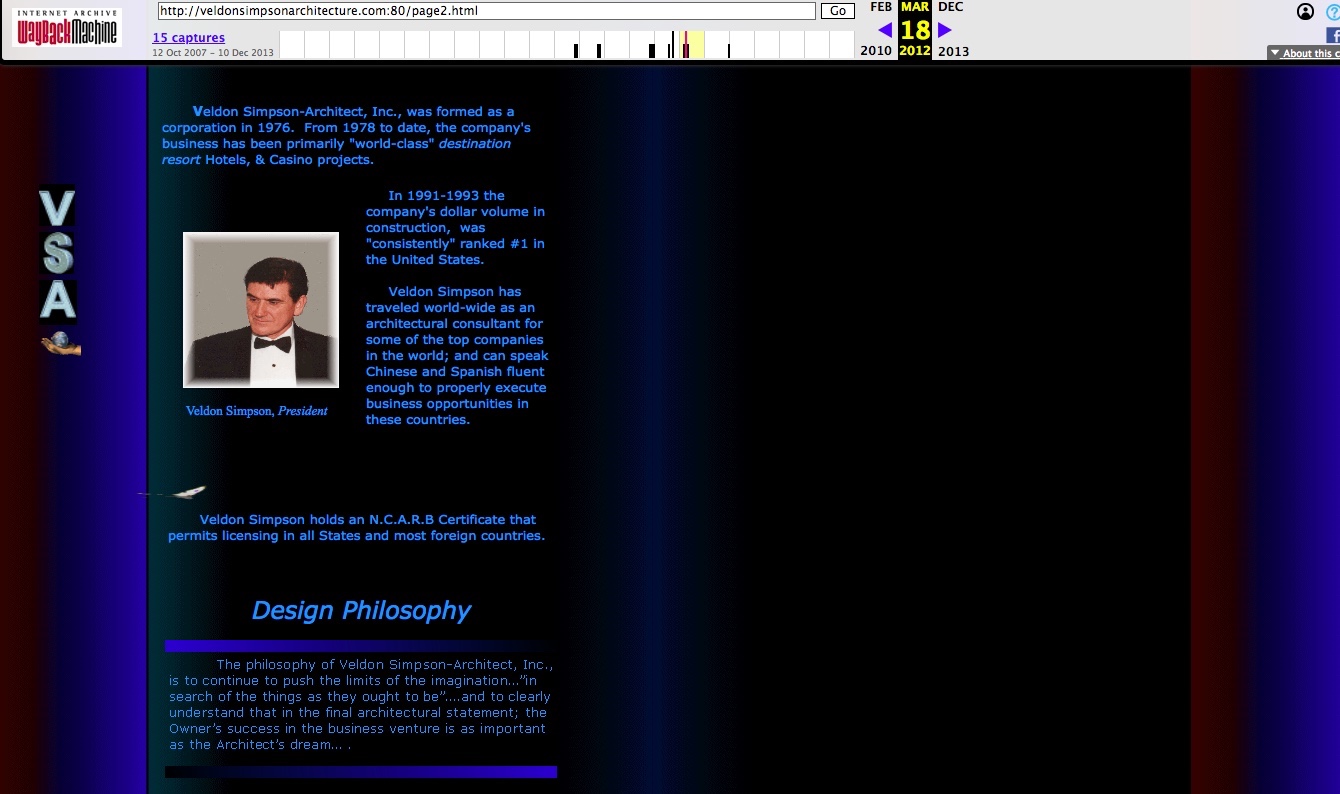
    I think my friend who described Veldon Simpson architecture was actually trying to call him a nova, something that suddenly came up big and then burned out just as fast.  Excalibur, Luxor, the Adventuredome at Circus Circus are all in his portfolio.

    In 2014, his website was still up, but now all you can find of him is an archive.org screenshot of his website. The rumor was that he worked cheap, worked his people cheaper, pocketed a bunch of cash, and flamed out.  He would be a cautionary tale in our industry, if he was remembered at all.

  • My aesthetics

    I used to have a really long rambling description of my aesthetic preferences on boardgamegeek and I’ve been wanting to cut it down to the simple statement:

    I like asymmetry.

    But yesterday, I just realized that is not exactly true.  I do indeed love asymmetry as the most heroic of aesthetic gestures. But I may actually have a greater appreciation for tightly constrained variety, such as Bach’s Goldberg Variations, the literary style exercises of the Oulipo group, and boardgame designs like Coloretto or Container.

    There was one other word I wanted to slip into the short statement – elegance.  But it is a very slippery term which needs explanation, and I couldn’t figure out how to do it elegantly.  Maybe its better to just let it sit unspoken in the background.  So for now I think I’ll go with:

    I like asymmetry and systematic variety.  A saber and a box of chocolates.

    Less pithy, but a bit more picturesque and maybe a little more accurate.


  • Aphorisms in my profession

    I find that I spend my self repeating lots of aphorisms, here’s the whole lot of them.

    If you don’t get a promotion in two years, it’s time to find another place.

    People will take all the free work they can get.  I’m gonna also.

    You have to protect yourself and your time.  It’s your choice to do anything.

    It’s your job to tell your manager what can be accomplished given the constraints.  Let them decide how to allocate your efforts. The logical extension is that sometimes you got to threaten to let a project fail, because the alternative of sacrificing yourself for the sake of a project.

    When you work overtime you are getting a lot of experience, even if you’re not getting paid.  44 hours a week is 10% more than the regular joe and the learning compounds fast. On the flip side, if you’re willing to accept slower advancement in the profession, it might not be worth working OT.

    Architects get paid in money and experience. Make sure you’re getting your fair share of one, the other, or both.

    Don’t let yourself be comfortably miserable at a job.

    We don’t make as much as other professions, but it’s better than a lot of the other alternates out there and I really enjoy the work.  But if you hate the job, for god’s sake we don’t get paid enough for the stress and long hours.

    For a recent job, I made it clear in the first interview that with a young family I was not interested in doing overtime.  It almost certainly affected my negotiated salary, but my boss was really good about making sure I would not be overloaded.  It was the best decision I made for that four years run.

    The architect is a symphony conductor but he also has to play his own instrument.

    Every email you send has a lawyer attached to it.

    It’s not a problem unless you have a solution.

    If you aren’t recovering from the previous recession, then the next recession is around the corner.

    An architect’s job is to manage expectations.

    And don’t forget to write meeting minutes.

  • Architecture is…

    My friend shared a arch daily list of definitions about architecture. Most of them are academic pabulum, but a good amount seemed was worth cutting, pasting and sharing:

    Pithy sayings
    12. “Architecture is an artificial fact.” – Mario Botta in Perspecta
    30. “Architecture is the petrification of a cultural moment.” – Jean Nouvel in Newsweek
    57. “Architecture is bashful about reality.” – Wouter Vanstiphout in Archis
    75. “Architecture is a history of style written by the victors.” – Herbert Muschamp in New York Times
    87. “Architecture is the pathology of the contemporary era.” – Forensic Architecture

    As Compromise
    32. “Architecture is a muddle of irreconcilable things.” – Juhani Pallasmaa in The Architectural Review
    36. “Architecture is most often a victory over the process of creating architecture.” – Sam Jacob in Log
    42. “Architecture is capable of absorbing anything, and hence tends to dissolve into everything.” – Ole Bouman in Volume
    67. “Architecture is expected to carry too much weight in many cases.” – Patricia Patkau in Globe and Mail
    117. “Architecture is the sum of inevitable negotiations.” – Felipe Mesa in Domus

    A profession to make things better
    21. “Architecture is about improving conditions: environmental, social and sometimes also political.” – Arjen Oosterman in Volume
    68. “Architecture is not a goal. Architecture is for life and pleasure and work and for people. The picture frame, not the picture.” – William Wurster
    83. “Architecture is both an art and a practical pursuit, and the profession has always been divided between those who emphasize the art, that is pure design, and those who give priority to the practical.” – Paul Goldberger in New York Times
    102. “Architecture is not about the creation of newness but rather about the fulfillment of needs and expectations.” – André Tavares in Forbes
    109. “Architecture is not an inspirational business, it’s a rational procedure to do sensible and hopefully beautiful things; that’s all.” Harry Seidler in the Sydney Morning Herald

    I think this as close a summation of what I try to do.
    112. “Architecture is about giving form to the places where people live. It is not more complicated than that but also not simpler than that. – Alejandro Aravena in his 2016 Pritzker Prize acceptance speech