GRIZZLY PEAR

written snapshots

Category: Work

  • Luck and Low Expectations

    I had a short email exchange with a young architect about planning a career and finding the elusive work-life balance in our notoriously brutal profession. Here is an edited version.


    Yeah, it’s good to think about a long-term career trajectory. However, my career experienced a few twists and turns – none that I could have guessed a couple of years in advance. As such, I’ve learned that the value of planning is in doing the exercise.  Even though the final result will not match the pre-vision, a practice of regularly contemplating “next steps” has prepared me to quickly grab new opportunities and pursue new desires that come up.

    And yes, you’re correct to worry about work-life balance.  My career was supercharged when I joined a corporate firm and worked two years of regular 50+ hour weeks. The more you work, the more you learn – it’s a compounding investment in yourself.

    However, this textbook career path can become a long-term trap. Study hard in your off time to pass the tests quickly. Push extra hours to get promoted to associate. Once you’ve level set long hours, the team needs you to keep it up. And it doesn’t get easier once you’re principal – now you have to make payroll. 

    A hard push for the first few years might be a good jumpstart for a young pro without a family, but completely devoting yourself to architecture is corrosive to your sense of self and your long-term relationships. Career success is nice, but it doesn’t necessarily translate to a better life.

    So how did I avoid getting stuck on this hamster wheel? Good luck and low expectations.

    1. My parents paid my way through school, so I don’t have any debt (luck). Also, my wife and I live frugally, so we have a low burn rate (expectations).  Avoiding major financial obligations has let me pursue a career as an activity of choice instead of an endeavor to maximize income.  I’m free to balance my income against the time invested to earn it.
    2. Maybe I would gotten stuck in the promotion trap if I stayed in Houston, but we moved to Vegas right after I was promoted to Associate. Unlike colleagues who are still at that firm, this move broke the cycle.  This cross country move was spurred by a busted heater in our apartment, so I chalk this up to luck.
    3. Now that I’ve been doing this for twenty years, I’ve seen the sacrifice required to enter and stay in the upper eschelons. Fuck it.  Aside from my two years in corporate, I’ve happily settled for a job with interesting projects, a fair hourly rate, and reasonable hours.
    4. I don’t love high architecture.  I enjoy the job and my brain is wired as an “architect” for to spaceplanning and managing projects. However I’m not a capital-“A” Architect. Don’t ask me to come up with flashy designs. With this realiziation, my expectations have been muted – architecture is not going to be my primary means of self expression. Architecture is my path for good work to support a good life.
    5. Similarly, I’ve tempered my expectations in government work. Sure, it would be cool to have my name engraved on a bronze plaque outside a university building. But I have zero interest in all the other headaches that my administrator has to manage. So why claw my way up this ladder?
    6. Finally, I’ve got my health and my family, what more can I ask for? Why push my luck?

    Have fun sorting out your career. Who knows where your career will go! Just remember that everything (good and bad) comes with an opportunity cost. Plan regularly and stay flexible.

  • OPM.10 (Staff and Management)

    A few months ago, I was on a web panel with four architects and an HR professional to discuss the changing relationship between employers and employees.

    In preparation, I wrote responses to questions that were sent to us before the event. The conversation turned out to be more collegial than one might assume from the contents of this post. For better or worse, the written word is a sharp instrument.

    I feel some trepidation in publishing this post because I’m contradicting statements I’ve heard from past principals I’ve met. However, I believe this alternate viewpoint should be given voice.

    Thanks for reading. Please subscribe if you’d like the next letter in your inbox.

    Is it management’s job to make the relationship work no matter what?

    As business partners, the different parties play separate roles in the organization and have different responsibilites towards each other. That said, the employee is transient compared to management, so the incentives and the stakes will diverge. Management needs to juggle multiple relationships and competing interests within the firm while trying to maintain a harmonious environment. Conversely, an employee only has one job, so they are more dependent upon the whims of management than the firm’s dependency upon any specific employee.

    How transactional is the relationship?

    How transactional is any business relationship? Someone is hired to do work. They do it. They get paid.

    What moderates the raw exchange is the context. A career is an “infinite game”. The definition of “winning” an infinite game is to keep playing. A small victory isn’t worth losing a seat at the table. Reputation and relationships are critical in this tight-knit industry.

    Personal pride, firm reputation, employee retention, keeping your job, and company culture are all aspects of the infinite game that breathes life into the day-to-day grind.

    How much commitment do staff owe management, and why?

    How much commitment does a firm owe its client? Standard of care. As an architect, the life safety of the public is non-negotiable. Everything else should be discussed upfront.

    Here is a juicy question. Youtuber CGP Grey worked several side hustles before settling into his current career. He is very open that he did his best work early in the morning before going to work as a teacher before going full time as a content creator. As long as they discharging their duties properly, do employees owe their employer their “holistically best” effort?

    My answer is maybe. If architecting is just a job, then the standard of care is fair. If architecture is our profession, then coming to work at less than best is shortchanging ourselves in the long run.

    Of course, there are shades of grey. After I had children, I chose to limit myself to a 40-hour workweek. I knew it would affect my market rate and possibilities for promotion, but I discussed it upfront in my job interviews and this request was respected by my employers.

    What level of sacrifice should management make to accommodate a staff member’s preferences or weaknesses?

    What level of sacrifice is management willing to make to retain that staff member’s services (or maintain an overall culture to support the morale of the wider team)?

    Additional thoughts on this unequal relationship.

    The employee gives 8 hours out of 24 every day, half of their waking day. That’s a pretty big ratio. Within the company, this employee’s salary is only a small percentage of their budget.

    Would a firm look kindly on an employee who repaid two months of 50 hour weeks with eight weeks of 30 hour work weeks?

    Between the Dotcom Bust and the Great Recession, we’ve lived through a couple of moments of sudden mass layoffs. Why do employers believe that calls for loyalty still have resonance?

    The analogy of the firm as a family is tenuous at best. What do people do with their family members when funds run tight?

    Employees aren’t owners. They don’t get a cut of the pie. They have minimal say in how the business is run. (Admittedly, employees also don’t live with sleepless nights worrying about how to make payroll.) Why should they be expected to act like it?

    Summary

    Management needs to get work done and turn a profit. The employees need to get work done and keep their jobs.

    Getting work done is the basis of the relationship, but life is complicated. It takes earnest effort to keep the two parties in alignment.

    The employee-employer relationship is best served with a cold understanding of the nature of this business arrangement, tempered by the infinite nature of this game.

    ~

    One Question

    Is this perspective on employment too transactional? Is there a better mental framework for these relationships?

    Hit reply and let’s chat!

    ~

    Three Links

    Jeff Eaker points out the future of the office is outside the office. And we’ve been living it for the past year and a half.

    Congrats to the Journey to the West Podcast! Every week, Richard Tseng and James Young discussed the Chinese novel, Journey to the West. 100 chapters and two years later, they’ve completed the project. In the era of dystopic social media, this project is a reminder of the decentralized internet at its best.

    Arnaud Marthouret took a stunning, disorienting photo of the central stairs at the Calgary Library, by Snohetta. I hope the building is effective as it is photogenic.

    … and a public domain photo.

    Instruments at Clonsilla, Co. Dublin, October 1938

    ~

    Thanks for reading the OPM letter! I’d love to have a conversation if you have any feedback. I hope you found some prompts to stretch your craft and relationships as a curious Owner PM. See you next week!

    Stay humble, be kind, and keep experimenting!
    Justus Pang, RA

  • OPM.07 (notes on) The Hávamál, Codex Regius, 13th Century

    Moderate at council should a man be,
    Not brutal and over bearing;
    Among the bold the bully will find
    Others as bold as he.

    Thank you for reading. Please subscribe if you’d like the next letter in your inbox.

    ~

    (notes on) The Hávamál

    In this polarized moment, it is easy to forget that we share more than we diverge. Each individual is unique, but we are all human, and functioning societies have evolved to rhyme with each other.

    Proverbs blend the universal with the specific. These sayings give us a glimpse of the humanity of those outside our tribe, separated by distance and time.

    Recently, a friend shared some quotes from the Havamal on social media. The memes didn’t fit my mental stereotype of hard-charging, harder-drinking Vikings. Intrigued, I dug up a translation by W. H. Auden. The Havamal was indeed a delightful compilation of such proverbs, akin to the wisdom books in the Bible.

    Given my love of aphorisms, I was particularly drawn to the first half – a mix of world-weary proverbs advising honor, caution, cynicism, and practical wisdom. The second half changes in tone and holds a visionary power, especially the passage of Odin sacrificing himself to himself.

    To be fair, it isn’t all roses; a couple of passages are demeaning towards women. However we are not slaves to the ancients, and these sayings can be recast as relevant as gender-neutral warnings to be wary of our own urges.

    As our society becomes more secular, we risk identifying ourselves too tightly with our professions. We see ourselves as vessels of our income-generating activities. Even worse, we might view others in light of their utilitarian offerings.

    These proverbs remind us that each person is a tapestry far more richer than a canned response to “what do you do?”

    In my three years as an Owner Project Manager, I have been constantly reminded this is a relationship profession. The final goal is an edifice of glass, steel, and concrete, but the art is in working with people who carry their own hopes, dreams, and fears.

    At our best, an OPM should push this temporary tribe towards excellence in moment, leading them towards greater opportunities in the next project.

    A kind word need not cost much,
    The price of praise can be cheap;
    With half a loaf and an empty cup
    I found myself a friend
    .

    ~

    One Question

    What are are the references of wisdom in your life?

    To ask well, to answer rightly,
    Are the marks of a wise man:
    Men must speak of men’s deeds,
    What happens may not be hidden.

    Hit reply and let’s chat!

    ~

    Three Links

    Peter Hayashida wrote a lovely meditation his career and life in general as he was wrapping up his work at UC Riverside.

    Writer CJ Chilvers has a post of Personal Publishing Principles. Each of us should do create a similar manifesto for our work.

    The Voyager satellites included a golden record of sounds from earth. It is also posted on youtube.

    … and a photo.

    Mahjong Tiles, Las Vegas, August 2021
    My son spent an afternoon building up and knocking down walls of these tiles. My grandparents gave me this Mahjong set twenty-five years ago.

    ~

    Thanks for reading the OPM letter! I’d love to have a conversation if you have any feedback. I hope you found some prompts to stretch your craft and relationships as a curious Owner PM. See you next week!

    Stay humble, be kind, and keep experimenting!
    Justus Pang, RA

  • OPM.06 (Labyrinth Lessons)

    Who knew a little chalk could reshape your morning routine!?

    Thanks for reading. Please subscribe if you’d like the next letter in your inbox.

    Labryinth Lessons

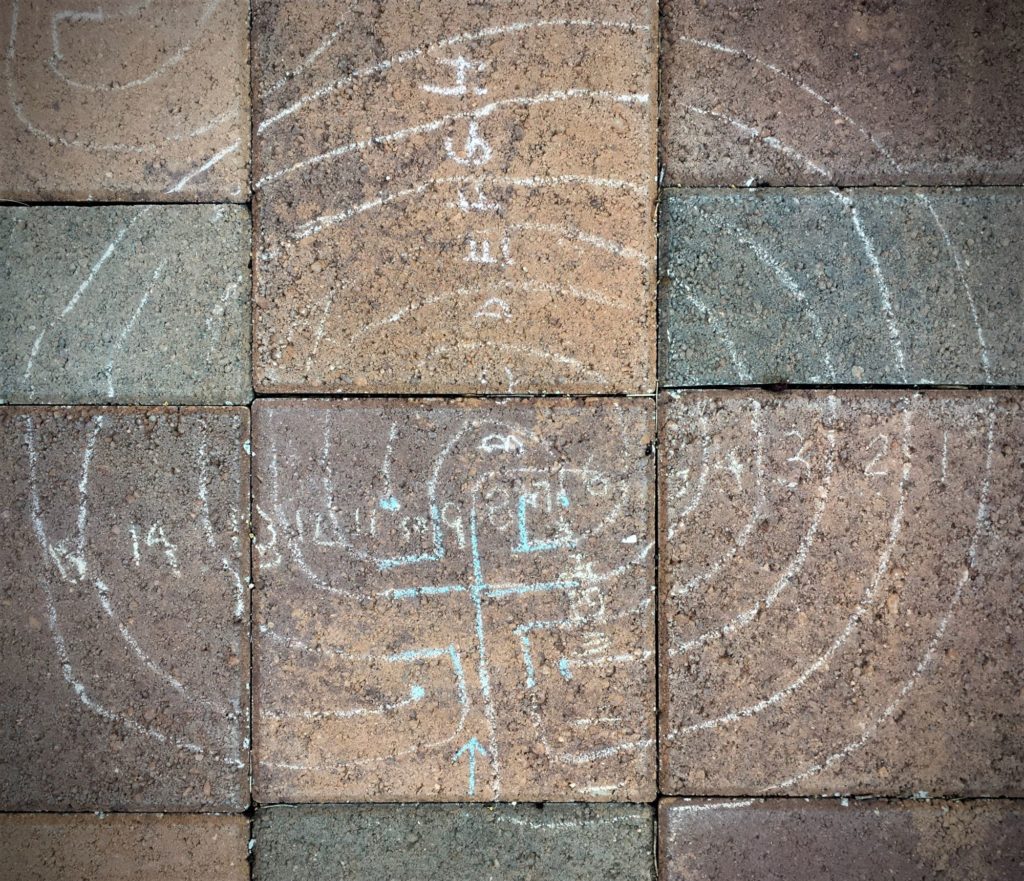
    My daughter and I drew a labyrinth on the backyard patio. Unlike a modern maze, the classical labyrinth is a single continuous path that continually loops upon itself until you reach the center.

    I started to walk the labyrinth every morning as the kids played in the yard. A week into this new routine, I noticed that my mind was craving its morning roundabout on the patio – I had unconsciously slipped into the practice of a daily walking meditation.

    What other rituals should we instill for ourselves and our teams? It may seem daunting, but our fears could be overblown. Our psyches might quickly adopt the new routine.

    ~

    It rained as I wrote the first draft of this post. The morning after, we redrew the labyrinth. As I retraced the lines, my daughter added little drawings inside the path. She designated special powers to these sketches, sending us to various parts of the yard if we stepped on them. This simple path became the armature for a new outdoor game.

    Don’t be afraid to take the first, imperfect step. The new endeavor could be the foundation for future continual improvements.

    ~

    After further rainstorms, we are now on iteration #4. The game is gone, the labyrinth rotated 90 degrees, and the path has been widened to fill the entire patio. Even so, we are at least one version away from perfection. The impermanence of the chalk has been a feature, not a bug. Indeed, the impermanence of the chalk is why we drew the labyrinth in the first place.

    Don’t fear temporary changes. A collection of minor tweaks could lead to something bigger. Our buildings may be permanent, but our processes are ephemeral. We should constantly experiment and try something else tomorrow.

    ~

    One Question

    What big problem needs to be tackled with a series of small steps? How are you gonna take the first step?

    Hit reply and let’s chat!

    ~

    Three Links

    This labyrinth experience was an unintended example of creating a Tiny Habit. Even though I have not been successful at manufacturing new tiny habits on command, BJ Fogg’s book is still worth reading.

    A few weeks ago, Arnaud Marthouret shared a few lessons from racing motorcycles. He recently followed up with three more lessons. They remind me of lessons I learned from a much slower activity – Tai Chi.

    Check out the Laughlin Labyrinths, created by Wes Dufek. Park safely and find your center in the desert and enjoy views of the backside of some cheesy casinos. It’s a moment of pure Nevada.

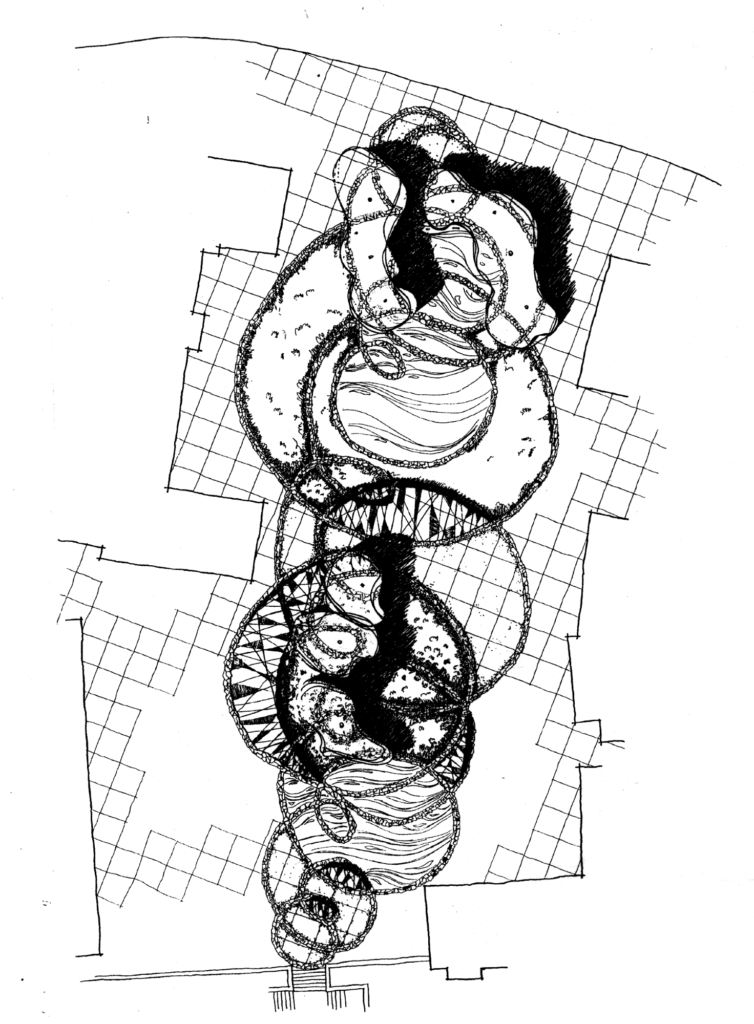
    … and a drawing.

    Maze, Landscape 103, 2000
    I was first introduced to the classical labyrinth in a studio taught by Chip Sullivan. It’s interesting to see what stray errata have stuck from my time in undergrad. Two decades ago, labyrinths wouldn’t have been on that list, but here we are.

    ~

    Thanks for reading the OPM letter! I’d love to have a conversation if you have any feedback. I hope you found some prompts to stretch your craft and relationships as a curious Owner PM. See you next week!

    Stay humble, be kind, and keep experimenting!
    Justus Pang, RA

    ~

  • “It’s not about proving yourself, it’s about improving yourself.”

    Yup. I’m the fucking client. I’ve got nothing left to prove.

    But there is always something I can do better.

    This need for constant improvement should drive me.

    Let’s kick ass on this job and beat it on the next one.

  • A Plucked Phoenix is Worth Less than a Chicken.

    拔了毛的凤凰不如鸡。

    A plucked phoenix is worth less than a chicken.

    Chinese Proverb

    Joining the government was quite magical. People started returning my phone calls. Folks from the same companies who didn’t bother sending a confirmation receipt when I previously sent them resumes inquiring about public job postings.

    If I wasn’t careful, I might actually believe that I had moved up in the world. However, I always remind myself that they aren’t picking the my phone call. They are taking calls from a Project Manager 2 at the State Public Works Division. It’s about the position, not the collection of biologically animated cells that happen to identify with me.

    Of course, I hope that some of the new companions from the past three years actually appreciate my company, not merely the State’s patronage. But it’s impossible to shake the nagging question, “what would happen if?”

    I’ve been lucky to have stayed on an upward trajectory in my career (so far), but I wonder if a fall from grace is ultimately a more painful ride than staying stuck in the mud. Then again, a drop is the risk that comes with moving up in the world.

    Increased fragility from higher prominence is the ante to play the game.

    Hopefully, an over-inflated delusion about one’s intrinsic value isn’t.


    I’ve been blessed to work with great architects over the past three years. I’ve really enjoyed their company and I hope our partnerships will continue for many more years at the Division!

  • The Project and the Real Project

    One of the reasons I’ve enjoyed my work is that I tend to always think of my projects as a two for one deal.

    For example, I am the Owner’s Project Manager for a new university building, but the real project is learning how to be an OPM on a major capital improvement construction project.

    The first project gets me paid, the second project gets me excited to go to work every day.

    I wonder if this has something to do with a pattern in my career where I’ve made a change every few years. Once I’ve learned the craft offered by a company, I sense a calling to move on, especially after I’ve repeated the process a few times. At that point, the hidden project of learning the firm’s specialties has lost its appeal since I am well familiar with it.

    Maybe a more productive pattern would be to find deeper projects within the projects. Once I’ve got the process down and internalized the typology, I should buckle down explore other the real projects behind the project. Once I understand, I need to find a source of satisfaction in a project beyond just learning something new.

    Just asking such a question is scary because it’s a question with no easy answer. But, who knows, maybe this is where the path to mastery might begin.

  • Project Communication Protocol

    I’ve been toying with creating a communication protocol for my projects. I would hand it to my Architect so they would be liberated from thinking about how to communicate so they can focus on what to say.

    Online

    Non Urgent Items go onto an Online Taskboard (to be be discussed in a weekly one-on-one meeting between the Owner and Architect).

    Yes / No quickies can be handled in Email.

    Anything you send to someone that isn’t under your contract should CC: me. I’m not worried about being buried under emails. If I’m not in the salutation, I’ll scan it and file it away quietly when I get around to it.

    Telephone

    Use Phone Calls liberally. If an email exchange might ping-pong more than three times, then pick up the phone. Make sure to document the conversation with a follow up email.

    Don’t bother with voicemail. I never check those.

    If it’s really urgent, Text me. Or call my cell twice in a row.

    Meetings

    Videoconference preferred to save on travel time.

    All Meetings should have an Agenda prepared X days in advance and Minutes distributed within Y days. (This is painful on purpose, to ensure the benefits of the meeting matches the cost).

    A great meeting has three key elements: the desired outcome of the meeting is clear ahead of time; the various options are clear, ideally ahead of time; and the roles of the participants are clear at the time. … I think that’s the single largest source of optimization for a company: the makeup of their meetings. To be clear, it’s not about fewer meetings because meetings serve a purpose. Rather, it’s key to improve the meetings, themselves. A lot of my efforts focus on teaching people this framework. Ironically, I find that most people are just challenged by that stuff.

    Spotify Founder and CEO Daniel Ek

    Links

    I read these four examples a year ago and haven’t referenced them, but they have been fermenting in my brain. They links are sorted by alphabetical order of the company, but do the kids say these days? Retweet is not endorsement.

    Expectations (Automattic, Inc)

    The Basecamp Guide to Internal Communications

    The 10 Slack Agreements of Buffer

    Gitlab Handbook, Communication


    I started in a small office, hand drafting with a telephone, using dial-in internet. Less than twenty years later, I have a cellphone and a computer, both of which have high speed internet and instantaneous access to email and MS Teams.

    When we talk about progress, its easy to forget that the world that we saw slowly changed in real time is just the basic “normal” for those who grew up after the technology became widespread. These younger folks grew up in a totally divergent communication environment, and I believe that a communication handbook may be the best way to bridge the divide, even if it seems stodgy as hell.

  • Punch!

    It’s the morning of my punch walk. Three years of work (for me, four for the other team members) crossing the biggest milestone before students start learning stuff in August.

    I woke up early, much too early for someone about to walk the building all day.

    I feel a mix of trepidation and expectation, when I last visited the site a couple weeks ago, there was a lot of work to be done.

    But here we are.

    Like all milestones, they seem bigger in the future and diminish rapidly after being crossed.

    Tomorrow will be another day of punching.

    Monday will be the fallout. Wrap up some paperwork, wrestle with some loose items.

    A project never ends with a bang, they generally tail off with a whimper.

    By then, we’re long gone, chasing the next milestone on the next project.

  • Web Taskboard + Weekly Check-in for Owner-Architect Communications

    I am an Owner’s Project Manager and Architect for the State of Nevada Public Works Division.  We remodel, plan, and construct facilities for State Agencies for Using Agencies.  The way our system is set up, we ultimately hold the contracts with the Consultants and Contractors.

    I’ve worked on projects as small as a kitchen demolition in a mental health facility to a $44M Education Academic Building for Nevada State College.  This post is based on my experience developing this process during construction administration for this major building (we are a couple months from substantial completion).

    Primary Goals for a Web Taskboard + Weekly Check-in Process

    1. Minimize Emails (or at least email searching).
    2. Centralized hub for Tasks (and information) between the Owner and Architect. 
    3. Create space for synchronizing the Owner and Architect (aligning priorities and identifying unspoken concerns)

    Web Taskboard

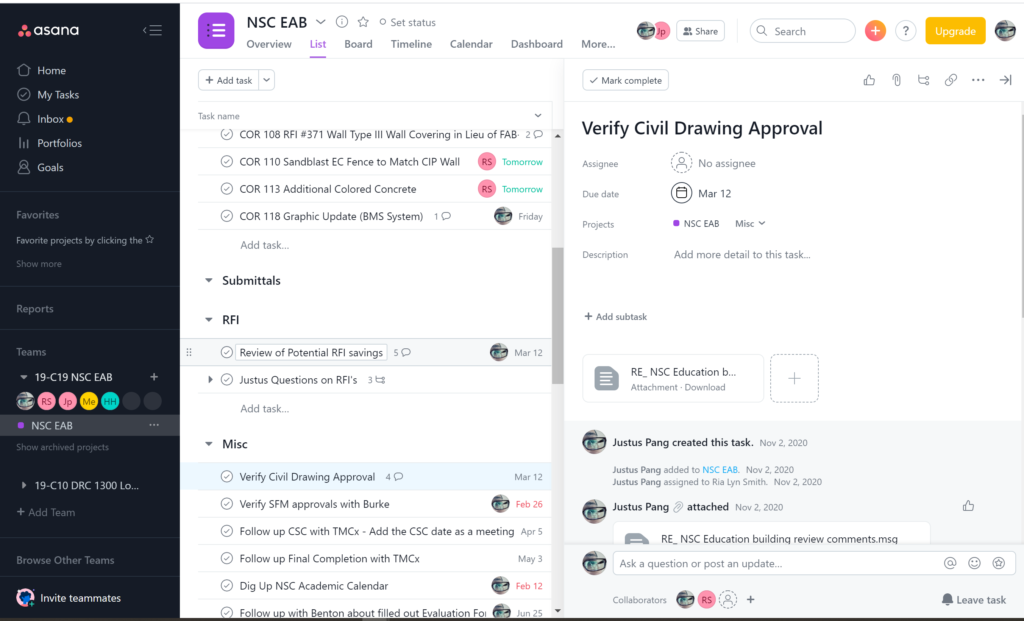
    We use the basic free package of Asana and have not found any significant limitations. 

    Asana Screenshot

    This task board is only used for coordination between the Owner and the Architect’s PM.  The CMAR is not involved since another ad hoc communication channel could cause confusion. The Architect keeps track of their own internal tasks separately (such as typical RFI or Submittal processing), and I keep a separate things-to-do list for project tasks that don’t concern the architect.

    We treat Asana as an open, free flowing space.  Tasks and Deadlines can be added or assigned to anyone.  There are only two restrictions:

    1. If a new task is assigned to someone else with a deadline in less than a week, then a courtesy phone call (followed up by “manual” email) is expected.
    2. Hard Deadlines are to be noted in the Title of the Task.  Otherwise, dates are merely treated as “preferable goals” to signal intent, and it is not a big deal if they are shifted.

    When a task is added, relevant files (documents or key emails) are uploaded into the task.  This eliminates use of email inboxes as repositories of information.  Someone should be able to open the task in Asana and have all the relevant information to start work.

    Weekly Check-in

    A critical part this process is our weekly check-in.  I’ve found it typically takes an hour.  We have a standing placeholder on Monday afternoons, but we are flexible since it’s just the Architect’s PM and myself.  That said, we never skip a full week.  The call is loose and will veer into tangents, but it follows this rough Agenda:

    1. Project Vibe
    2. Run through the Asana List
    3. Go through Recent Walk Thru Comments (due to the pandemic, I conduct my job walks alone)
    4. Any other Open Items?
    5. Long Term Look Ahead
    6. Next Steps (this week’s priorities)

    Analysis

    In theory, this system could minimize ad hoc emails between me and the Architect’s PM.  Unfortunately, this doesn’t happen in practice, because there are always other parties (such as the Architect’s Principal in Charge, Contractor, Using Agency, etc.) who needs to be included in key communications.  However, this system has successfully eliminated email searching because Asana has centralized all project tasks between us.

    This system has given me a much better feel for project progress, despite operating under strict quarantine (we live with our in-laws).  My relationship with the Architect’s PM was great before implementing this system, but this tool has been indispensable in maintaining tight synchronization during the usual chaos of construction administration.  Before implementing this system, I could sense slippages of miscommunication; now we are never more than a week from airing out any concerns before a misalignment could get serious. 

    The weekly synchronization gives me a clear grasp of project needs and priorities.  This has empowered me to focus intensely on my immediate tasks at hand for the rest of the week (for this project or otherwise).

    The system isn’t a magic bullet, we still need to execute.  For example, it would have been extra slick if I had started our FF&E purchases a month earlier than I did.  The tasks were on the list the whole time, but I did not stay on top of my responsibilities to push this part of the project forward at the perfect time.  However, the task board certainly helped me avoid the much worse event of being a month late!

    This process isn’t free – it costs an hour every week.  2.5% of the time where two professionals aren’t executing direct deliverables (not to mention the separately held OAC meeting and job walks).  The best analogy is to call this practice “PMt insurance”.  I believe this regular time commitment has helped prevent small issues from becoming big emergencies.

    We tried Microsoft Teams and Asana.com.  I hoped that MS Teams would integrate better with MS To Do, however that feature only works with the user whose server is hosting the Team.  So, we went back to Asana because it is very consistent in its email distribution (allowing the Architect to keep a record of all communications), and because I prefer Asana’s “List” (spreadsheet) interface.  However, I would use MS Team for internal-only project teams, and I am open to trying other systems if someone feels strongly about it.

    I have Asana’s iphone app, but I don’t use it for task management. However,  I use Asana’s phone app to make “notes” during the job walk.  I then discuss these comments on the weekly call with the Architect’s Project Manager and she incorporates relevant items into her weekly field reports. 

    Personal style disclaimer: I prefer one-on-one phone calls for resolving project issues since I feel decisions and gameplans are developed fastest in this manner.  This process systematizes such a preference for handling non-urgent tasks between me and the architect.  Other PM’s personal styles may differ.

    Future Experiments

    I plan on utilizing this process for future projects, starting at the design phase. I will request that the Architect select their preferred website (Monday, Trello, Wrike, Teams, Asana, etc.) and include any necessary premium costs into their fee.

    For the design phase, I plan on extending the invite to the Using Agency and the CMAR’s Preconstruction Team.  I still do not think this will be an appropriate communication channel with the CMAR’s team during construction operations.

    I wonder if this process will minimize large group design meetings, or at least streamline them, since much of the updates could be handled via the web taskboard and in the weekly check-ins, especially since we hold formal presentations (and subsequent meeting minutes) after each of the major design phase deliverables.

    I’m not sure if this will be useful for smaller projects, but I’ll give it a shot on my next one.

    I might try doing this for internal communications, such as a weekly check-in with my direct supervisor.

    References (some links)

    General Thoughts

    Sample Agendas

    Acknowledgments

    Many thanks to Ria Lyn Smith, who was my co-conspirator in developing this process.  I initiated this system after reading about remote team weekly check-ins during the initial lockdown, after construction had started on our building.  I grateful for her willingness to add this experiment on top of all the other fires of construction administration.

    Also thanks to my AIA roundtable partners – Scott Knudson, Nea May Poole, Rachel Oleinick, Heather Pierce, and Emma Tucker for the lovely conversation that spurred me to finally put this post together. Finally, thanks to Heather Holmstrom for reviewing a draft and proposing some edits for this post.