I dreamt of an asian pear.
Stamped with the image of a watermelon.
Red flesh, black seeds, green rind.
A juicy bulbous slice.
GRIZZLY PEAR
I dreamt of an asian pear.
Stamped with the image of a watermelon.
Red flesh, black seeds, green rind.
A juicy bulbous slice.
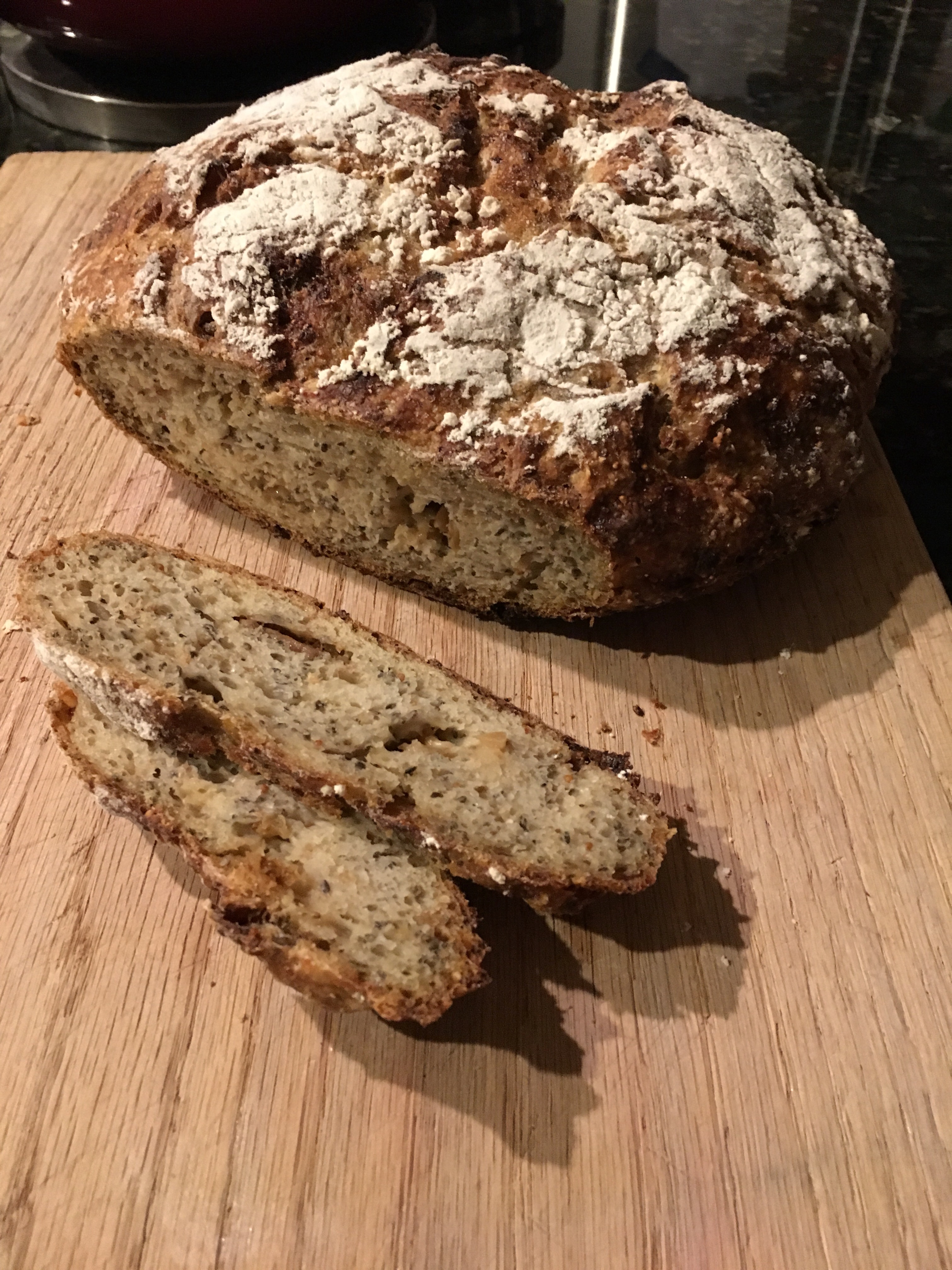
We decided to make pancakes for Saturday morning so I bulked up my starter the night before. With such happy starter in the kitchen, I had to make bread with it, even though I still have half a loaf from last week’s late bake.
400g flour
300g water
100g starter (the usual 50/50 mix)
10g salt
60g rehydrated figs
60g chia seeds, soaked in 90g water
40g flaxseed meal, soaked in 80g water
With fresh starter, the proof started very nicely, but we went to a 3pm event at the library, so I had to put the dough into the fridge. Sunday was spent with one of our daughter’s friends, so I didn’t get around to baking till Sunday night. All this was a minor of a shame, since that dough was in a really, really good mood when it was first put in the fridge.
By the time I took out the dough, it was on the verge of being overproofed. It wasn’t so bad I had to attempt a rescue, but it was barely able to hold its shape. For the bake itself, I also tried the two tweaks I mentioned last week – I just baked at 450f the whole time, and I started with a cold lid. Given the state of the dough, I think the bread rose just fine so I plan on adopting these for the future.
As for the bread itself, it has the usual tight crumb, which I don’t love because big open airy crumb is in fashion but I’ve given up trying to change since it’s good at catching butter butter. The flavor is slightly sour, given the 30 extra hours in the fridge, but not as strong as last weeks loaf which spent a good 60 hours in the fridge.
In non-bread news, we also made pork wontons using the Kitchenaid pasta maker last night. The recipe came from the web with a 180 flour, 26 egg, 64 water ratio. Our egg was 45g so the ratio was upped accordingly and I accidentally added a 16g too much much water, so I had to add another 32g of flour. The wrappers came out fine. It seems the best process for making this dough is to let it rest (in a closed container to keep moisture) a lot along the way. In the future I’ll mix, rest, divide and flatten each ball at the 1 setting, and then thin it all the way down on an as needed basis.
For the filling, my wife used our brand new new Kitchenaid food grinder. The meat was a bit lean, but there were no glitches with the tool itself. I can’t complain, it was deeply satisfying to use these things we purchased to celebrate the new job and its pay raise. The bigger numbers on the biweekly check is nice, but it’s feels good to have some toys also.
One of the duties at my new job is architectural plan reviews, which includes both drawings and specs. The hardest part of the task getting started; it is daunting to look at break open the massive drawing set and multiple specification volumes that need official owner comments.
I’ve had a design development set staring at me for a few days now, mutely shaming me every day that passes without any progress. I tried to start the markups a few days ago, but I could not concentrate. The eyes glazed over and I was mindlessly flipping pages. Mercifully, an interruption came up and I didn’t end up wasting too much time on this fruitless attempt.
Last night, I began to review it in earnest. Again, it was slow going to start, but I suddenly remembered to pull out the yellow highlighter (which I use to mark off notes that have been read) and I soon slid into a nice groove.
I’m certain that shear repetition will make this task less daunting after each completed review. But I also suspect that getting started will become easier because I’ll get better at setting the table sooner rather than later. When confronted with a mountain of paper, I’ll start by pulling out the yellow highlighter and red pen, letting these simple objects prime my brain for the task at hand.
I just woke up from a dream where we were on the verge of buying another fixer-upper that was in truly execrable shape. It was an old victorian house with multiple additions over the years with several tenants already living in it. Our plan was to subdivide it further and rent out the first floor as an Air BnB. The deal fell through when we went up to the second floor, saw that the floors were completely sagging, and finally realized the enormity of the task.
After all, we had already done in real life with our never ending house remodel. It was a difficult experience, that constantly loomed over us for several years. People think that house remodels are fun. Maybe it’s an enjoyable hobby for a select few, but for most folks, it would actually be an utter slog like we experienced it.
It’s been nice to have our house more or less completed, but the best part of the experience was really learning to work with others. First, it cemented our opinion that my wife and I make a good pair. Residential architecture is the most personal physical manifestation of your vision of the future, made that much more intense because you are expending your own limited resources to actualize this vision. Furthermore, as the homeowner builder, you are continually confronted with decisions long after the main design exercise has been completed. Having gone through this crucible, we now have tangible proof that we will ultimately come up with the best solution to any problem, even if we don’t agree at the start.
On top that, it was the first time that I was the owner, both of the building and of an enterprise. As an architect, I’ve always tried to sincerely keep the owners’ best interests in mind, but when you also must cater to your boss (any employee’s true client) it just isn’t the same as being the actual owner of the building. As the homeowner-contractor, we were also suddenly thrust into the position of being a temporary GC, one who would be living in the results. Since we were on a tight budget, we had the pleasure of working with several subcontractors who delivered subpar work. As someone who has never been in a management position or owned my own business, this was a sudden baptism into conflict resolution. No one comes out of it happy, but we did get them to come back out and redo it to a meet a minimal standard and come to an acceptable compromise.
Silly as it may sound, this quixotic house remodel experience was the best preparation I could have for my new job as a project manager for the state. Now, I’m well practiced in being an Owner. When I first started the house remodel, I deferred too much the experience of my subcontractors. After being disappointed several times, I’ve learned that I need to carefully supervise their work. I’ve now taken this mindset working with my consultants. I respect their expertise, but I won’t blindly trust their recommendations. These are my buildings and I am gong to live with the results. I’ve always been fair, but now I know to be firm.
It wasn’t a fun process, and I don’t recommend doing your own house remodel if you aren’t in the AEC industry, there’s gotta be less painful ways to learn these lessons! Even though it turned out great for my career, I ain’t doing it again, in real life or the dream world.
I just came out of a design meeting for a new $45 million dollar college building. One of the consultants was a cost estimator who I had worked with at my previous company, so I was quite happy to see them in the room.
We had worked together on some small tenant improvements and they were always detailed, responsive, and professional. When I scheduled a project, they were honest about their capacity, and even if our deadlines got moved by the client, they made sure I still had something presentable.
I would naturally catch some oversights and disagreements during early drafts, but the comments were always minor. They carefully thought through every item and were always prepared with clear explanations whenever I challenged their conclusions. In short, I loved working with them.
Now that I realize that this whole time they’ve also been working on other projects with a bunch of extra zeros, and my esteem only goes up further. At the old gig, my jobs were small but they were the most important thing in my world, and I never doubted it was the same for them. For one’s sanity, any good professional will be forced to prioritize their tasks, but having done so you can’t forget that each client has hired you to deal with their top priority.
It can’t be an easy juggling act, but when you can make the little guy as happy as the big boys, you are indeed a true professional.
A couple nights ago, we gave our boy a haircut. He was born with a full head of hair, and it was the first thing anyone mentions when they saw a photo of him. But the hair has been starting to cover his eyes for a couple weeks. It was well overdue, even though we’ve been loathe to cut it.
Like all good parents, we googled “how to cut infant hair”, parked our daughter in front of the Peppa Pig Show, and took a bunch of photos. After the preliminaries were completed, we took the little guy to the bathroom, and my wife wet his hair as I held him up. Then we started hacking away. As a baby, he kept twisting and turning, which made clean cuts difficult. He soon got tired of the situation and started fussing, making clean cuts impossible.
Soon there wasn’t much else to do. We had obliterated the lovely hairdo that he’s unknowingly flaunted his entire life. My wife and I giggled at how badly we did. For a moment we were young lovers again, who just finished a new adventure.
We had some old cream that was set to expire, so we made some butter last Saturday. With the butter came buttermilk, which I had never tasted in its non-cultured form. I didn’t realize that non-cultured buttermilk would taste (like milk, duh!) but I was kind of disappointed.
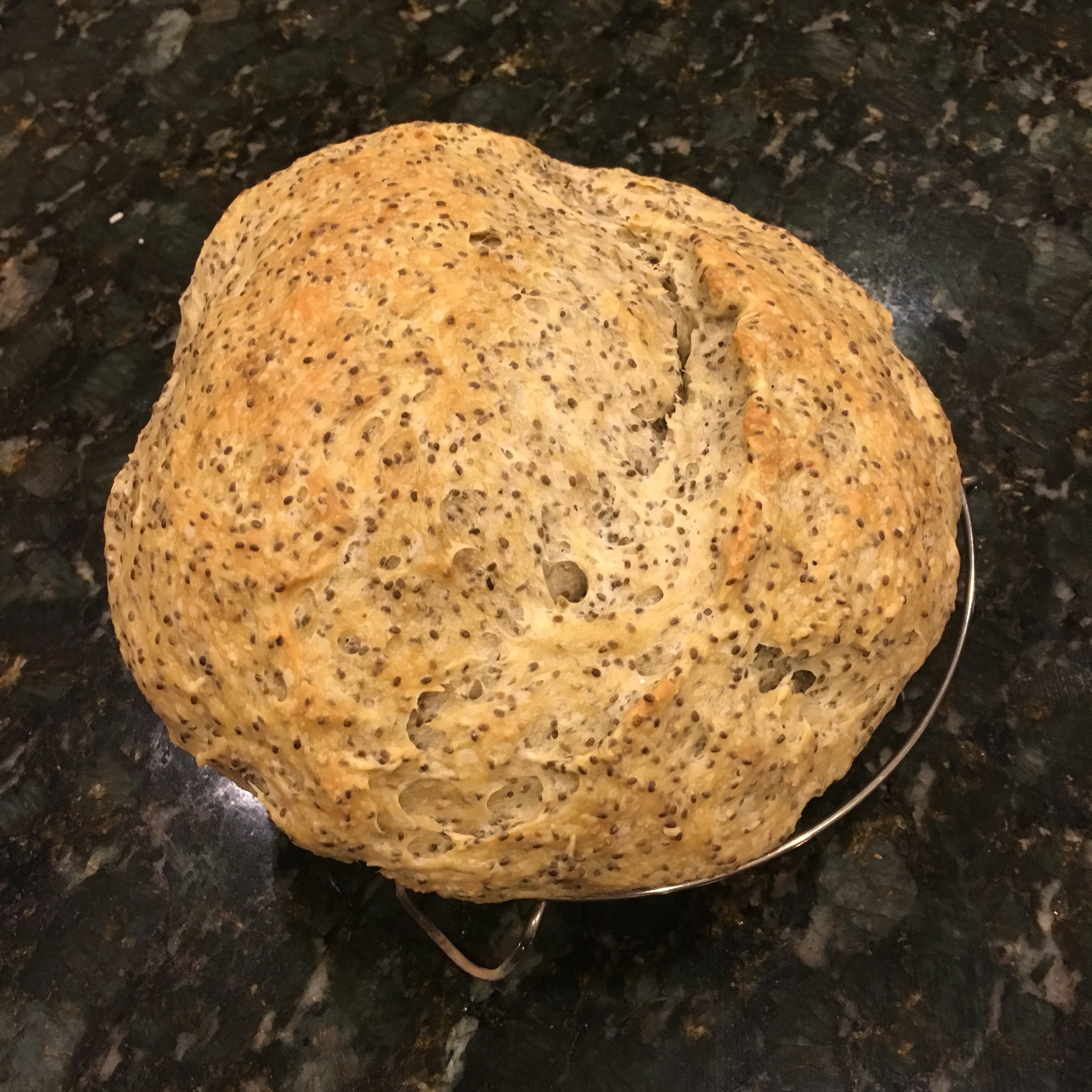
However, leftover buttermilk would be perfect for one thing, making an enriched bread. We had a birthday party to attend that day, so we refrigerated the buttermilk for a mix on Sunday morning. So I took the usual 4-3-1-.1 recipe to make an enriched bread
400g flour
150g buttermilk + 150g milk
100g starter (the usual 50/50 mix)
10g salt
60g melted butter
60g chia seeds soaked in 90g water
We started with a twist I don’t plan on repeating. I decided to mix the dough in the kitchenaid. The machine seems to work just fine, but since I don’t normally handknead (it’s too wet a mix for hand kneading) this doesn’t save any effort and it alienates me from the dough and the tactile feedback that comes from hand mixing.
After that came the second twist. We found out there was a drum circle in the Summerlin library in the afternoon. Given that the few loaves have overproofed, I decided to play it safe and threw the dough into the fridge when we left for the event. This was definitely the correct decision, since we ended up meeting up with some friends and stayed out past dinner.
On Monday I took the dough out after work, warmed it up, but ultimately decided it wasn’t ready to bake. It was getting late and a bake would have really made it a late night. With my tendency to wake up early, anything past ten is a bit too late.
However, the dough wasn’t getting any younger and we had also finished our bounty from last week’s overproofing fiasco. So on Tuesday I brought it out after work, warmed it in the proofing oven until 8:20, after which I fired it up to 350f. The dough had not completely warmed up, so I folded the dough, an exercise I had recently stopped doing, and it held its shape nicely.
Aside from the long proof and the mixer, I tried two other deviations from my usual process. First, I did not preheat the lid. The process of handling a preheated dutch oven is fraught enough, I’d just as soon avoid having to work with a hot lid as well. Given how this one came out, I’m not sure this will be a permannt change, but I’m going to try again with a normal dough. The other twist came from my coworker who wets her ball of dough with her hands to get a chewier crust. Unfortunately this dough came out with an very thin crust, so while it fun to fondle the dough before throwing it into the dutch oven, I doubt I’ll try it again, certainly not with an enriched bread.
The process of transferring the dough to the dutch oven was uneventful, five snips to the top, throw on the lid, and back into the oven. As usual, I baked for the first half hour with the lid on, and the rise looked good when I took it off. The crust was still white after twenty minutes without the lid, so I ended up baking it for another forty minutes. After an hour and a half in the oven, I was getting worried about drying out the loaf so I pulled it out even though the crust was still very pale.
This morning, I just cut my first slice and the verdict is mixed. The crumb is just fine, the usual density I generally get as long as I avoid overproofing the loaf. However, the crust is paper thin; the color in the oven did not lie. I avoided going high on the oven to avoid burning the fats in the butter and milk, but I think I may have stayed too low, especially since I maybe could have gone higher because this bread did not include any sugar in the mix.
And finally, the bread is a bit sour. A couple weeks ago, I had pondered why my sourdoughs are never sour. I’ve read that the key is a cold proof, which doesn’t happen naturally in Vegas, so I rationally knew the answer. Now I’ve proved it to myself. However, my wife is not a fan of commercial sourdoughs, so I doubt it won’t go over well with her. But my daughter, who will drink the vinegar and soy sauce mix that we make for potstickers, might dig the flavor.
If we ever make butter again, I’ll definitely use the buttermilk in the dough, though I don’t plan on voluntarily repeating this extended proof unless circumstances force the issue again.
My wife and I were talking about our favorite season of the year and concluded that it is fall. Summer is too hot and winter too chilly. Spring is nice enough, but it is marred with a sense of foreboding; every day brings us closer to the dreaded start of summer. Late May is the hardest part of summer, when the heat hits in force, but you have not yet been acclimated to triple digit intensity.
In Houston, it’s not the heat in August but the heat in October that gets you. Out there the relentless humidity lingers until just about Halloween. With our dry heat, Vegas is much harsher when the sun is up, and equally as relentless around the clock in July, but it does lighten up in the evenings, especially as summer winds down.
This transition between summer and fall sets the scene of my favorite vignette in the city after living here for half a decade. I’ve seen it in multiple playgrounds as children and parents are released from the coop of their air conditioned boxes. The kids race around on the equipment as the parents are chatting on the side. You hear yelps and screams, and three or four languages mix together around you. Everyone is out. A collective energy fills the air.
I wonder if any other city has as much a divergence between its public and private personas. But if you want a glimpse at the heart of this city, drive out to a playground right now, this evening, and we’ll be here to show you.
The five month old has been happily gumming on anything in arms reach, his hands, his toys, the blanket, our hands. Even if she didn’t display the same enthusiasm, our daughter went through a similar phase, but we were new parents and I generally refrained from letting her chew on my fingers.
A few weeks later a tooth had broken out, and I found out it was no joke. The first time she bit my finger, I immediately regretted that I had missed out on something pretty cool and exceedingly rare. In this modern professional age, we only have a kid once or twice in our lifetimes, and lord knows when or if the grandkids will be following up. How often will you get to have an infant comfortably chew on your hand?
But life was kind enough to give me a rare second chance, and I’m not passing this one up. I’ll wash my hands extra, and for damn sure I’m going to let him gnaw away.
I just received a very kind note from a friend who I contacted on Facebook Messenger. Following up on yesterday’s post, it energized me on pushing forward with this project, but it also cemented my decision to stop trying to use the Facebook timeline for conversations.
Earlier in the week, I had posted an item on the public timeline, tagging several people hoping to start a conversation, but got minimal response. It was a relatively benign subject about some changes on the AIA code of ethics, but I think the overwhelmingly public nature of social media makes difficult for people to have a conversation, aside from yelling about politics.
Furthermore, the timeline is too perfectly engineered for passive consumption. Like an ipad, the timeline is great for viewing but not conducive for producing – hell FB even pre-manufactures posts for you. Over the past year, I’ve taken several abortive attempts to deactivate my timeline because the addiction was just too much, but I keep coming back. I’d like to find a balance for using this product since I enjoy seeing news and links from old friends, but if the opportunity cost is fewer true conversations, maybe I’ll have to quit cold turkey.
So yes, another post adding to the chorus of social media self haters. Stealing from an insight by Bomani Jones, we all have a Facebook account but who actually loves the service?