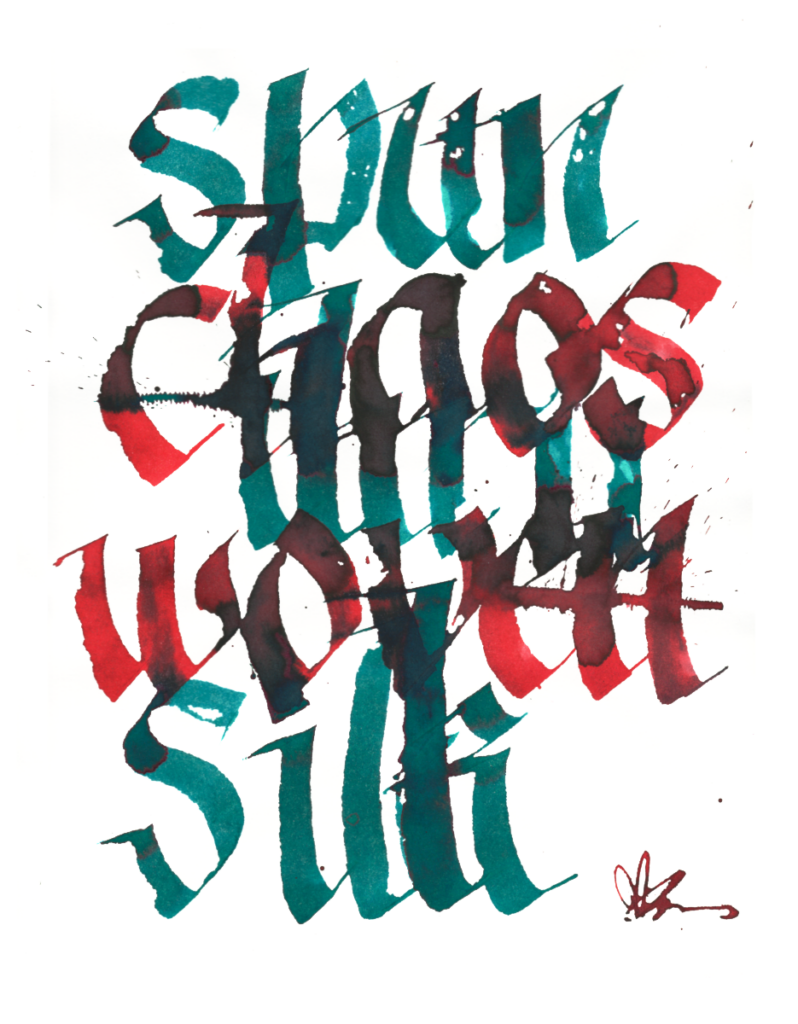
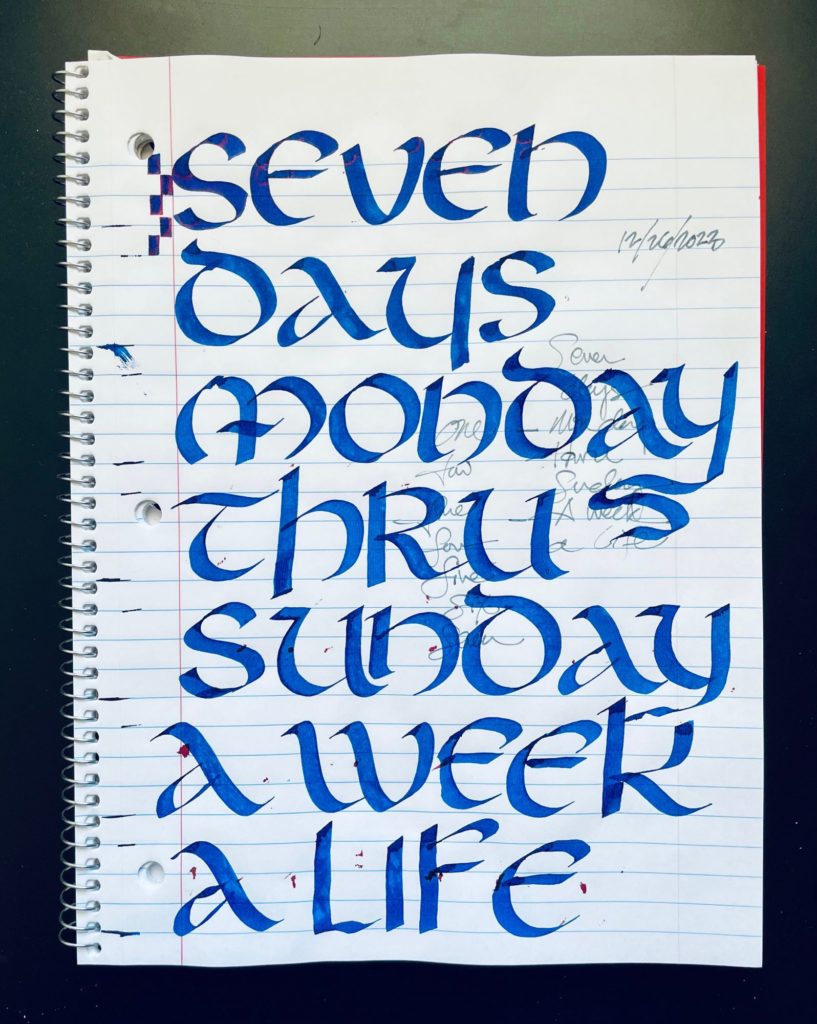
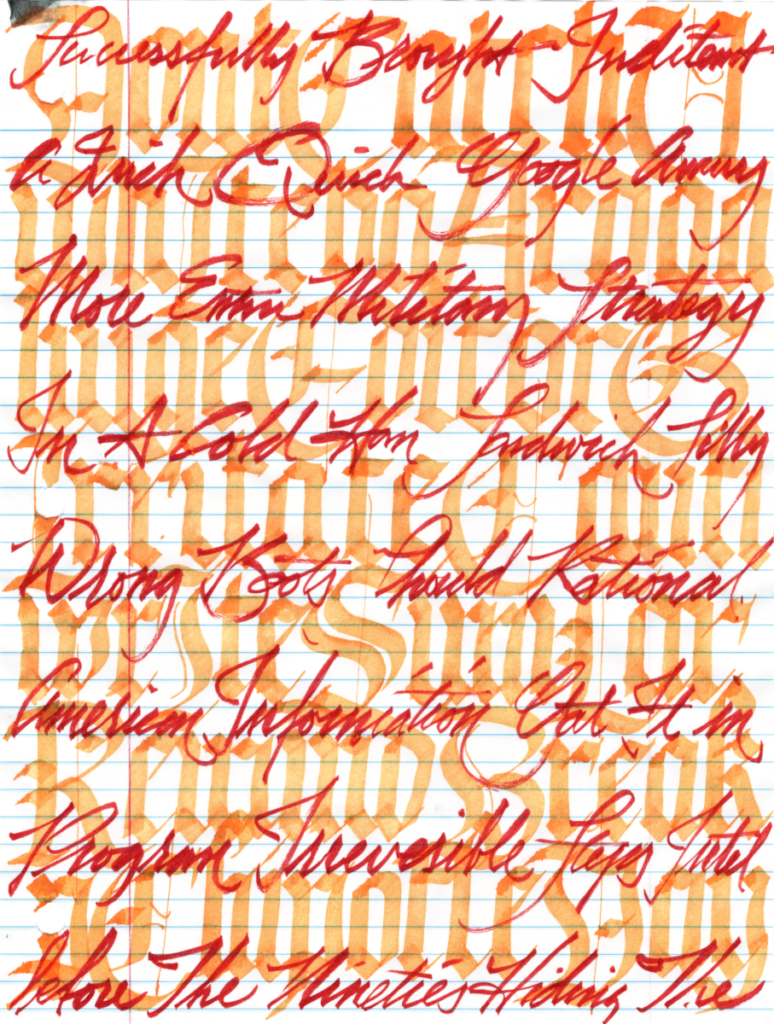
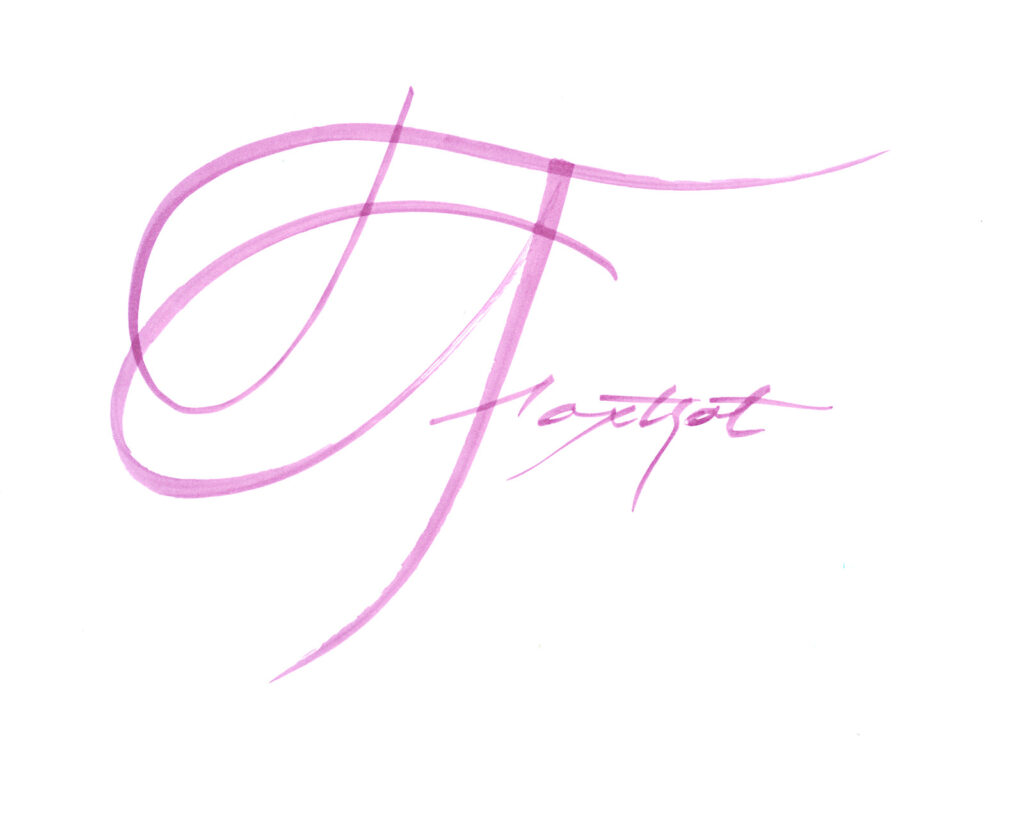
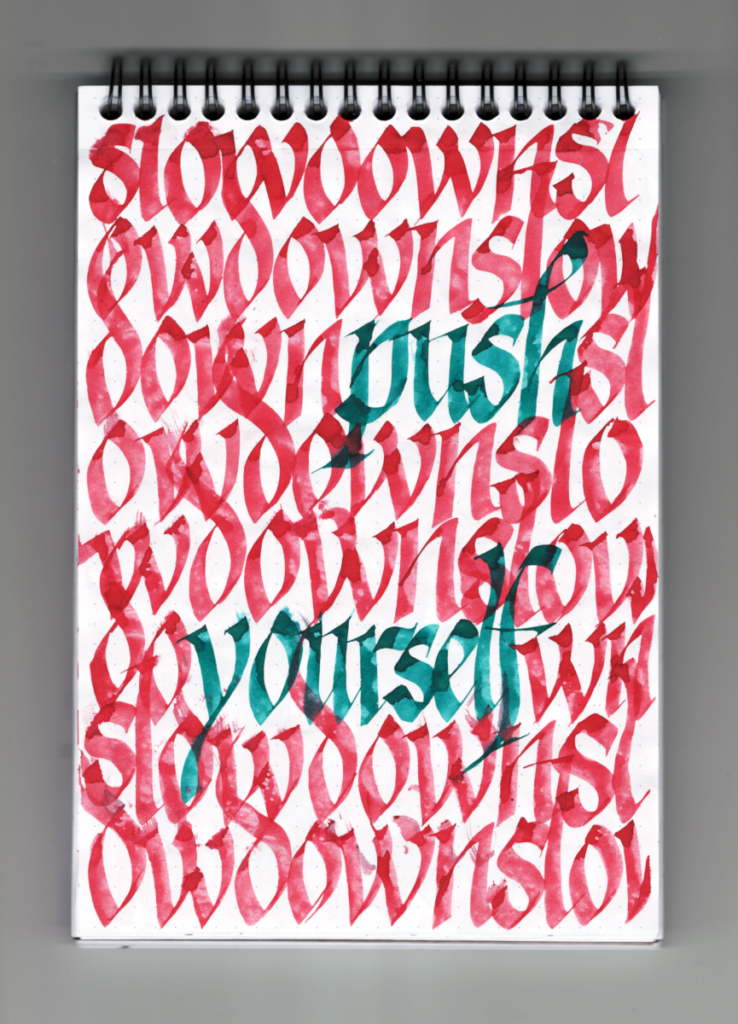
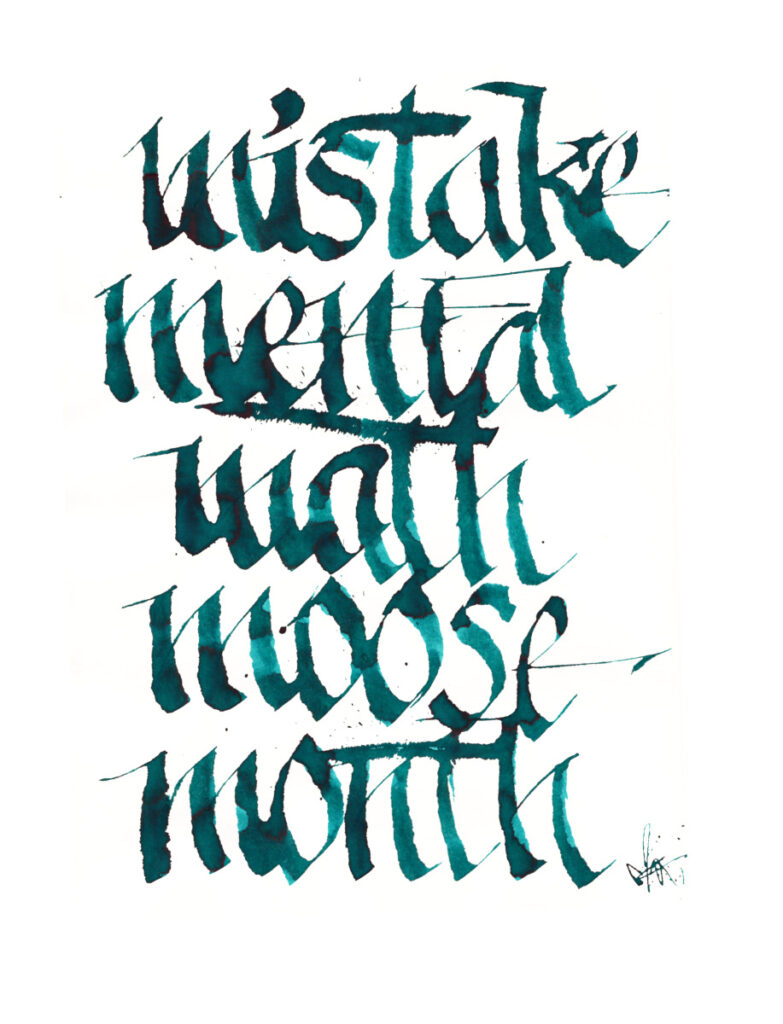
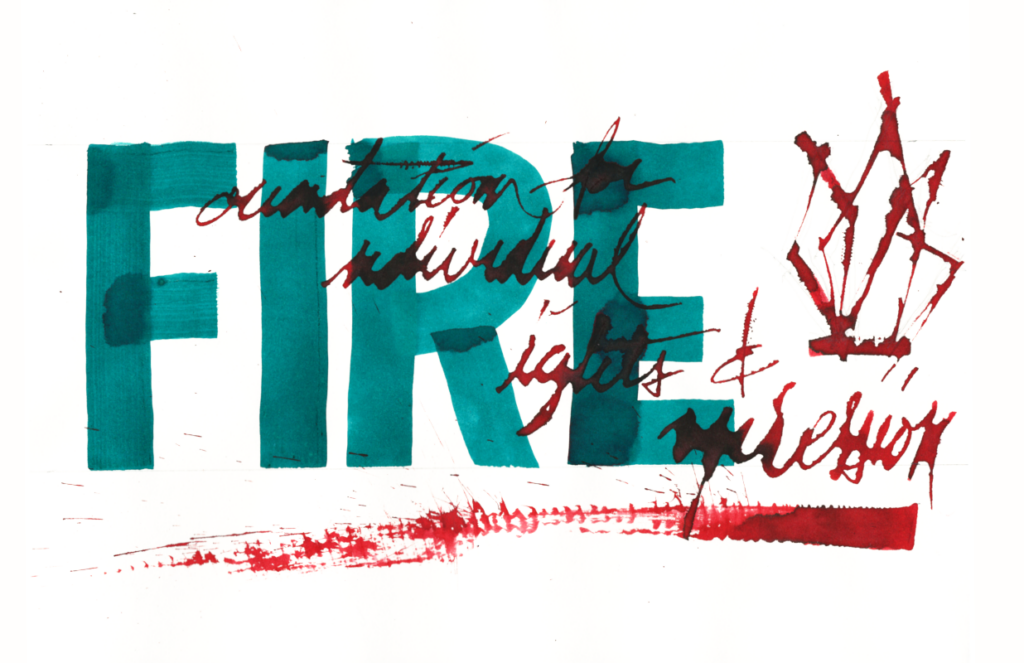
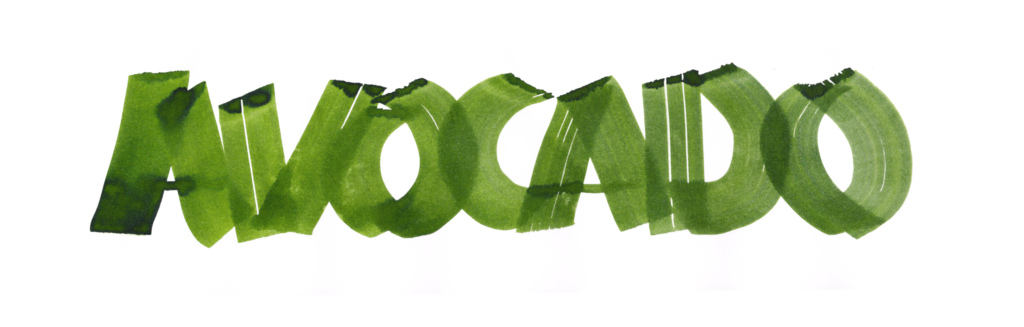
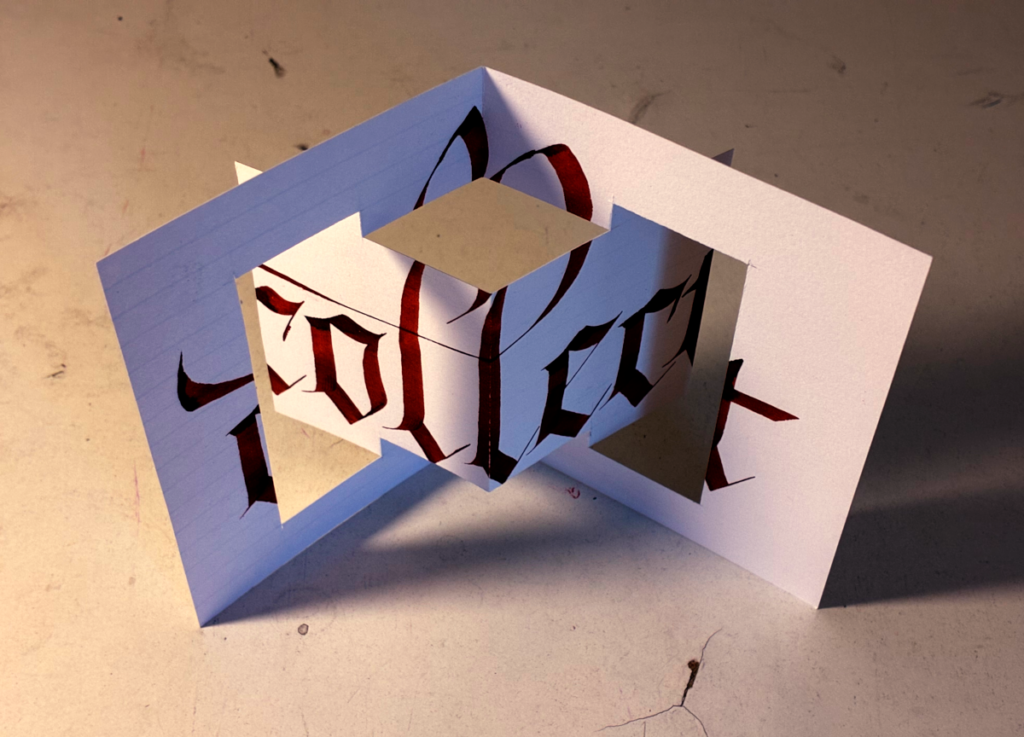
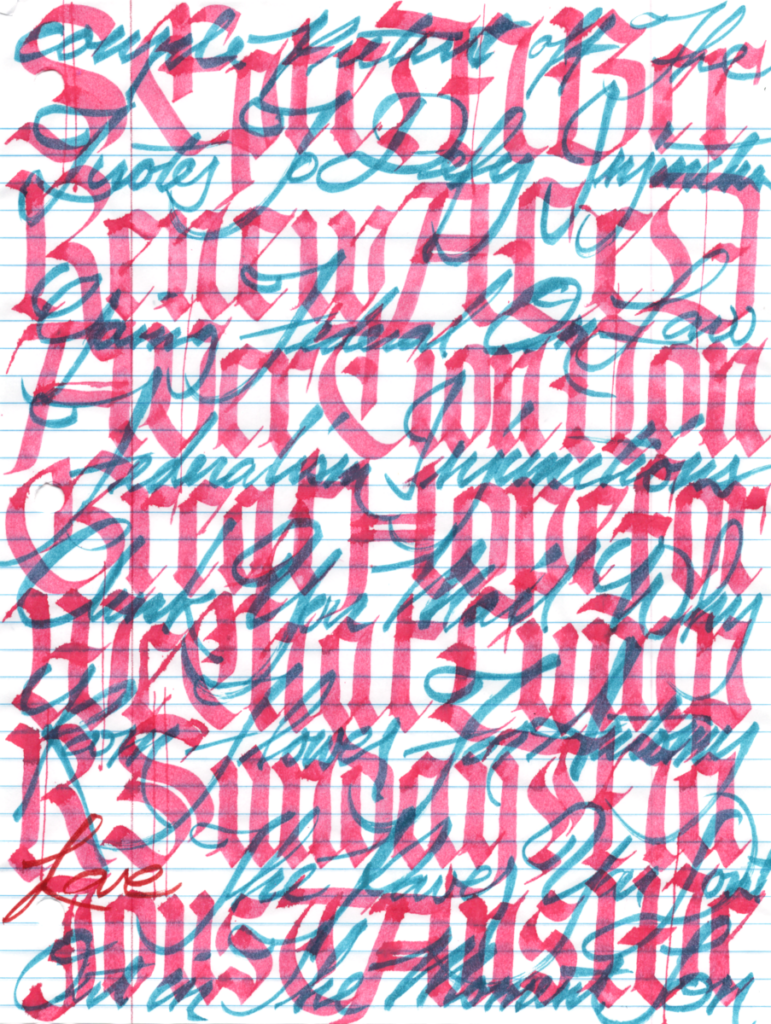
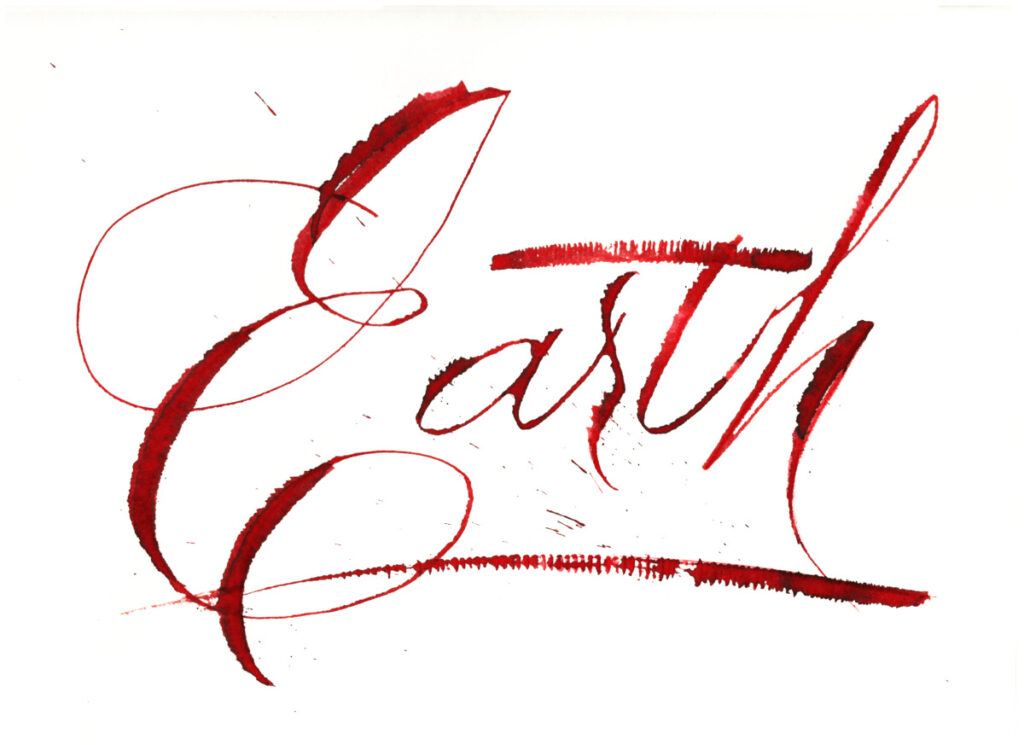
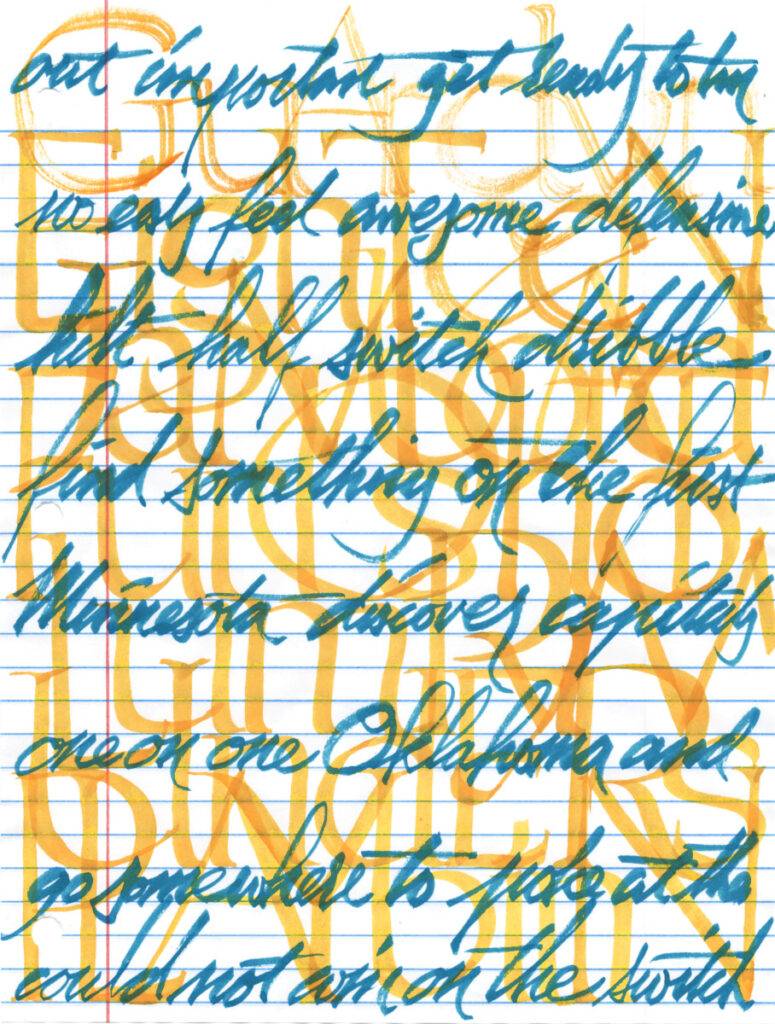
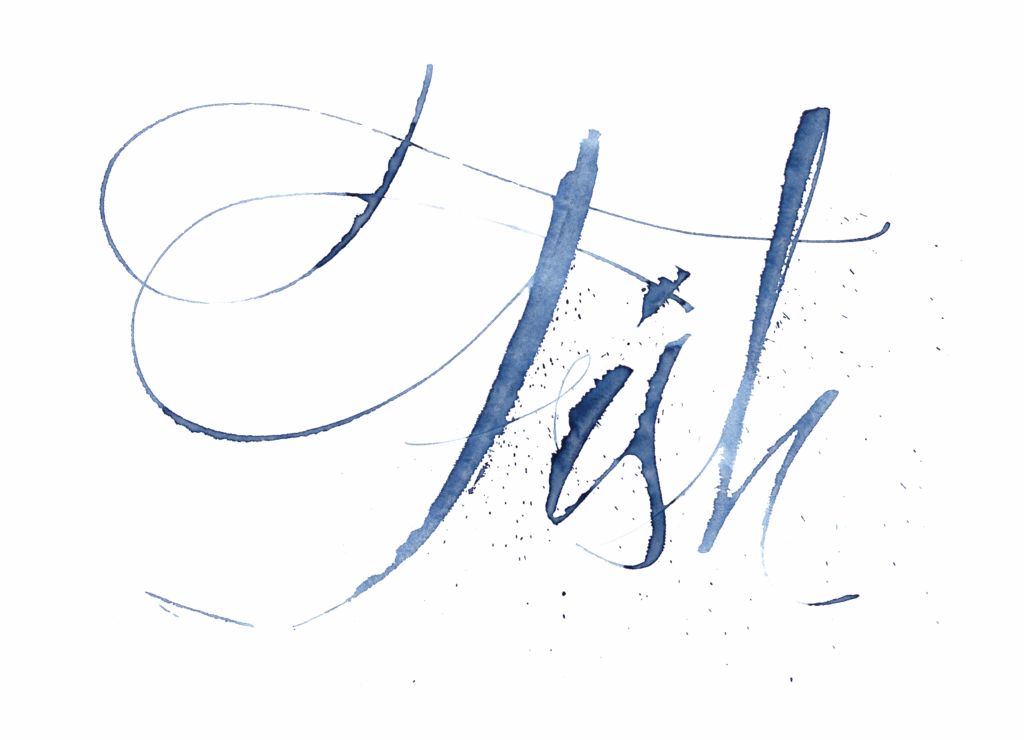
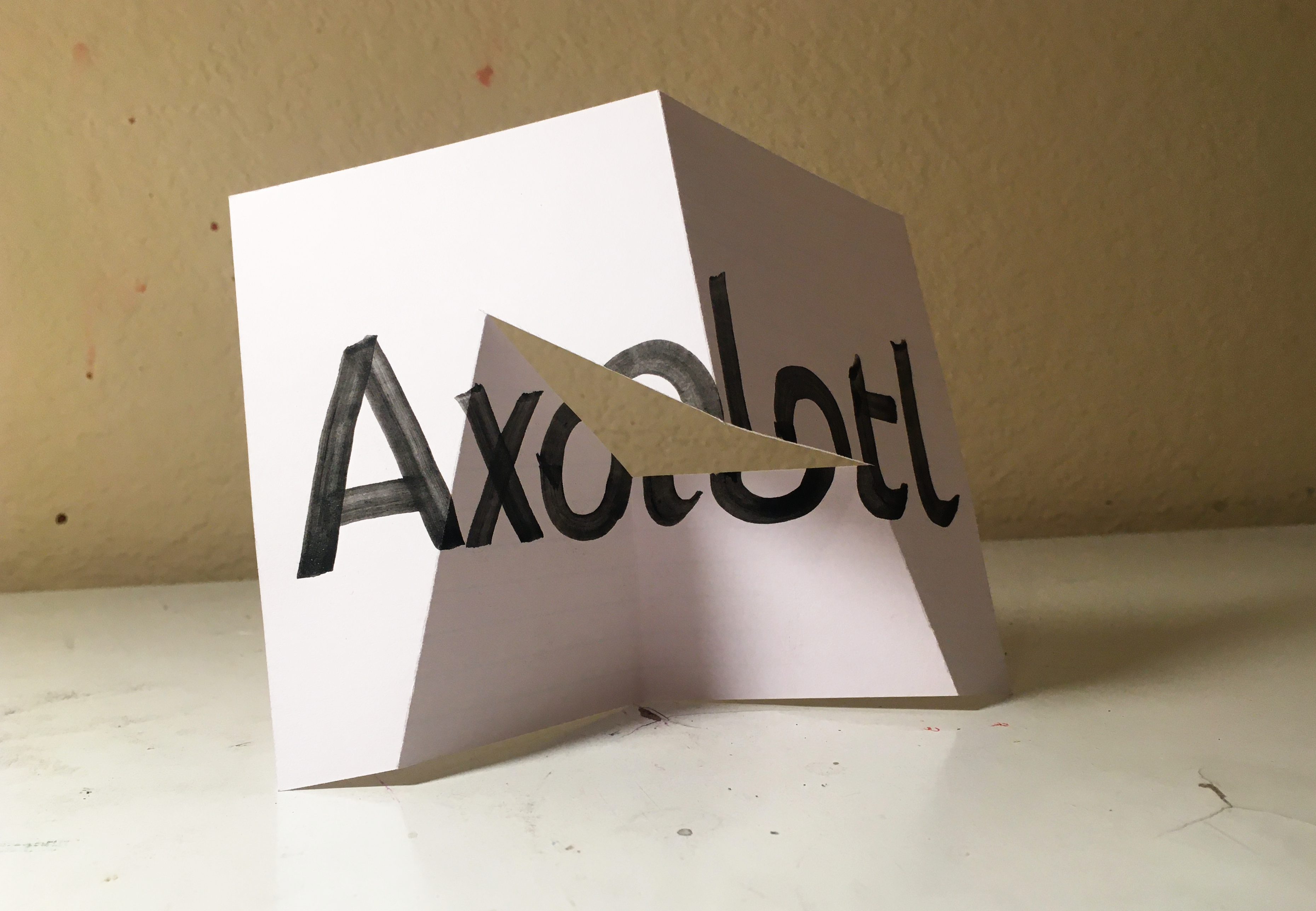
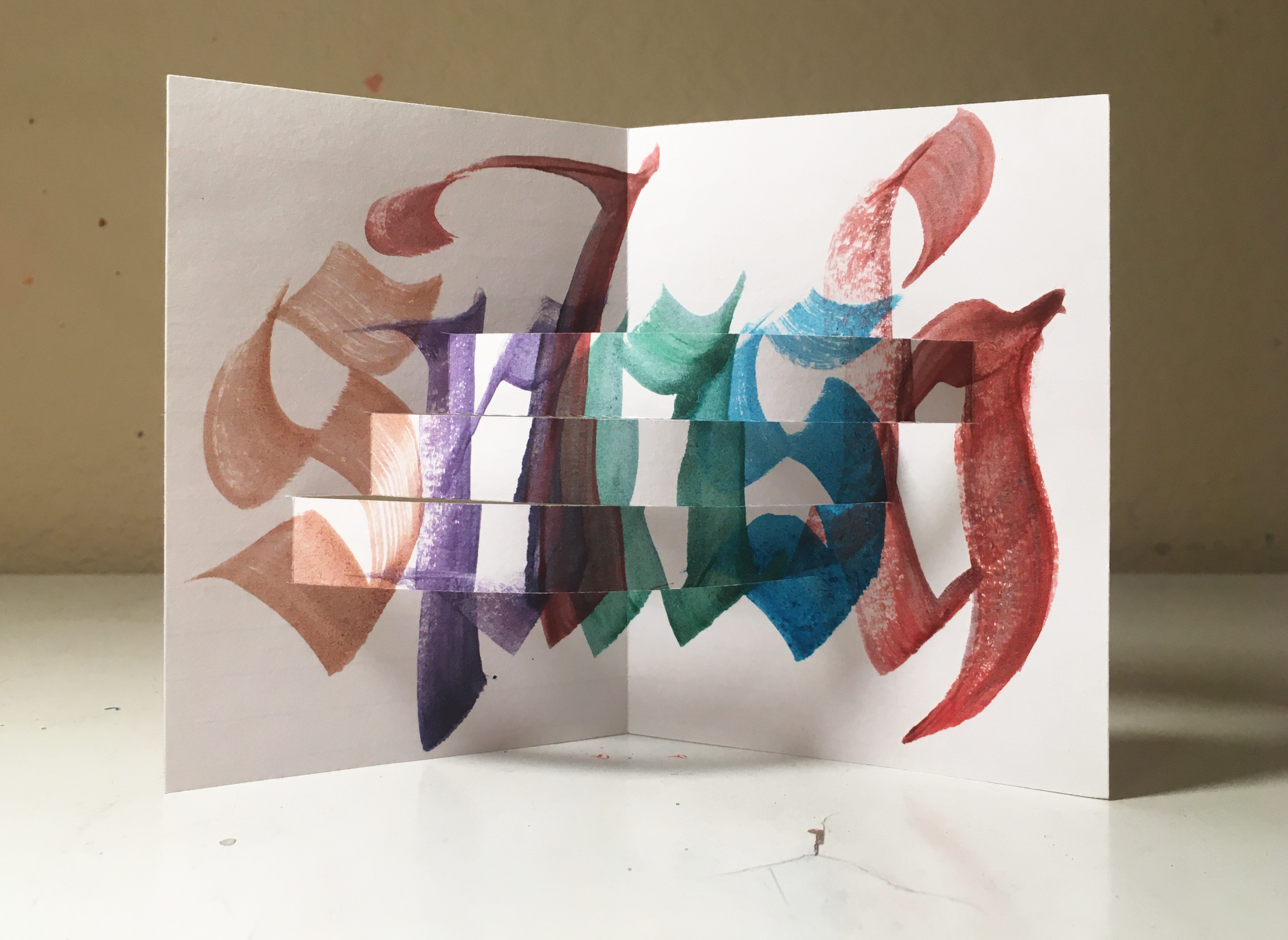
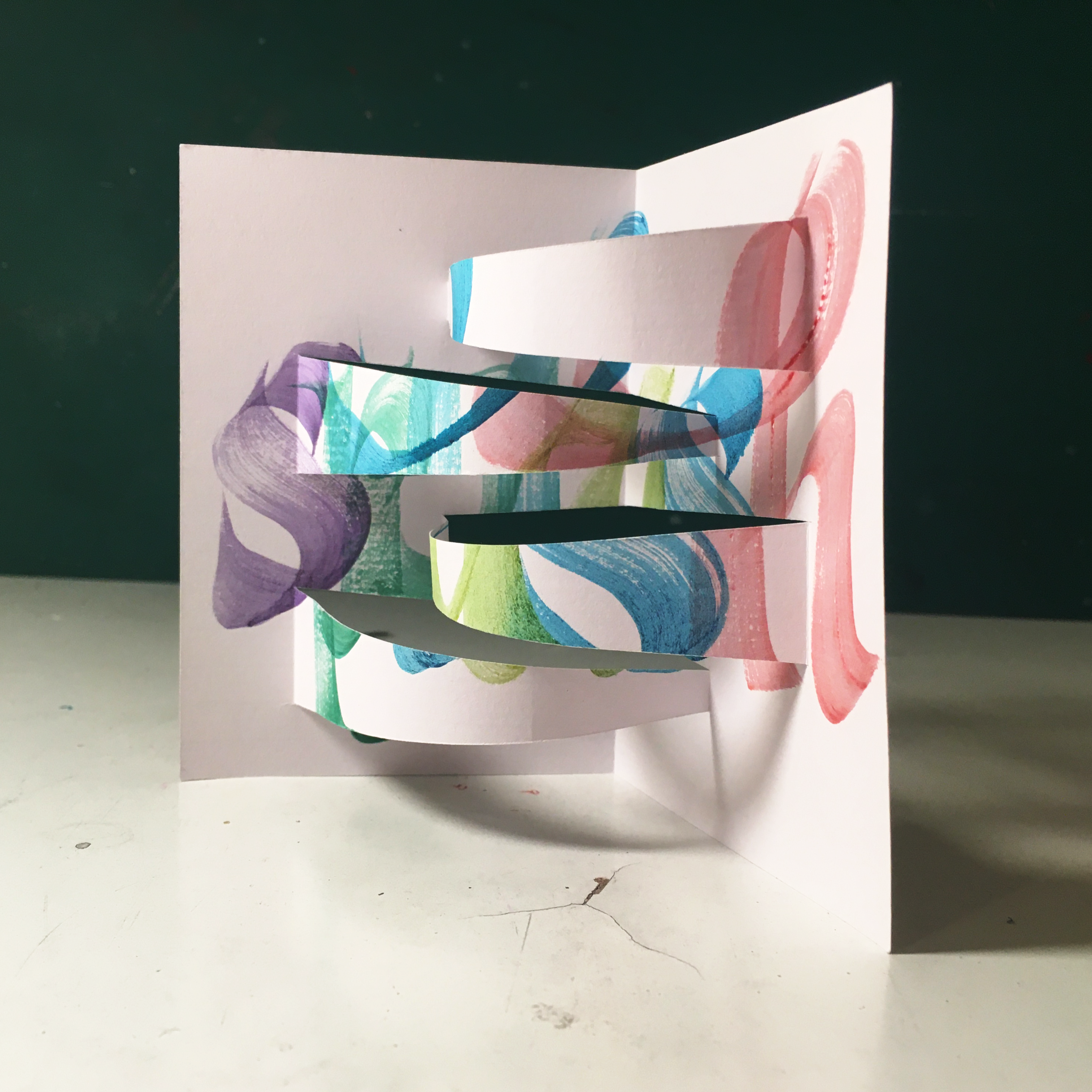
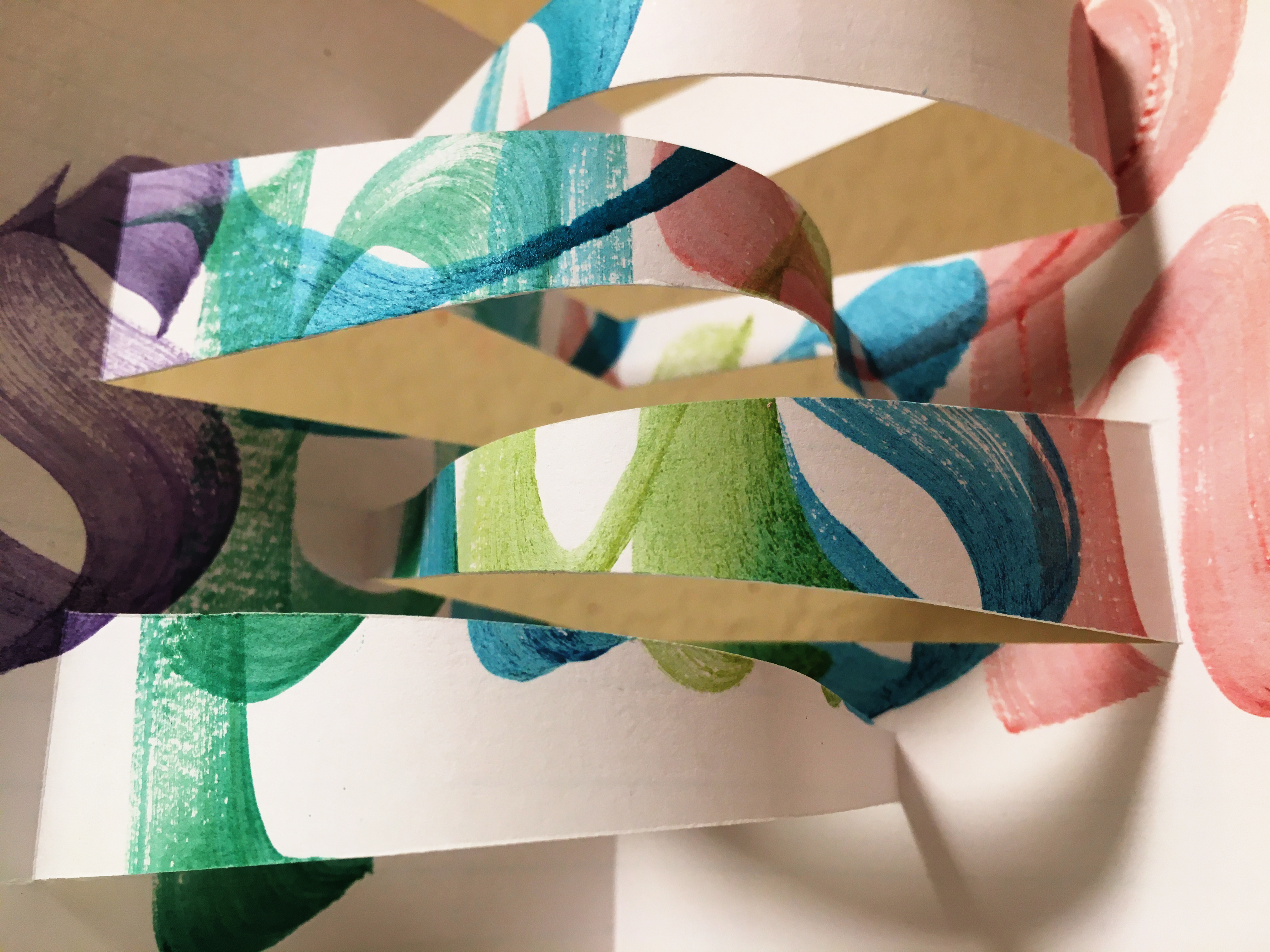
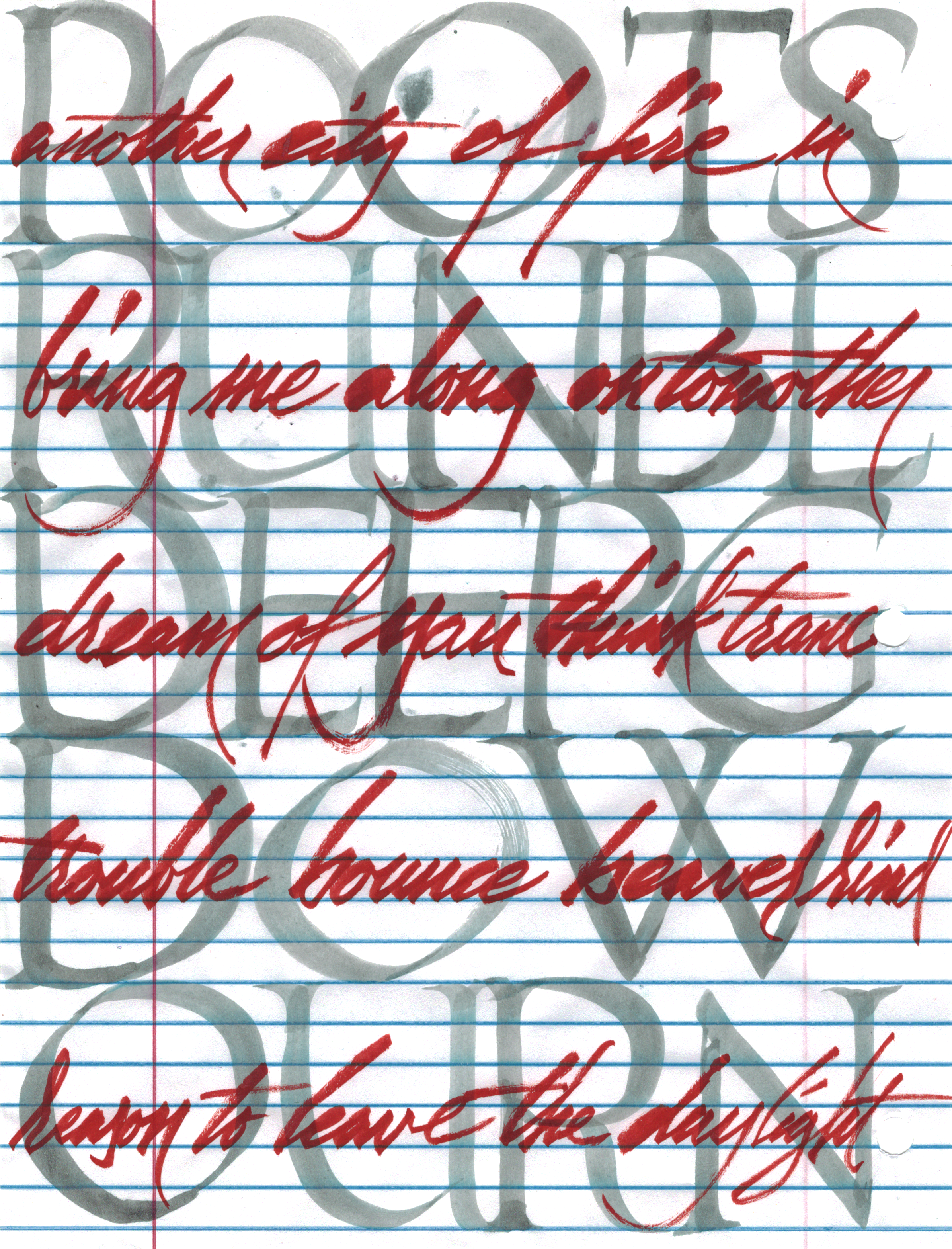
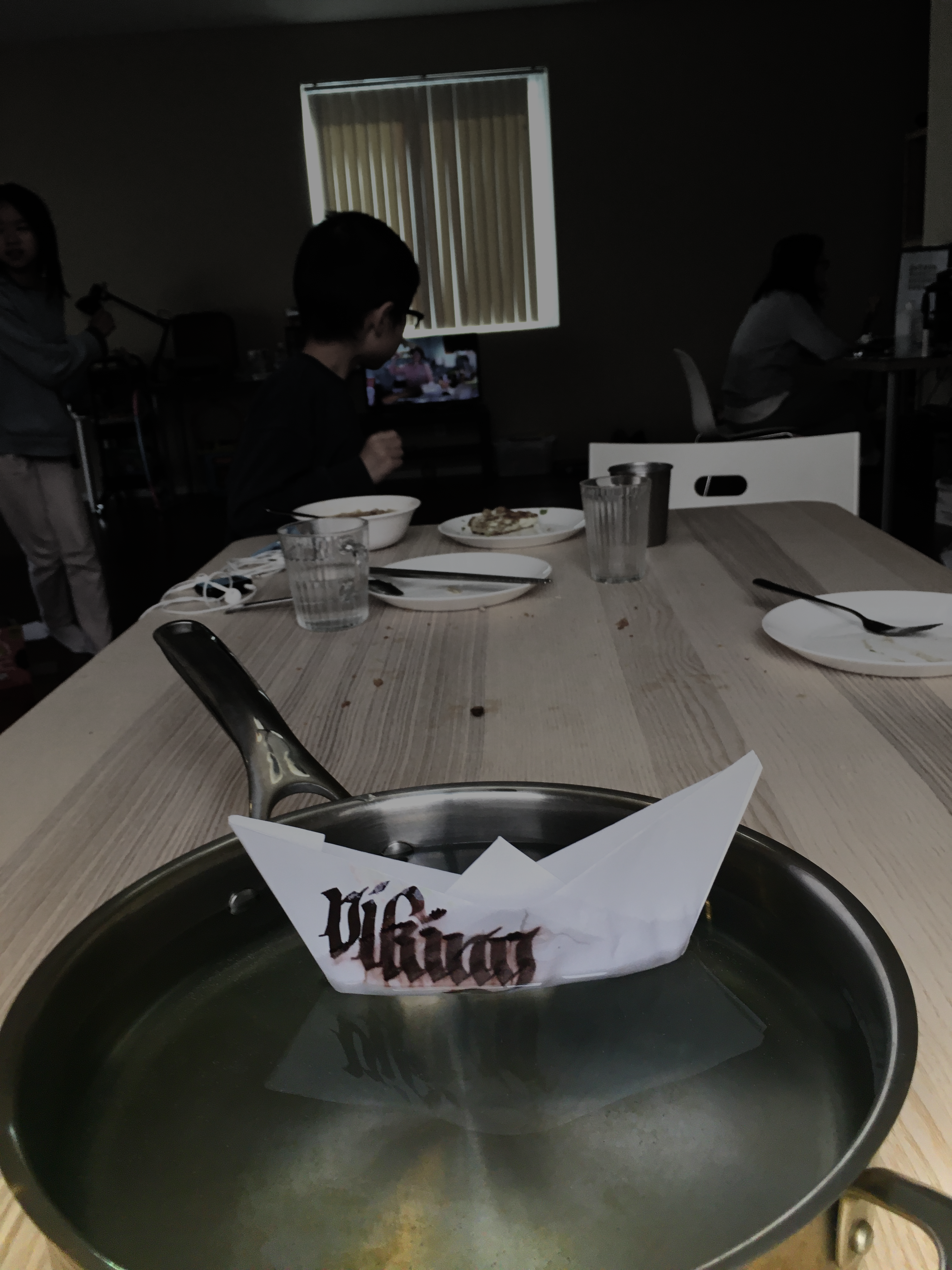
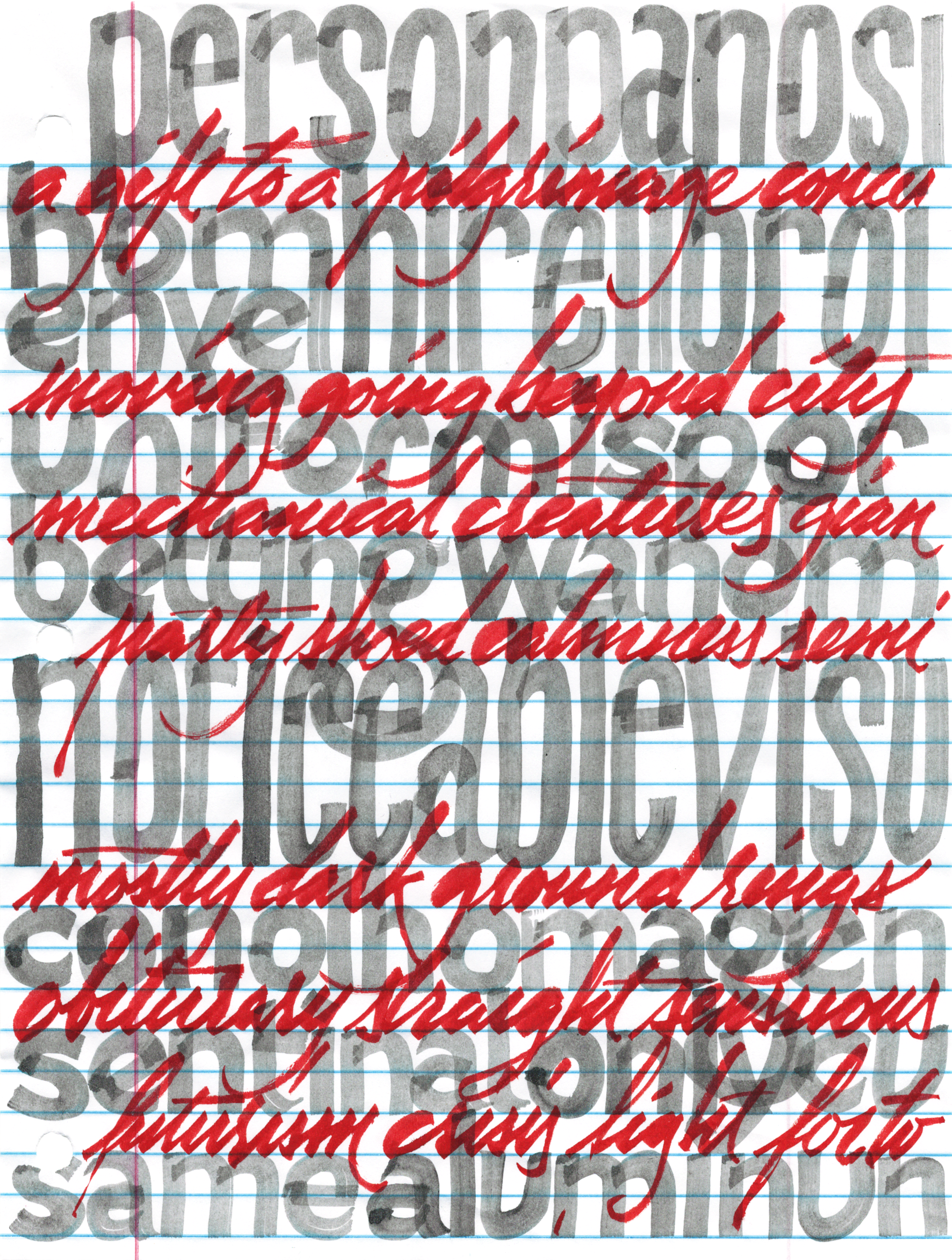
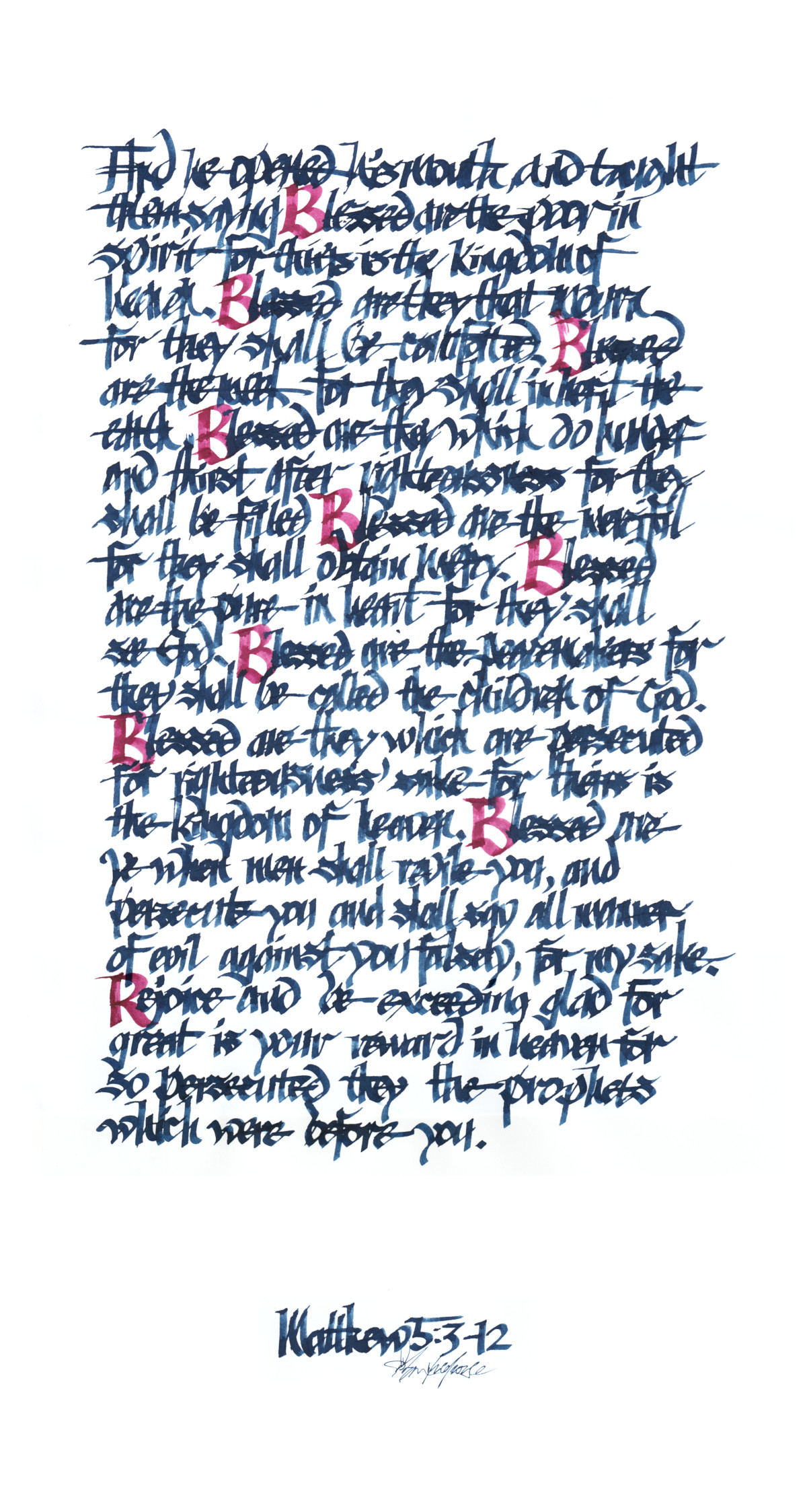
Even a 9×12 sheet can’t fit a 3″ brush without ligatures and a pile of failures.
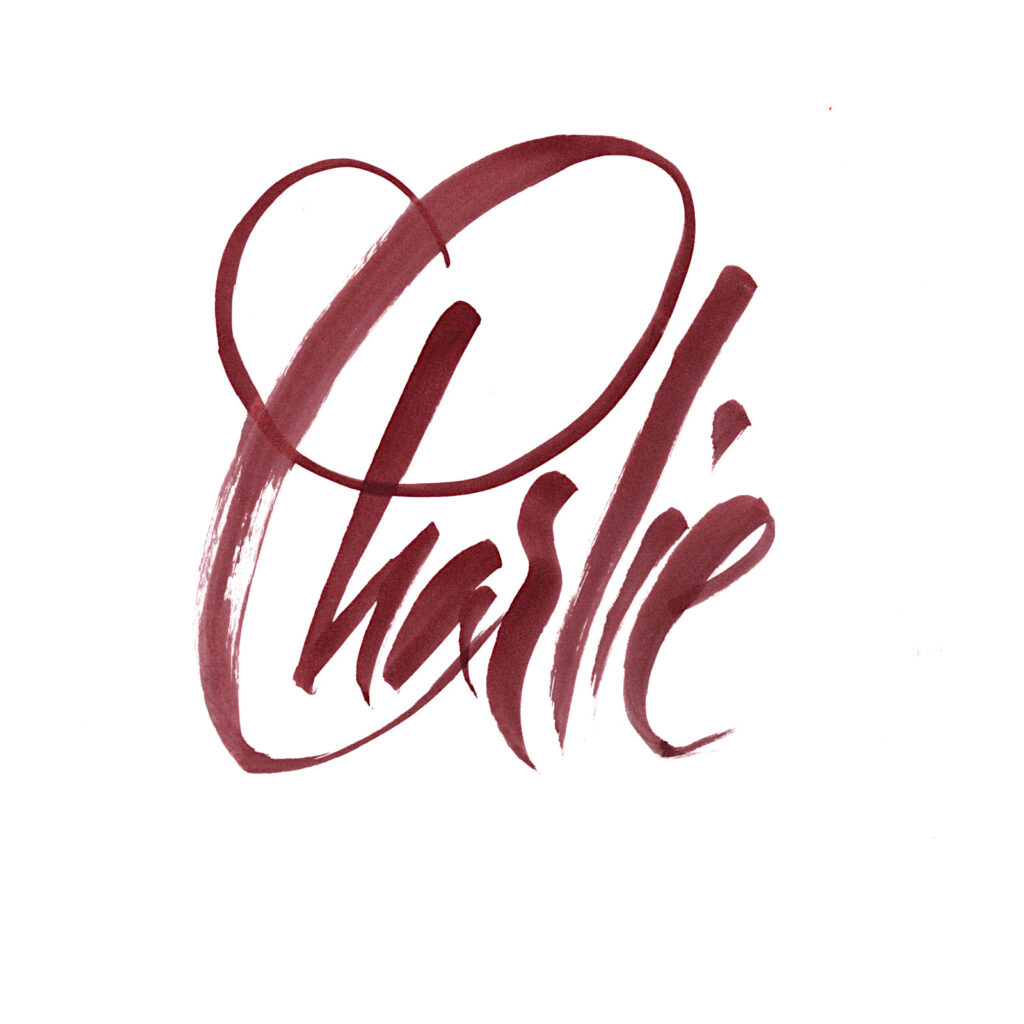
At this point, it’s only remarkable when I’m satisfied after a few attempts.
,
,
,
,
,
Years ago, we bought a toy bird for the girl that records and repeats short snippets. The boy is now well past her age then, but two fresh batteries and it squawks again.They’re upstairs, talking, singing. and laughing at distorted tweets.
In the other ear, Mama is on the phone, searching nutrition labels for high protein, high calorie foods to stem Grandpa’s weight loss.My mind searches for anything to thread these competing conversations across electronics, but I come up empty.
Having worked in small firms, I’ve always been the young guy. Even that time I went corporate, I ended up being the junior staff member on a major project.
That’s fine. I learn more from the experienced folks.
So it was a bit odd turning Owner and suddenly becoming an old guy. In the few cases where I’m younger, it was by a year or two, not decades.
Middle age is odd. They say architects don’t blossom till they are fifty. That was forever away, now just three years out.
I’ve gone through the stereotypical “now what” moment, but I’m also comfortably confident in my skills. There’s still plenty to explore, but I have much to share with the next generation.
Maybe this OPM letter was a my way to share some notes along this journey.
~
Some Links
Over the past few years I’ve fallen hard for calligraphy. It’s why this letter took a long hiatus. You can graph with the most simple of materials, but here are some things that stand out.
The Pilot Parallel was my introduction to calligraphy. As a lefty, I had long thought it impossible, but once I got my hands on one of these pens, I just had to try (with the help of YouTube). It’s an inexpensive pen with none of the hassle of dip pens. If you’re not sure what size to get, go big with the 6.0mm.
What to graph on? Anything will do, but normal printer paper will bleed, as will binder paper. The best value I found was acid-free sulfite paper from Blicks, which is usable on both sides.
If you get deeper into the hobby, then splurge with the Brody Neuenschwander Handwritmic Ruling pen. I also enjoy the Dreaming Dogs ruling pens (especially for alternative shapes), but the Handwritmic has the best build quality with a nib that can handle a variety of scripts.
LED light tables are super cheap now. Mine is just a non-name brand from Amazon. Print out guidelines on paper and now you won’t have to rule your sheets all the time.
And finally books, books and more books.
Any edition of the Speedball Textbook is a good start (I’ve got 12, 16, and 20-25).
I’m fond of Arthur Baker’s Foundational Calligraphy Manual because he elucidates a technique of twisting the nib, which feels really weird until it’s natural. At this point I’ve picked up all of his books.
A wild card, out-of-the-box gem is Scott Kim’s mind twisting Inversions.
And no list of books would be complete without grand matron Sheila Water’s epic Foundations of Calligraphy. I find this one intimidating—high standards are great, but for a hobby, fun comes first. But when you get serious, it’s a must-have.
At this pace, I’ll be a year behind, except that this new year has come with a new habit—less socialing, more zining. After I make a few zines, maybe I’ll get into the selling and distribution business.
Or may not.
Anyways, there will be less catching up of old Substack Notes.
,
4/13/25
jump easy enter vector five galaxies between you and remembrance Georgia come back into life
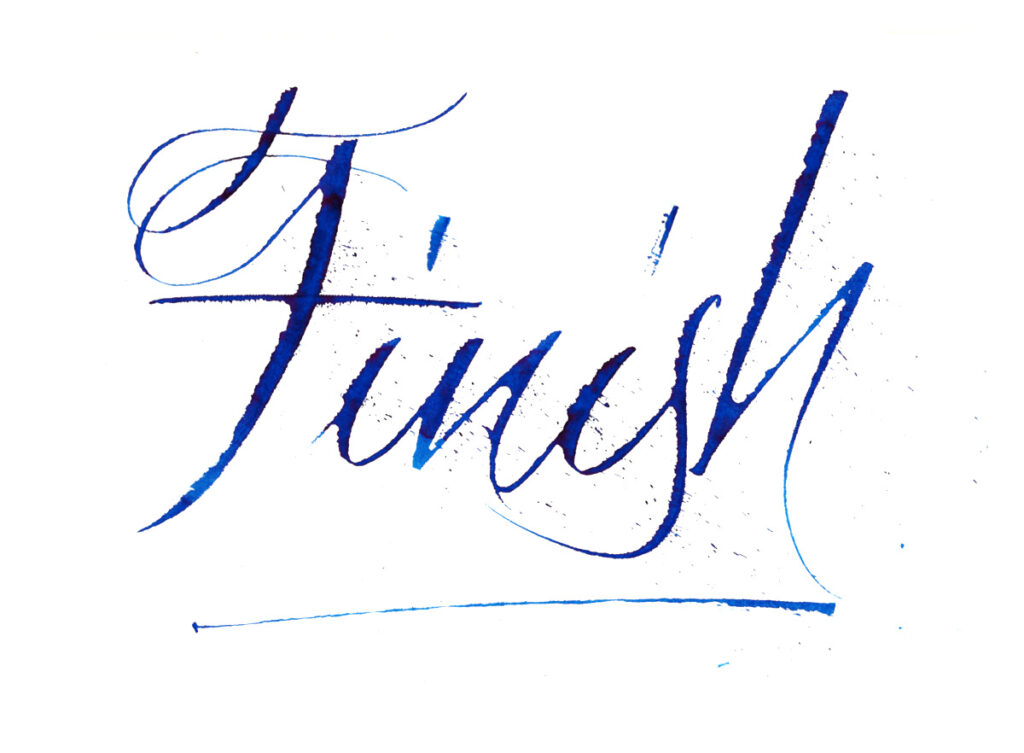
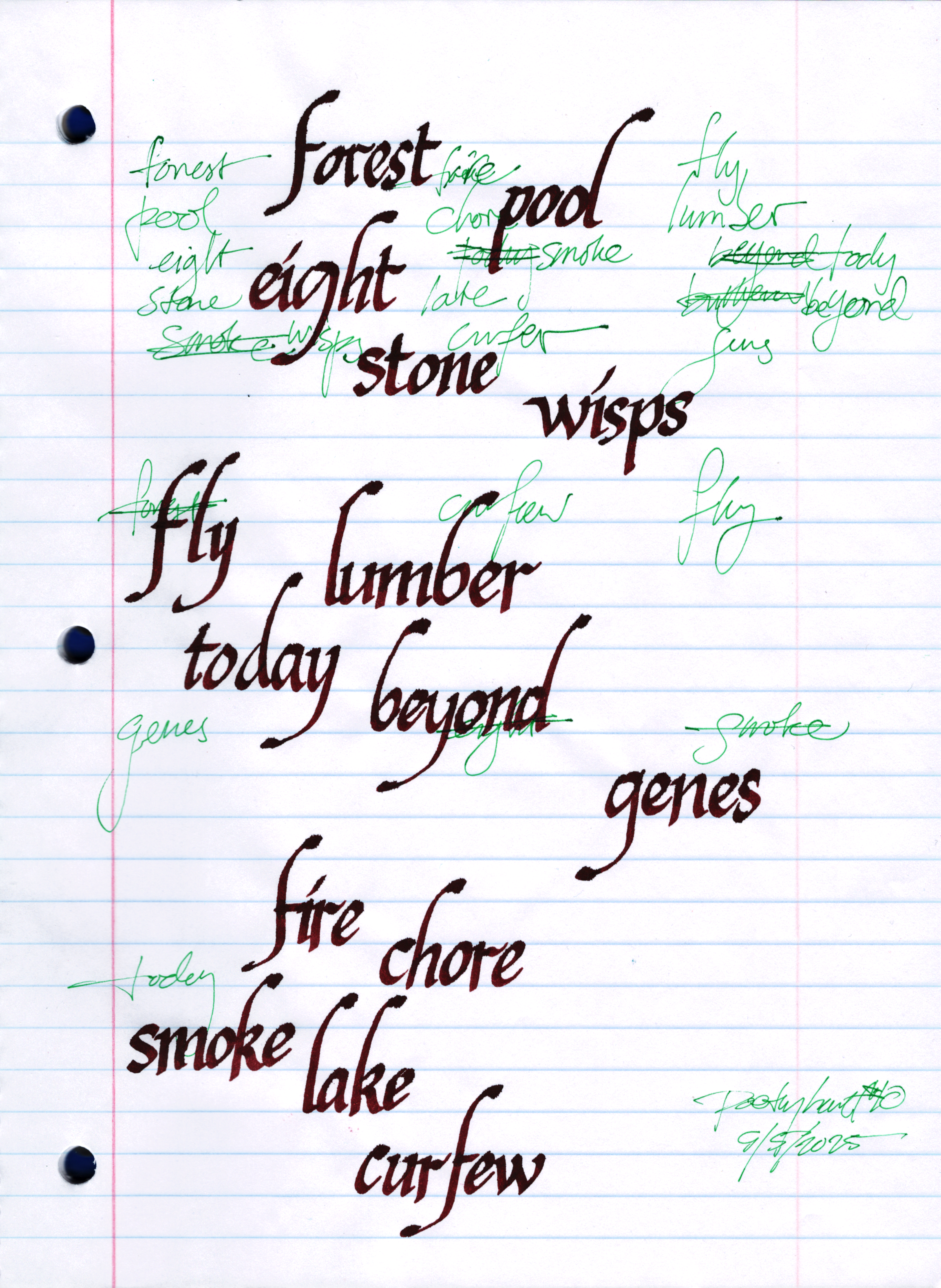
In my current calligraphy practice, I’ve been focusing on the letters more than choosing words, hence my reliance on word lists.
These poetry hauls are fun opportunities to play with smaller scripts arranged on a page. I only have to pick five words to turn the given ten into a fifteen word poem.
,
4/20/25
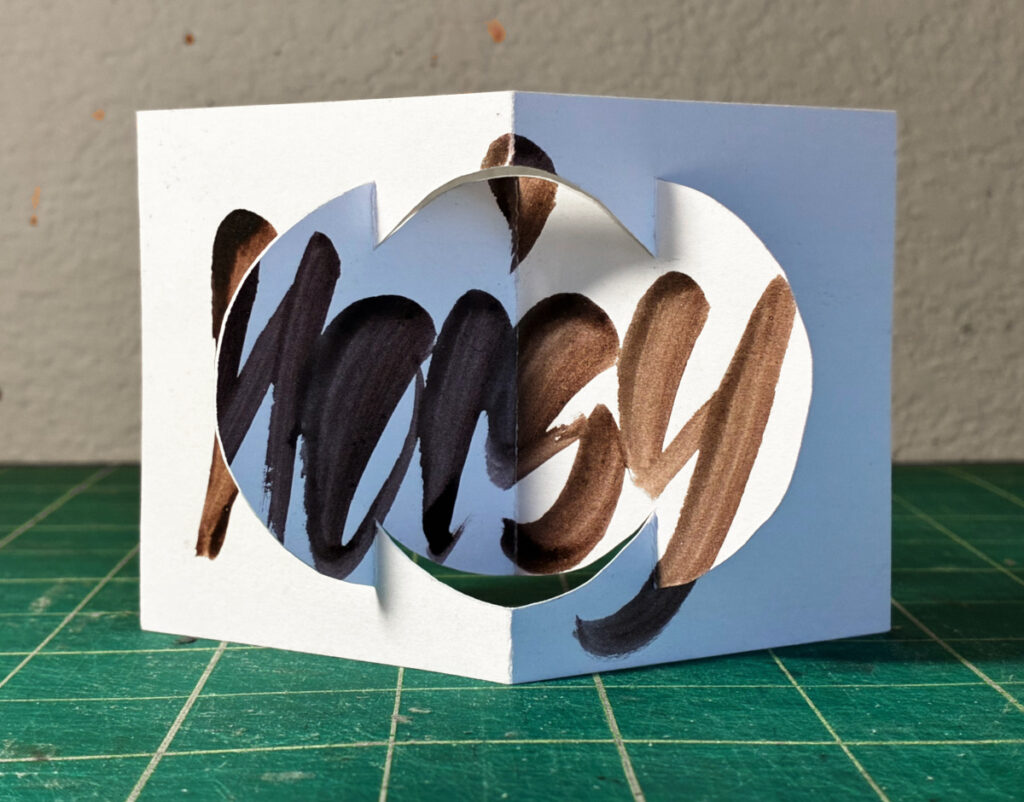
Celebrating Easter with the most destructive beast known to mankind.
,
5/25/25
Celebrating my colleagues’ new lives. Yes, our team had babyx2 last summer!
,
5/28/25
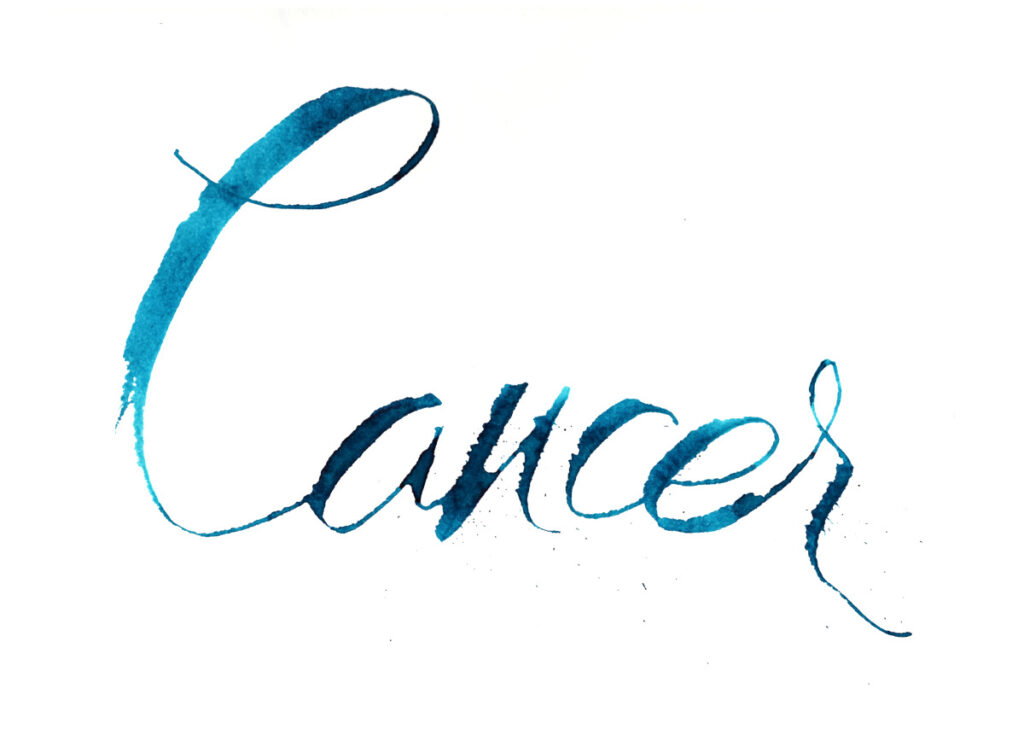
Gemini Annie has two many
An inside joke with an online buddy who worked with a pair of cute twins at her old job.
I’m not a fan of the astrological words, certainly not in the context of making 5WP’s. But I’m in a “collect them all” mood with all of the Inktober challenges.
,
6/1/25
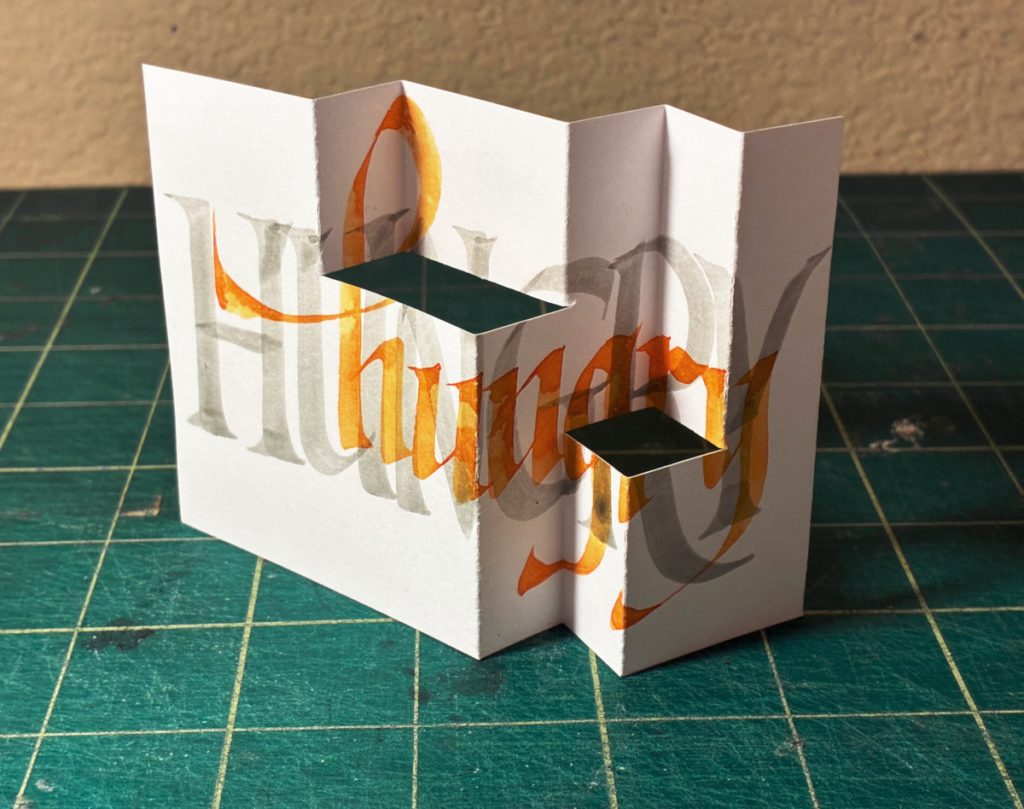
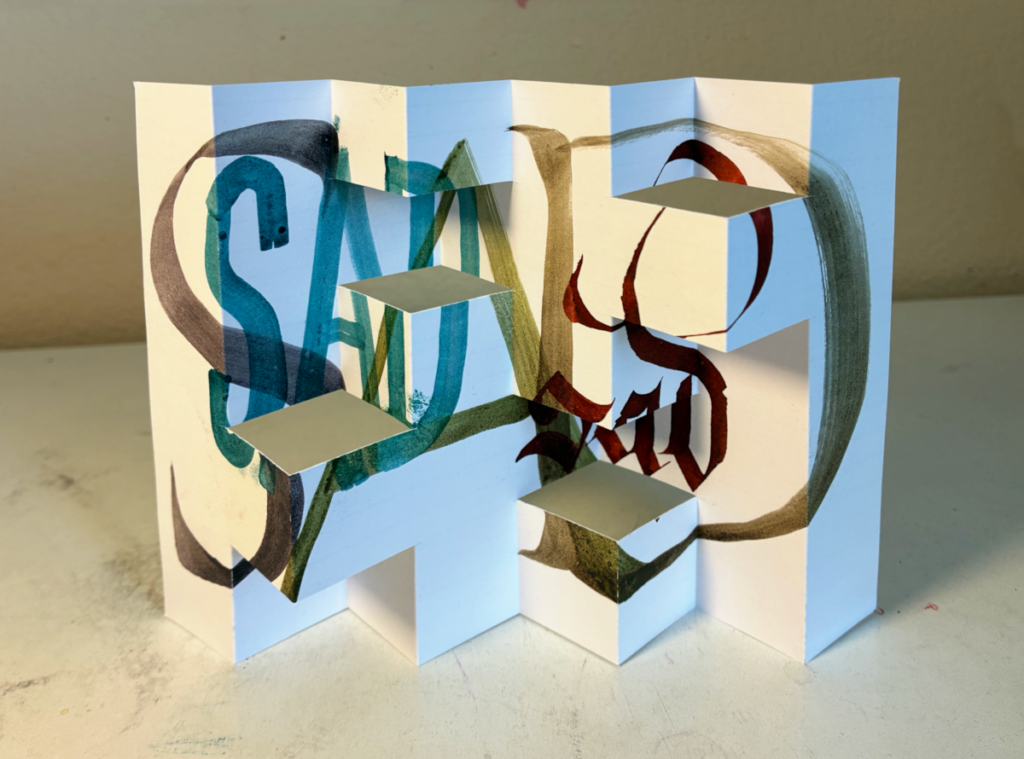
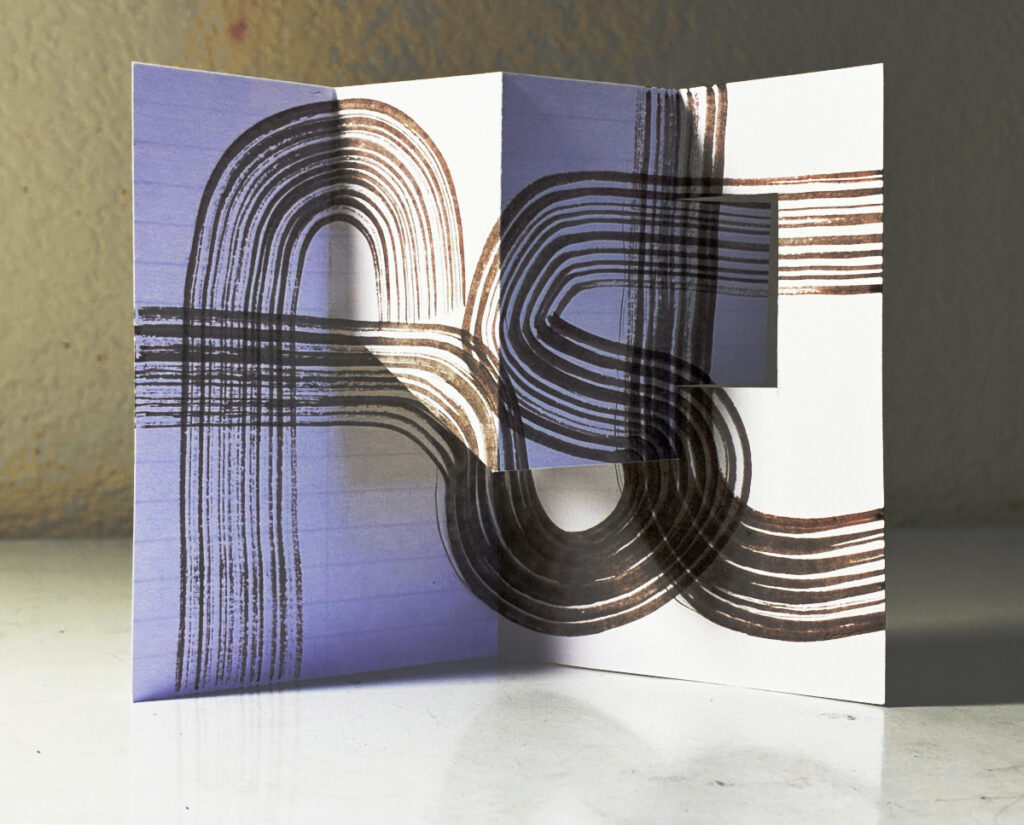
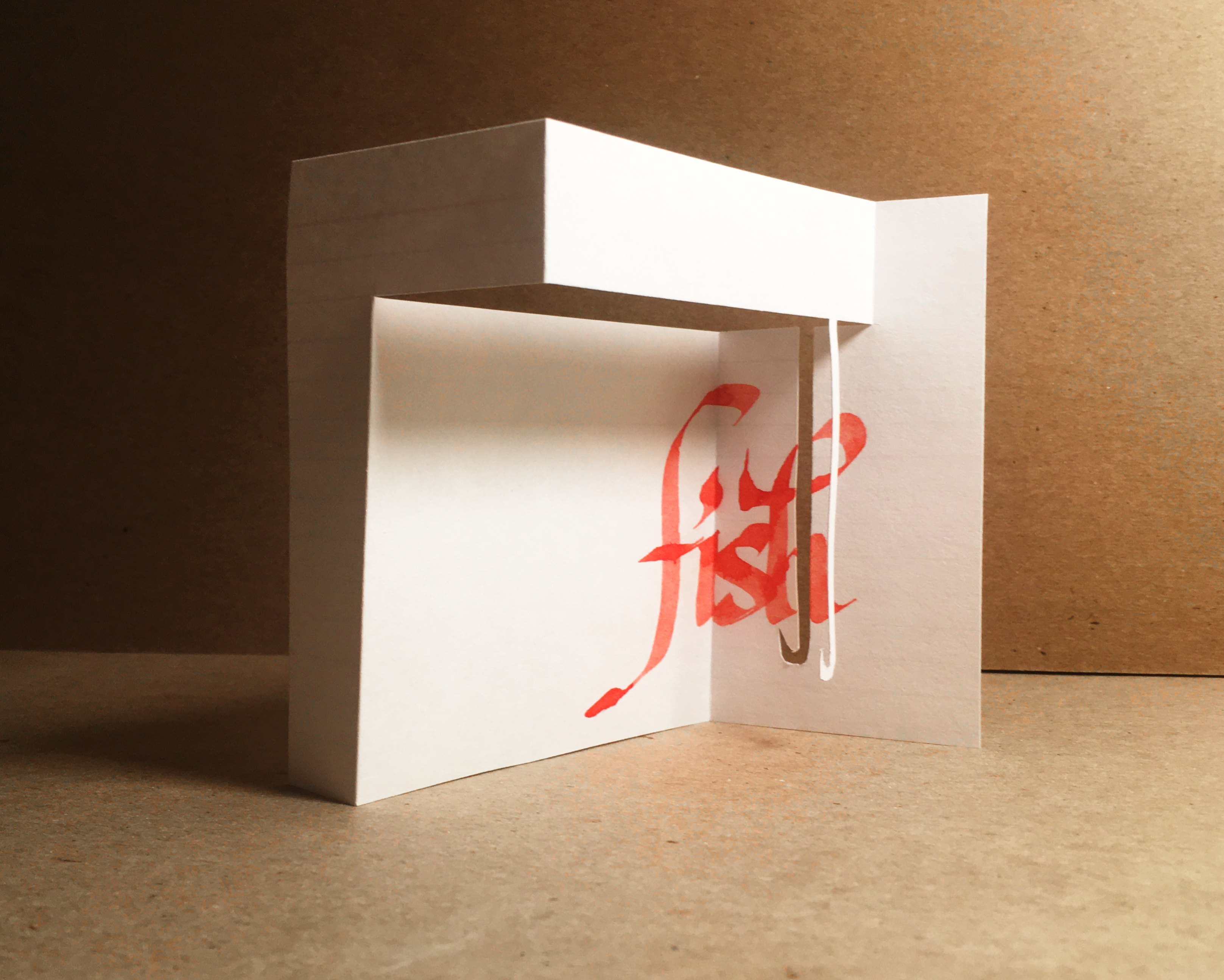
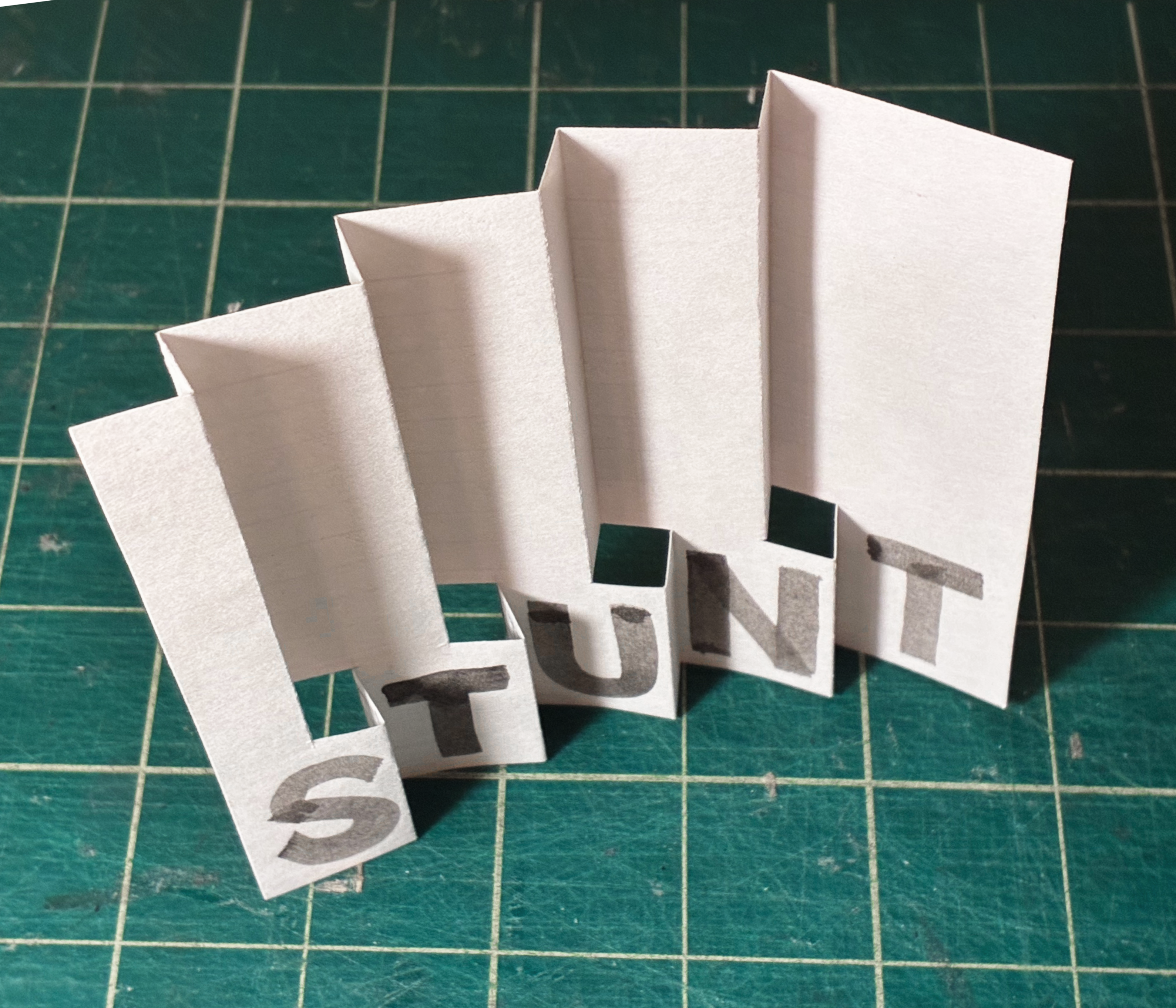
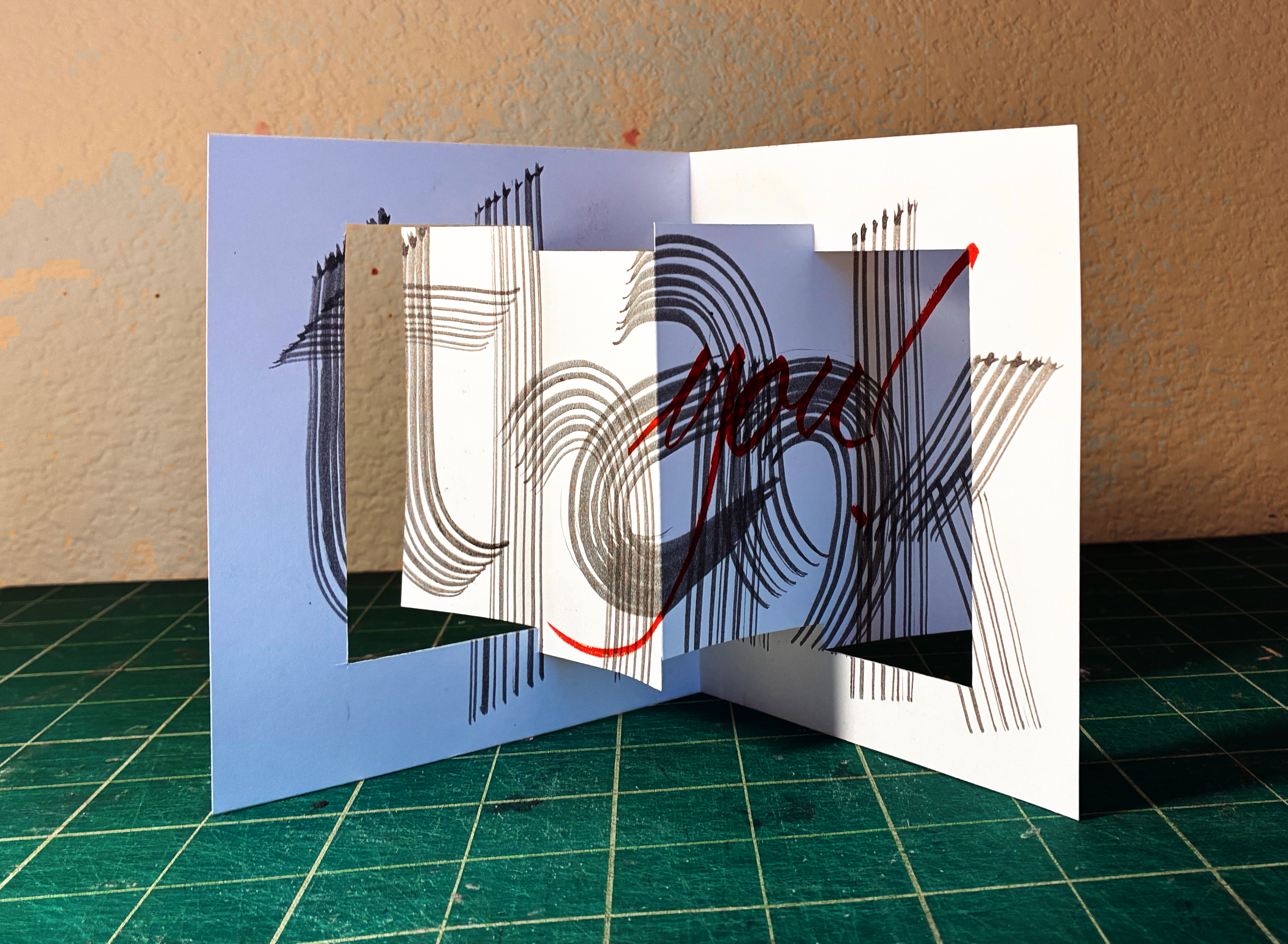
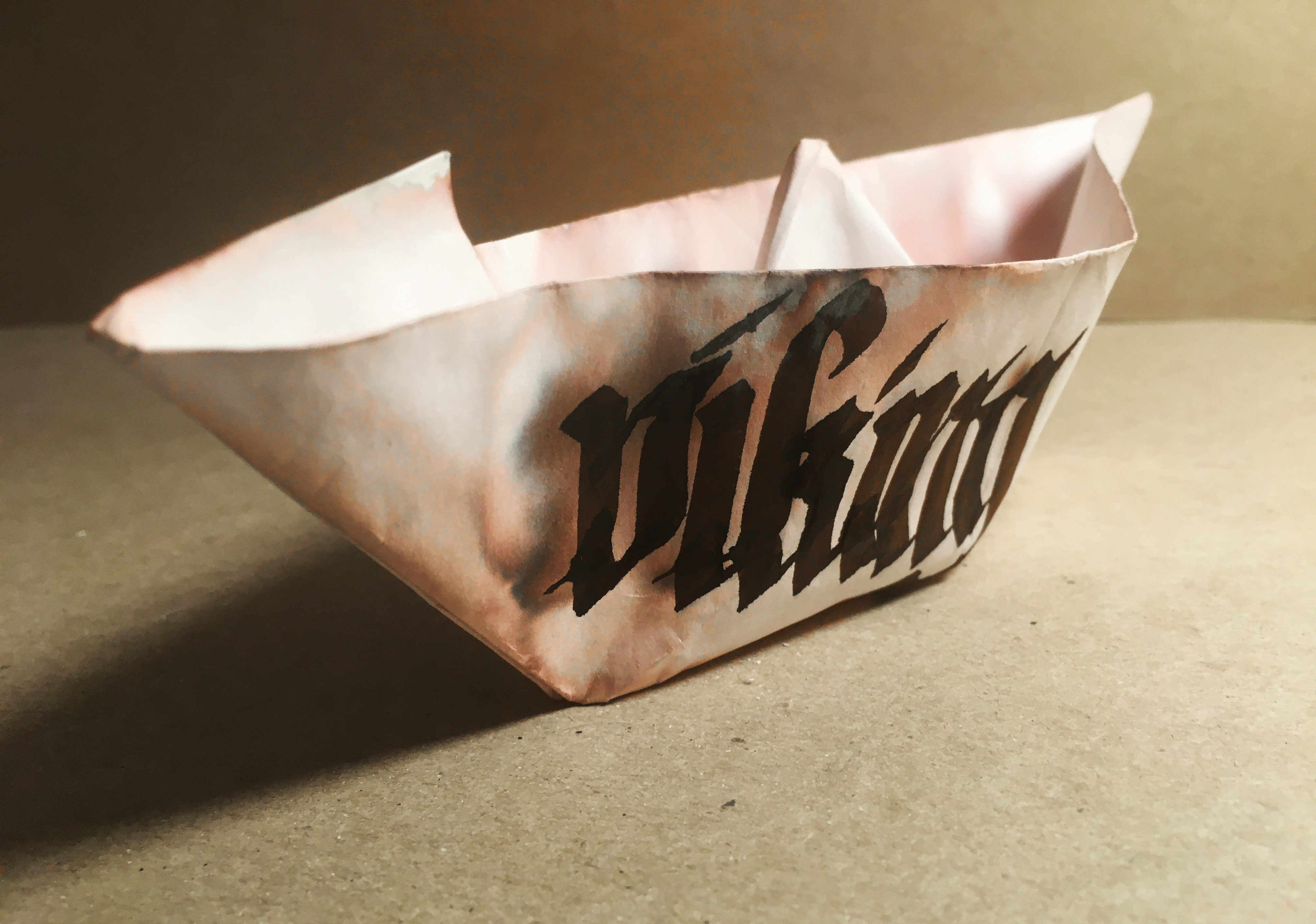
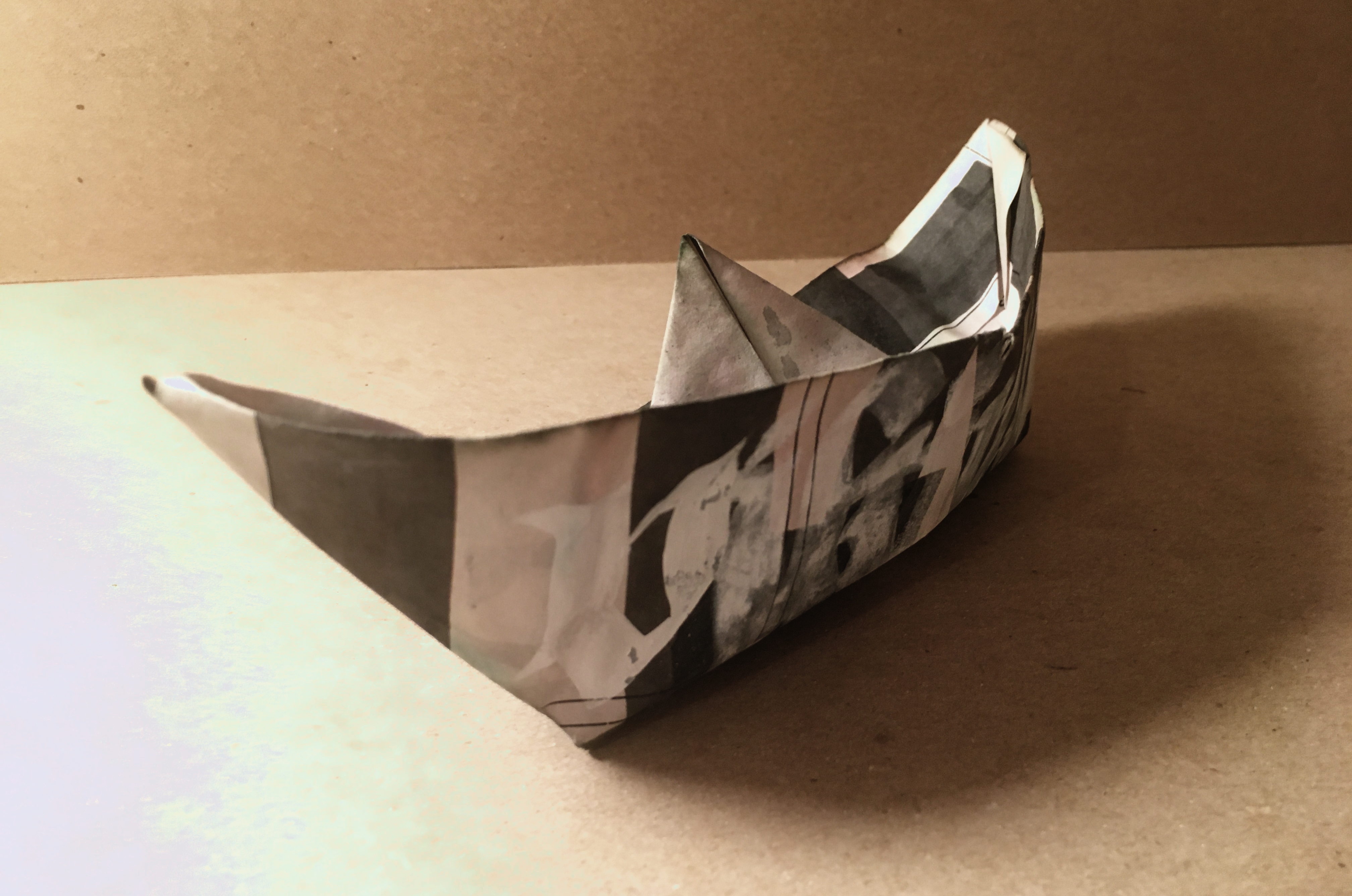
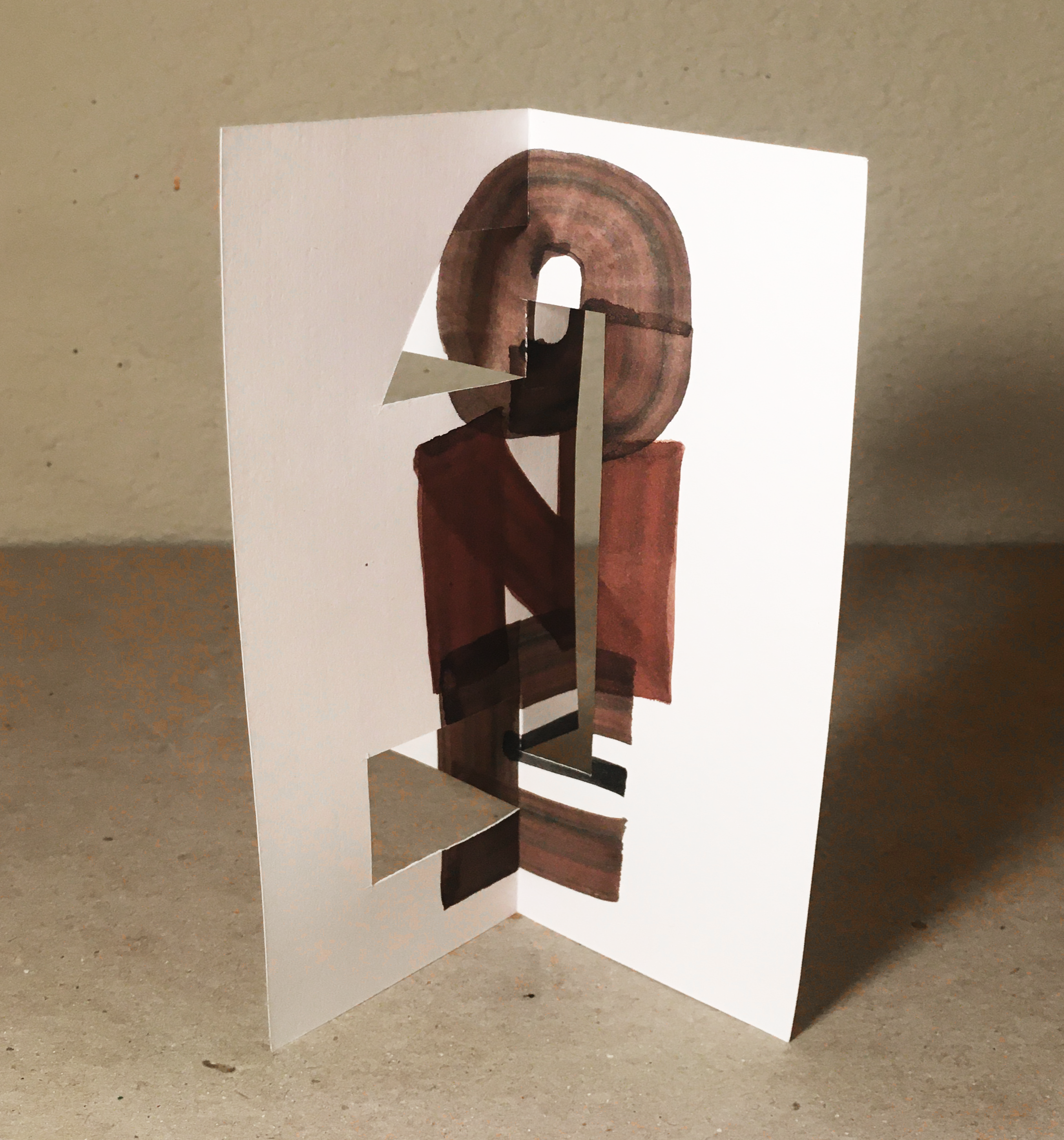
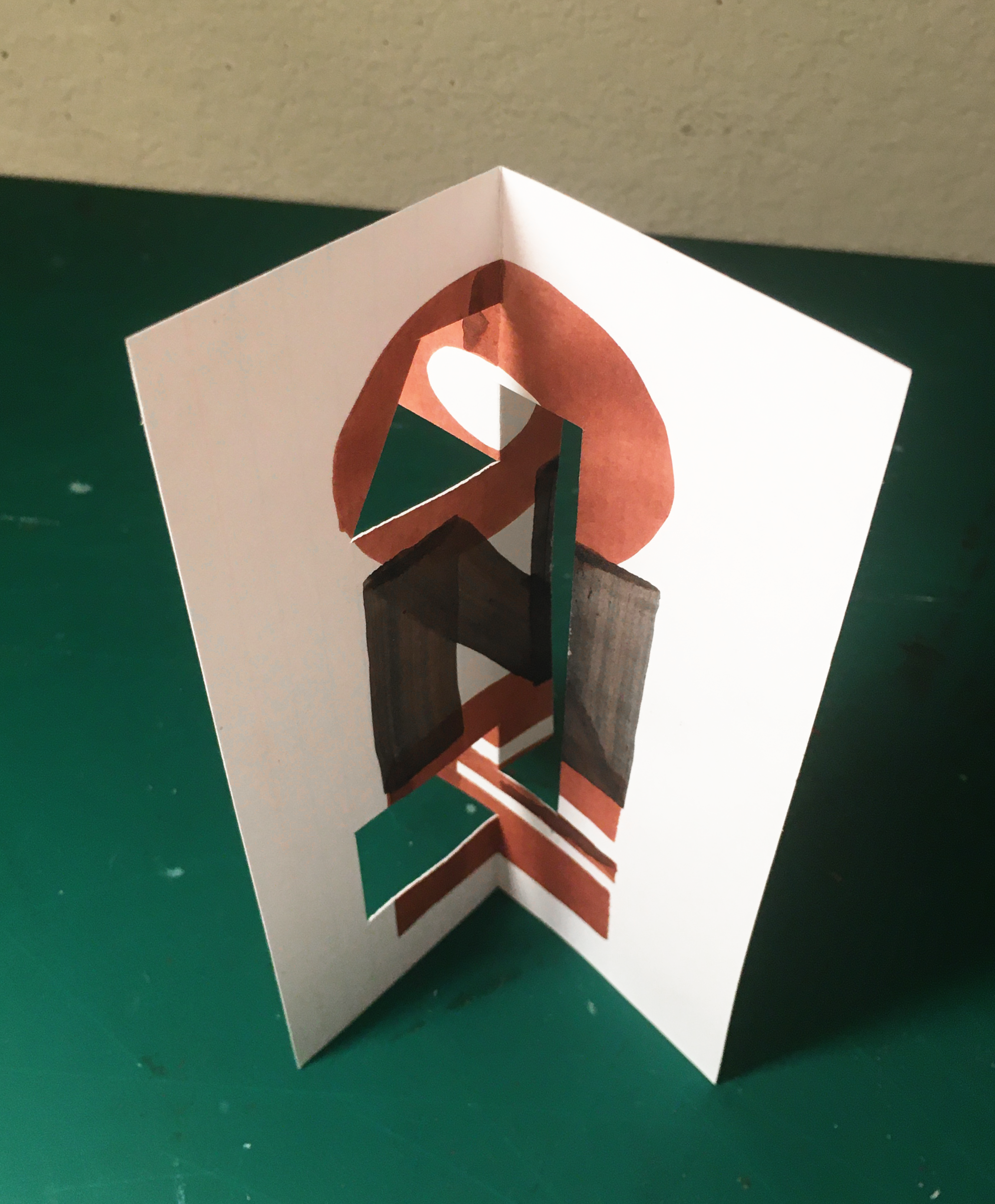
Vista, playing with folds inside folds.
,
I just listened to a podcast with a business professor who teaches about power. It was grating, until they had a discussion about the price of power.
In so many words Jeffrey Pfeffer acknowledged—when you got power, power got you.
I’ve seen this dynamic over the years. It’s why I’ve been fairly unambitious in my career. I do good work and this has stumbled me upwards, but I’ve never pressed for the next promotion because there is no free lunch in corporations.
Cya next time!
,
PS—Exploration Peak
We went to the park with the kids. After the playground got busy, we hiked up the trail to the picnic structures on top of the hill. When we got there, the girl noticed that the benches had initials carved all over them.
She asked why people would do this. I responded that people want to make their mark in this world, even if it means vandalizing our public property. Not particularly noble, but I get it.
While hiking down the hill I thought of Bernard Tschumi’s follies. Of course, those big red structures are another stratosphere of architectural sophistication compared to picnic canopies.
It made me nostalgic for college, with memories of famous architects. Gods in our eyes; just men making their mark in our world.
—October 2021
,
PPS—The turtle sandbox
The kids rediscovered the sandbox. A big green plastic turtle with a couple feet/stools and some toys. It’s a bittersweet object. We got it long ago, before the boy was a concept in our world.
He’s now old enough to play with himself in this box. He appreciates the company, but he keeps himself contented moving sand around. Our daughter is still young enough to enjoy the moment, but lost patience after a while.
Kids are fickle, but that means they can also come back to rediscover old joys, while we adults live at a much higher gear, too bored to watch children pushing sand. I rationally understand this is a vanishingly short moment, but my brain craves the high octane sugar buried in the telephone computer.
In twenty years, I hope that I’ll remember the evening light, the sand in my feet, and the fading Vegas summer heat before the start of fall, not this aching addiction to a glowing screen.
A quarter-century ago, I started my final semester in undergrad.
I was accepted into the Urban Nomadism studio with Raveevarn Choksombatchai, who was renown in school as a sharp critic. We started by reading Bruce Chatwin’s The Songlines and the chapter on rhizomes in Deleuze and Guattari’s 1000 Plateaus.
That was the last bit of clarity I saw through spring. Raveevarn was indeed a brutal critic. She would break down any idea to question every assumption. I wasn’t ready for that intellectual challenge—I restarted after every desk crit.
I spent the entire studio flailing. I made a video of rubber ducks. I found a site at the 16th Street Station in West Oakland. I finagled a tour of an Oakland port facility by just walking on site. I analyzed a key play from a game where the Saints beat Kurt Warner’s greatest show on turf. I visited truck stops all over the Bay Area. I threw ramen on the wall cause I had nothing else.
I slammed my head against the concrete walls of Wurster Hall night after night, until I ran out of time. Three nights before final presentations, a buddy pulled me aside for a brainstorming session. After a pack of cigarettes, we had a plan and section.
The next day, Raveevarn agreed it was a good diagram for starting a project.
I slid her the form to drop the studio.
She signed it.
My last class at Berkeley.
In 2018, I wrote about this experience and that lesson stands true.
It took a while to process what went wrong, but I eventually realized that I needed to grow a backbone as a designer. The critquer’s job is to critique, and my job is to complete the project. Sometimes they are right, sometimes they are wrong, and sometimes you just have to ignore everything and keep it moving.
I noticed a couple other things while writing this piece.
Raveevarn gave me her time until the very end. Yes that’s her job, but architecture professors have been known to cut their losses with underperformers. It can’t be fun to hold the hand of lost a 21-year old over five months. I’m grateful she didn’t give up.
Her investment eventually paid off. Not as a designer—I never got better than pedestrian. But as a professional, I’m responsible for allocating my time. Sometimes it’s administrative fluff. Sometimes it’s progressing big efforts. Sometimes stepping all the way back to challenge why we’re here.
Beyond written job duties, my craft is in perceiving those soft moments where judicious pressure can make a tangible difference. An architect once paid me the nicest compliment, “you’re not like other owners, you think“.
For that, I can thank those brutal desk crits in 2001.
November and December 2025 turned into a crash course on estimating budgets and schedule.
Having gone through the crucible of three CIP seasons with the State of Nevada, I can quickly slam out numbers, but with multiple mega-projects on the horizon at the airport, I wanted to standardize our contingencies and develop a transparent process for turning a construction cost estimate into a project cost estimate.
A while ago, I had pondered the question about desired accuracy for a project estimate. With a little research, I found a professional society who studied that exact problem—the Association for the Advancement of Cost Engineering (AACE). In their rubric, the roughest estimates are categorized “Class 5” with an 80% confidence of landing between -30% to +50% for construction projects (AACE 56R-08, adopted in ASTM E2516).
This range worked aligned with recommendations from our planning consultant for early cost markups. More specifically, we added a 20% Design Evolution markup to the Direct Construction Cost. This marked up cost became the basis of all the other costs in the project estimate, including a 20% Construction Contingency and a 10% Owner’s Allowance (because there are always changes after bid!)
Over the course of a project, the Design Evolution would drop to 0% when issued for Bid, while Construction Contingency should drop to about 5% as conditions in the field are investigated, but holding a bit for bid risk when bids are opened. The Owner’s Allowance would stay steady at 10%, but could shift if management was unwilling to allocate so much budget for post-bid changes.
As with all rules of thumb, the estimator is still responsible to account for the specific project needs, but having suggested defaults frees me to focus on unique conditions that require special consideration.
While it might be more technically accurate to stagger the cost of escalation over the course of time, we structured the estimate to provide a subtotal of the entire project cost and then add escalation as overall markup. Hopefully this will clearly highlight the cost of waiting to approve these major projects. While fools may rush in, analysis paralysis is not free—a few percent a year adds up fast!
So how to estimate a schedule? Unlike cost estimating, I was not prepared to tackle this question because I was always shoehorning dates to fit the State’s two-year legislative cycle. But the internet is a wonderful place, now that I have the freedom to recommend schedules that best fit our project needs.
Again, there is no need to re-invent the wheel—the Navy dealt with this problem in the 1950’s, creating the “Program Evaluation and Review Technique (PERT)”, where an estimator develops three schedules resulting in an Expected schedule. Since I’m intimately familiar with each step of the process, it’s easy to develop an Optimistic Schedule. My estimating spreadsheet combines these small steps into larger phases (design, permitting, construction, etc.) which makes it simple to take some broad guesses to develop the the Most-Likely and Pessimistic Schedules.
The spreadsheet then averages the estimated schedules to calculate an Expected Schedule. This schedule is considered to be a 50% confidence level estimate—half of projects will be delivered after the completion date. To bring the schedule back up to an 80% confidence level, the spreadsheet does some simple statistics to calculate a Schedule Contingency, which is shown as a final line item to determine the opening date.
As such, the schedule sheet is structured similar to the cost estimate (with the esclation added at the end). The Expected Schedule keeps the project team held to a tight process, while the additional contingency gives management a date they can confidently share with the public. This is similar to the US Army Corps of Engineer’s guidance that Congress is typically presented with an 80% confidence schedule while internal schedules are presented at 50% Confidence (USACE CSRA).
With a schedule in hand, we can now calculate escalation to the midpoint of construction. Since the cost estimate targets an 80% confidence level, we include the entire schedule contingency before the midpoint of construction.
How much annual inflation should to assume? The US Federal Reserve targets 2%, but the 2020’s have been rough, seeing 7-8% annual jumps. Things have settled down, but given recent experience, we are still assuming 4% annually. Call me in 2036 to see if that was anywhere near correct.
With that, the cost and schedule has been estimated. If you wanted to be fancy, you could build some s-curve spending projections. However, for the scale of my projects, I’ve only been asked for annual estimates, so I just use the even linear spending tracker calculated in Microsoft Project.
(Microsoft Project is a whole other thing I learned these past two months. It’s too much to cover but a few concepts that some figuring were task dependencies, hammock tasks, assigning costs to the tasks, and using flags to add color to the Gantt chart. YouTube is a great tutor, as well as AI—LLM’s are only semi-reliable, but used carefully, it was critical in working through both big picture questions and navigating software quirks.)
With this information, we can hold a jury to vet the project. Since the Construction and Design Division will be tasked with delivering the approved budget and schedule, we owe them an opportunity to critique the estimate. We also invite key operational staff for extra eyes to challenge assumptions and catch what’s missing.
And with that, we can finish the estimate with a cover letter to memorialize the basis of estimate to provide context around numbers:
Project Description (what will this do; where is it?)
Project Justification (why is this needed; who is served?)
Key Assumptions (when (schedule) and how the project will be delivered)
Base Documents (percentage of design complete, and often referencing a 3rd party estimate)
Confirmation (or not) that an internal jury vetted the project.
List of attachments (additional diagram, cost estimate backup, etc.)
After a couple initial tests, this template is working well. I can smash out a draft estimate in half a day, though I’d prefer a few days to do it right. Beyond half a week, I suspect that extra effort would be minimally helpful—I’ve often claimed that I can spend three hours or three weeks to end up equally wrong.
With that, I’m happy that I was given the time to develop a project estimate template that shares the work, from the basis of estimate to the final budget and schedule. Critically, this a transparent document, showing the assumptions with a clean line of logic so that decision makers can evaluate the staff’s technical opinion on the proposed project.
And with that, it’s on them.
~
Some Links
For some reason I don’t have much patience for live action films, but I gladly watch animation all the time with the kids. Here are three standouts from the last three years.
Puss in Boots: the Last Wish is the stunning sequel to the lackluster spinoff from the Shrek franchise. It was shockingly great with a tight, rich story paired with gorgeous animation. I guess DreamWorks was impressed by Sony Animation’s revolutionary Spiderverse and upped its game!
Robot Dreams is a cute, yearning story of a dog and his robot, lovingly set in in 1980’s New York City. We just watched the movie, so it might be recency bias, but it should have won the 2023 Oscar over Studio Ghibli’s The Boy and the Heron.
Flow was the worthy Oscar winner for 2024, a surreal tale of a cat weathering a sudden flood in the valley. As a wordless film, I was worried that the kids wouldn’t dig it, but they both loved it. Gints Zilbalodis is an auteur who has the courage to finish what Pixar started in that epic that first half of Wall-E. Zilbalodis’ 2019 full length film Away (included in the Criterion Collection DVD) was also well worth the watch.
Bonus! We just re-watched Ernst and Celestine now that they’re now old enough to enjoy the sweet tale and gorgeous watercolor animation. It might come from a children’s book series, but it’s absolutely enjoyable for adults as well.
~
General Store, Moundville, Alabama, 1936, Walker Evans
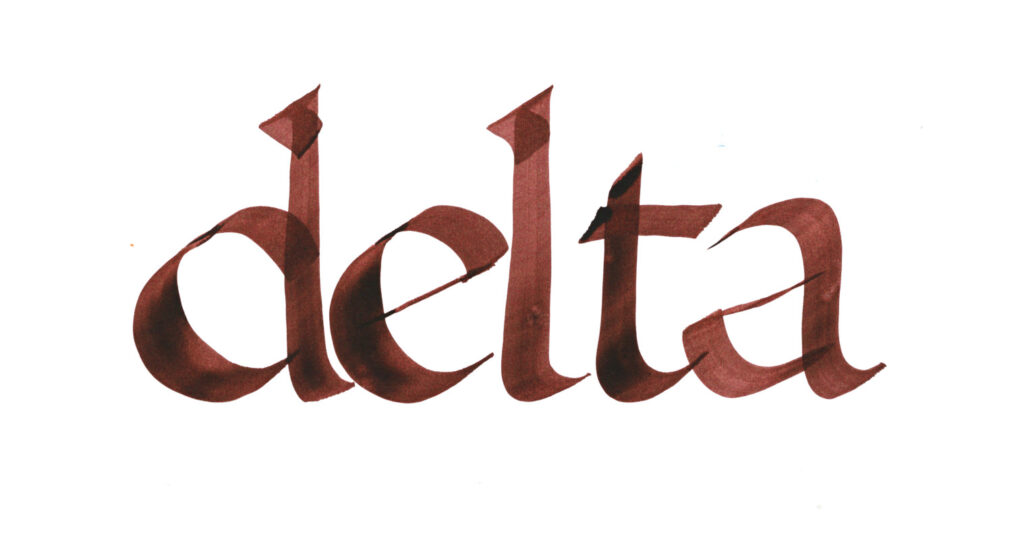
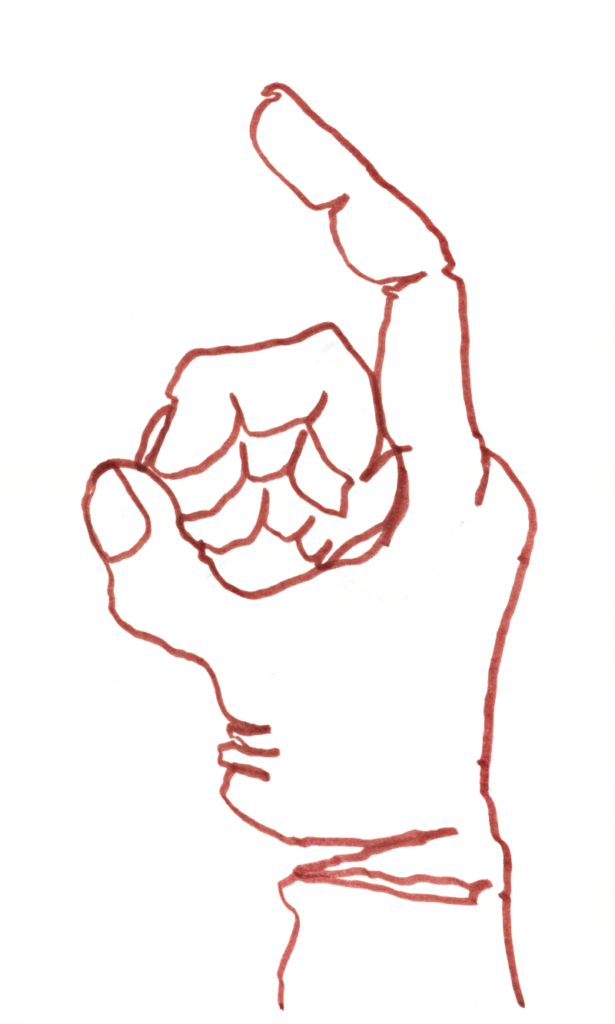
I wanted to start this NATO alphabet series with something simple. I was also testing some new paper. Smooth is nice, but it highlights fingerprints. Once they are used up, I’ll focus on the sulfite paper, because it’s cheaper and can be used on both sides.
,
,
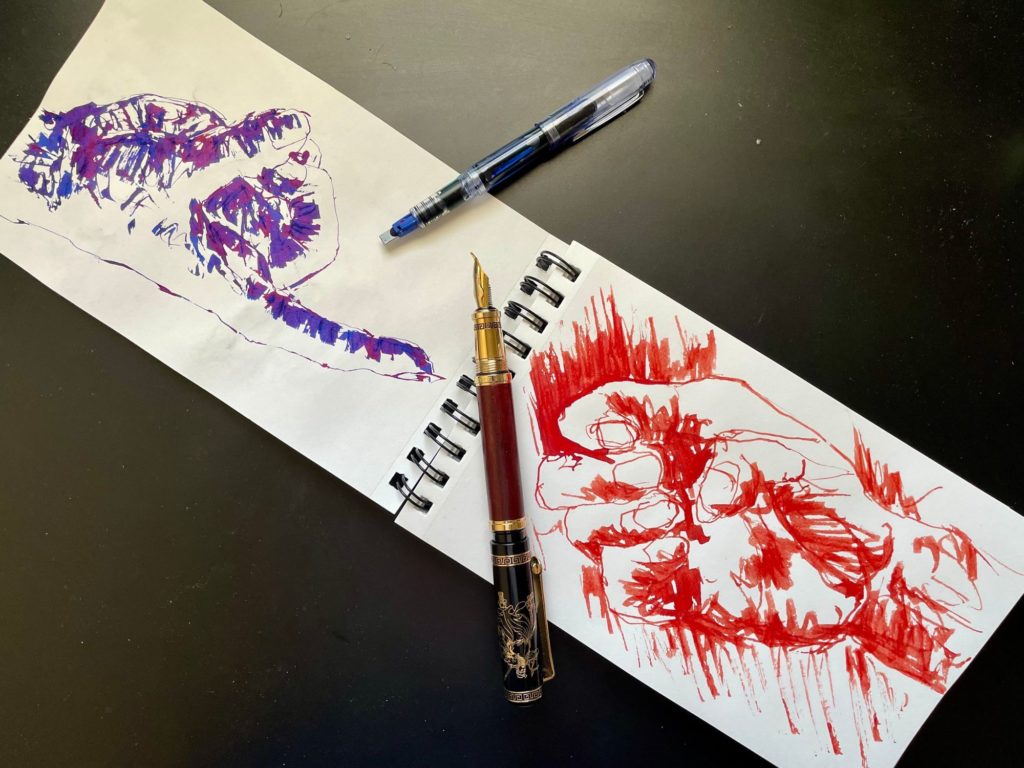
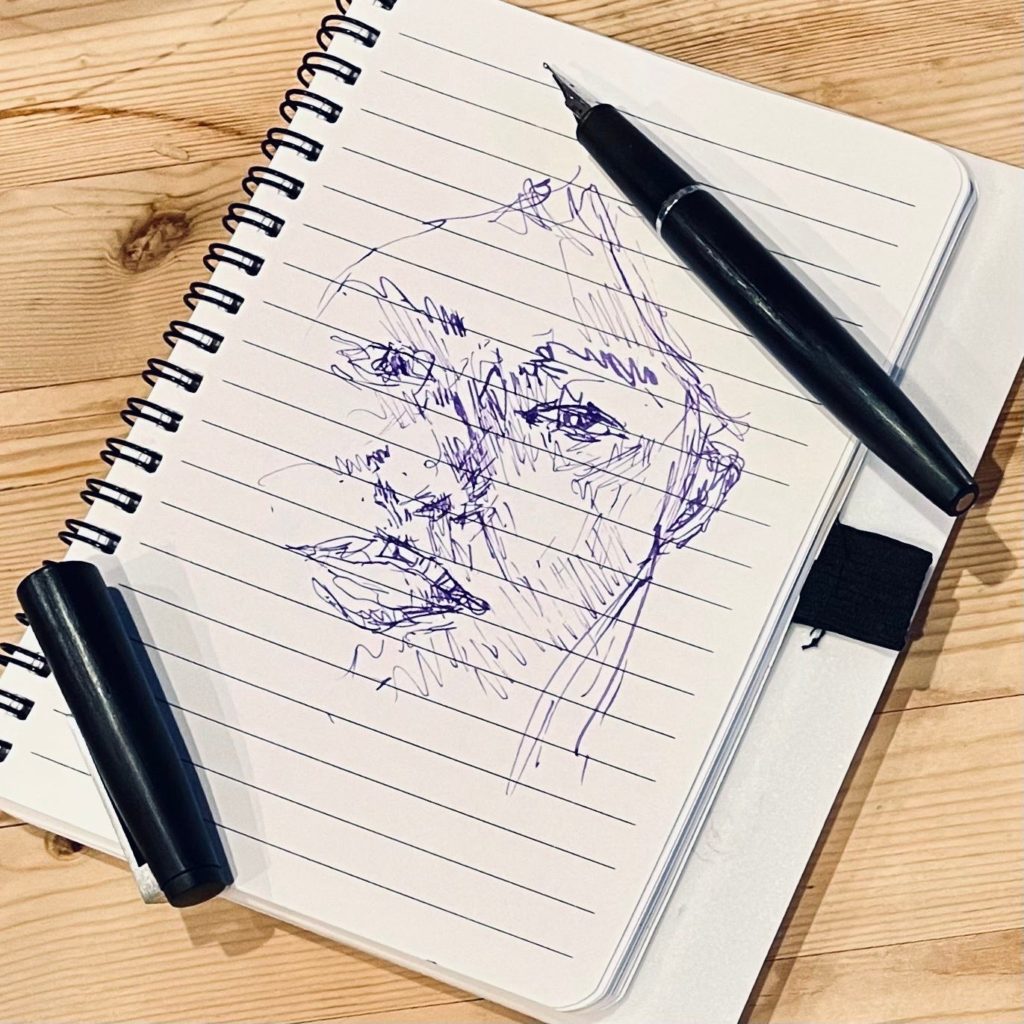
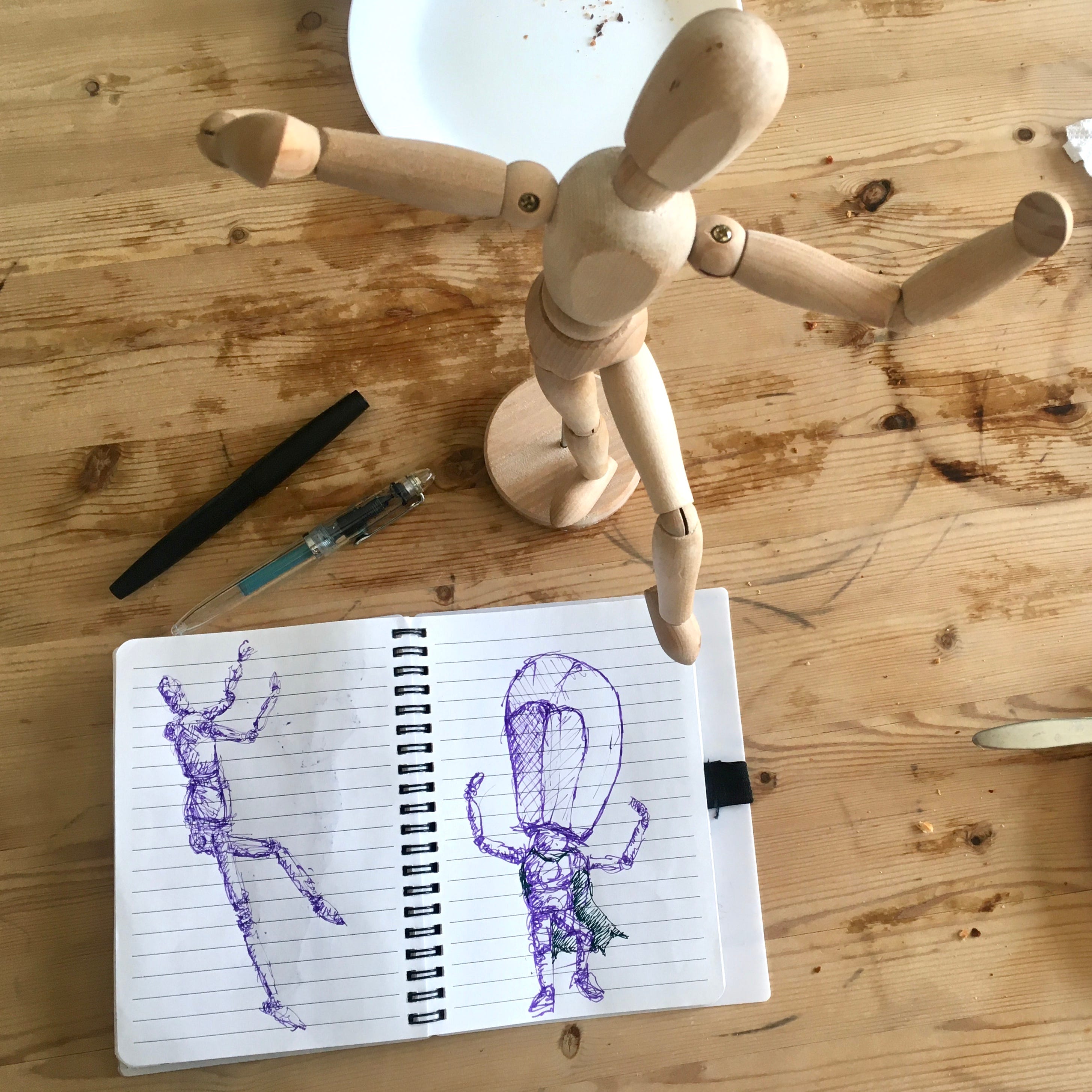
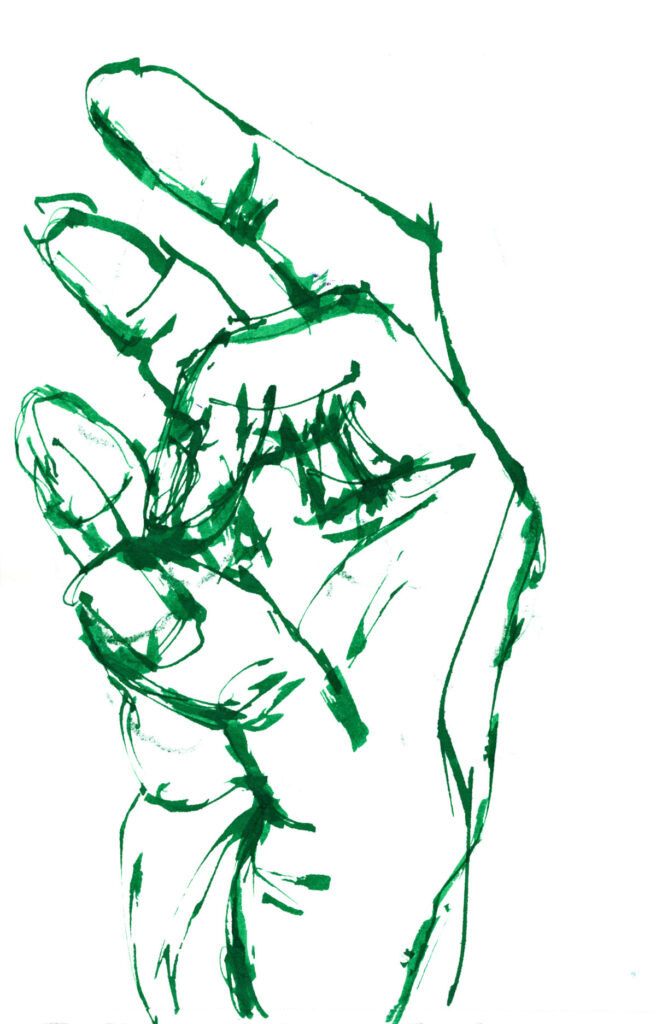
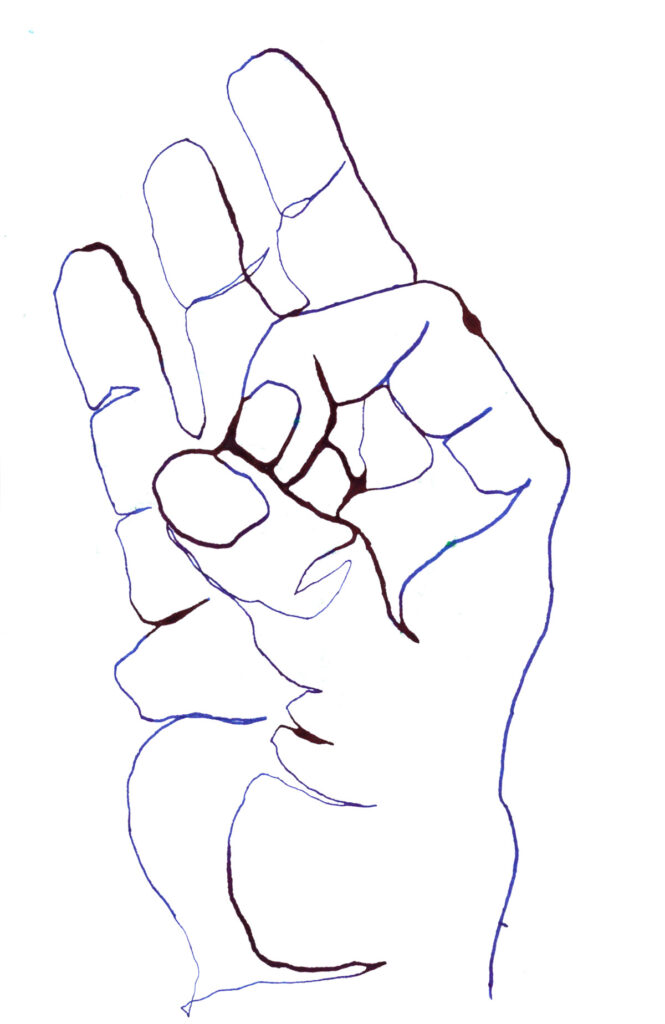
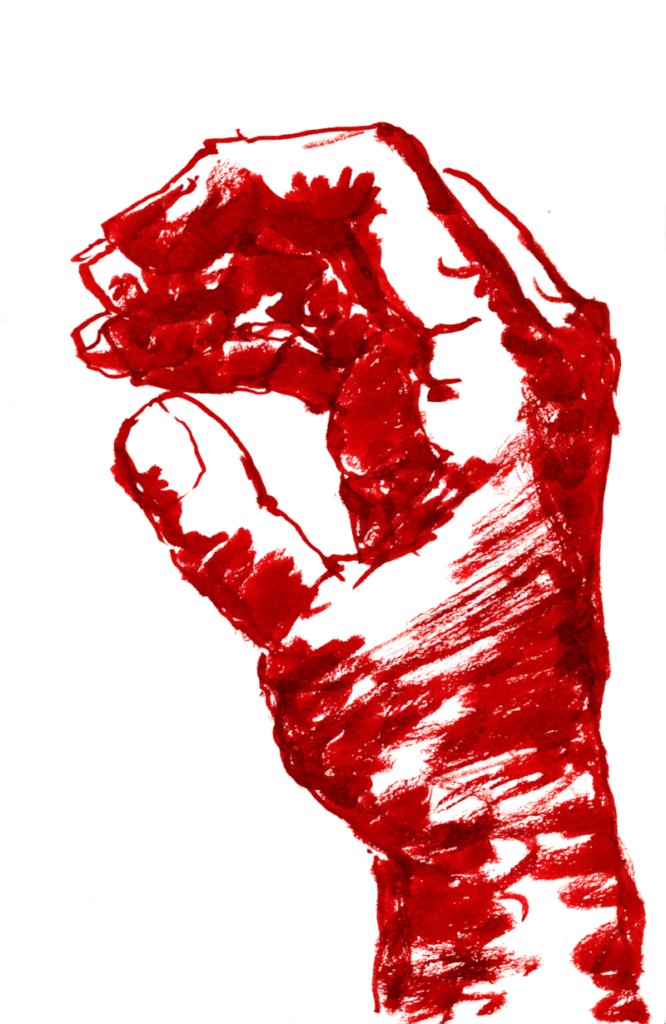
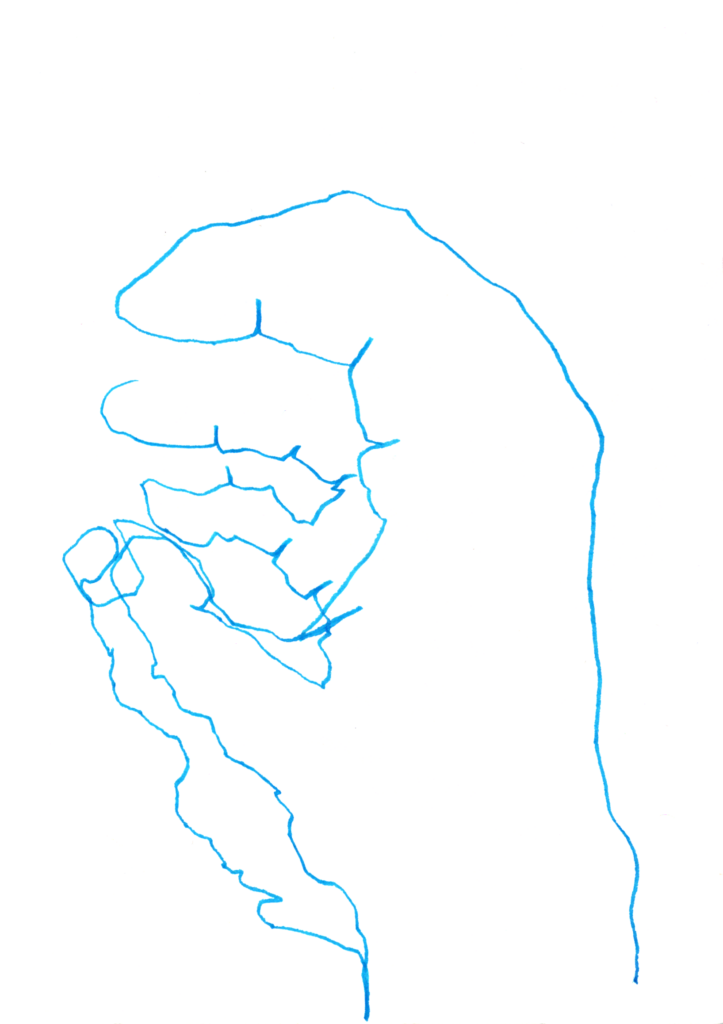
Thanks to Hazel Burgess for suggesting that I try blind contour drawing. It’s a great exercise!
,
,
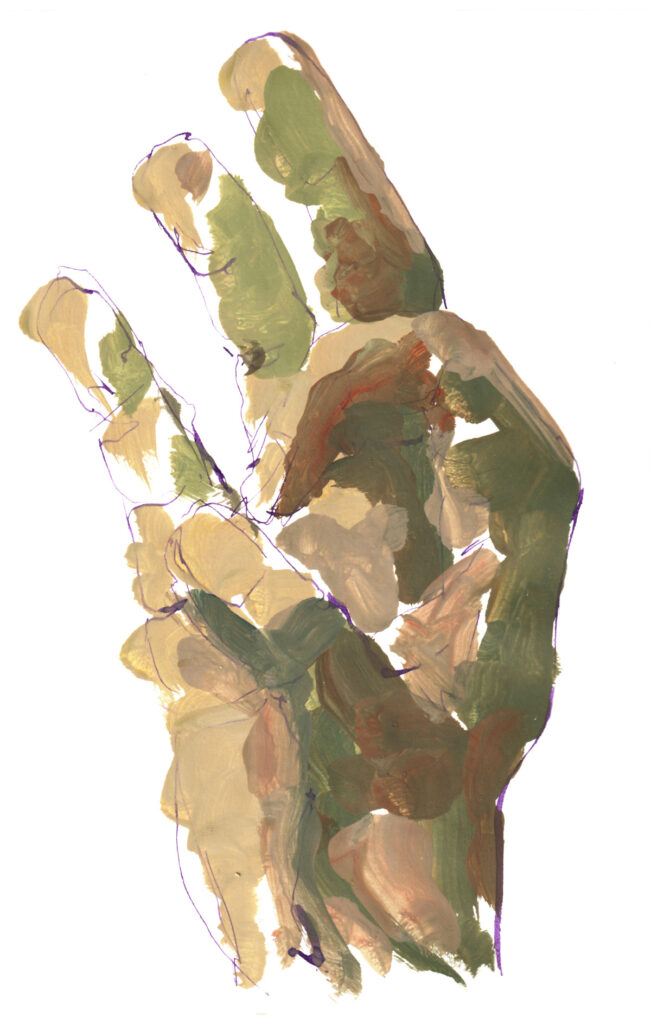
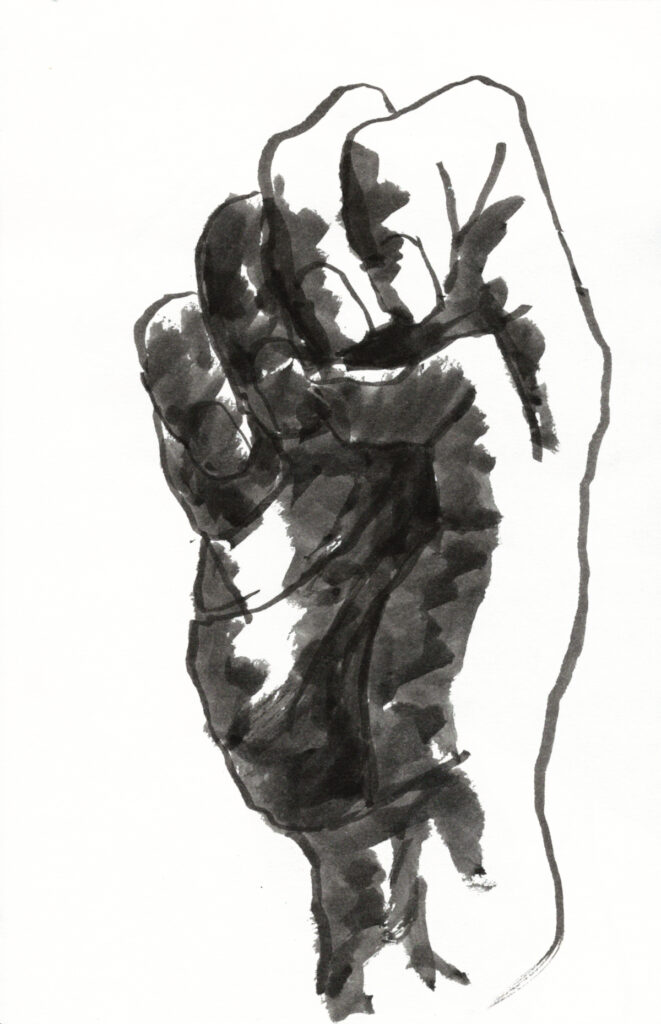
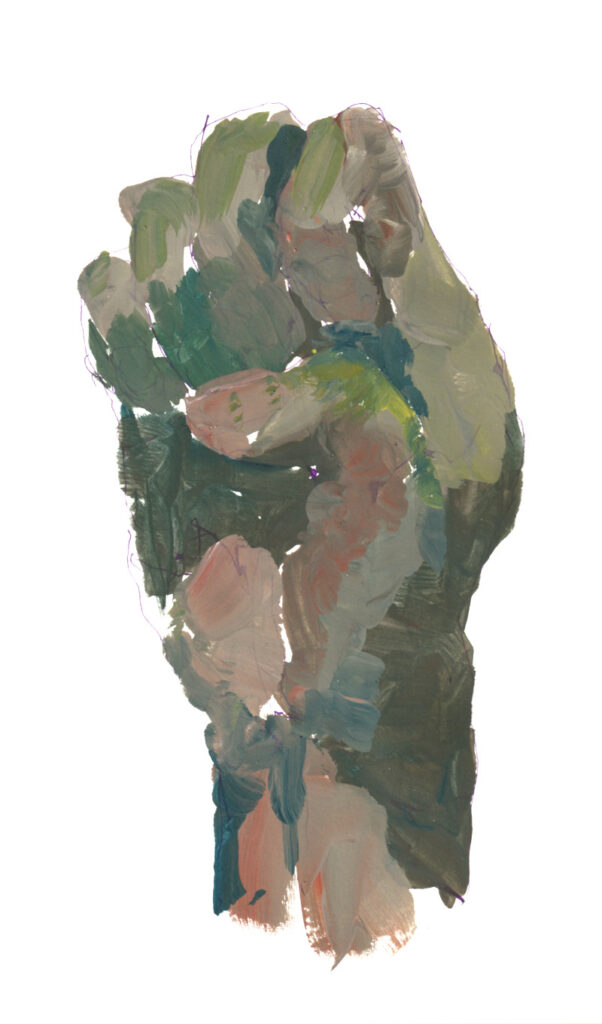
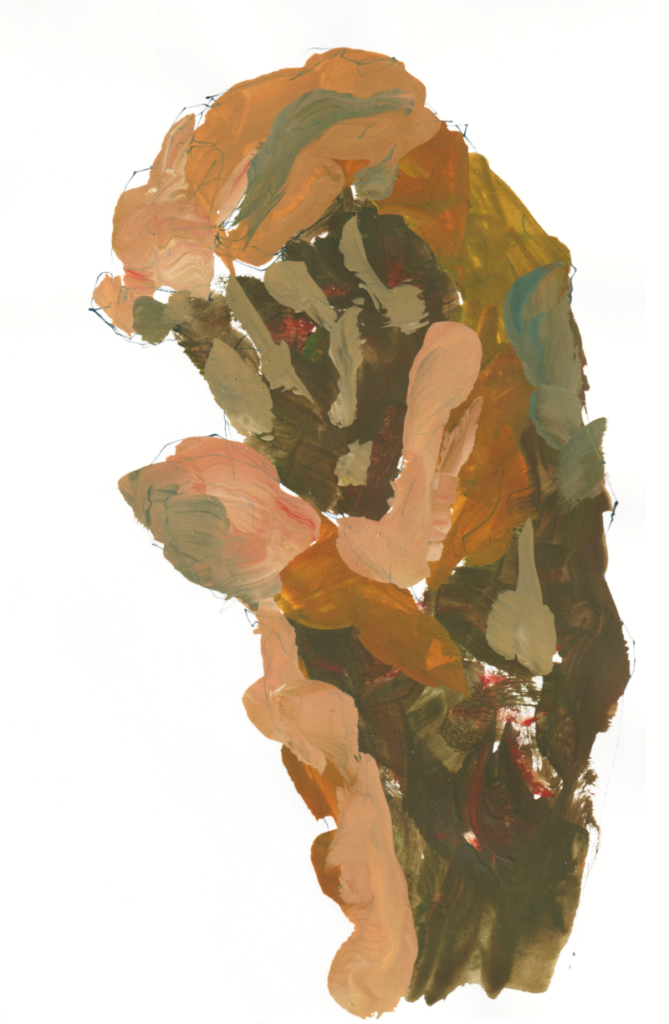
And thanks to Jozsef Abranko for the nudge to use my gouache to paint (duh!)
,
,
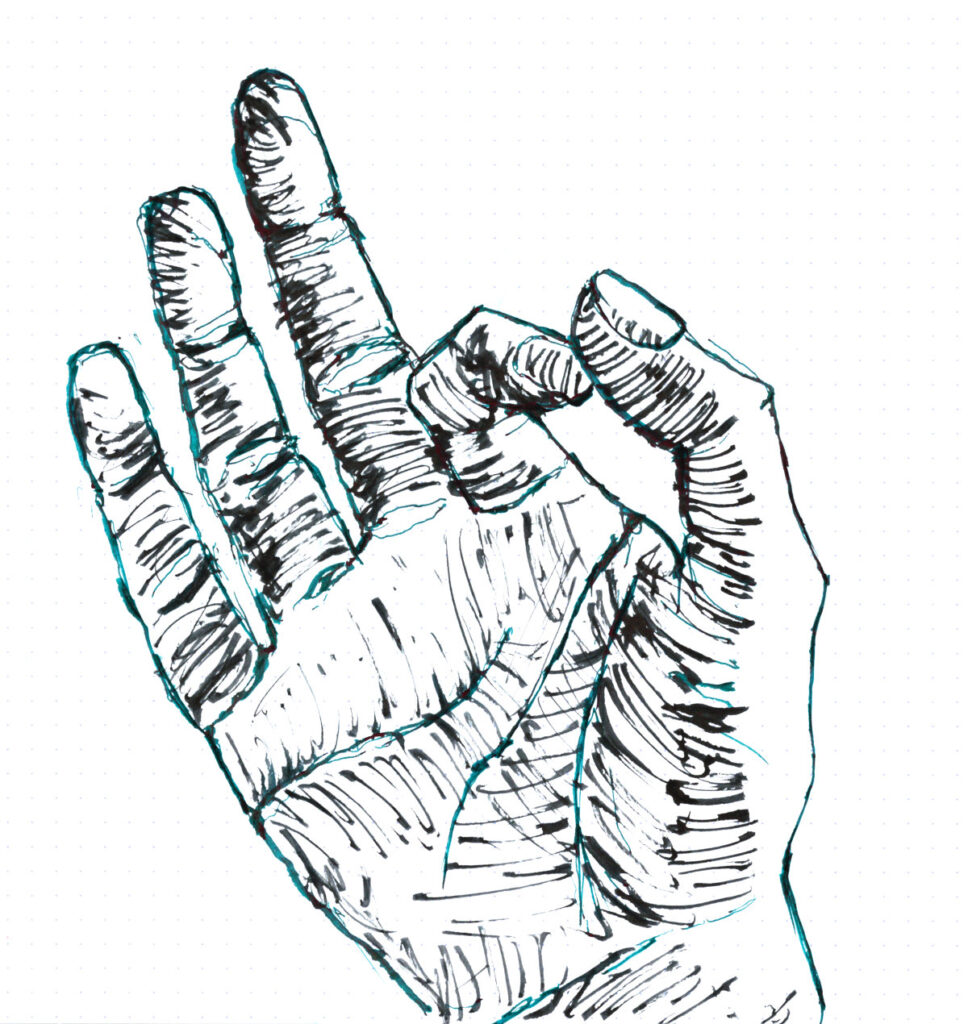
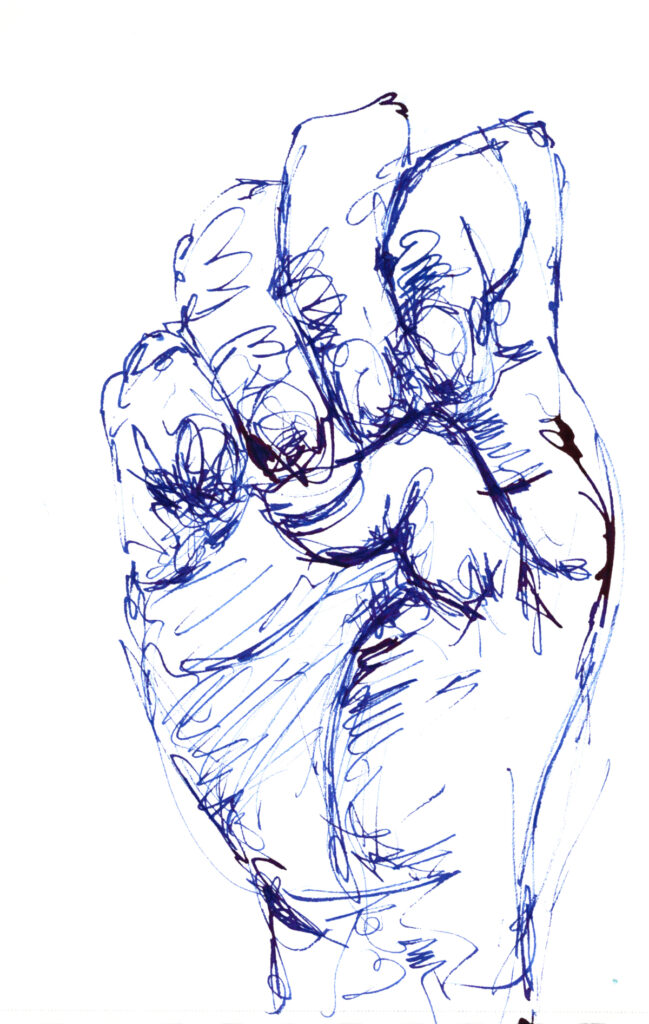
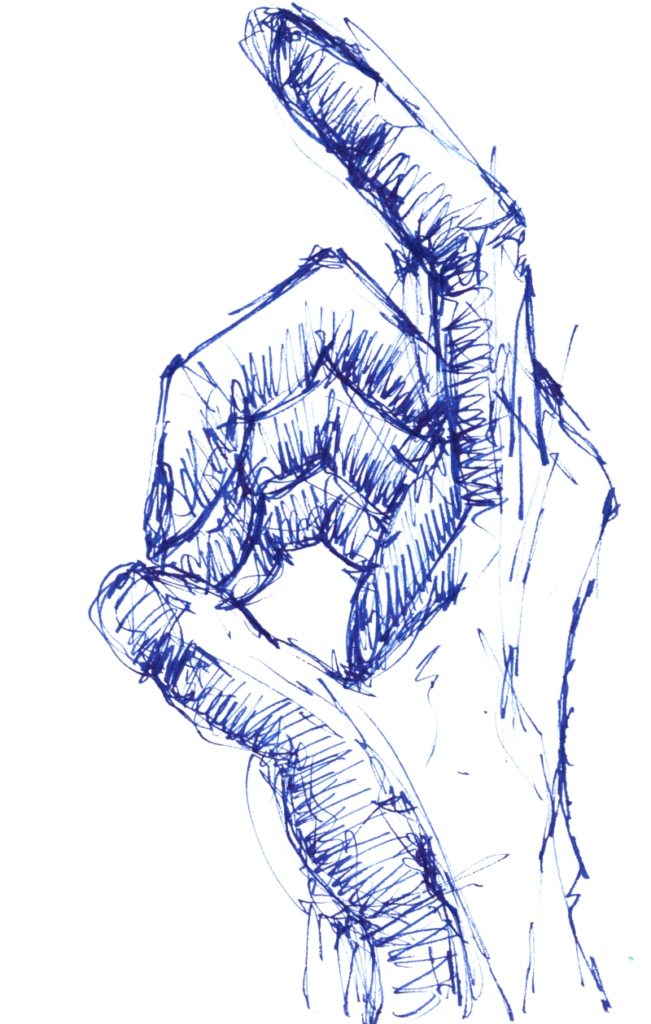
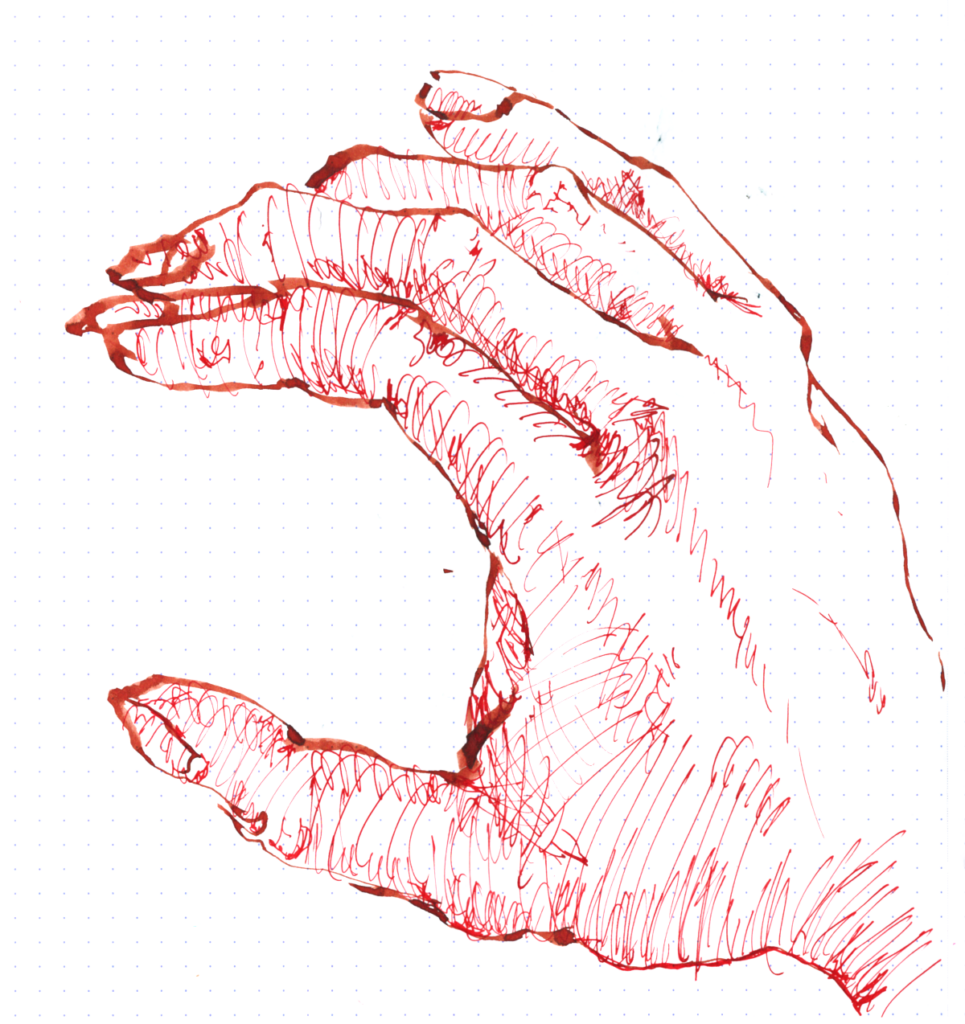
I had been constipated with drawing for two decades before generative AI became a thing in 2022. When computers can create perfection in seconds, imperfection is now proof of humanity.
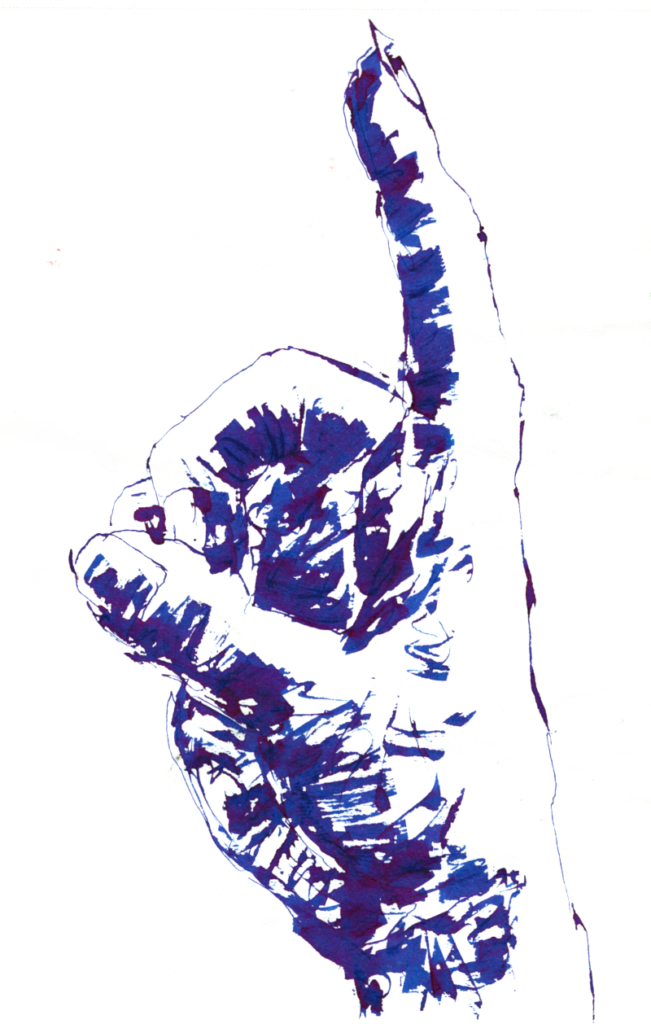
Nothing like a digital existential challenge to get moving. I picked up the pen again, meditating on my right hand shaping the letters of the alphabet, morning after morning.That cycle was replaced in 2024 by calligraphy, but I always wanted to properly close out this practice that awoke my spirit after such a long hiatus.
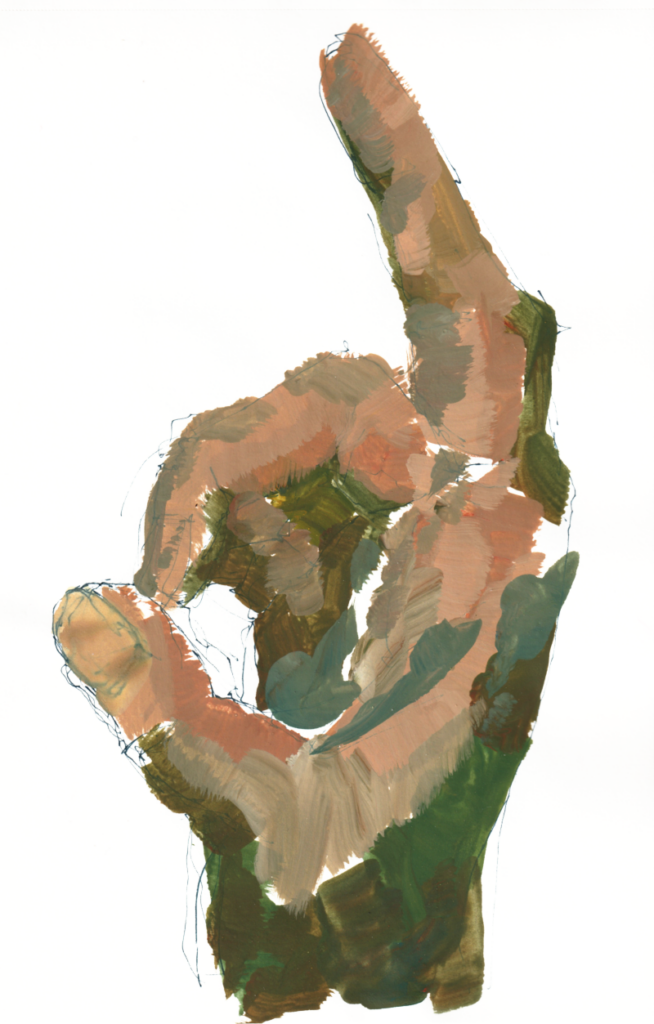
I hope you enjoy these old sketches paired with new graphs and my new explorations in gouache.
One of our admins retired. After twenty plus years, time to enjoy retirement. We gave her a proper sendoff with a card and a lunch.
Over the last couple of years, every single contract ran through her. For an agency all about spending money to build stuff, she was the cog.
The next day I went through all our workflows erasing her name.
It was a cold exercise. But government business, keeps on marching. I hope she’s enjoying the time off. It must be better than putting up with us.
~
Some Links
I’ve heard that Merlin Mann no longer supports his own Inbox Zero idea, but I do (for work). I tell interns that they need to be observant and reliable. I don’t know how to teach observant, but having a minimal inbox (along with a solid process for tracking archived emails) is a great way to become absolutely dependable.
Seth Godin is the original daily blogger. To be honest I’ve moved on his self help, but reading his daily posts for the first fifteen years of my career ingrained an ethos of care and generosity that has taken me far in this profession.
A few months ago, a video introduced me to the Cult of Done manifesto. As a hoarder, I have a hard time throwing things away, certainly not after a week. But still, it’s been influential in clarifying what I want to work on.
The Cult of Done Manifesto
There are three states of being. Not knowing, action and completion.
Accept that everything is a draft. It helps to get it done.
There is no editing stage.
Pretending you know what you’re doing is almost the same as knowing what you are doing, so just accept that you know what you’re doing even if you don’t and do it.
Banish procrastination. If you wait more than a week to get an idea done, abandon it.
The point of being done is not to finish but to get other things done.
Once you’re done you can throw it away.
Laugh at perfection. It’s boring and keeps you from being done.
People without dirty hands are wrong. Doing something makes you right.
Failure counts as done. So do mistakes.
Destruction is a variant of done.
If you have an idea and publish it on the internet, that counts as a ghost of done.
Starting the New Year marching through pieces from eight months ago, then again, it’s fun to explore the (recent) past.
,
4/1/2025
Looking back, I should made a lot more of these backlit photos on the light tablet. I remember when light tables were big pieces of furniture. Now they are thin cheap LED’s powered by a USB-C cable.
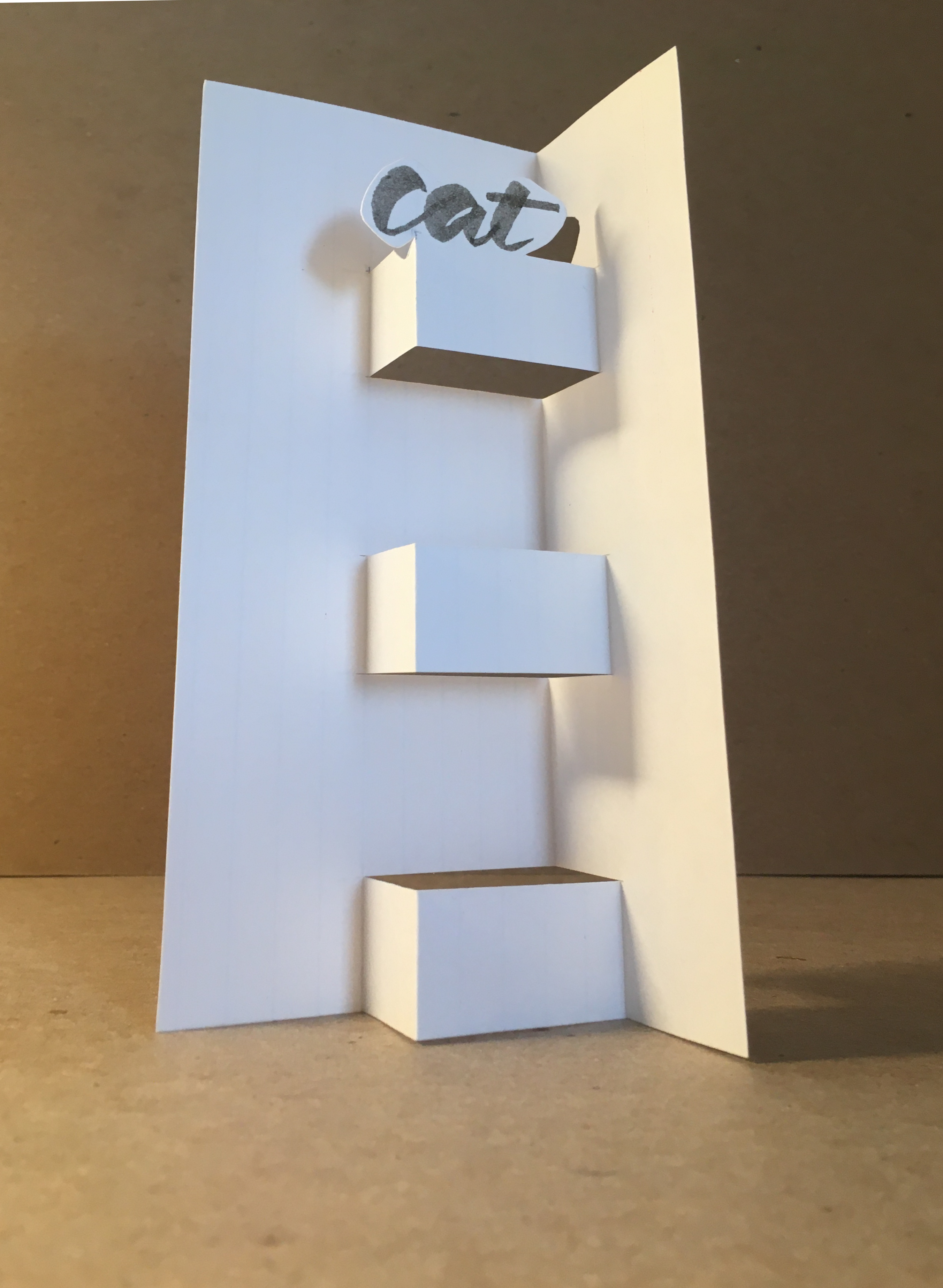
After making this piece, I realized that this prompt was likely inspired by the TV show Severance. So I made a popup based on that logo as well.
,
4/5/2025
state dinner droned past six rain lust through parged age never duplicate time flowing away
I spent a month playing with fractur script. Normally I use a 6.0mm nib, so it’s fun to drop down to the 2.4mm and fit more than a few words on a page.
,
4/7
A simple slice, with the sliver tucked into its original cut.
,
4/10/2025
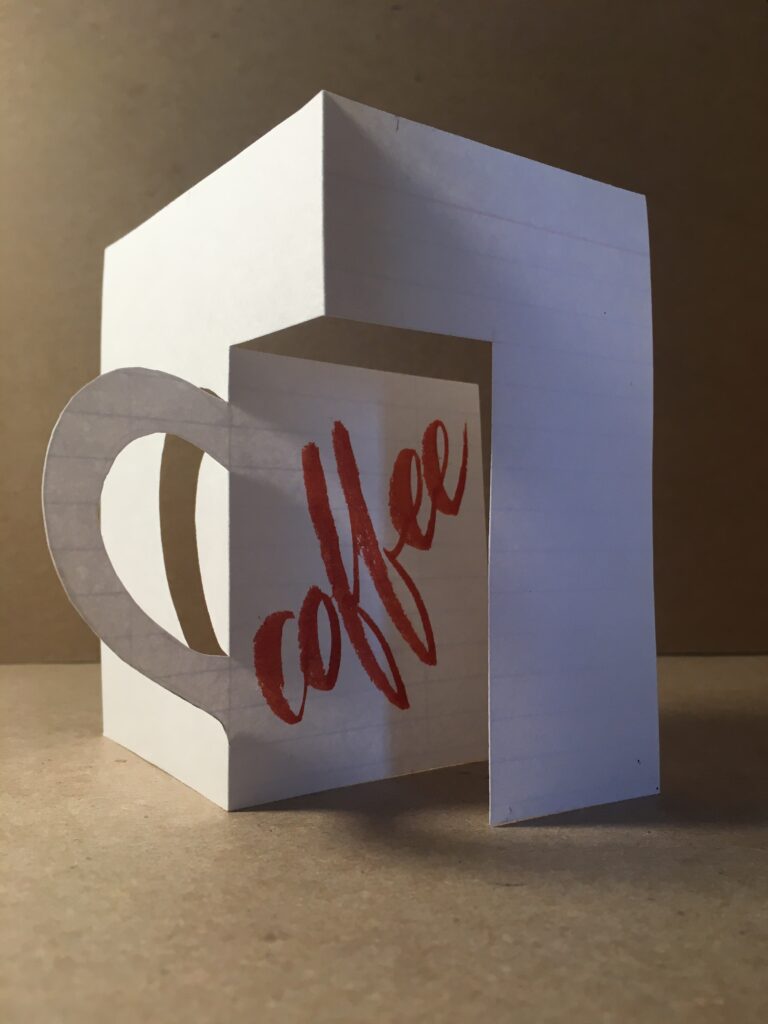
A literal take on the Lego form as I was studying the 3+1 (above) versus 2+2 (below) folds.
,
4/18/2025
Tigers hunt in the tall grass.
,
I’ve been on a good run of working ahead, so it’s been weird to write in the present tense when it isn’t Thanksgiving yet. Moving forward, I might drop this pretense until I’m back to being behind “schedule”.
Cya next time!
,
PS—Journey to the West, CCTV, 1986
After I recounted the story of the jade rabbit from chapter 95, my daughter wanted to watch the story. The episode adapted the novel well, hitting the key points while abridging and eliding non-critical aspects. The producers spun the story with a moral exhorting Piggy to behave, but otherwise followed the original.
Indeed, they followed the spirit perfectly. The novel is itself an artful collection of folk tales, so this was a figuratively faithful translation into a new medium.
Unfortunately, the production shows its age. The pacing is a little stilted and the budget is much less than one expects with modern fare. I imagine two audiences for this show—rewatching for nostalgia and for nerds to analyze how the novel was adapted to the television medium.
I would fit the latter group, but having no fondness for live action TV, this series isn’t for me, definitely not for a 30 hour commitment.
After completing the novel, I watched the final episode of the show. I love how they stayed faithful to the original story while closing it in its campy, endearing way. I see why this show has been replayed on TV every since year since its original broadcast. I watched a trailer of a 2011 take on the novel and the old practical effects of the original are vastly more appealing than cheap, outdated CGI.
—October 2021
,
PPS—Cowboy Bebop, Netflix, 2021
I don’t know how to remake a classic, except that this ain’t it. The production is of decent quality, though imperfect. John Cho is a little old. None of the actors hits their notes dead on.
This adaptation is trapped in the uncanny valley of recreating the past (episode 1) and creating its own identity (episode 2). The first episode missed the mark (a damn near impossible task), and the second episode proved it was going in a direction that I wasn’t interested in.
Vicious and Julia are barely characters in the original. He was (as the name implies) is a cruel force of nature. She’s mute lost object of desire. Making them human reduces their essence and costs us time in revisiting the main characters.
To be fair, I might have given this series one more episode but after disliking the second I crawled the internet, found mixed removed and moved on. Why spend 8 hours on a mediocre echo when I could just revisit the original masterpiece again?
—November 2021
,
PPPS—World’s Most Extraordinary homes, Netflix, 2017-2018
My kids make little tent structures around the house so we thought they would enjoy checking out all these cool houses around the world.
Yup, it was pretty awesome!
Admittedly, when the revolution comes, these folks will be the first to fight the mob at their gates (unless their private security forces pushes the rabble towards easier targets).
Class envy aside, the rapport between the hosts was fun and the houses were luxurious. Unsurprisingly, we preferred the smaller (often architect owned) structures. Financial constraints made for tighter designs that just felt right.
The first season was sorted by geography (mountain, coast, etc.), while the second was by nation. Both were fun to watch and it’s a shame there aren’t any more seasons.
I met the Architect and our Agency to discuss a simple fencing project. We addressed logistical concerns and needs of their staff and clients. We covered security concerns, budgets, and traffic flows.
At the end of the meeting, the Architect started to ask questions. He stripped away the project requirements. He challenged our priorities and tested the assumptions.
It was a beautiful moment of architecture. I got to see a flash of inspiration happen in real time.
I’m not sure what the agency will do. Maybe they will stick to what they originally requested. But the architect’s job is to ask the hard questions. We’re not just order takers. We push our clients towards their best future—which might not the one they imagine.
In my years, I’ve had the privilege to watch professionals practice their craft at the highest level. A few years ago, I watched my old boss sell a design, weaving a tapestry of a story. It was a raw display of skill, and I told my interns to cherish the moment, cause that doesn’t happen every day.
This was another such moment. It was also a professional challenge. Why didn’t I ask those questions earlier? I might be the owner, but I haven’t become a ticket machine, yet.
I’m here to challenge your assumptions and refine your future.
I’m still an architect.
~
Some Links
YouTube is an amazing warehouse of amazing dancers. I presume TikTok may even be more addictive, but I’m not touching that drug.
Lia Kim is my favorite dancer and choreographer. This collaboration with Jinwoo Yoon for Rain Dance always takes my breath away. Their body control is so tight and synchronized with the music. (While in Korea, a shoutout to TIMT who posts behind the scene to accompany their short performances.)
Sven Otter’s electro-swing is captivating in both his homemade videos and in commercial advertisements.
Marquese Scott was one of the original YouTube dancers and Pumped Up Kicks video still hits, even with the simple set camera on the ground. I also love this collaboration with a sign spinner.
This year roughly followed the seasons, with one big break.
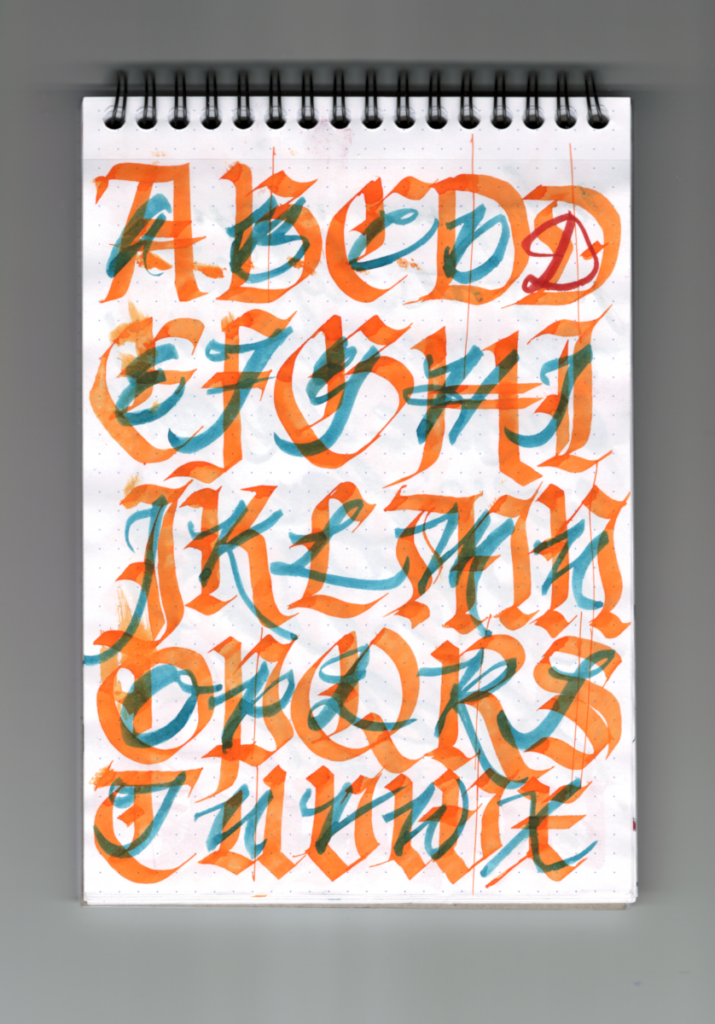
Winter started with a monthly focus on new scripts—finally bearing down on Italics, Gothic, Copperplate, and Roman Capitals.
We bought the boy Paul Jackson’s Cut and Fold Techniques for Pop-Up Designs which I promptly commandeered. It completely changed Spring as I cut and folded through all the designs in his book.
Pop-ups are fun, but I hate photographing them, so I returned to the ruling pen in Summer, focusing on cursive. Splatters are addictive!
Then a big break September with a week in the hospital. Not fun, but I’m grateful for the wonders of modern medicine.
Autumn started with my recuperation through Inktober and then walking through the NATO alphabet. It officially became a challenge season when I dived into Callivember with the kids’ watercolor sets.
The last weeks of this year are closing out in two directions.
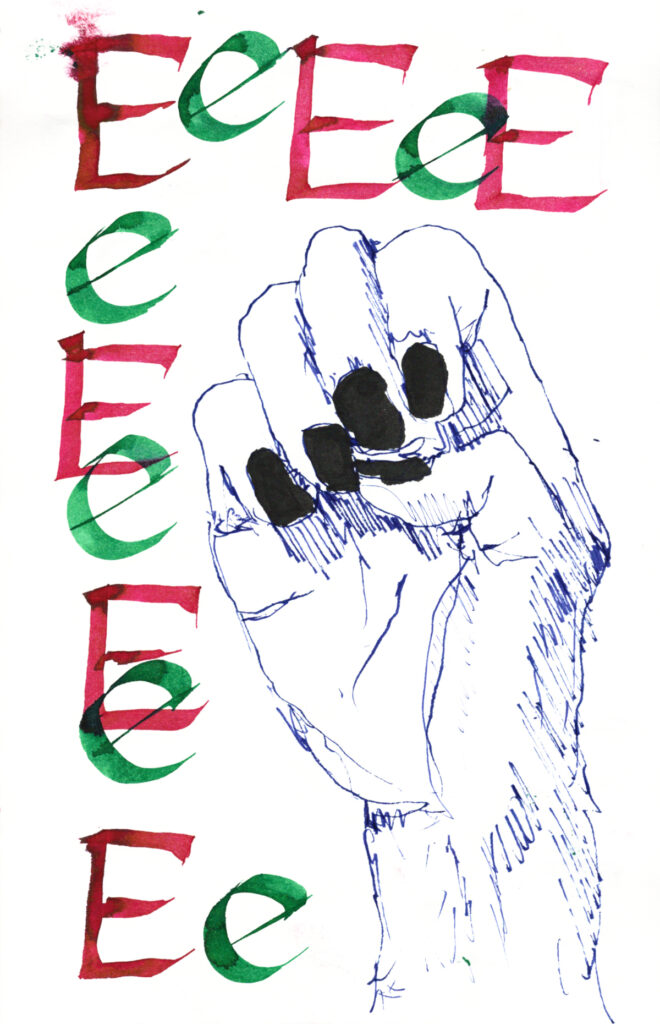
I’ve graduated from Crayola watercolor pans to a tube set of gouaches. OMG, I love opacity! Gouache works great on colored construction paper, and I’m now painting my hand, which pairs nicely with old hand sketches for the NATO alphabet series.
With free release of Affinity, I also started making zines. We even purchased a color printer now that I discovered the existence and efficiency of tank printers. So now I need to publish some zines to justify this purchase!
And for 2026? The good news is that I finally got traction on the 2024+2025 theme of “Catching Up”, plowing through my old blog drafts. I’m only halfway through those drafts and never got around to dormant home projects, but it’s time to move on.
“Curation” is my word for 2026. Life is packed full of interesting things and I need to make some hard cuts—”if it’s not exciting or veggies, then NO!” Even more than the past few months, I hope to embrace the cult of done (or trashed).
Aside from my “exciting” calligraphy, blog, and zine projects, I got the usual list of “veggies” that everybody else has with the new year—a never-ending list of home projects, controlling my diet (nutritional and digital), and creating a regular exercise routine.
So yeah, goodbye to 2025 and here’s to a fresh start in a couple of days, just like every morning!