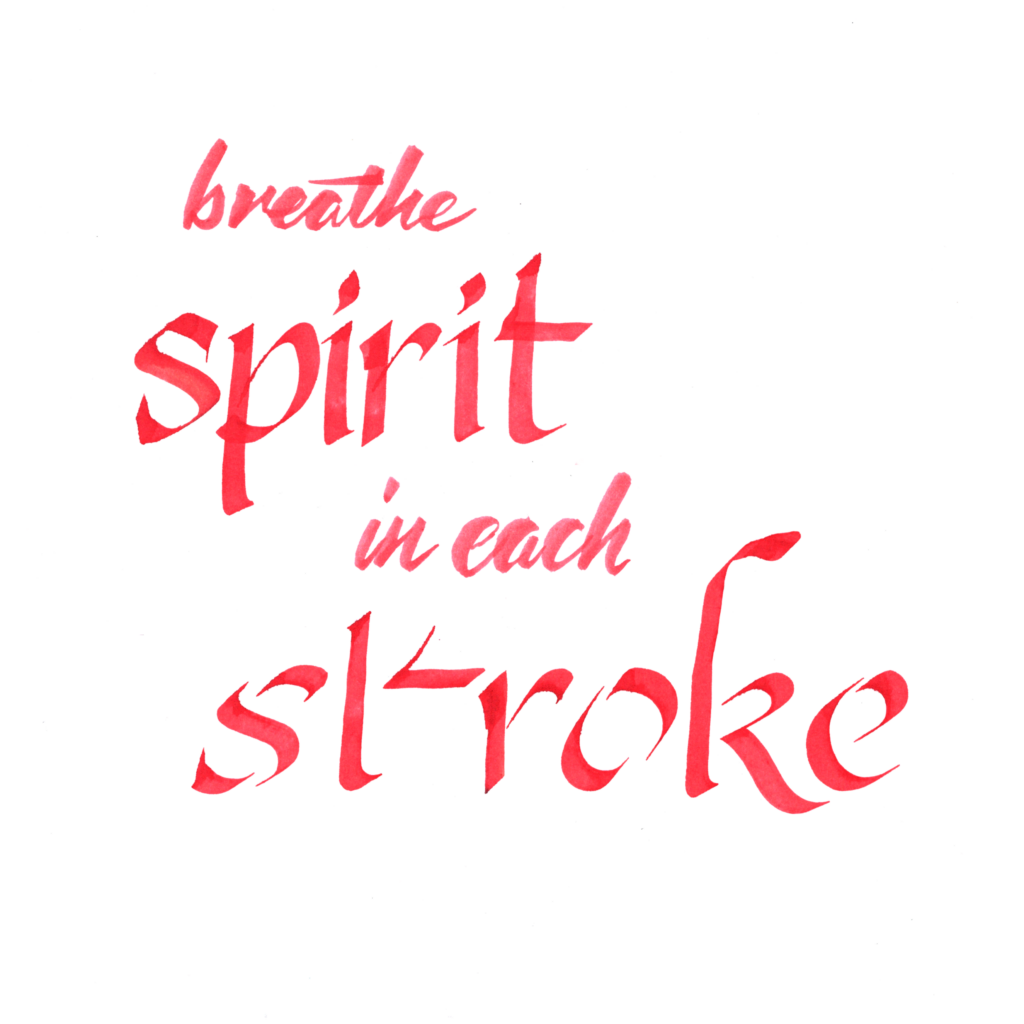
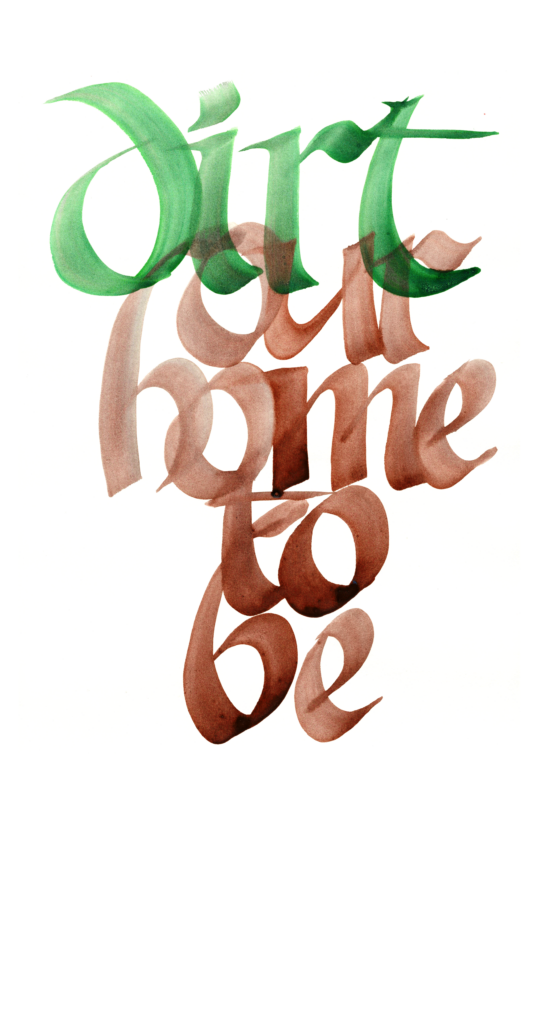
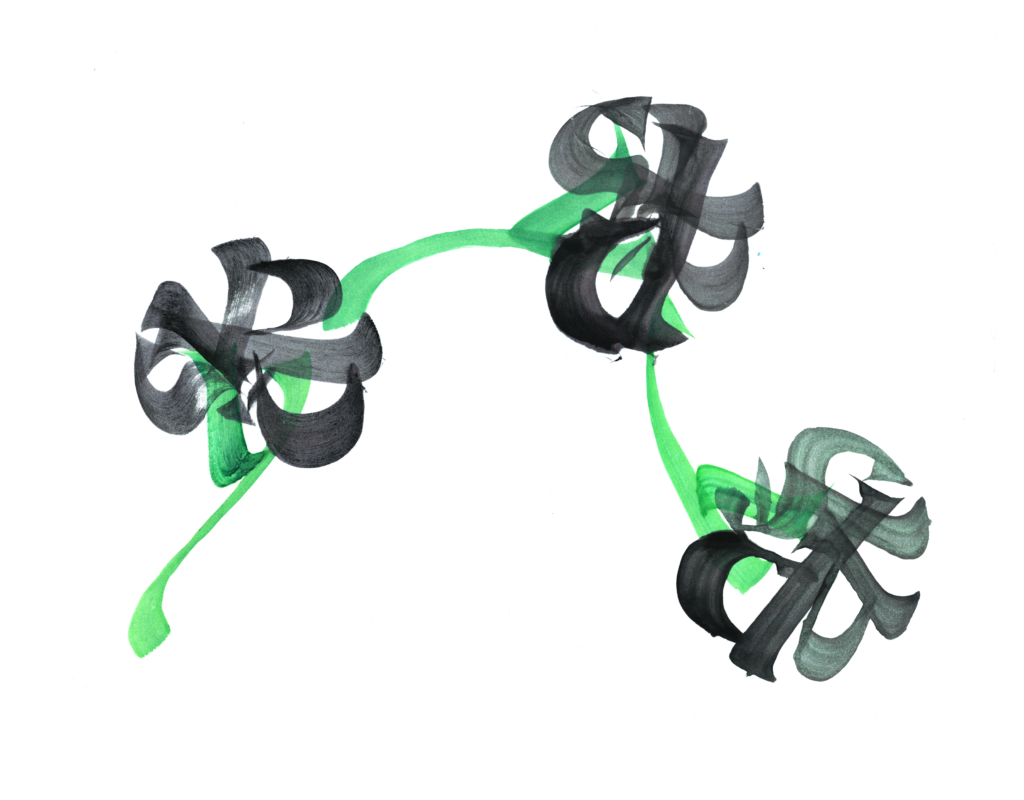
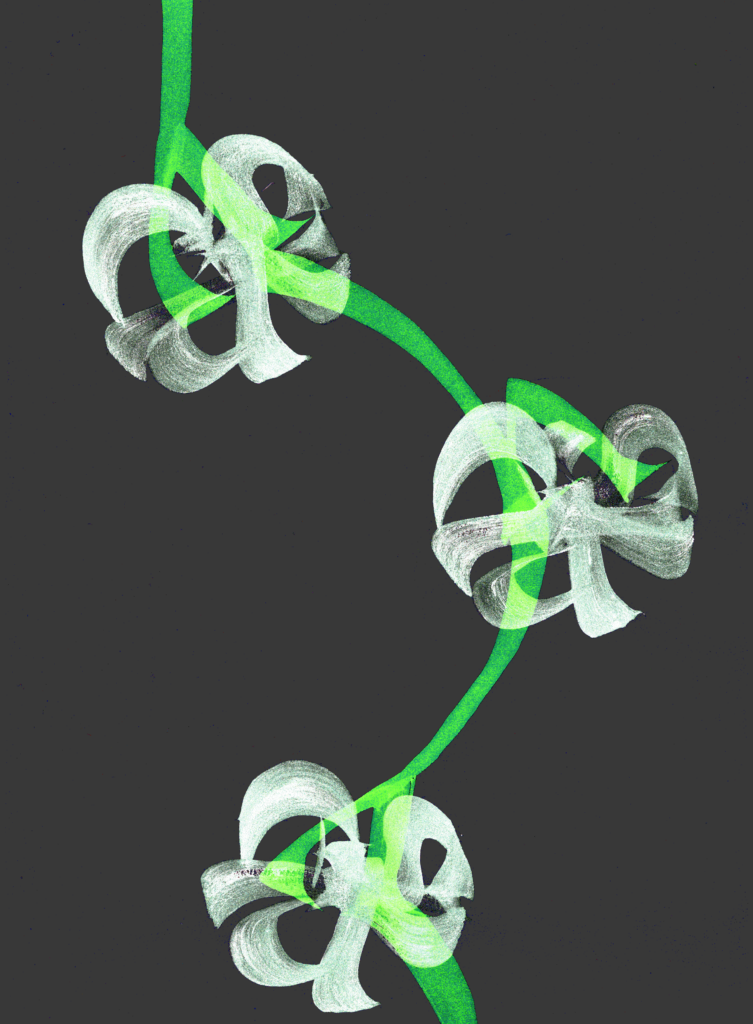
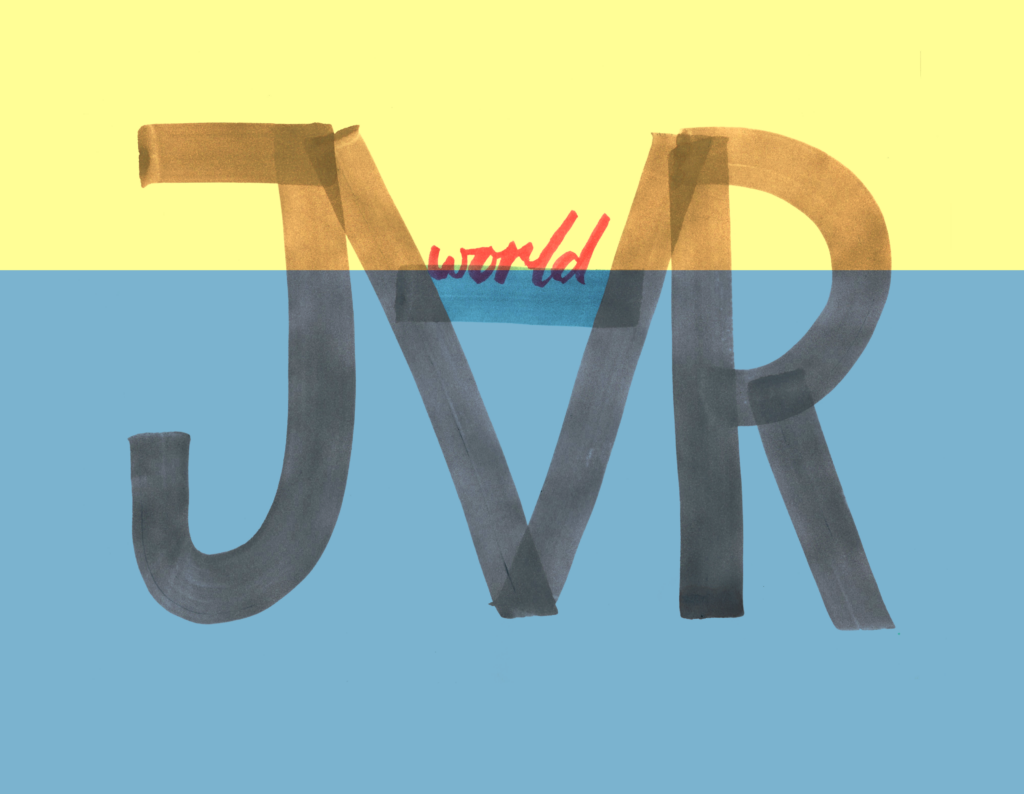
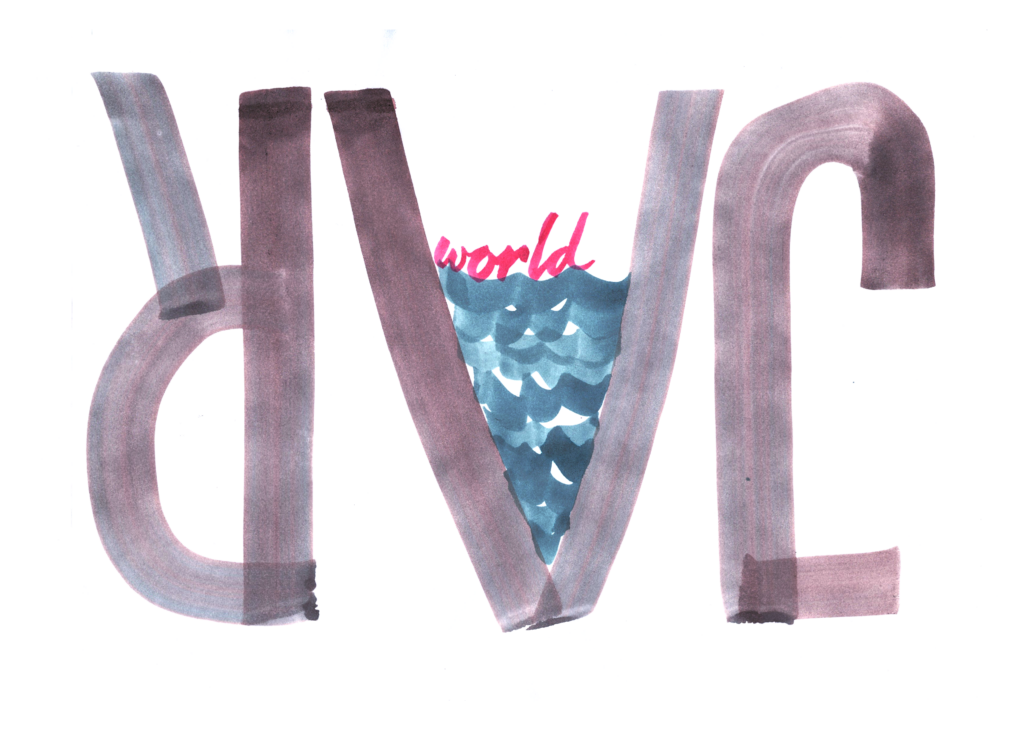
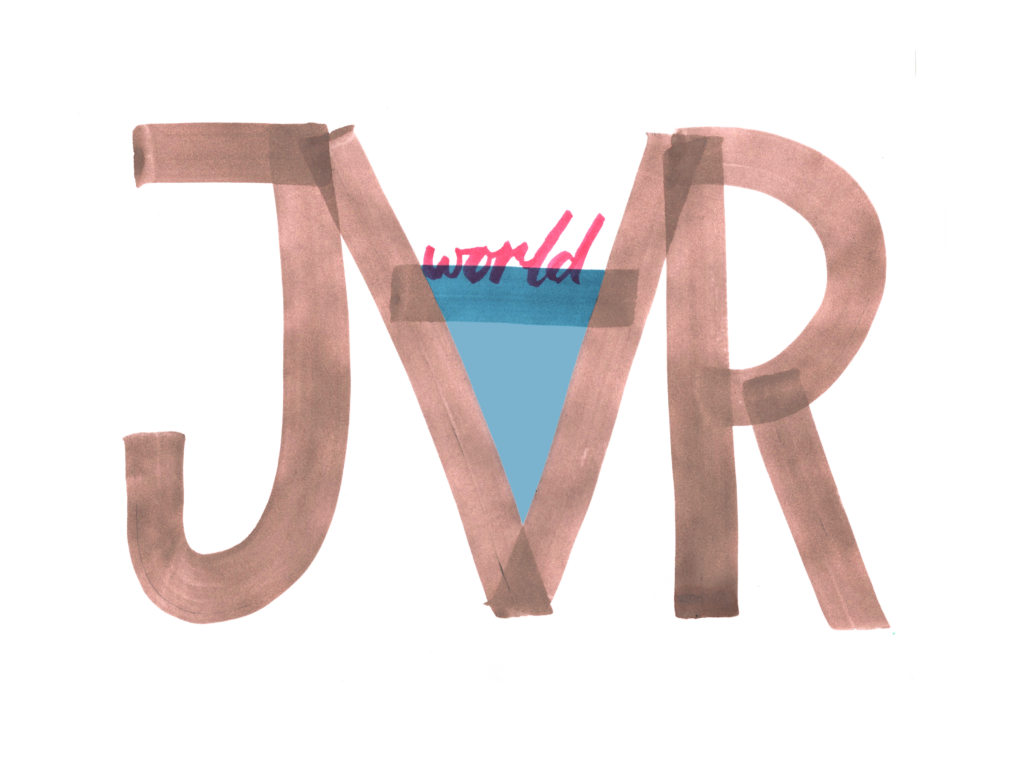
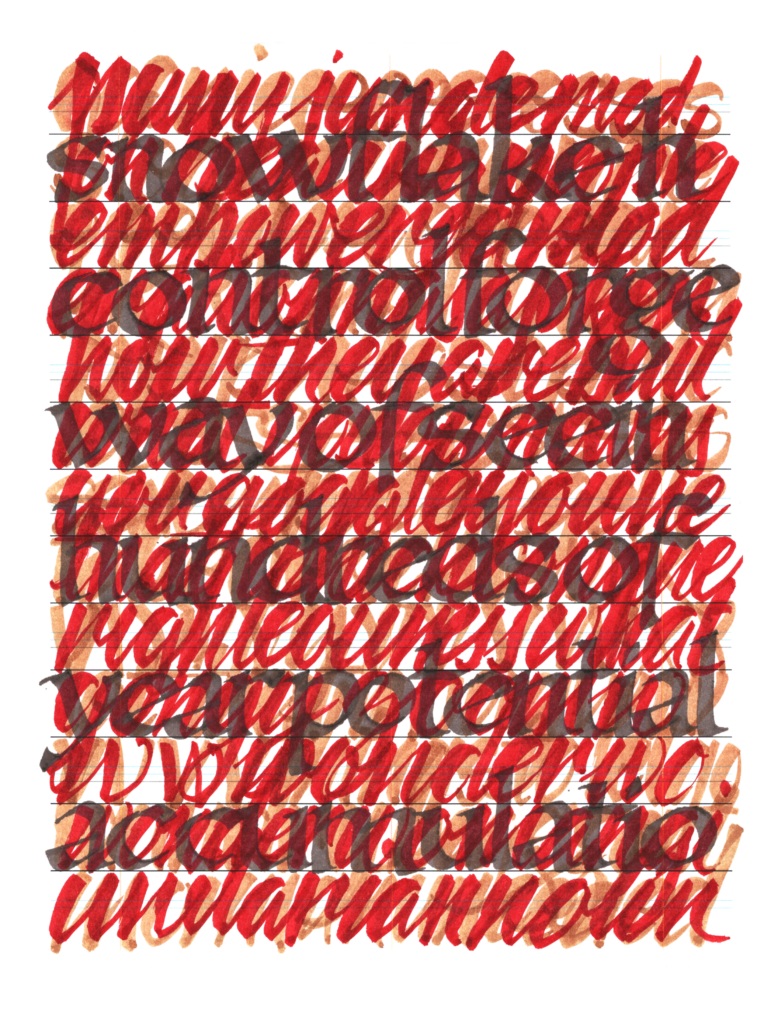
I cheated a little in this one, moving some of the words in the box to fine tune the composition. I never feel great about digital manipulation, but as time passes, I feel less guilty about it.
,
3/6
dirt our home to be
I love how the colors came out on this one, especially the inversion of the colors with the words.
,
3/8 Inktober 52 (2025), week 10
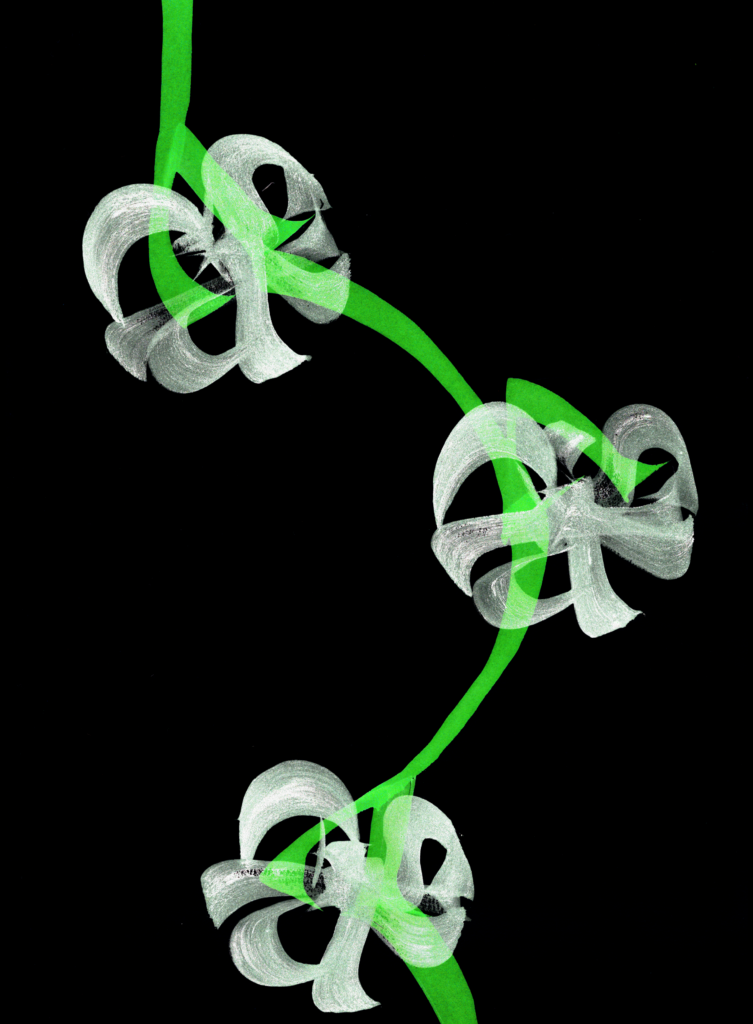
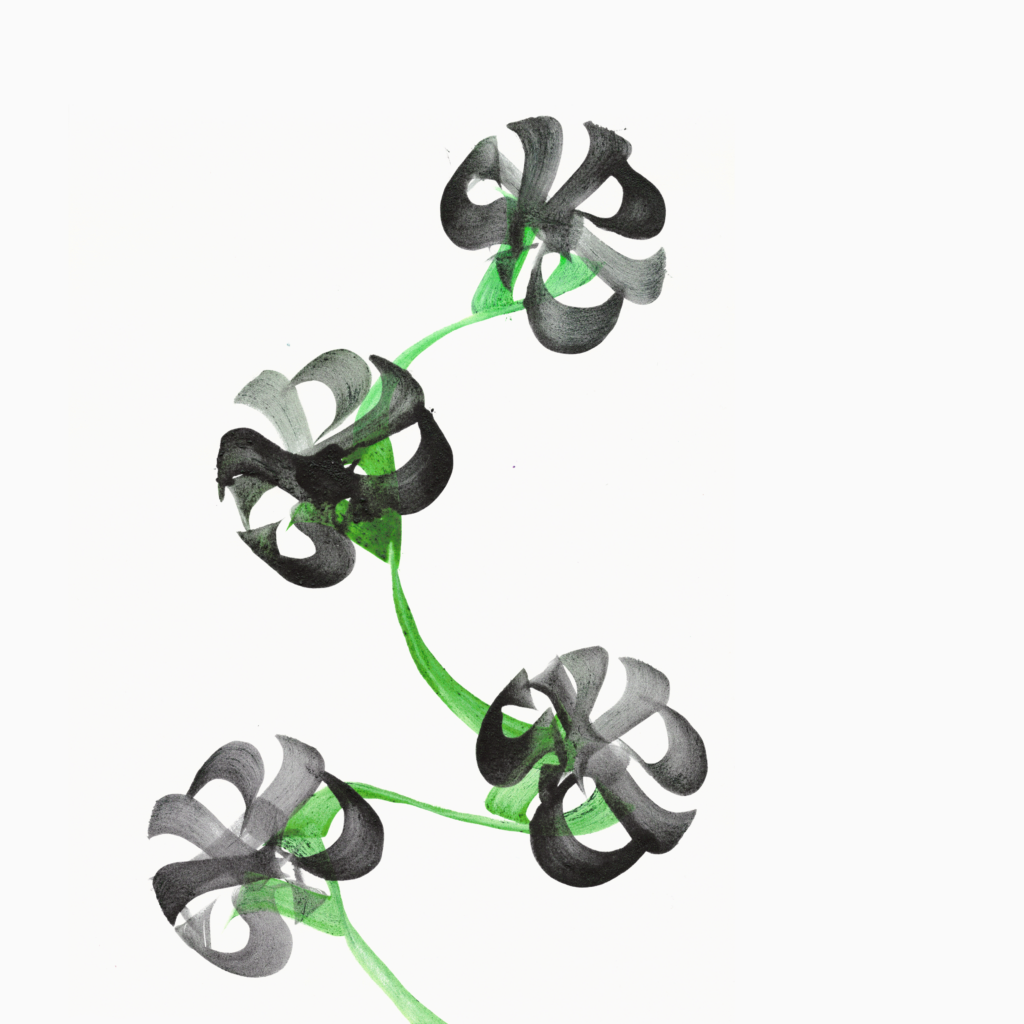
a chain of black daisies
This 5WP was banked on inverting colors in the computer, but the image of a black daisy won out.
,
3/9 Inktober 52 (2024), week 12
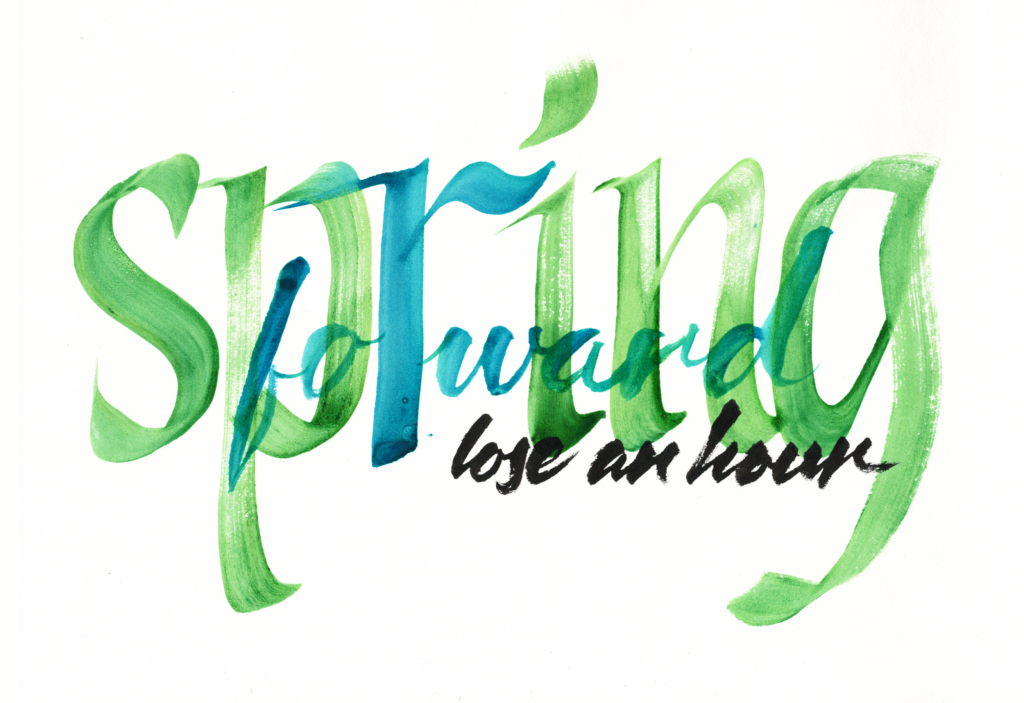
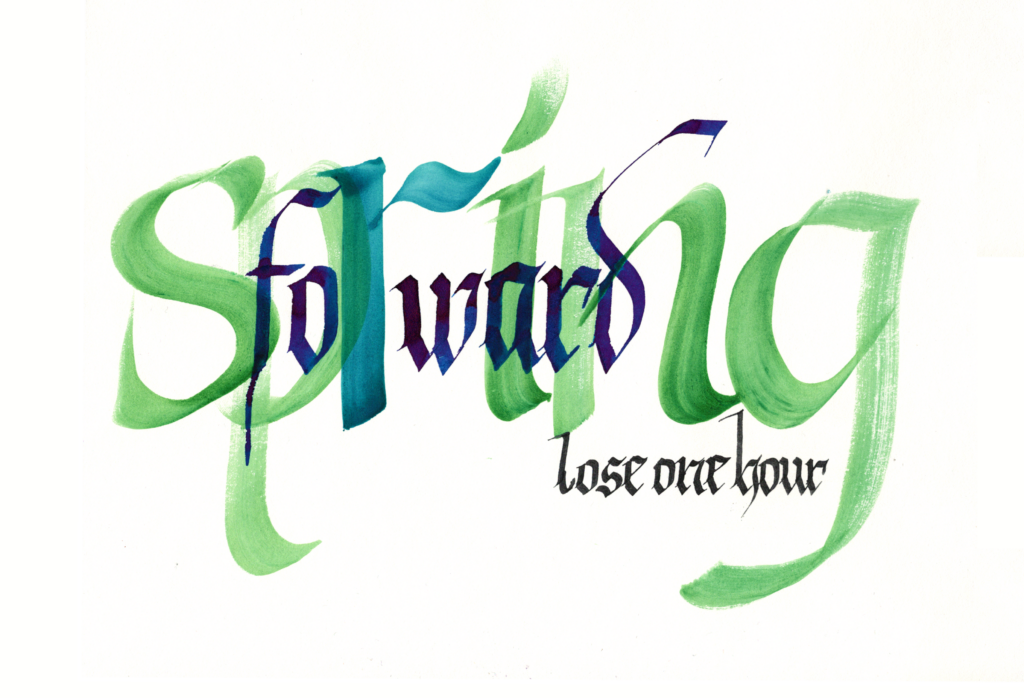
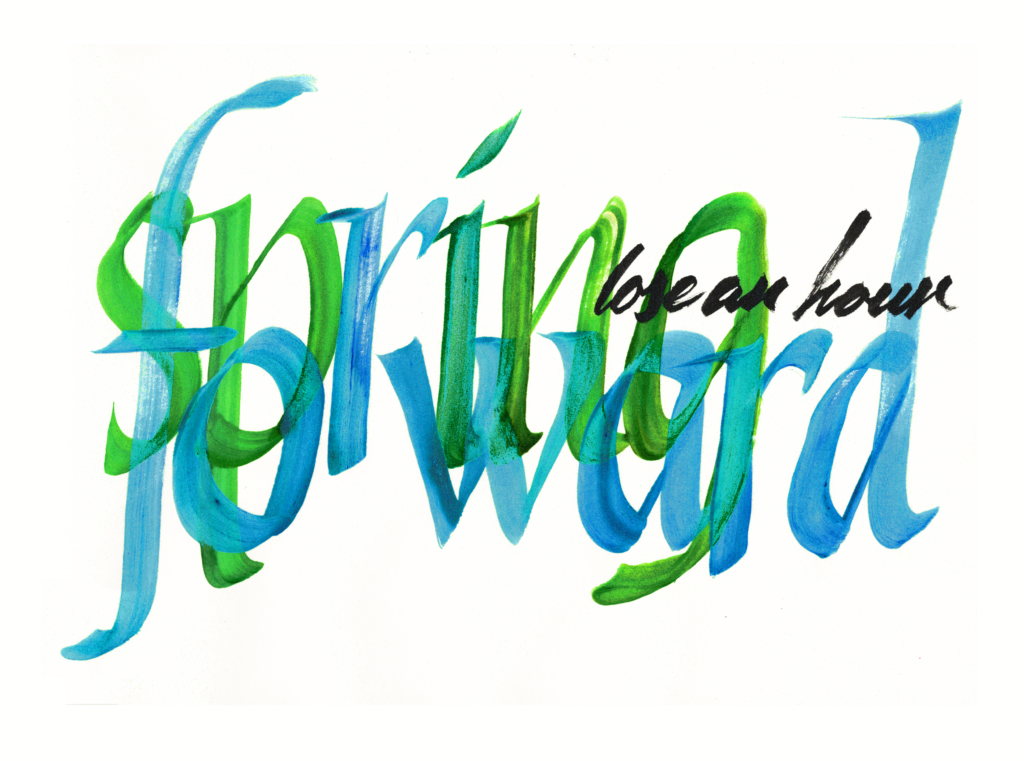
spring forward lose an hour
It’s interesting to revisit the layering of colored words months after graphing the pieces.. Clearly the top example was the best, but it took a few shots to explore the possibilities. I often compare calligraphy to hitting the slots.
The greatest thing about the constant practice is that once I land on a good composition, I am supremely confident than I can get it right. Unlike the previous Inktober, I don’t worry about whether I can replicate a good turn of hand from a practice sheet onto the final sheet.
,
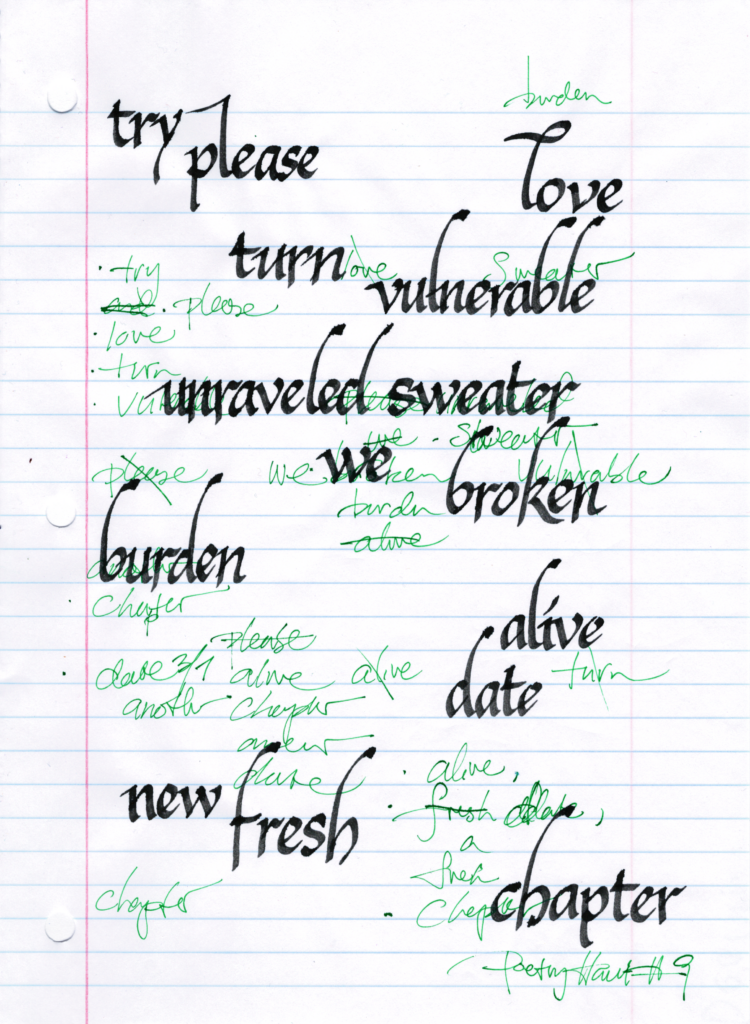
3/10 Poetry Haul #9
try please love turn vulnerable
unraveled sweater we broken burden
alive date new fresh chapter
More play with italics.
,
I am constantly in awe of the Monkey King. I never thought I had any affinity to superheroes until I saw my kids watch old Sun Wukong videos and read the books myself.
Then I realized I did have a favorite superhero all along, planted when my mom would read stories from old Chinese picture books to me and my sister when we were little kids.
Cya next time!
,
PS—Monkey King, Wu Cheng’en, trans. Julia Lovell, 2021
I’m typically too snobbish to read abridged versions, and now I’ve gone through two of them with the Walden audiobook and this Lovell translation.
In some ways it hearkens to the proscribed system in How to Read a Book where one takes multiple passes at varying levels of detail. I’m pretty good at skimming books, but it certainly helps when someone has done that work for you.
As for this book itself, it’s one heck of a story. The introduction warns you that this is satire, and it follows through on the promise. The Taoists are venal, the heavenly bureaucracy is minimally competent, the Buddhists aren’t much better, and I don’t think there is a single happy marriage in the book. Our gang of pilgrims are least dysfunctional bunch of the lot, which isn’t saying much.
As an abridged book, some of the stories are cut as was most of the poetry, which seems to be a distinctive aspect of the original novel. But that’s all good, it’s a fun read and it enticed me to read an unabridged version. Hard to give it higher praise than that.
After reading an unabridged translation by Anthony C. Yu, I must admit that cutting out the poetry quite impoverishes the experience. As much as I appreciate that this abridged version introduced me to the original, without the poetry it’s like reading a screenplay and ignoring the movie.
,
PPS—A Field Guide to Roadside Wildflowers at Full Speed
Any excuse to bring up this gem makes it a good day.
,
PPPS—New Tales of the Monkey King
I guess this TV show was a fun romp.
I don’t particularly mind the cultural appropriation because it’s way different than the original book and it’s Australian. I got enough problems in my own continent, I can’t get bothered over what they do on the other side of the globe.
But the first season was just OK. It certainly wasn’t anything that I would have watched without its nominal relationship to the 西遊記.
Yeah there’s a monk and his/her three disciples. The disciples are all gods in exile, and there are demons in this world, but then it goes off into its own universe.
Unlike the clear heavenly imperium of the original, the screen writers went for a good versus evil mega-battle—the bane of all superhero comic book movies. It’s a complete change from the original book. Instead of four folks on a long journey, they’ve been dumped into a Manichean struggle.
Even so, I enjoyed watching how they took an old story and modernize it to a contemporary popular medium. I can’t fault them for taking inspiration from the source and blazing their own trail.
But I must quibble with their depictions of Monkey and Tripitaka.
Monkey is depicted as a vain illiterate creature in this show. He’s certainly vain, but he’s a fucking badass. He’s quite literate, he should always be depicted as a Superman.
I’m fine that they recast Tripitaka a woman. One of the problems in the original story is that it’s a sausage fest. However, the screenwriters are much too kind to Tripitaka whose defining feature should be his helplessness. I dislike that she even learned kung fu in this show. I get that they are trying to avoid the damsel in distress, but if so, they should have chosen a different character to gender shift.
My the ultimate judgement?
I never watched Season 2.
I don’t regret the time spent on the first ten episodes, but if I want to know what happened on this TV show, I’ll just read the Wikipedia synopsis.
The Portland trip took a lot out of us. The trip was great, but planning and then recovering took a bunch of extra time before and after the actual time off. And then we followed it with a jaunt to San Diego right before school started. Travel is fun, but it eats into “free” time for sure.
,
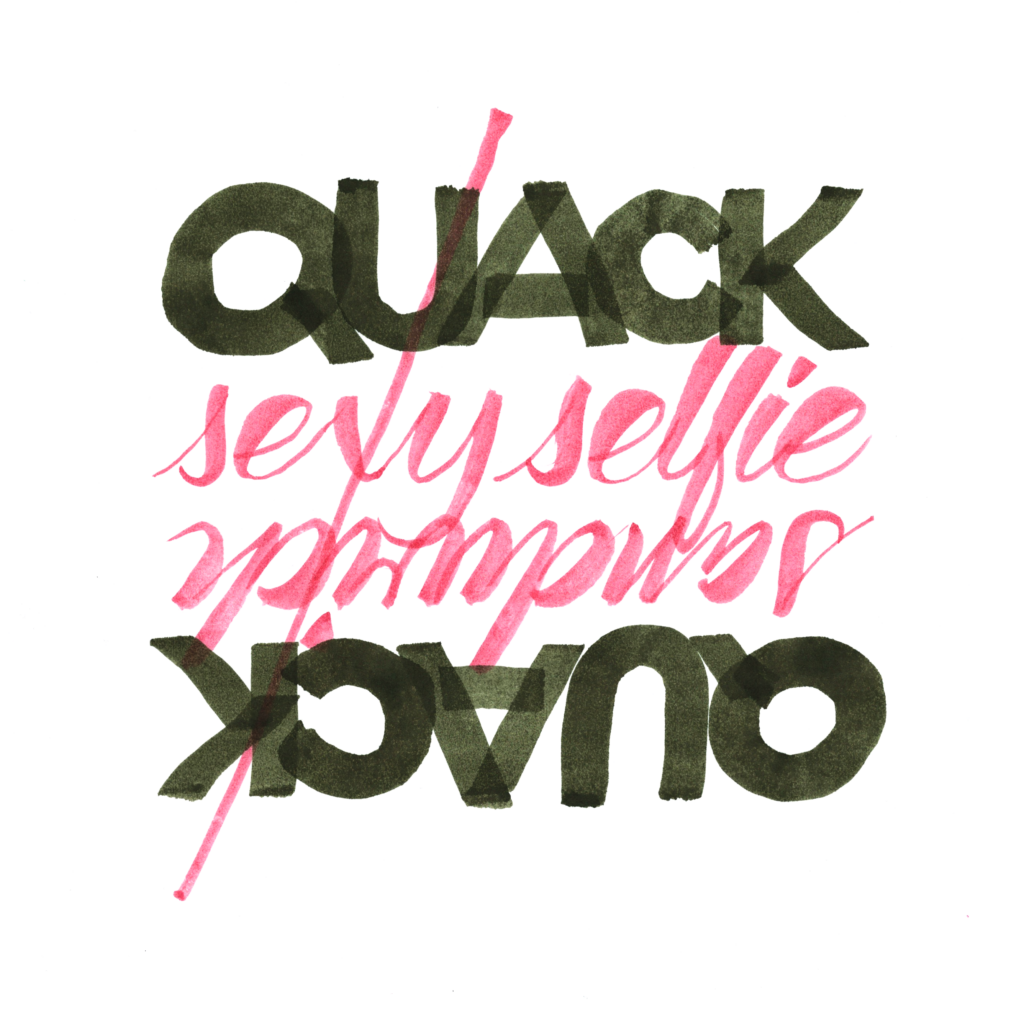
2/25 Inktober 52 (2024), week 21
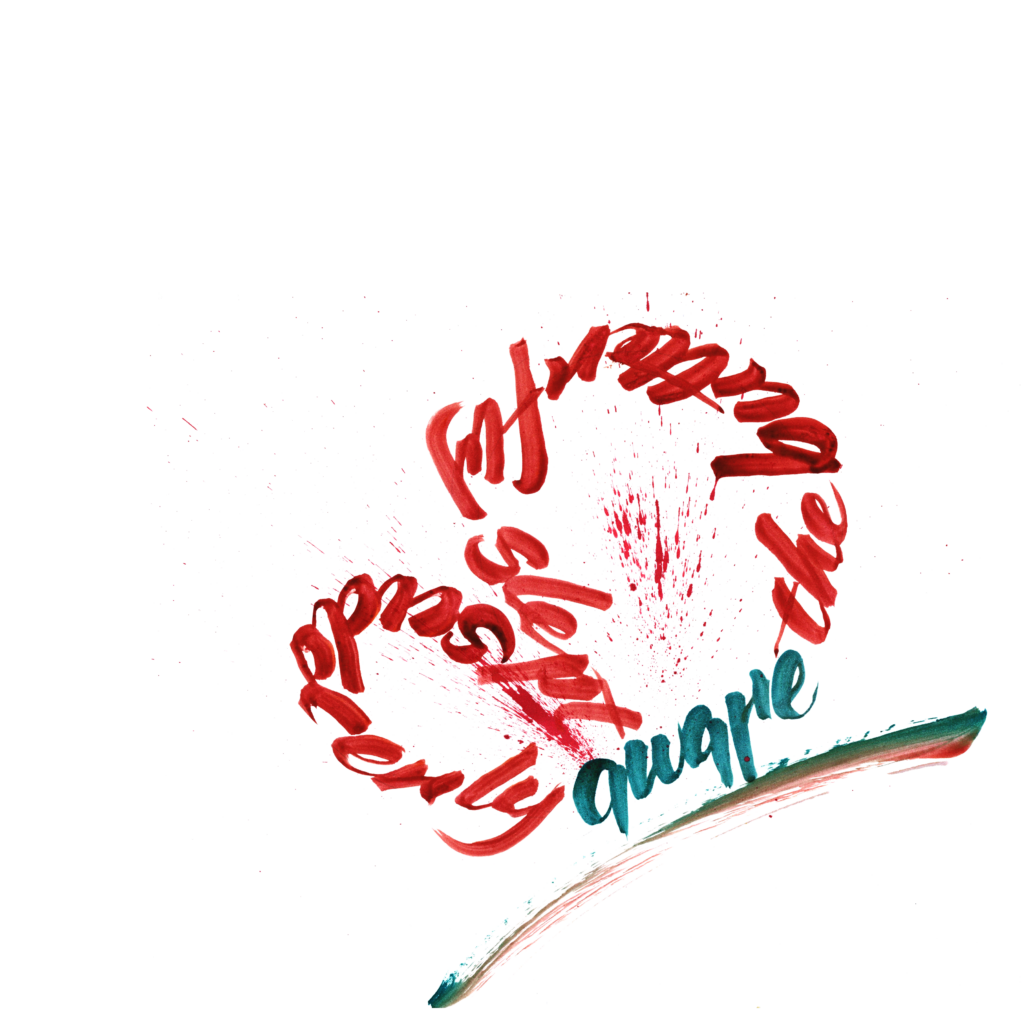
quack quack sexy selfie sandwich
How did duckface became a social media phenomenon? I guess every era needs its thing.
,
2/28 Inktober 52 (2024), week 20
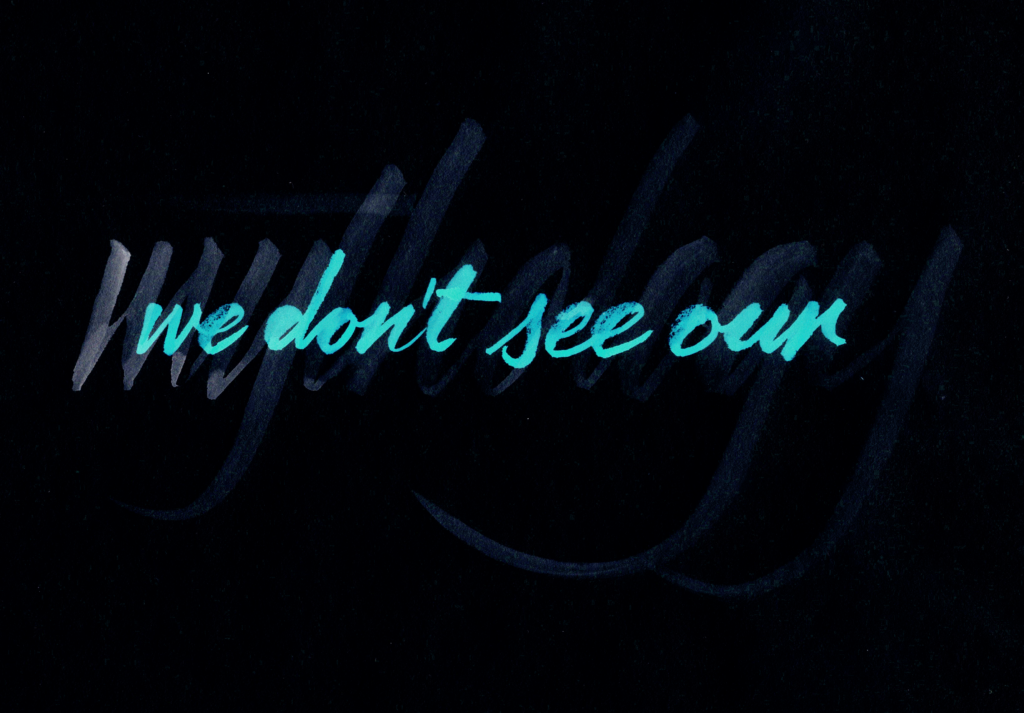
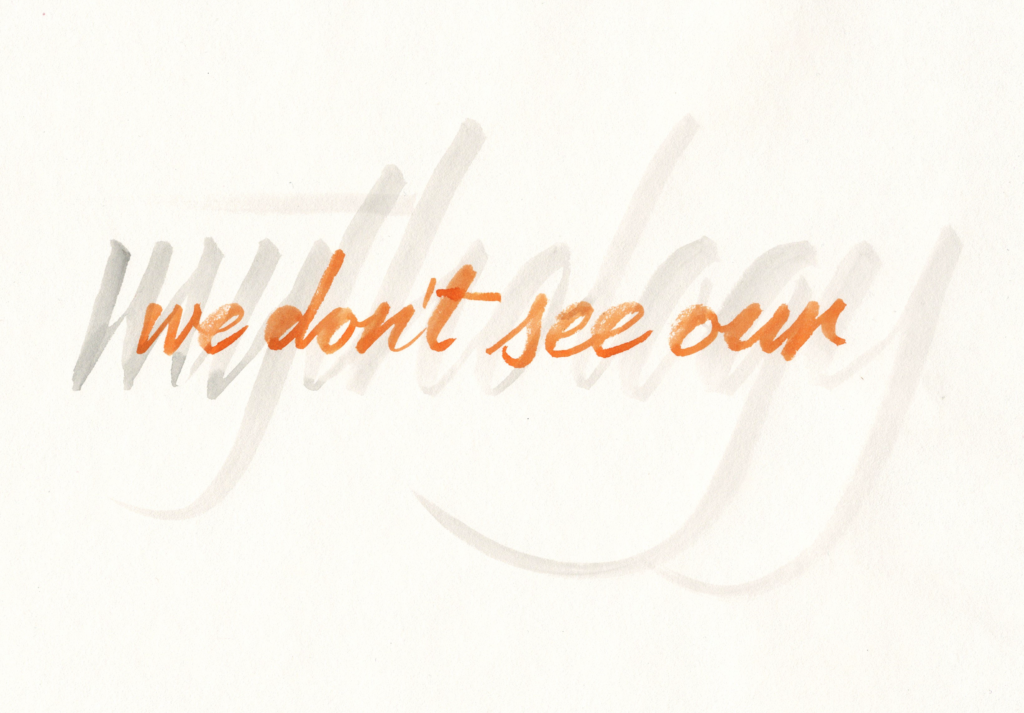
we don’t see our mythology
I went light for a white on white vibe. Then reversed it.
,
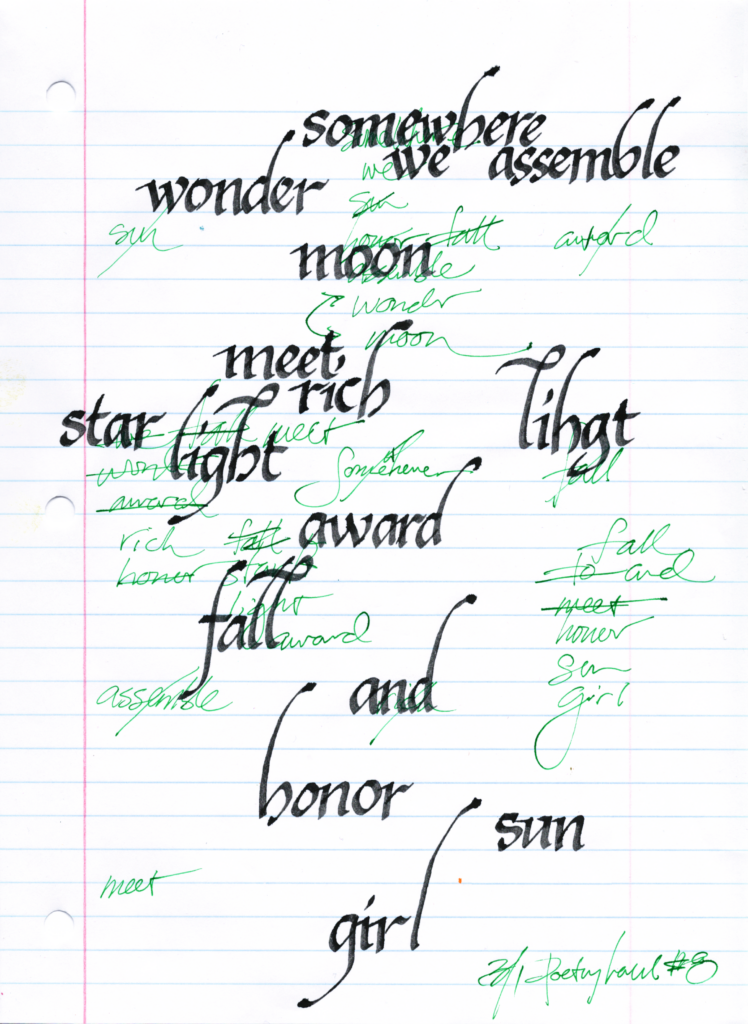
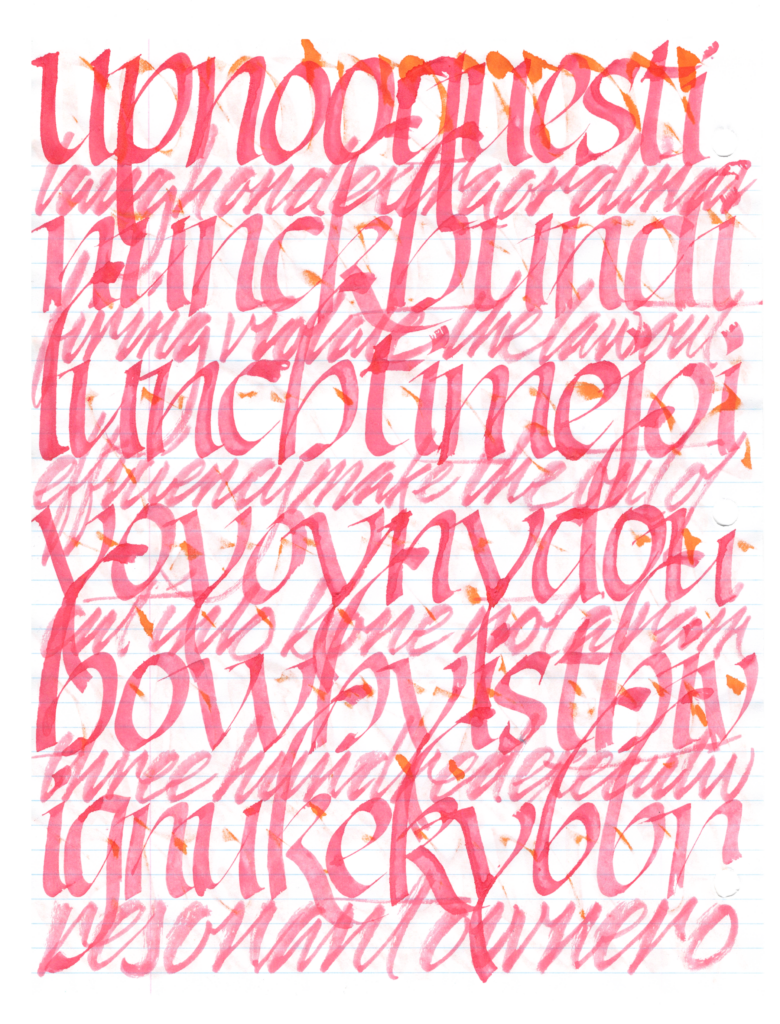
3/1 Poetry Haul #8
somewhere we assemble wonder moon meet rich star light award fall and honor sun girl
I had some fun with extended italics as I wrapped up February.
,
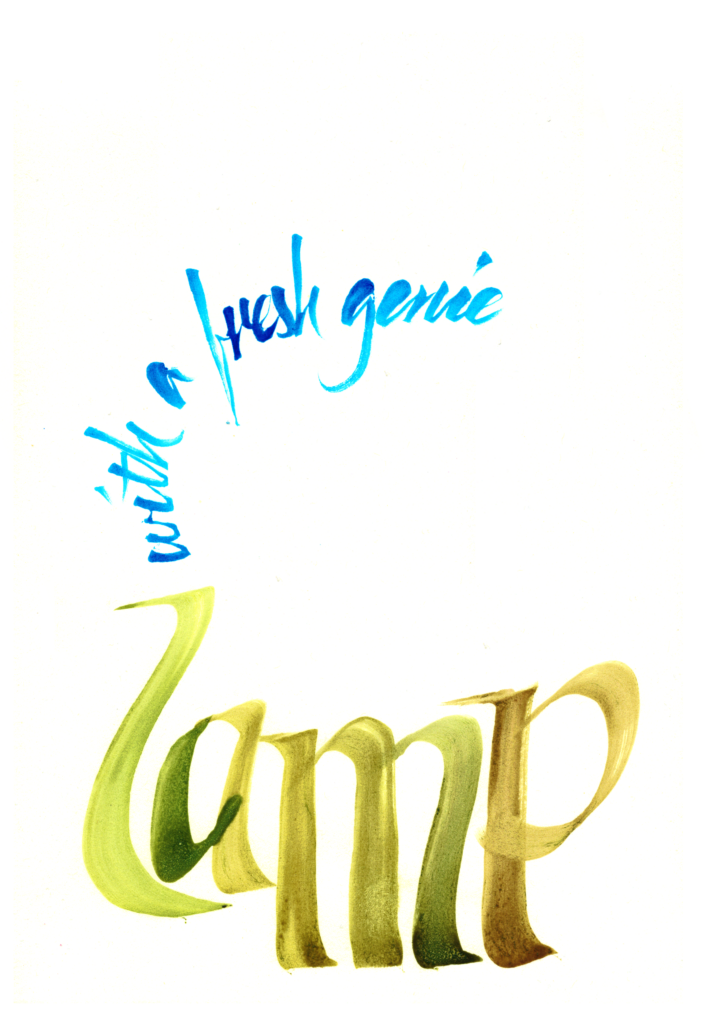
3/2 Inktober 52 (2025), week 9
lamp with a fresh genie
The flat brush runs fine, but I’ve continued to have trouble with cursive with a pointed brush. The Pentel brush pen works great, but I’ve never gotten the hang of normal pointed brushes.
,
3/3
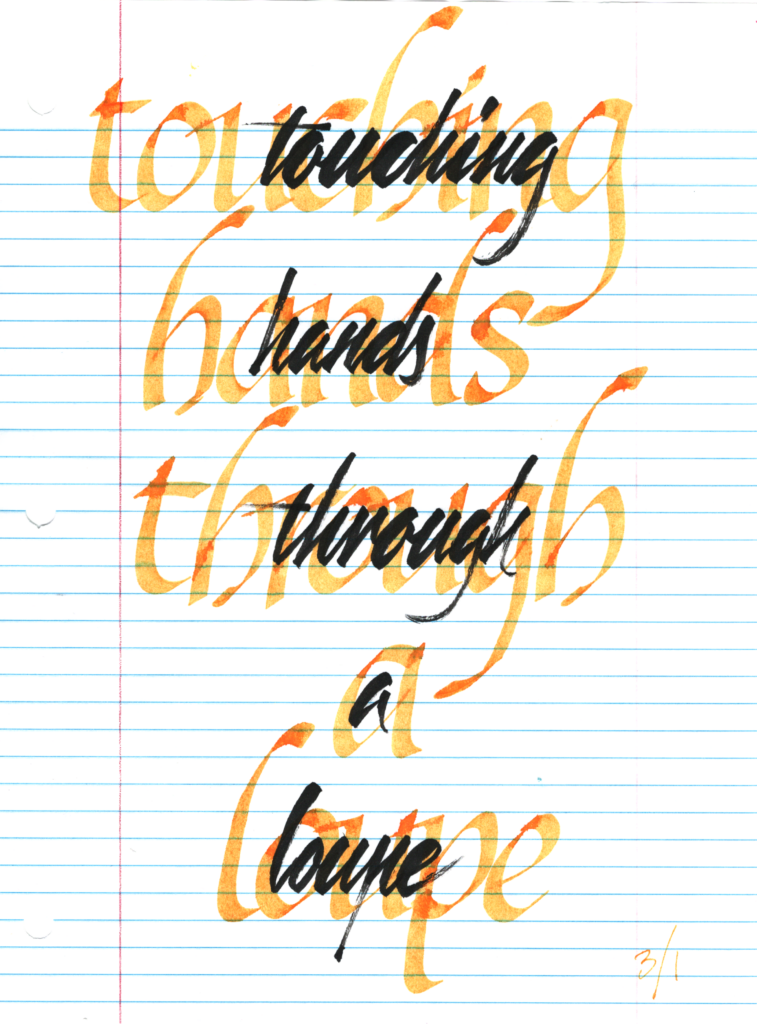
touching hands through a loupe
I had purchased a collage by Duane Toops and zoomed in with a jeweler’s loupe. Collage is a tactile art, I could see his hand in the cuts and ridges of paper on paper.
The cursive looks like it has regressed, it might be time to add it back on the list as a monthly focus.
,
Again, it feels like I’m trying to just get something in before another month disappears. Things have been super busy at work. But it’s a good busy. I’m doing good work on great projects.
I just need to slow down the pace. As much as I hate to admit it, things at the airport can wait, especially as time with the wife and kids continues to drip away.
I didn’t get this posted in time for August, and then my body revolted to put September on hold for three weeks.
Even worse, after returning from the hospital with my liver abscess, another family member went to the ER after dropping a bunch of weight and experiencing serious discomfort in the gut.
The family is going through a bout of organ revolts. We’ve had a good run, so I guess we were due.
Health shouldn’t be taken for granted, and yet, that is exactly what we do during the good times. One can’t live on permanent high alert, but I need to cultivate a practice of gratitude to savor the quiets between the storms.
Cya next time!
,
PS—The Mentor Leader, Tony Dungy, 2010
In 2021, I stopped reading self-help books—I got what I needed out of them.
After starting a work-related newsletter, I tried to restart the habit to grab some professional ideas to go with my artistic interests.
Naww, I’m past peak Self-help.
There’s nothing wrong with this book. This book matches Tony Dungy’s public persona—a quiet dude who makes everyone around him successful.
I blasted through the book at 2x speed. His main point is that a mentor leader should be humble. Being humble means receding into the background; success is found in elevating those around you.
I dig it! I bet I’m less humble than I’d like to believe, but I appreciate the appeal of his message.
Tony goes heavy on Christianity, but given my recent forays into ancient wisdom literature, that’s fine, even as an atheist.
Worth a quick listen if you’re in the mood for a generic leadership book, though you might remember nothing from it four years hence.
,
PPS—The Subtle Art of Not Giving a F*ck, Mark Manson, 2016
It’s kind of amazing to listen to a self help book and have nothing to say about it, even after trying to come up with an interesting take for a few days.
Just standard tough love, self-help fare, with a lot of F-bombs. The title is perfect for this book. If you pick it up, you’ll most likely dig it.
I didn’t disagree with Manson’s main points. There are only so many ways to approach life and his recommendations match how I see things, in spite of his crass delivery.
Pick your priorities (chose your f’s).
Control your reactions.
Owning your world is better constantly being the victim of your own psychodrama.
Avoid highs—chemical, relational, any type. They’re temporary and the crash only gets worse the longer you delay.
Commitment is freedom. It creates depth versus breadth.
Don’t pursue the results, pursue the process. Or if you don’t enjoy the process, give up on the results and chase what you enjoy doing.
The unconvinced will not be persuaded, but the book is fine if you want another take on such riffs. Another listen for 2x speed.
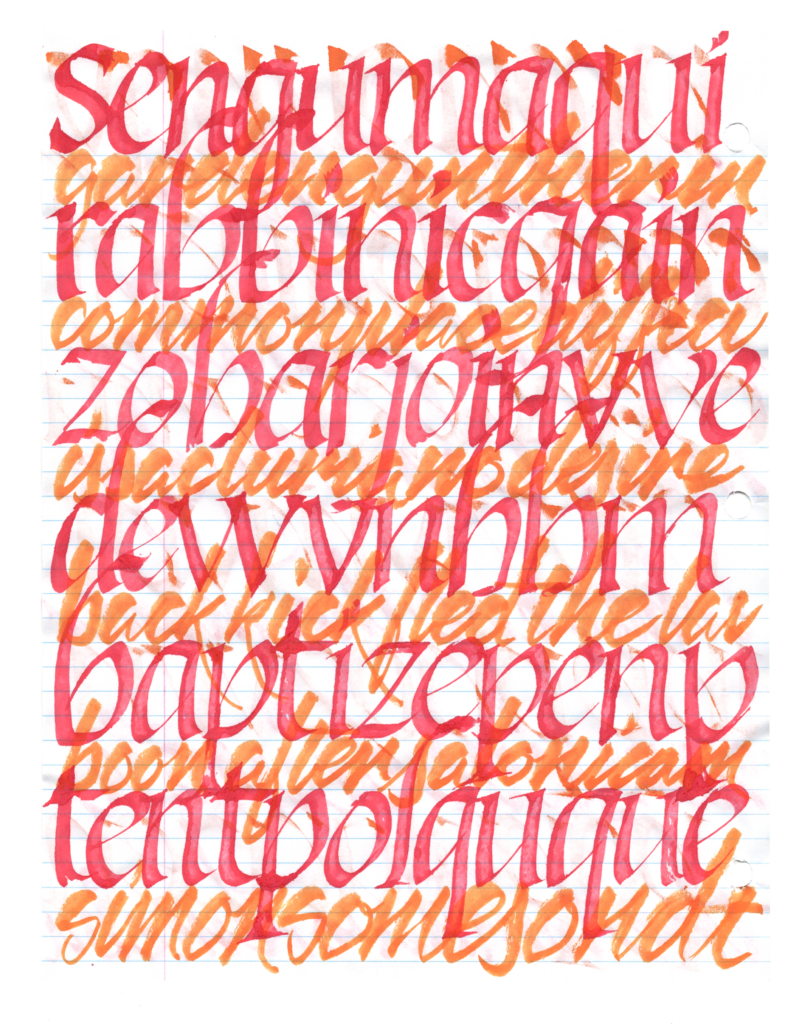
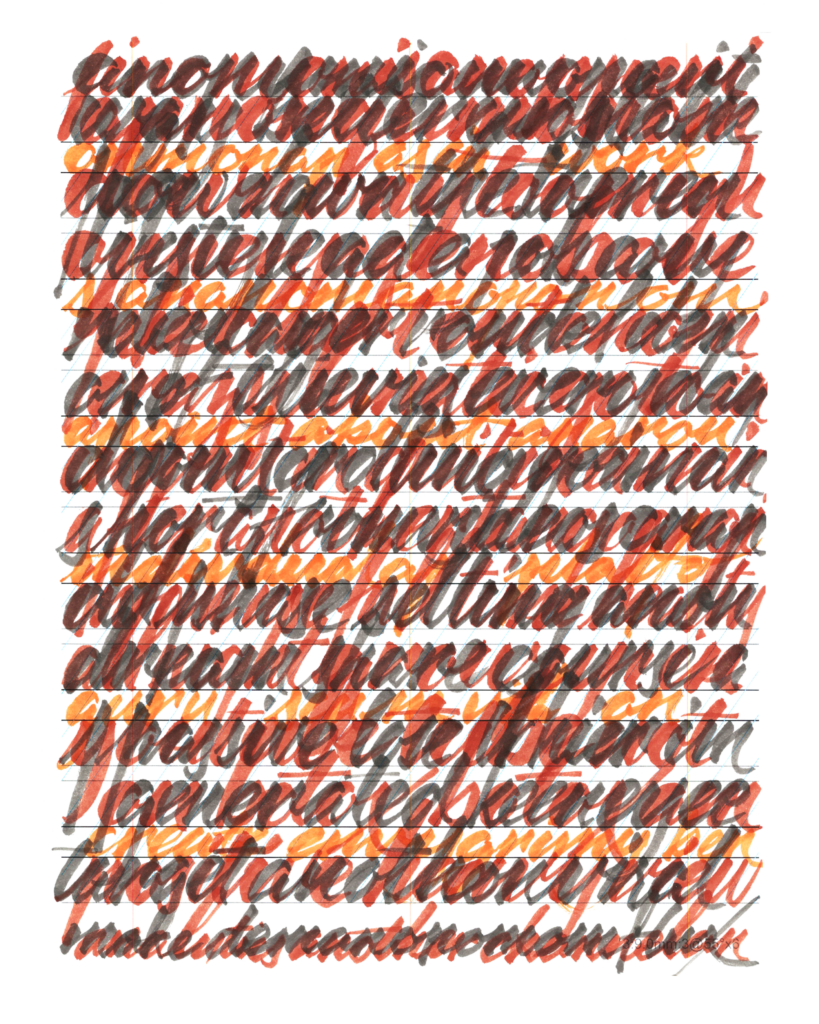
My cursive in February hit an apex after a January of practice.
It was also when I finally gave up on the square format for whatever aspect ratio that the piece wanted.
,
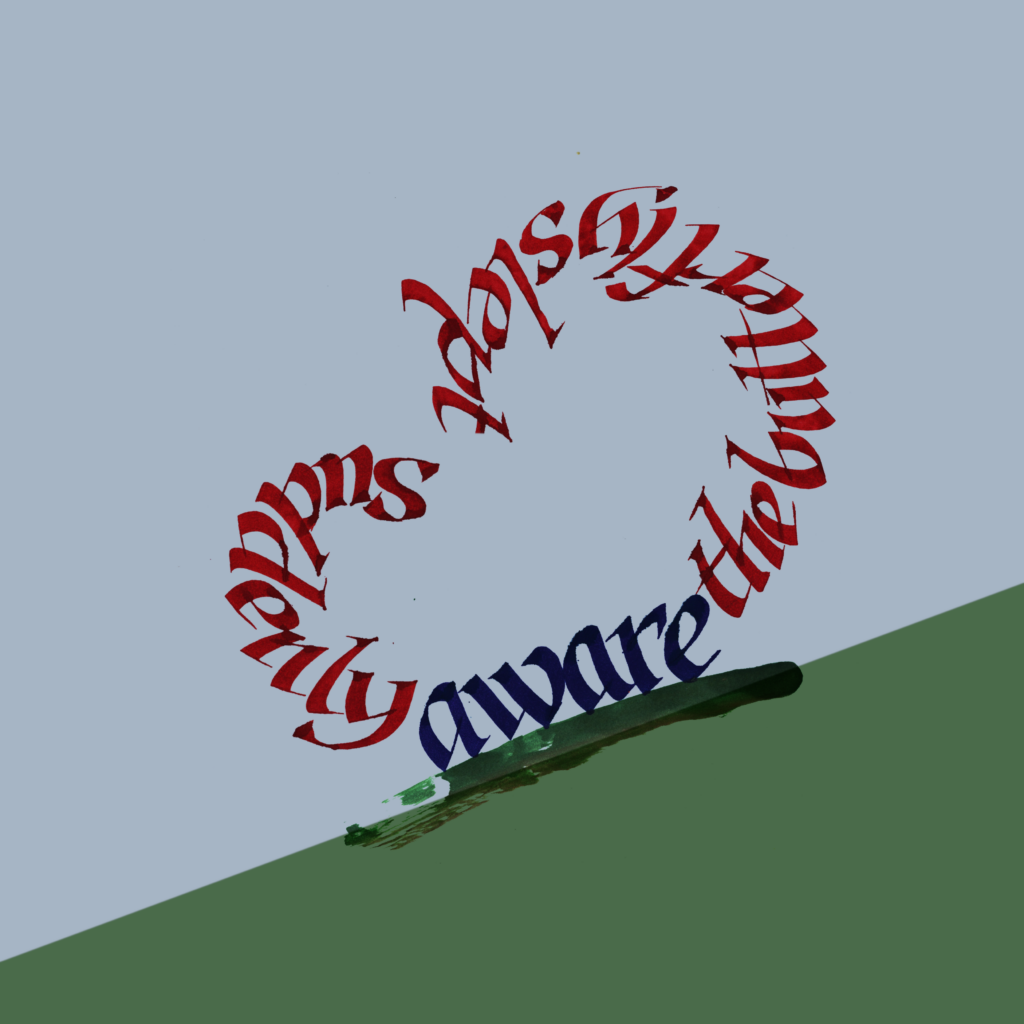
2/18 Inktober 52 (2024), week 26
suddenly aware the butterfly slept
Almost three weeks into February Italics, I was getting a bit more confident with the script, while still playing with brush.
,
2/20 Inktober 52 (2024), week 23
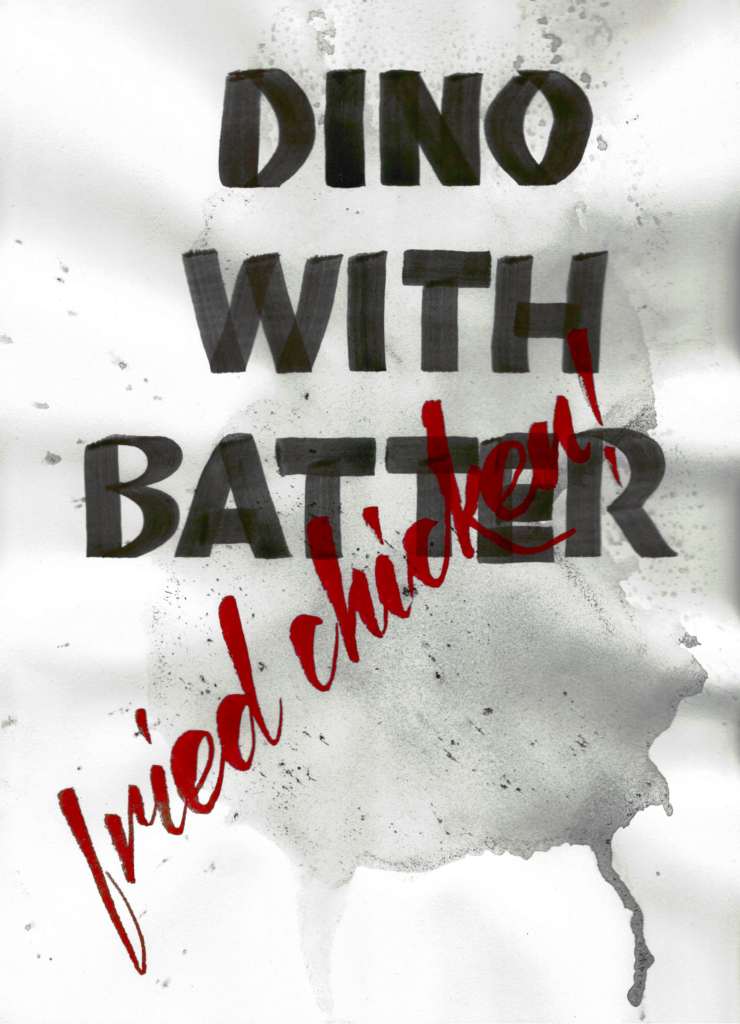
dino with batter fried chicken
One morning, I spilled a bottle of ink wash. My first move was to grab a sheet of paper to soak up the mess. Made for a great texture!
,
2/21 Inktober 52 (2025), week 8
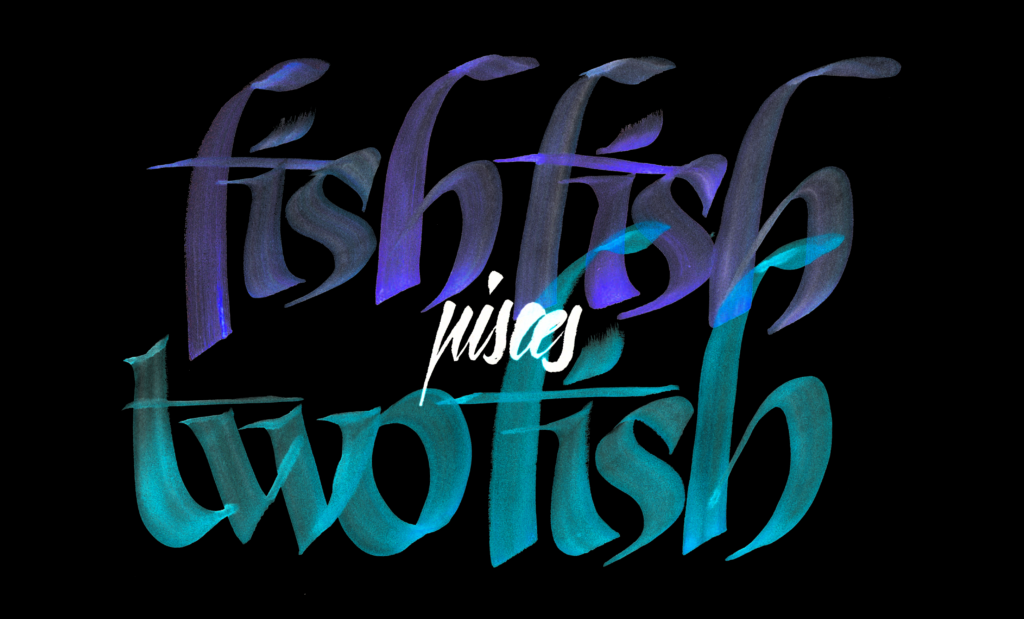
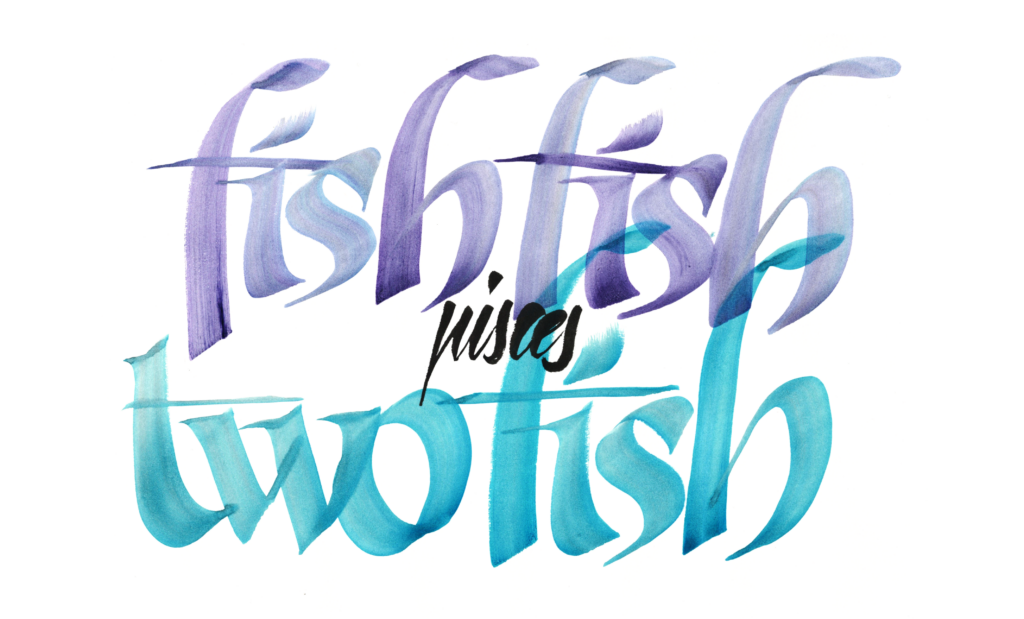
fish fish pisces two fish
GIMP has three different ways to invert a piece. In this option, the original colors were kept, except for white and black.
Inverting a piece absolutely feels like a cheat, but if it works, who am I to refuse the delights of the machine?
,
2/22 Poetry Haul #7
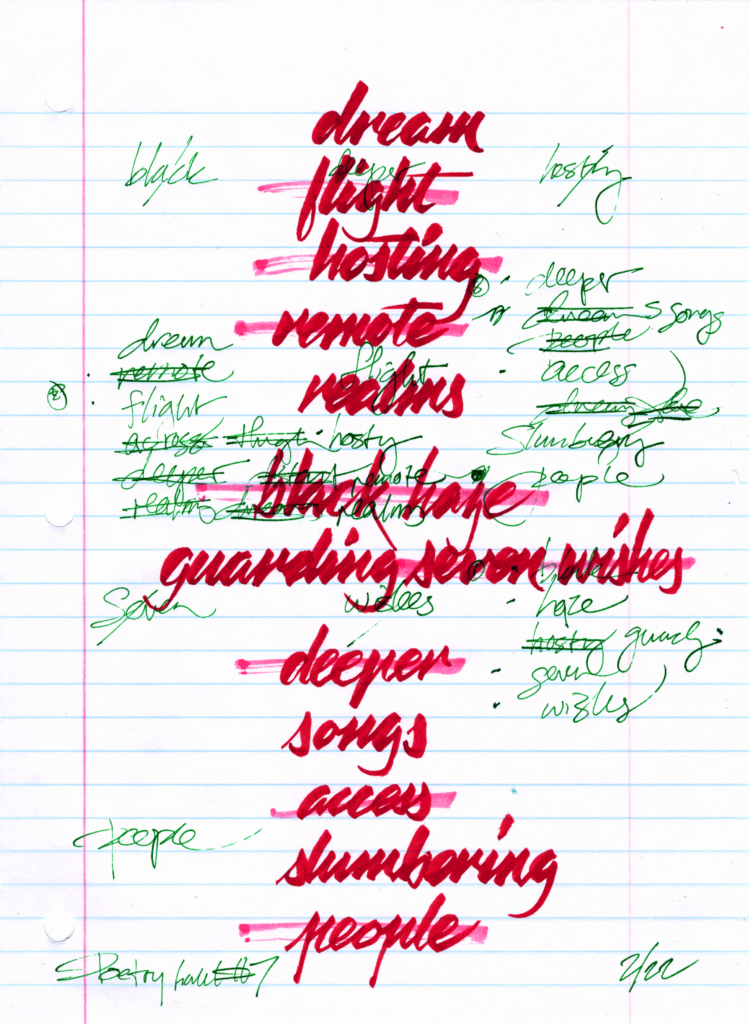
dream flight hosting remote realms
black haze guarding seven wishes
deeper songs access slumbering people
I love the when a page shows layers of partial stanzas frozen in messy process.
,
2/24 Inktober 52 (2024), week 24
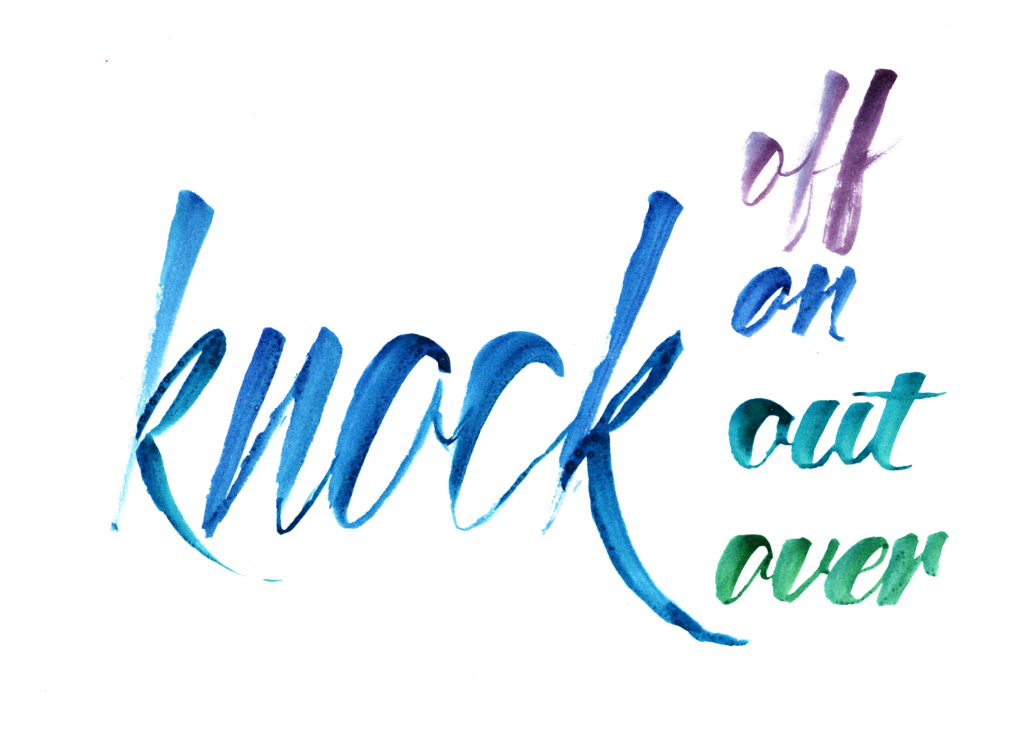
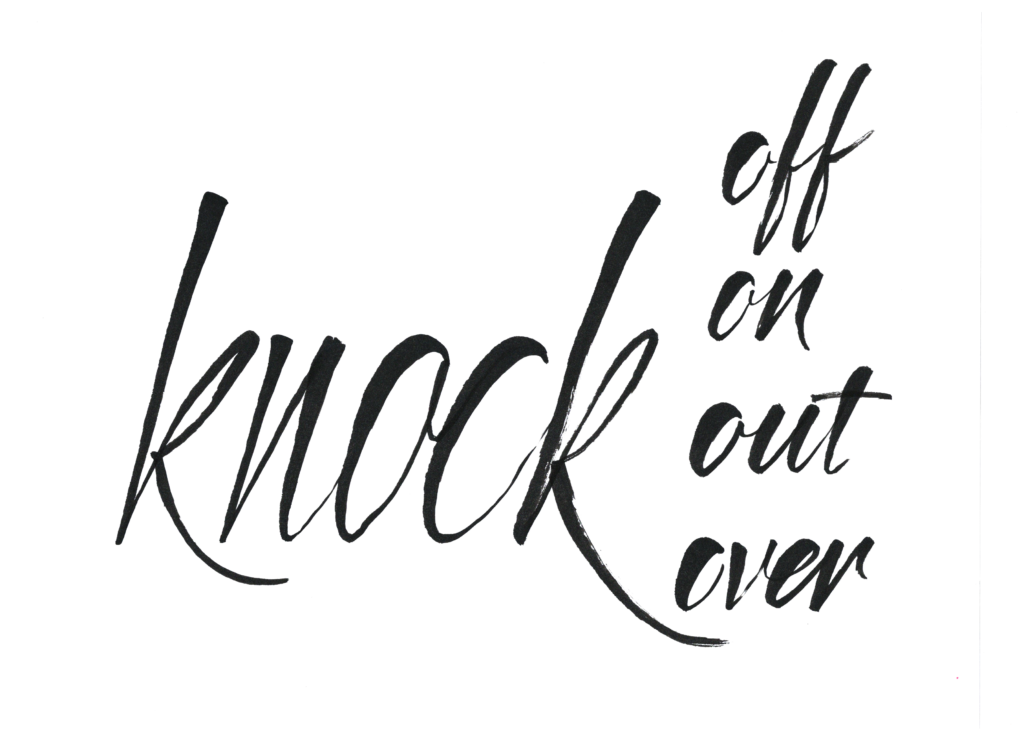
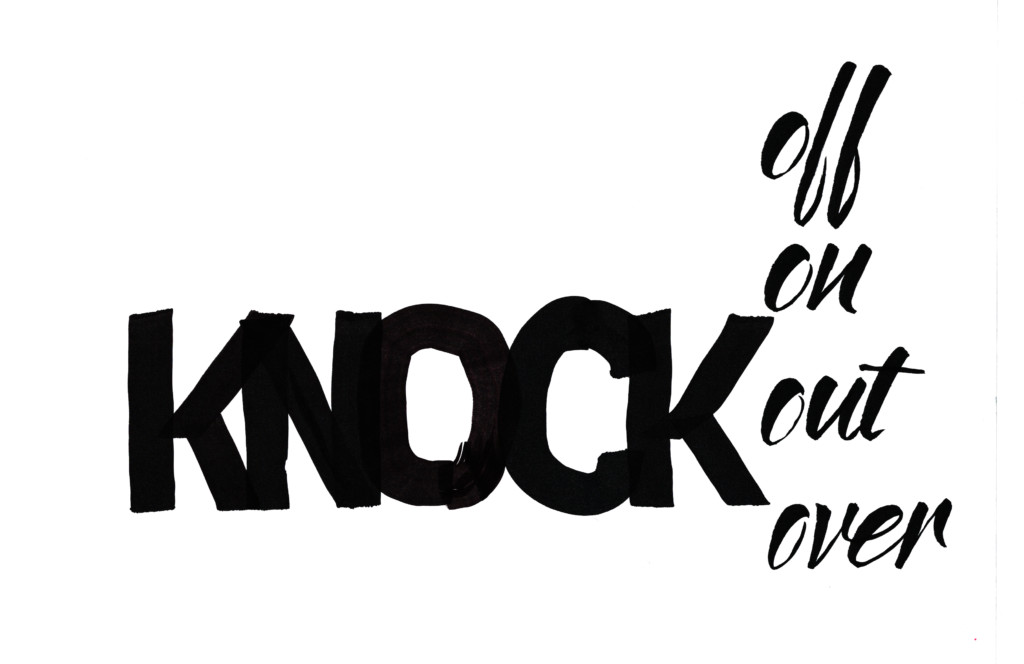
off on knock out over
I am super comfortable with the Pentel brush pen, but have not found a straight brush that feels right for calligraphy. Trying to do so would be an expensive pursuit.Art gets really expensive when you forsake satisficing for maximizing.
,
I can’t believe we’re in mid-May. How does a year fly? I need to internalize the Cult of Done Manifesto and push things out faster.
Or maybe just enjoy the pace I got. It’s a balance when navigating internet hobbies, especially when work is super busy.
Cya next time!
,
PS—Fuck you and your family
During the pandemic, I took daily walks and found a black Honda Pilot plastered with obnoxious bumper stickers and window decals—stick figures in various poses, a few f-bombs, and this window decal.
This was the only one that was remotely amusing.
I get a kick out of other families’ windshield representation of themselves. The basic stick figure trope as well as Disney, Star Wars, football, and this version cursing at everybody.
I’m not impressed with crudity for its own sake. Curses lose their sting when used wantonly, but this window decal was playful.
Subverting expectations is too highfalutin’ a descriptor, but at least it had something beyond the other gas station bathroom humor on that car. The occasional zag against the mainstream can land, even if being a dick just makes you a dick.
,
PPS—Waiting for emails
The start of the school year was rough. The school district’s distance learning program was totally overwhelmed with new enrollees in Fall 2021 due to the sudden rise of the Delta variant.
Even though we had been enrolled for a months, this fresh turmoil meant we did not receive any information. So we headed into the first day of school not knowing her teacher, when we should meet, etc.
At least we picked up a Chromebook and some textbooks earlier in summer.
This wait was a special sort of torture, hitting refresh on my email every few minutes hoping to receive a missive from her new teacher. I even waded back into Facebook to check in on other parent’s frustrations. Misery loves company.
Then I would blame myself for the anxiety. Sure, it would be nice to start with a special sort of excitement. But who really cares if it day one is a whimper or a bang?
Soon enough, none of this anxiety would matter. She would hard at work with whichever teacher she got. Who cares if she misses out on a few days of second grade instruction? We’ll still be in here.
(Ultimately, it turned out to be a bigger mess than I feared. The first month was a wreck with a substitute trying to learn her way in the worst possible circumstances. Fortunately, the school district enticed a cadre of devoted teachers to tackle a second shift and our girl ended up learning in the evenings that year. It’s all an ancient memory as she heads into middle school).
In that moment, life reminded that in spite of our era of instant communication, we don’t always get what we want when we want it. Even if it felt necessary.
Character traits are earned by doing, so I guess I owe the gods some gratitude for this chance to practice patience.
.
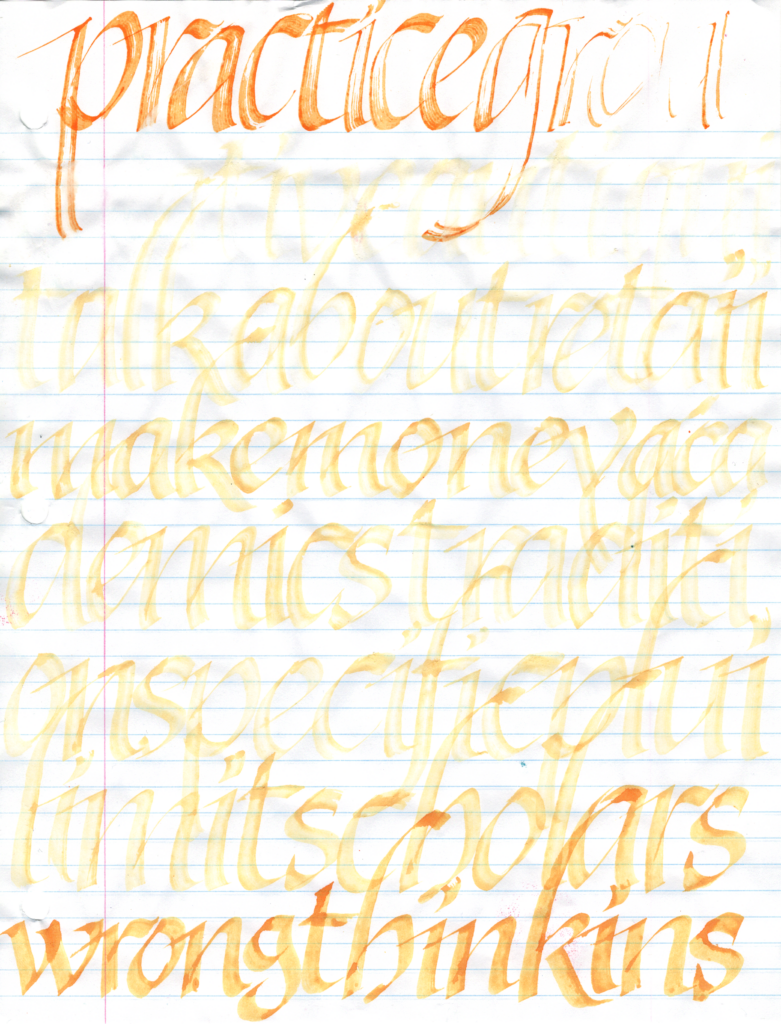
PPPS-Practice
2/5
I started my daily practice with extra printed templates that I used on the lightbox. This was the last of these printouts before transitioning to binder paper. It’s much cheaper and they’re lined on both sides!
Then again, it was fun to be reminded about how I would maximize these sheets with layers in light colored ink—a habit that I’ve continued during my morning meditations.
It’s a pain to track which goes with what…so I’m mixing up the Inktober 52 prompts with my own 5WP’s. Bon Appetit!
,
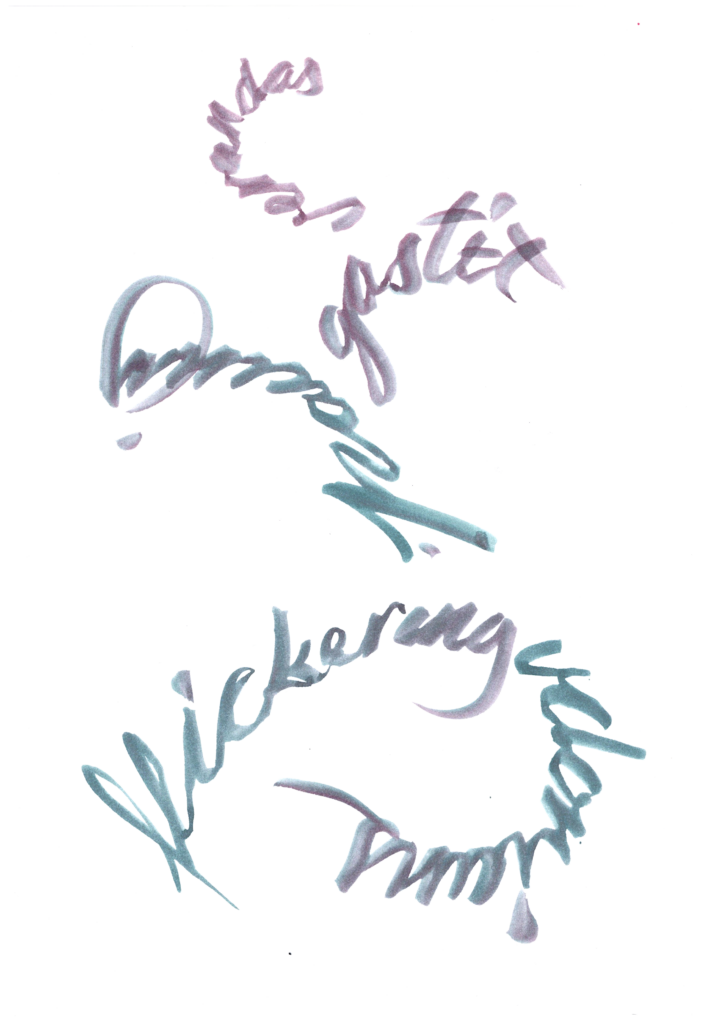
2/10 Inktober 52 (2022), week 51
flickering victorians pacing gaslit verandas
This was the last 5WP for an informal series on magic using Inktober prompts. I had a rough time composing this piece. When I was younger I would be disappointed the deflation that comes with the end of a project. Now I’m just used to it. On to the next!
,
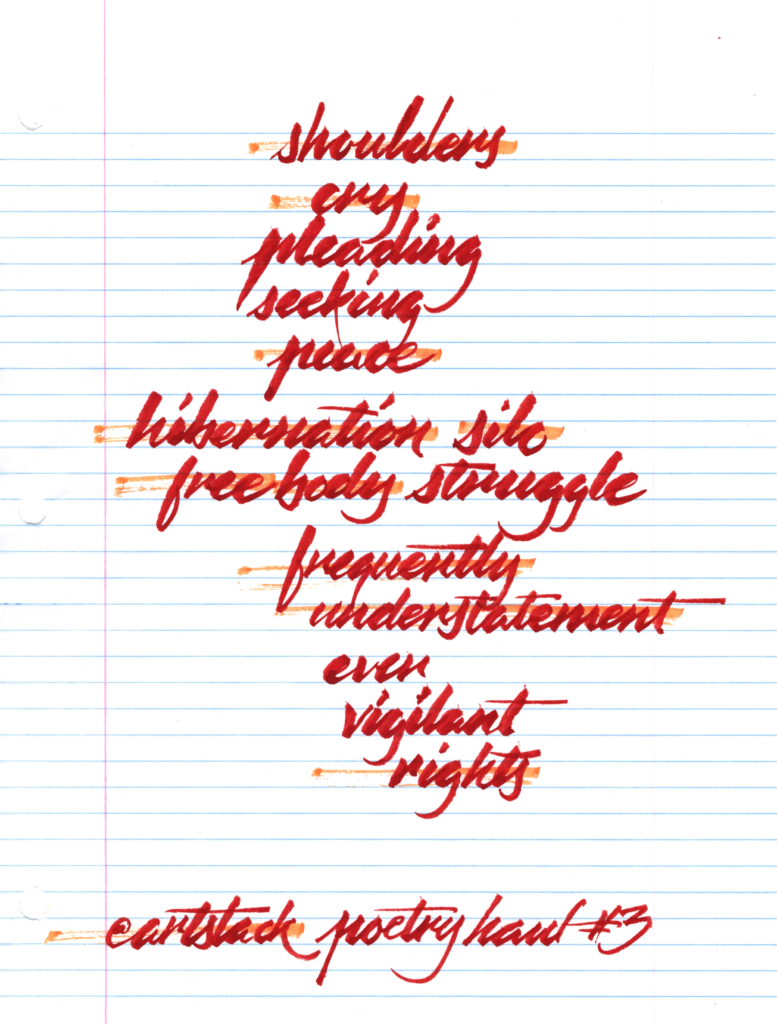
2/11 Poetry Haul #3
shoulders cry pleading seeking peace
hibernation silo free body struggle
frequently understatement ever vigilant rights
You really can’t cross the same river twice. In early February, I had just come off of a month of pointed brush work. I don’t think I could do this right now. Even though I’m still practicing daily, I’ve lost the edge that comes with focusing on it solely every morning.
To do this again, I’d have to relive January, like the Borges story where Pierre Menard creates a life to spontaneously re-create Don Quixote.
,
2/13 Inktober 52 (2024), week 28
ratty rebels raided royal realms
I save of all my scrap sheets. This was graphed on a test page for my team holiday cards. Of course, many attempts to work on such sheets also don’t turn out, so they just get blacker over time!
,
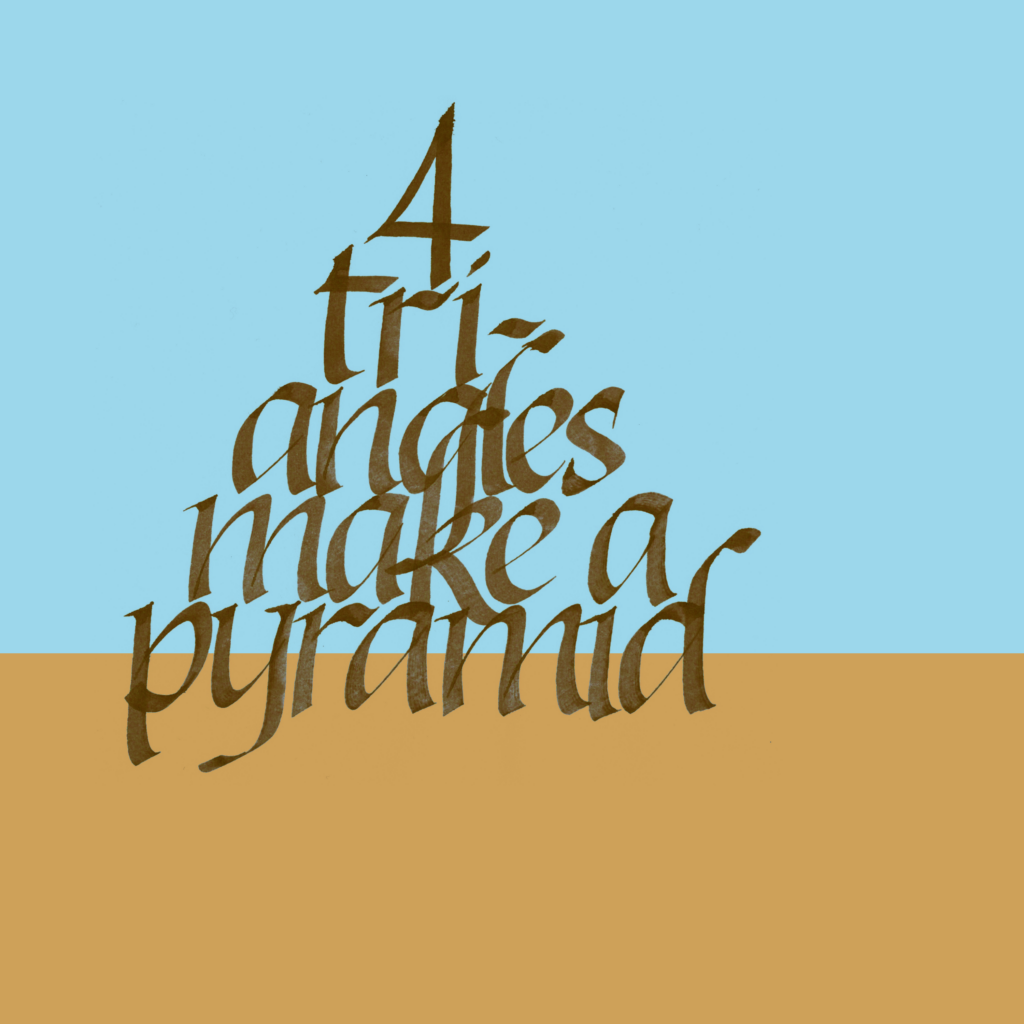
2/16 Inktober 52 (2025), week 7
4 triangles make a pyramid
I love calligraphy due to its handcraft. But the final deliverable is always on a screen. So am I a digital artist?
Maybe. Two months after the initial publication, I can’t remember the original ink color (turned out it was pink). The background was obviously an addition after the fact. And actually, this is version 2 because I had originally uploaded one where the script color opacity came out differently between the sky and sand backgrounds.
So yes, this is absolutely a piece of digital art. But in this digital age, is everything digital art? Maybe that’s a meaningless distinction? Everything flits across a universe of flickering rectangles, while the “real” work sits inside an old cardboard Sun Chips box.
,
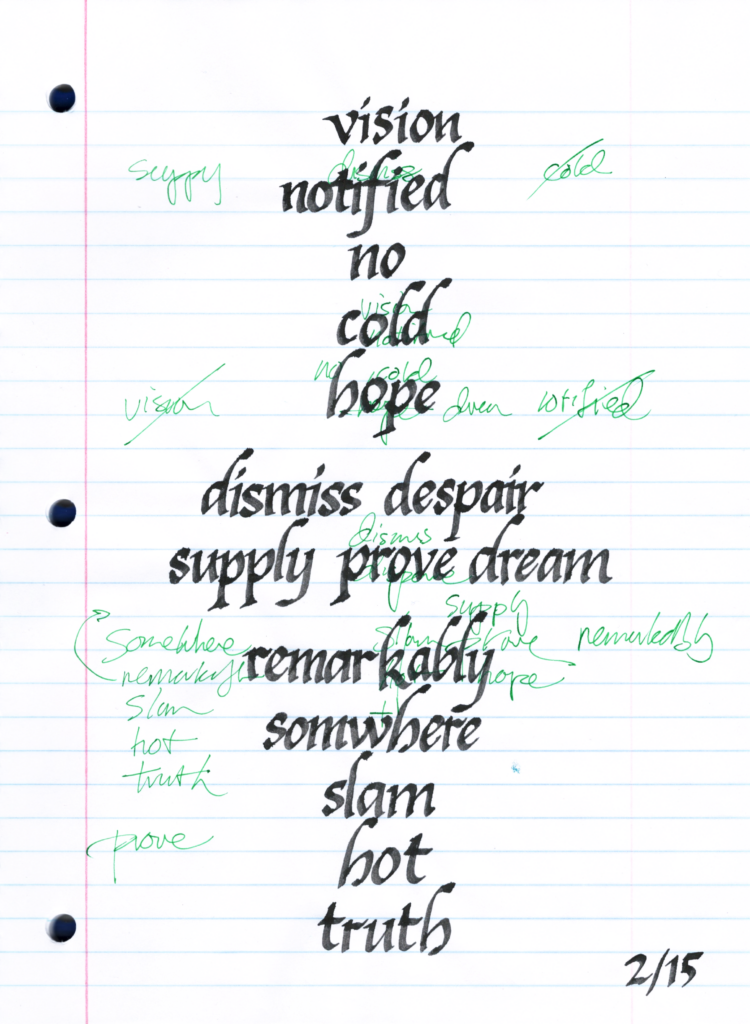
2/15 Poetry Haul #6
vision notified no cold hope
dismiss despair supply prove dream
remarkably somewhere slam hot truth
Like clockwork, I start publicly running the script of the month after two weeks of practice. After fourteen days, I’m comfortable with the muscle memory even if it hasn’t hit full smoothness.
On the third week, it gets locks in, edging towards boredom. By week four I’m playing with variations on the script.
By week six or seven I feel like I’ve already lost the script, or that it’s merged with the new script of that next month.
It’s a slightly depressing cycle, but no skill is permanent.
,
If even knowledge is impermeant, I guess a cardboard box of papers ain’t a bad parting gift.
Cya next time!
,
PS—Bissell Vacuum Cleaner
We’ve tried a few vacuum cleaners over the years. We have a $400 Miele in the closet, and we’ve also spent similar sums on a couple of cordless Dysons.
But our workhorse is an $18 Bissell. We’ve bought four of them. The first one died. The second for my mother-in-law and then we accidentally bought two more online when we were moving into our place. No matter, just keep one up and downstairs.
It’s just a little handheld vacuum with a handle extension and a flat insert to let you push it along the floor.
That’s the magic. So cheap you’re never scared to use it. Dirty kitchen. Suck it up. Laminate floors? Without brushes, this vacuum can’t ruin anything. No bags to track. Just dump it out and wash the filter.
And no batteries! This thing runs forever. Light and nimble, well worth the hassle of occasionally swapping plugs when vacuuming a large area.
The cheapest product came out to be the best one. At least the most regularly used everywhere, and is there a better definition of “best” for a household appliance?
,
PPS—Stainless Steel Baking Pans
We bought an 8″x10″ baking pan, a few years ago. Small enough to fit a toaster oven. Works great. Flat plate of stainless steel with a slight rolled rim. Nice and shiny.
And a second one last year, so we could swap back and forth, but we gave one to our in-laws.
But I got cute with the third one. Intsead of reordering the exact same item, I got one that came with a little grill rack.
It was so small!
I double checked. The dimensions were super close, just off one inch in each direction: 7×9 versus 8×10.
Do the math.
63 square inches to 80 square inches. I bought something that was almost a quarter smaller than the original!
What an embarrassing display of innumeracy. My mental math is great…if I use my brain.
But the rack is nice. We’ve gotten good use out of it. No complaints.
.
PPPS—Practice
2/12
Around mid-February I realized that I would totally lose the straight brush if I didn’t practice it regularly. So I started filling the empty lines between the main scripts with cursive.
I’m procrastinating on taxes by compiling this post. Taxes are a cost of society and a lovely spring buzzkill. On the bright side, we’re about to head out to an airshow at Nellis, so I’m getting our fair share of entertainment (and propaganda) for these taxes.
,
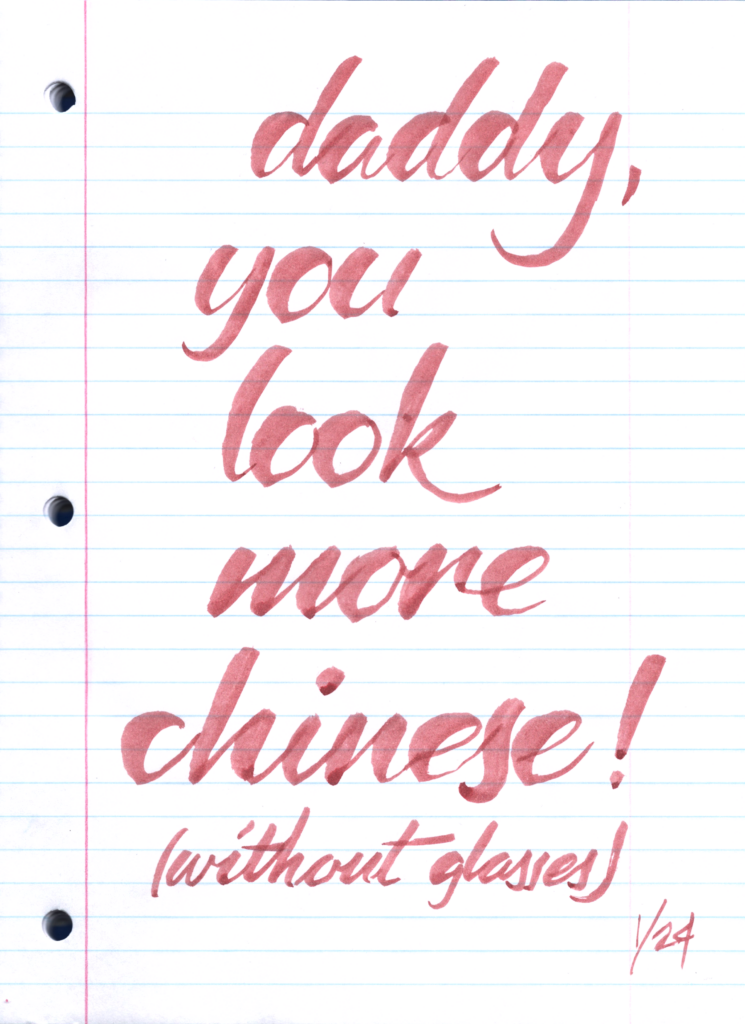
1/29
daddy, you look more chinese! (without glasses)
The boy is still earnestly drops lines of joy. I wonder how much longer it will last; it’s all so fleeting.
,
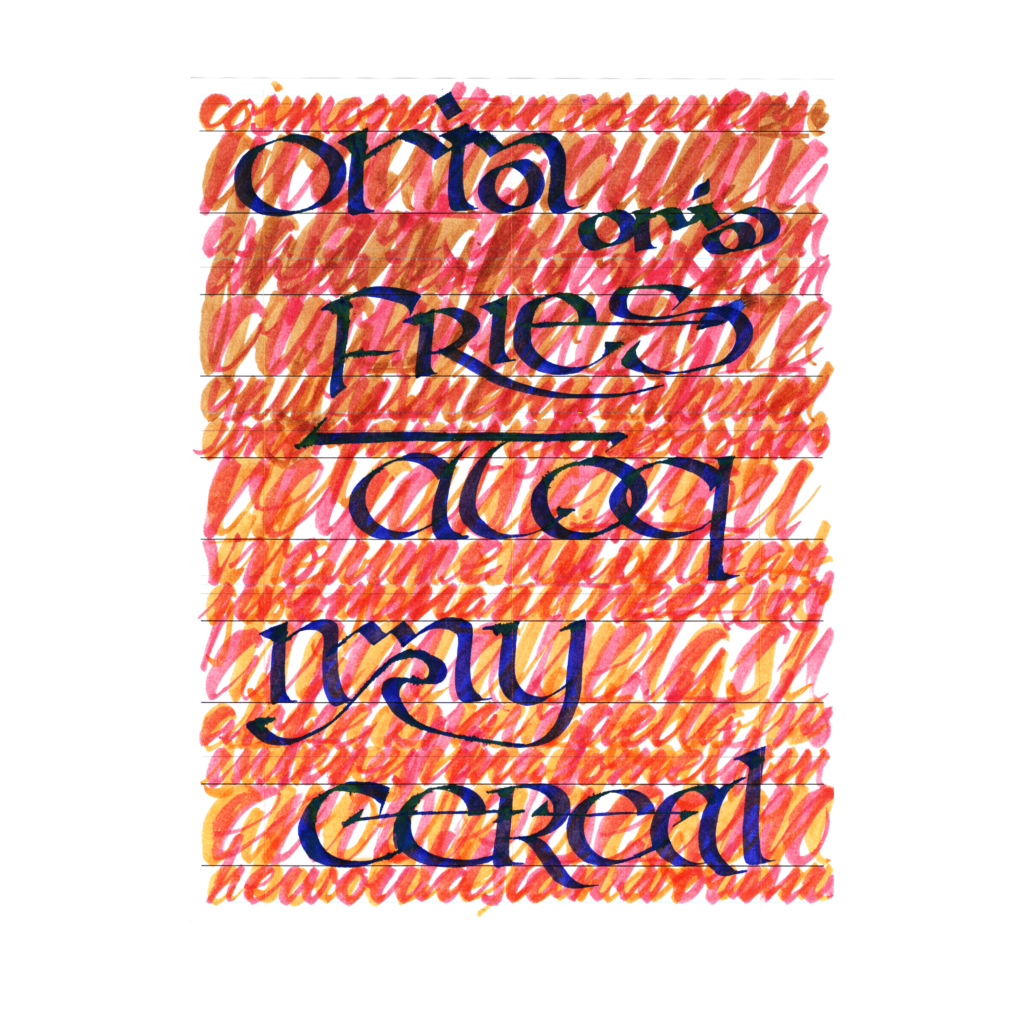
1/30
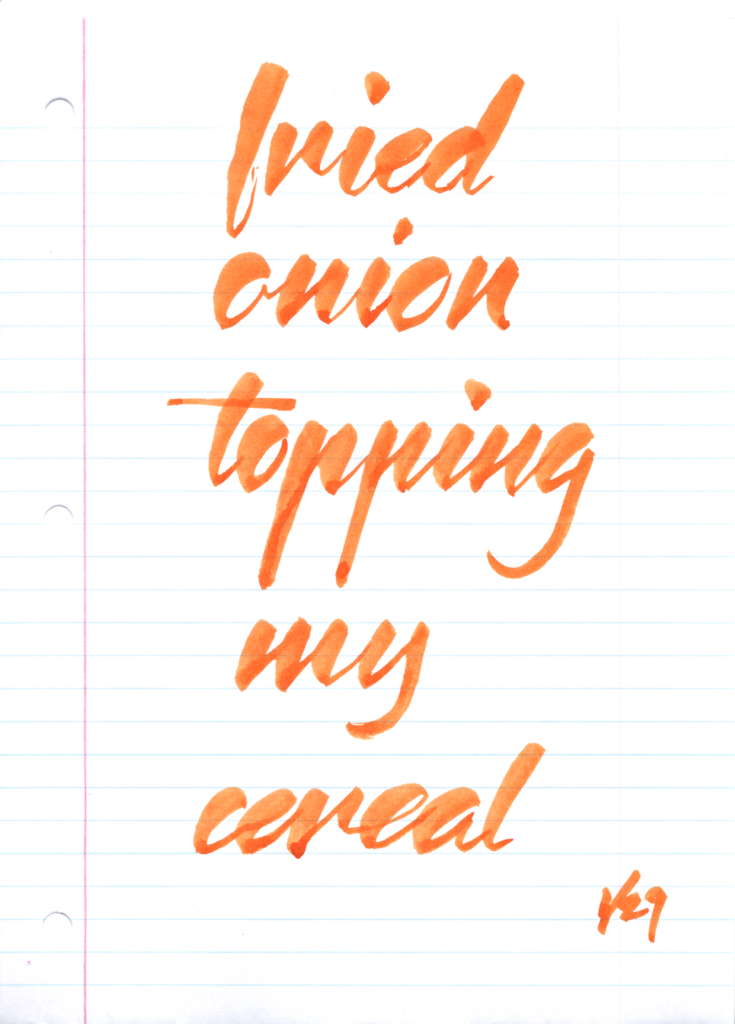
fried onion topping my cereal
I do love fried onions.
For a week in January, I played with funky Uncials, and it’s on the list to revisit for a full month. I wonder if I will ever stumble into a particular script that “is it“. Likely not—I’m a too into variety and impatient for perfection.
,
1/31
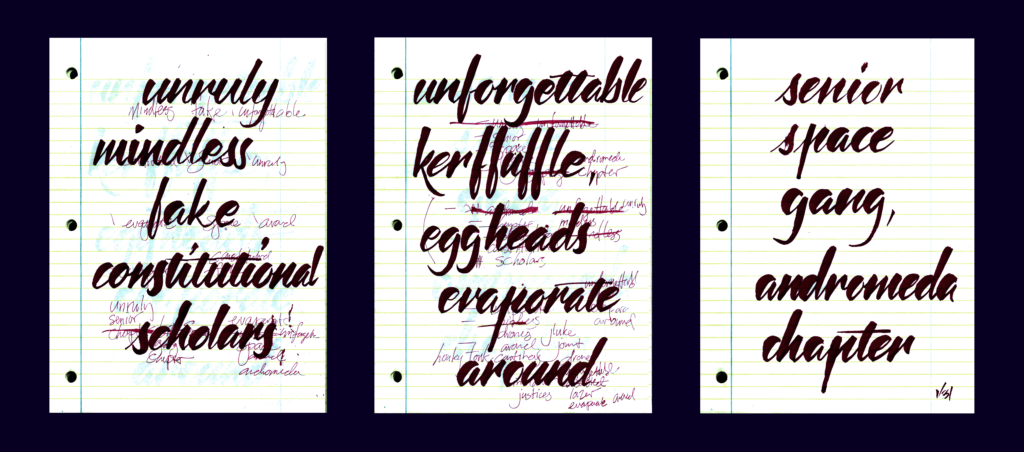
unruly mindless fake constitutional scholars
unforgettable kerfuffle eggheads evaporate around
senior space gang, andromeda chapter
These poetry hauls can be challenging! But it’s always fun to make them work. I love the mental picture of an alien biker gang who faux-studied our founding fathers.
,
2/5
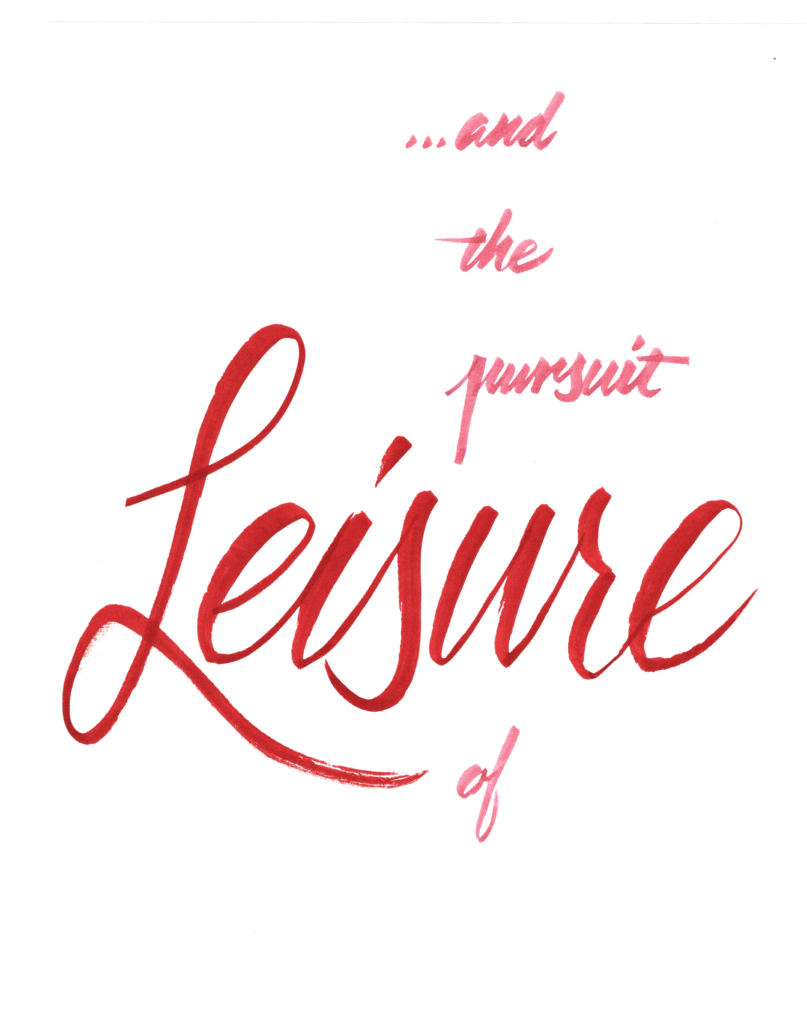
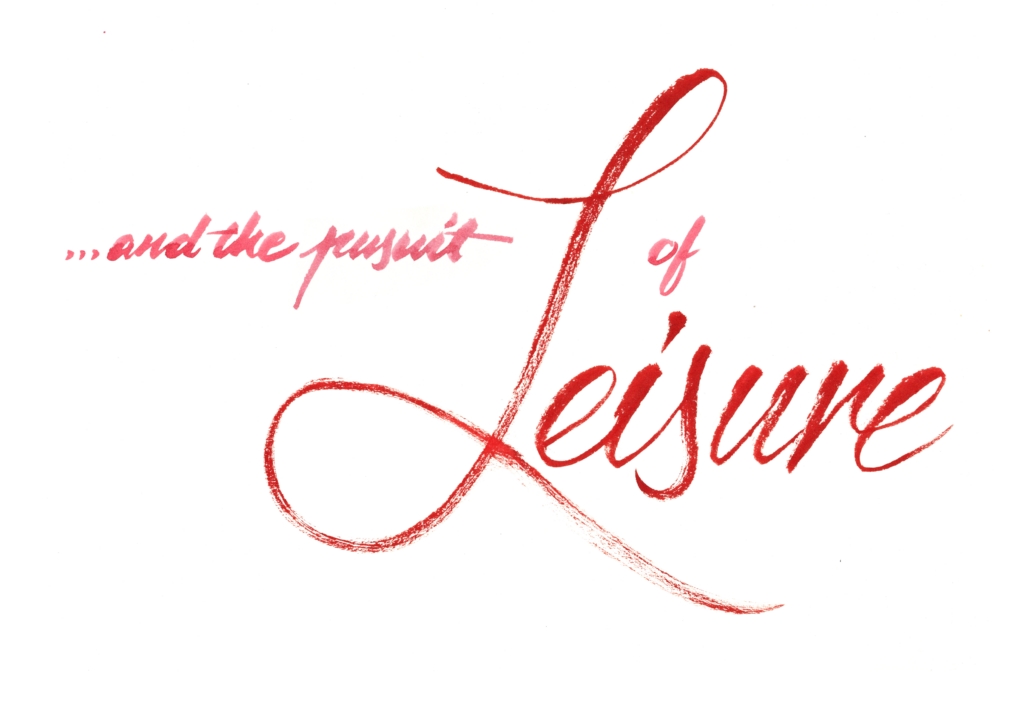
… and the pursuit of Leisure
This was inspired when Thomas J Bevan announced a Symposium on Leisure. I’m super happy with both of these. A couple months later, I’m not confident if I could do this today. The downside of picking up new scripts is losing old ones along the way.
,
2/9
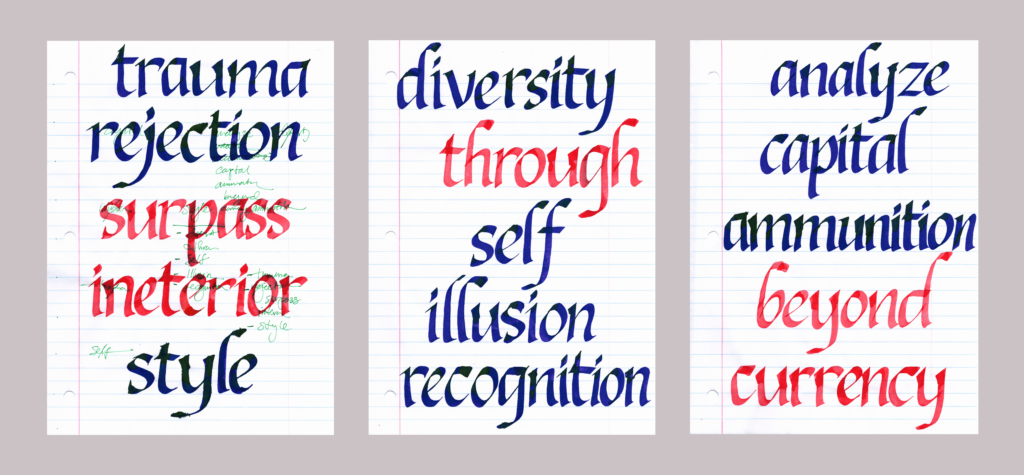
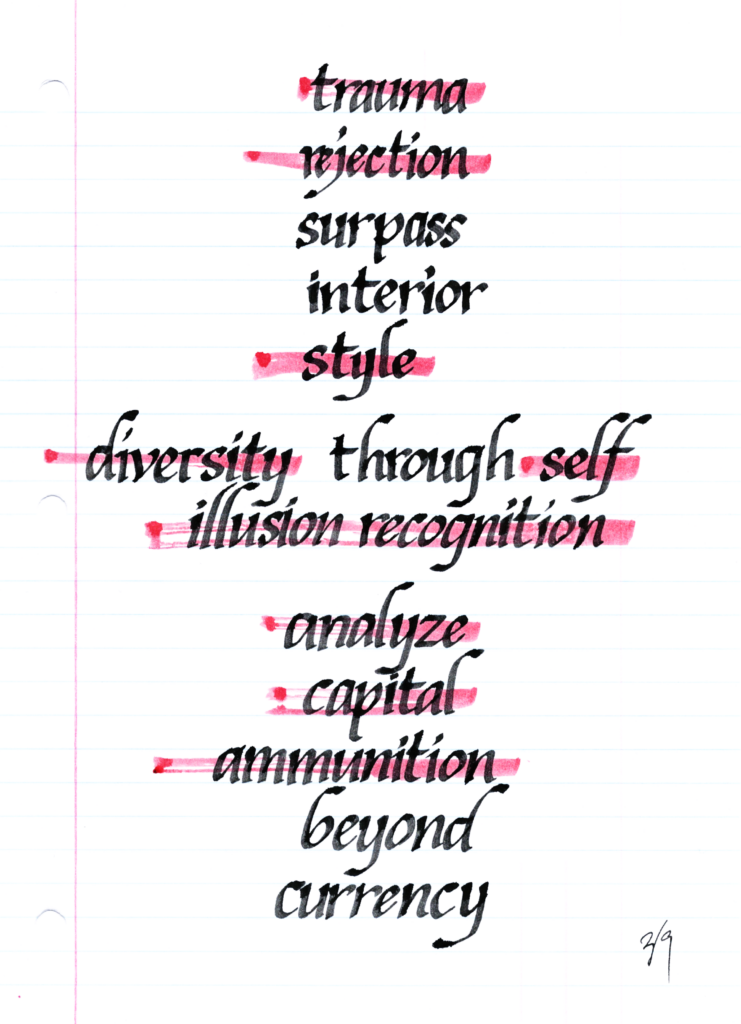
trauma rejection surpass interior style
diversity through self illusion recognition
analyze capital ammunition beyond currency
I made a mistake on “interior” so I rewrote the poem on a single page—which I immediately recognized was the right format for these poetry haul exercises.Sometimes you gotta keep doing something until the right format arrives. Repetition is the heart of process.
,
Between commenting on two-month old 5WP’s and editing four-year old blog drafts, these newsletters have become an exercise in archeology.
I do appreciate each of y’all who read and comment on them. Thanks for joining my delve into the past!
Cya next time!
,
PS—Word by Word, Ann Lamott, 1996
Bird by Bird is such a classic that the library has a long wait for the audiobook. So I started with this recorded seminar that she gave in Austin.
I dig it—I’ll be reading Bird by Bird.
Three key takeaways.
If you’re gonna be a writer, then write. Getting published is only a result of writing.
Find a writing group to work through this all together.
Draw deeply from reality.
I appreciate her suggestion for writer’s block. Give yourself permission to think. If you can’t write, then maybe force yourself to not write for a while. Sometimes your brain needs space to recharge.
,
Here are a few other exercises that sounded fun (though I haven’t tried them in the four years since I listened to that workshop).
List 10 favorite words.
Spend 300 words on someone you truly hate.
Describe yourself in detail five and ten years from now.
Where you would want to live, do it in exquisite detail.
Why you are here, why do you insist?
,
PPS—Bird by Bird, Anne Lamott, 1995
Vulnerable, crass, funny. Brilliant! I see why it’s a classic writing workshop in a book. Anne explores the difficulty of the process, and exhorts the reader to do the work.
She doesn’t shy from the benefits of the writing life, but reminds us that outside success isn’t all that special. Our personal problems don’t disappear after our shell gets polished.
So, it’s about sitting down and writing. Work and make it happen. Taking things one “small assignment” at a time. Finding a cohort to work with.
Don’t be disappointed when a project always ends with a whimper. (They all do.) Life keeps moving. The process stays going.
TLDR: Sit down every day, jump in, flail around, do a bit at a time, gut yourself to examine the innards, deliver, and do it again tomorrow. It’ll add up to a good life.
,
Speaking of Process, a friend and I started a journal of student work at Berkeley that lasted for two issues. It darn near killed me both years. For the longest time I thought it was a waste (aside from meeting one of my best friends). As a middle-aged man, I’ve learned that friends are rare. A buddy is one helluva a haul for a project.
,
This book is nominally about writing, but her subtitle is perfect: “Some Instructions on Writing and Life”. Her notes on completing a book mirror too closely to the work I’ve done as an architect. Writing might be her profession, but this book transcends her medium.
,
It is refreshing to read a self-help book by a great writer. The book shines; you don’t have to trust claims of her excellence in some other field—the proof is right here, page by page. Her display of craft makes her advice all the more visceral as she bares her soul and wrestles with the difficulty of life.
I’m now distant enough from these pieces they’ve become surprises to revisit. I should to accelerate the release of these five-packs, but things are about to crazy at work. If I fall further behind, that will let them age longer as old surprises to uncover.
,
2/6 Inktober 52 (2024), week 19
world floating in a jar
I had a rough time with the composition, and I need to take a month to practice the sign painting script to hit right.Even so, I’m happy with this final version, even if it took a little computer magic to make it work.
,
2/7 Inktober 52 (2022), week 9
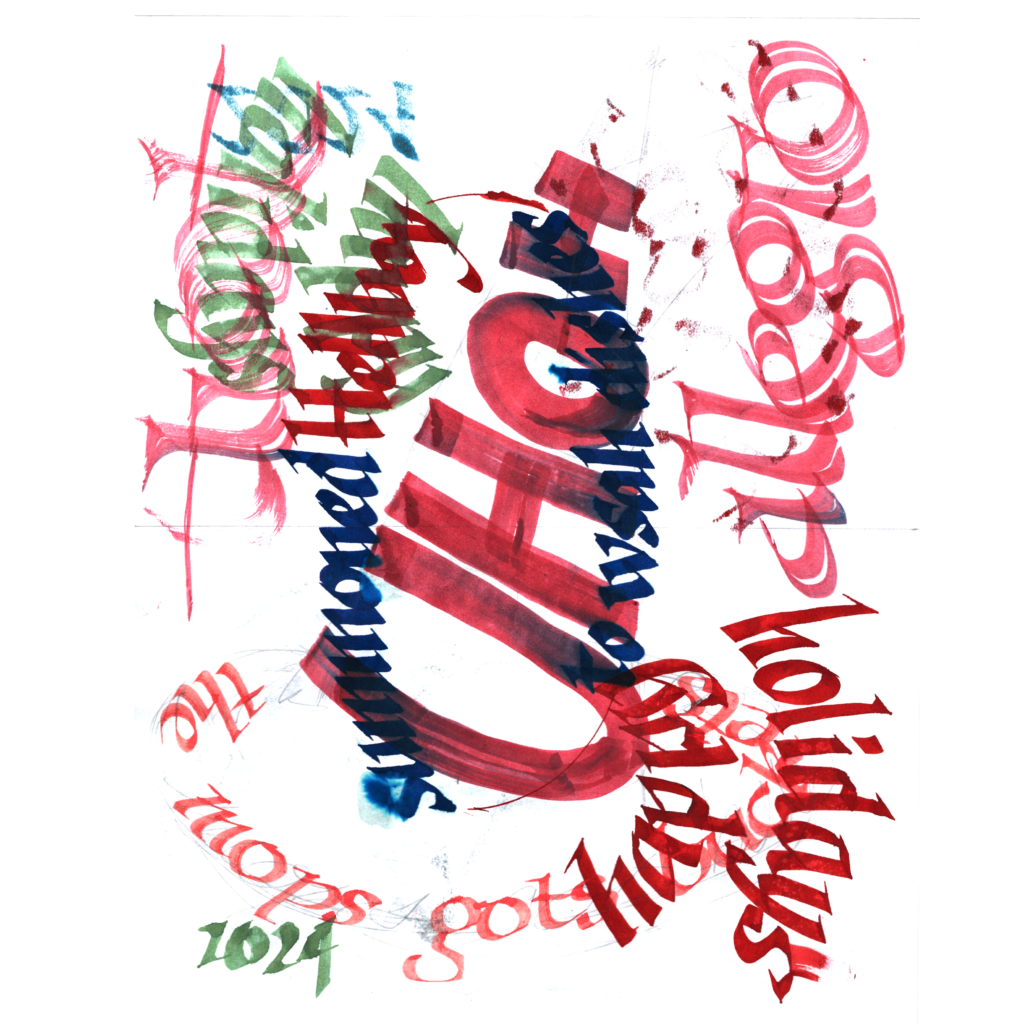
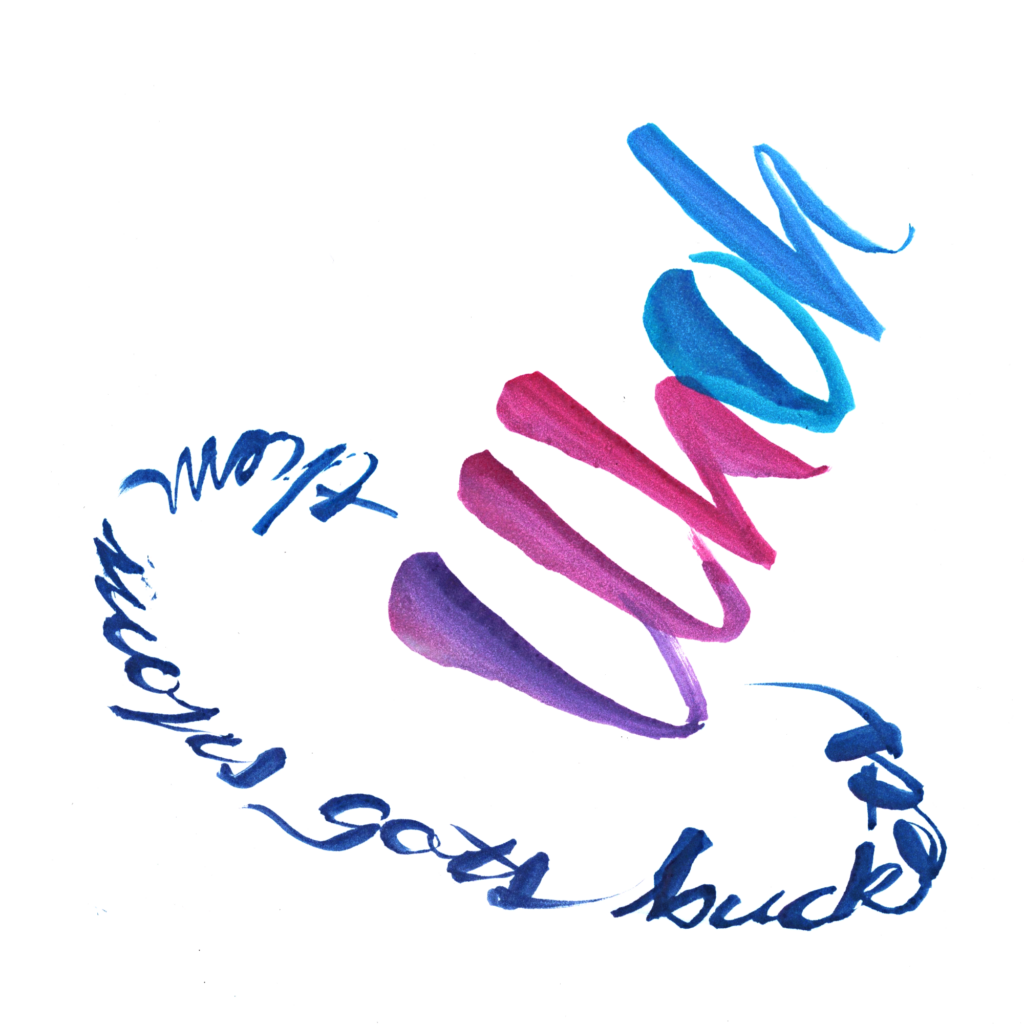
uhoh them mops gots buckets
In retrospect, I the sign painted UH-OH would have worked better, but in the moment I pushed the cursive in the finished versions. I’m looking for a good pointed brush outside of my Pentel pens, but it will take a few tries to get right. That’s gonna be an expensive exercise since it requires buying individual brushes.
,
1/25 Inktober 52 (2025), week 4
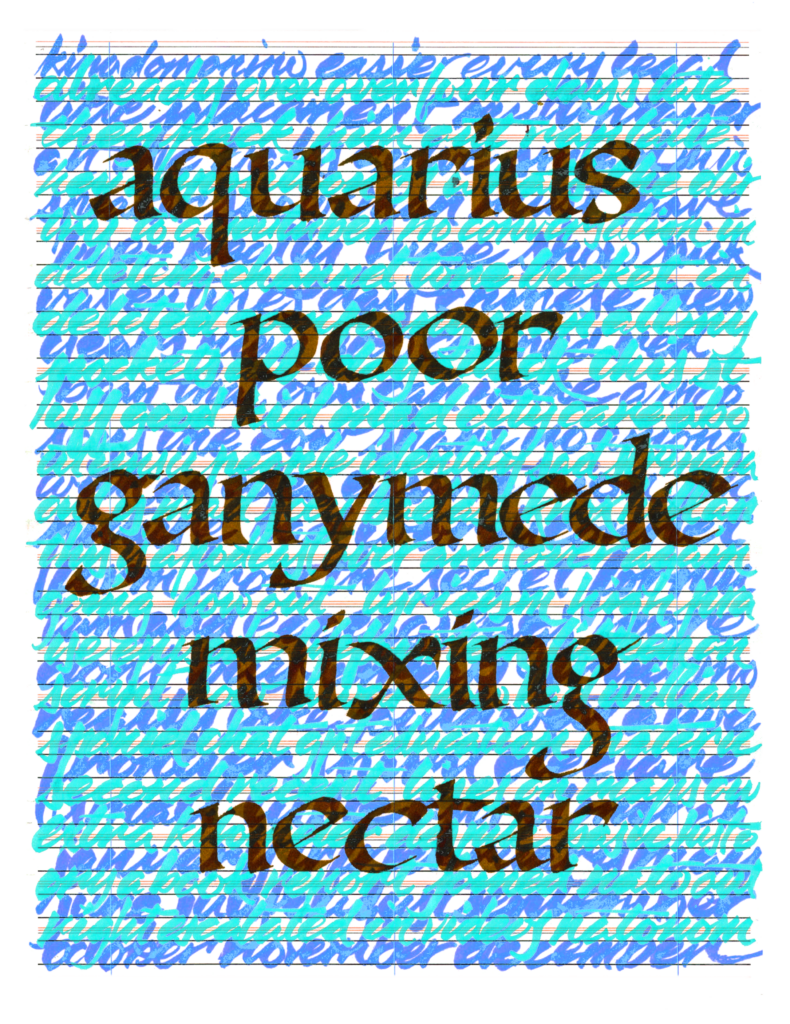
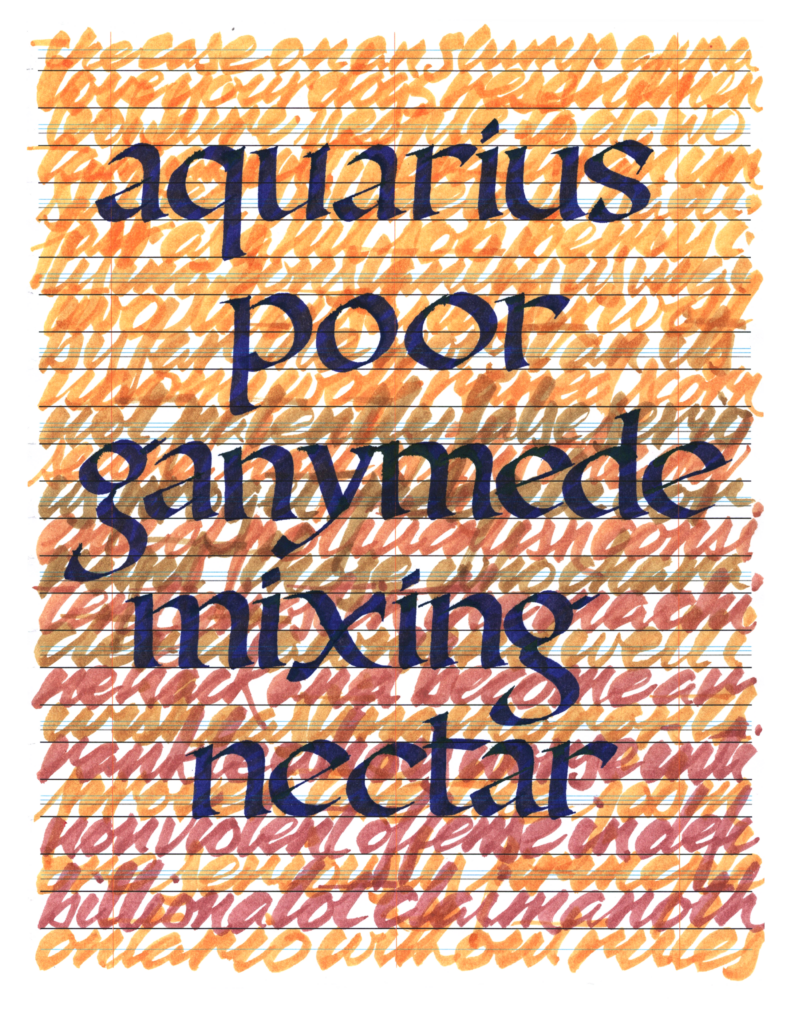
aquarius poor ganymede mixing nectar
I’ve been starting my mornings by practicing the my script of the month. Pushing the finished piece with the hue function gave it a nice watery feel, by changing the colors. My main practice inks are yellow and pink because they are quite dry (so they don’t heavily on cheap paper).
BTW the original Aquarius myth is sad, if not traumatic. Them Greeks told things real. Same for the Bible, even if we normally gloss over those parts.
,
2/1 Inktober 52 (2025), week 5
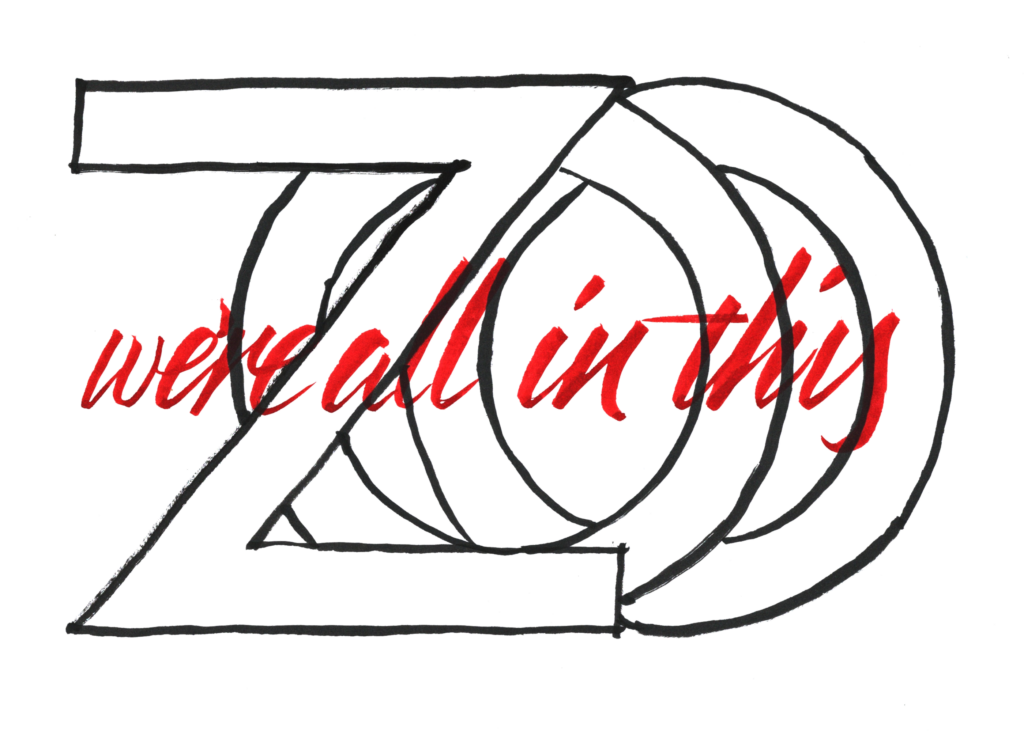
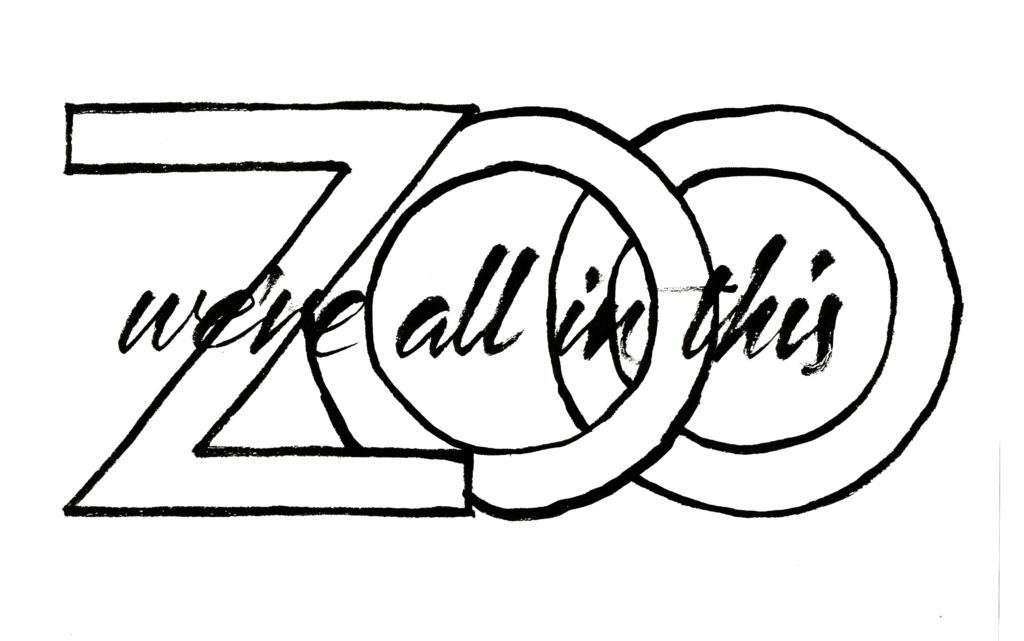
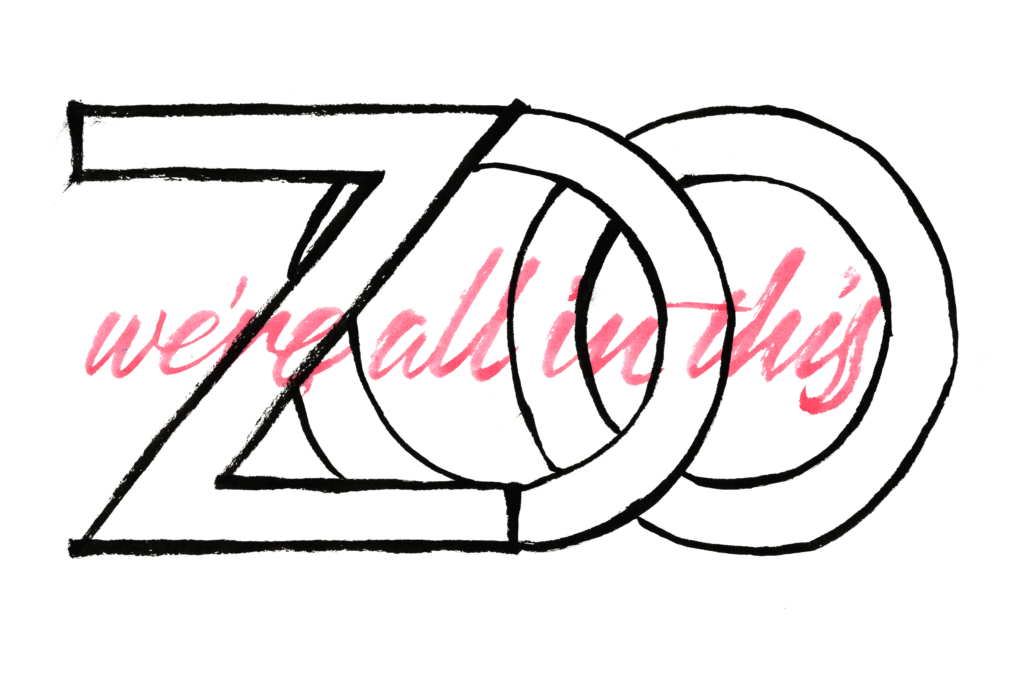
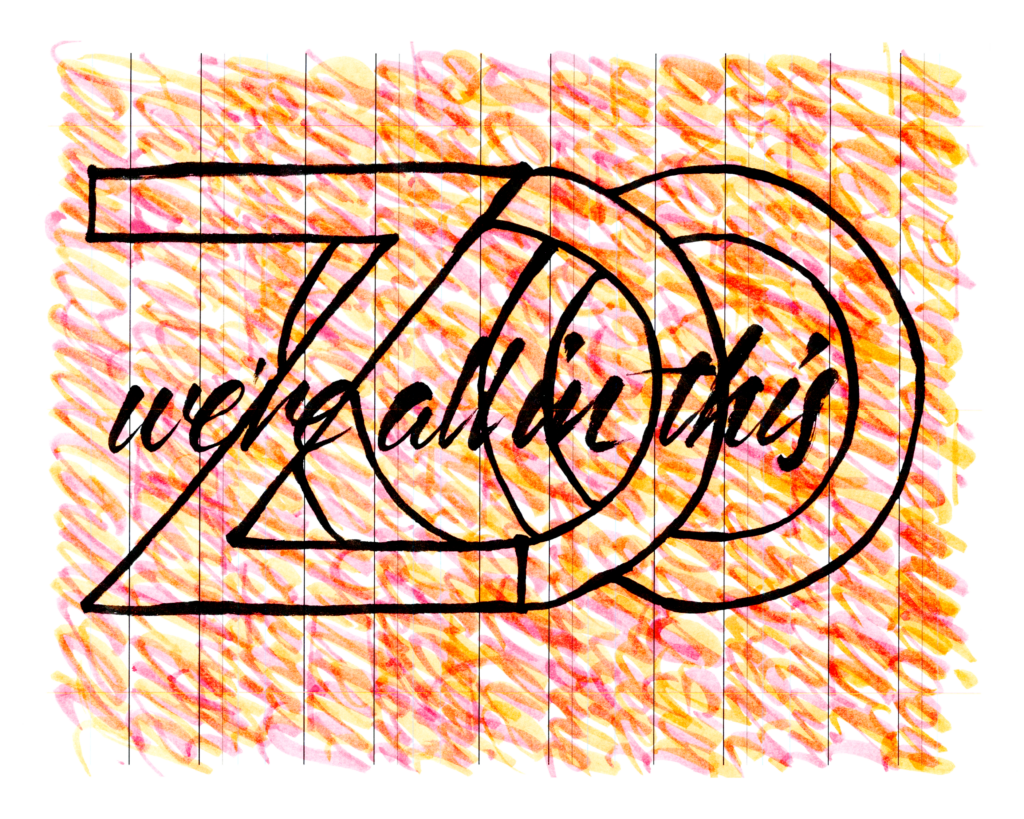
we’re all in this zoo
As always, there are so many little decisions that must be made after the overall concept. Again, the practice sheet came to the rescue, adding a little extra noise to give the composition presence.
,
2/8 Inktober 52 (2025), week 6
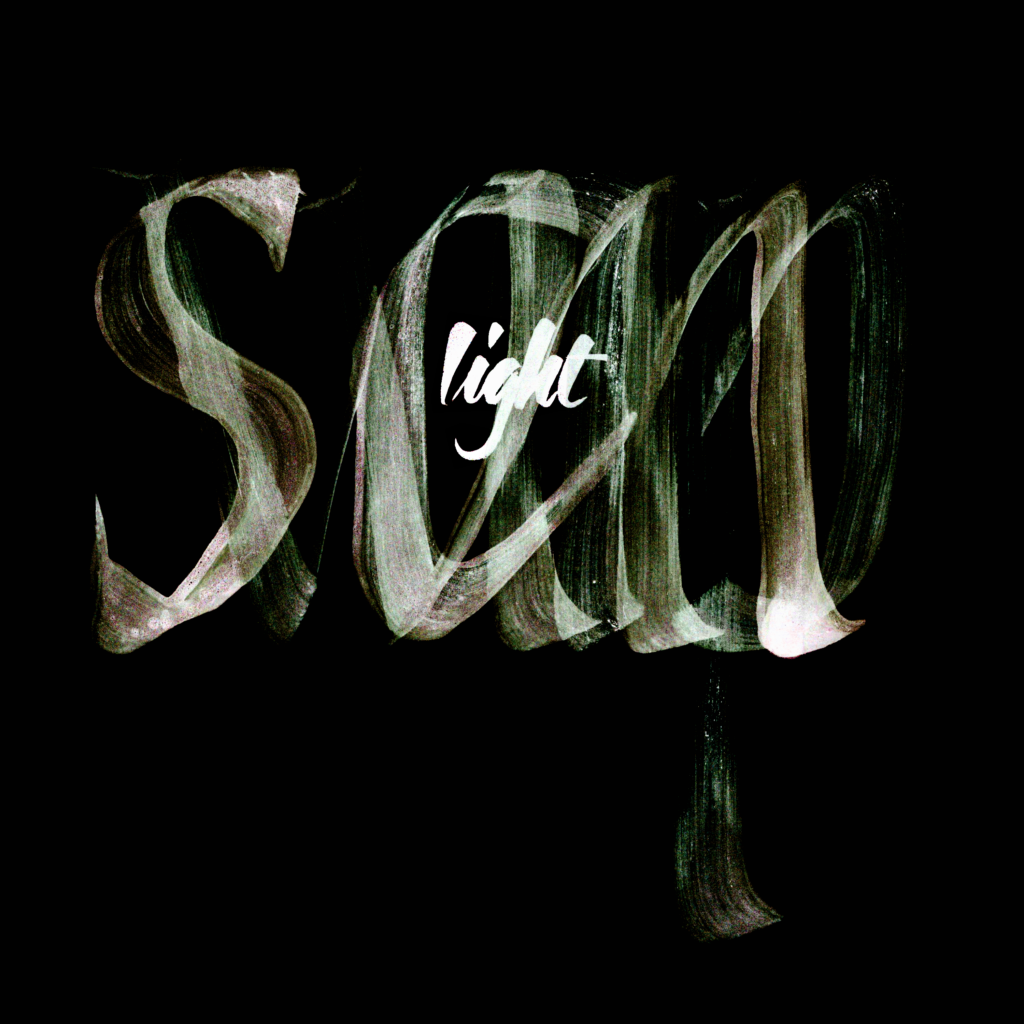
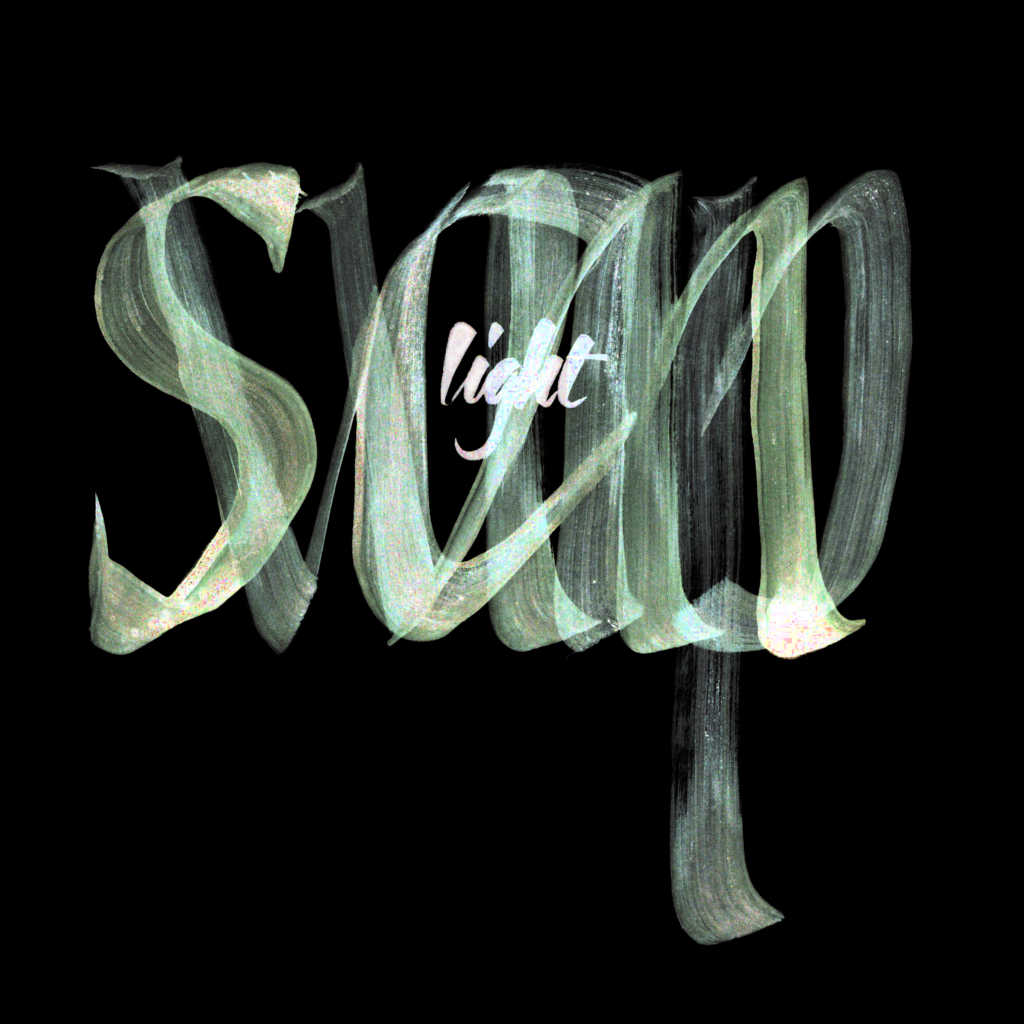
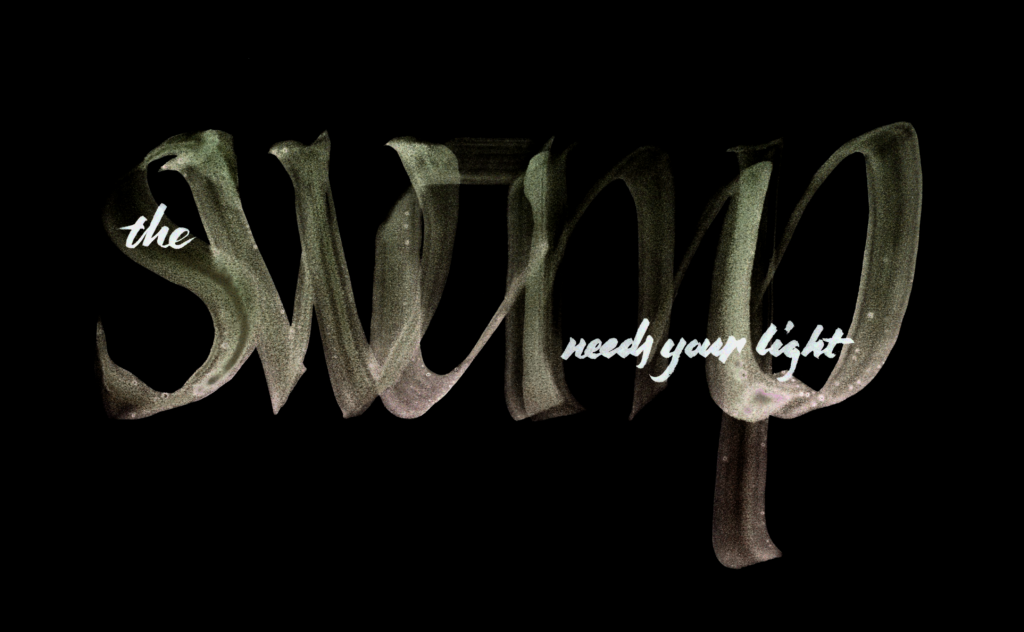
a light in the swamp
The top two versions are tweaks of the same scan. All versions were done as black/grey ink on white paper and then inverted in GIMP. After that, it’s about how hard to push the dials.
,
As much as I’d prefer to do it all perfectly on the page, the computer is an integral part of my process. These discussions about process are my penance for relying so much on the box.
Similar to the writing seminar in undergrad, I suspect my most influential class in grad school was the digital photography course with Frank White. As an architectural photographer, he unapologetically embraced the computer as part of the process.
Of course, the process is a lot harder if you don’t start with good inputs, but the final piece is the final piece. Excuses about what happened along the way don’t matter for the deliverable.
That’s how I do it here. I’m not above the occasional process photo to flashthat I can do most of it in real life. I’m not hiding anything, whether it came from the pen or was pushed in the computer.
It just is.
Cya next time!
,
PS—10 Bits For a Creative Practice
I wrote this as a response to someone’s post in early 2024, but the records have been drowned in the endless feed of content. I liked this enough to save it as a draft and it’s finally time to reshare it.
Show up every day.
Jump in! FFS just start.
Study the greats.
Celebrate your peers.
Don’t freak out about bad work.
Tension is the trigger to breathe. Relax.
If you can’t do it slow you can’t do it fast. No rush.
Pivot freely.
If the crop feels wrong, the crop IS wrong. (Trust your gut)—an aphorism I learned in that photography class.The concept of trusting default triggers has served me well over the decades for many things beyond images.
Do it again tomorrow!
.
PPS—Self Help Junky
Another response to someone else (exactly who lost in the endless feed).
As a former self-help junky, I’m a big fan of the anti-self-help movement. Of course, a moderate approach is generally best in life, but if you could only pick path I’d recommend skipping self-help.
But I’m moderating this reactionary stance after reading Kenny Werner’s Effortless Mastery.
I wonder if the question for judging a book is “how” versus “what”. Don’t invest in books that tell you what to do (or avoid). But there might be value in books that explore how to get somewhere that you already want to reach.
In that spirit, here is a quartet of self help books that might be of use:
Fail-Safe Investing, Harry Browne (great life-finance advice, though do your own research on portfolio composition because the specifics are dated)
So Great they Can’t Ignore You, Cal Newport (good compilation of career advice for someone entering the workforce)
Several Short Sentences about Writing, Veryln Klinkenborg (this book goes beyond writing to life, even if a bastardized version of his advice has infected LinkedIn with punchy shallow drivel.)
Effortless Mastery, Kenny Werner (a slow approach to practice, nominally about music but it applies to anything. It’s a distant second best to Tai Chi training at a good school.)
All that said, the Bhagavad Gita would trump all of these books, even if it’s profane to place this text next to self-help fare. May the gods forgive me.
But always be ready to ignore anything that you read in these books. Never confuse the author’s confidence in their advice for it’s applicability to your wild and wooly reality.
.
PPPS—Black to Yellow
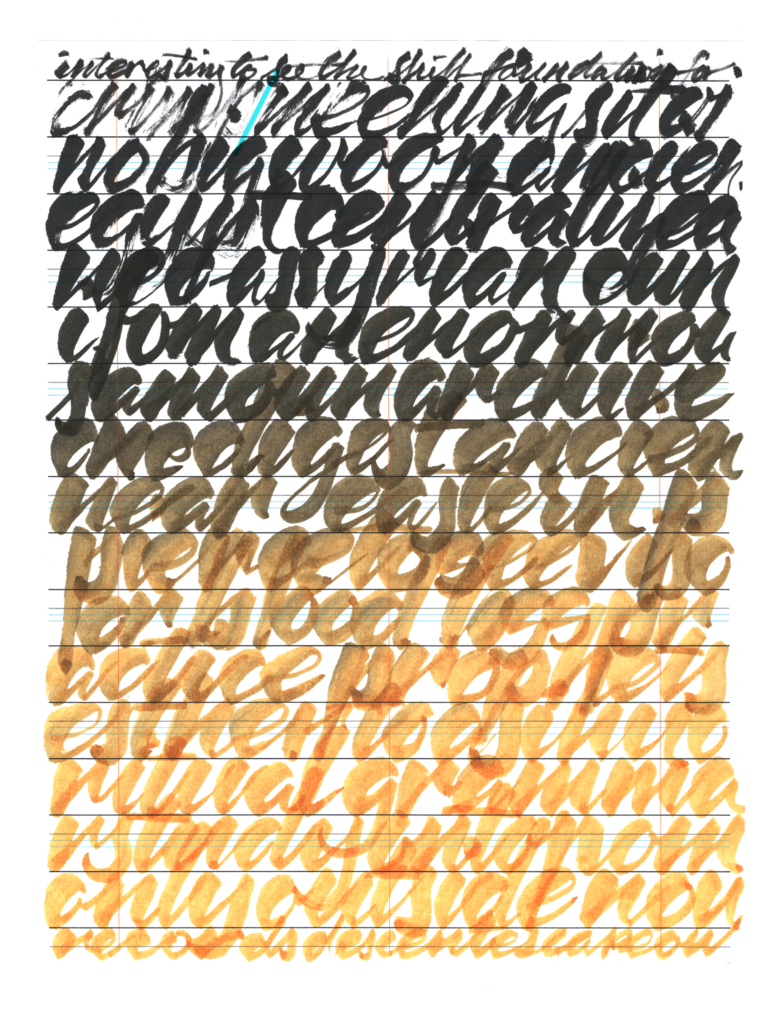
For giggles I took a brush pen with black in and put in a cartridge with Lamy Mango Yellow. The first sheet shows the transition from pure black (marked with the cyan slash on the second line) to yellow.
1/24
Interestingly, when I went back for more practice, there was still some more black that came out of the brush.
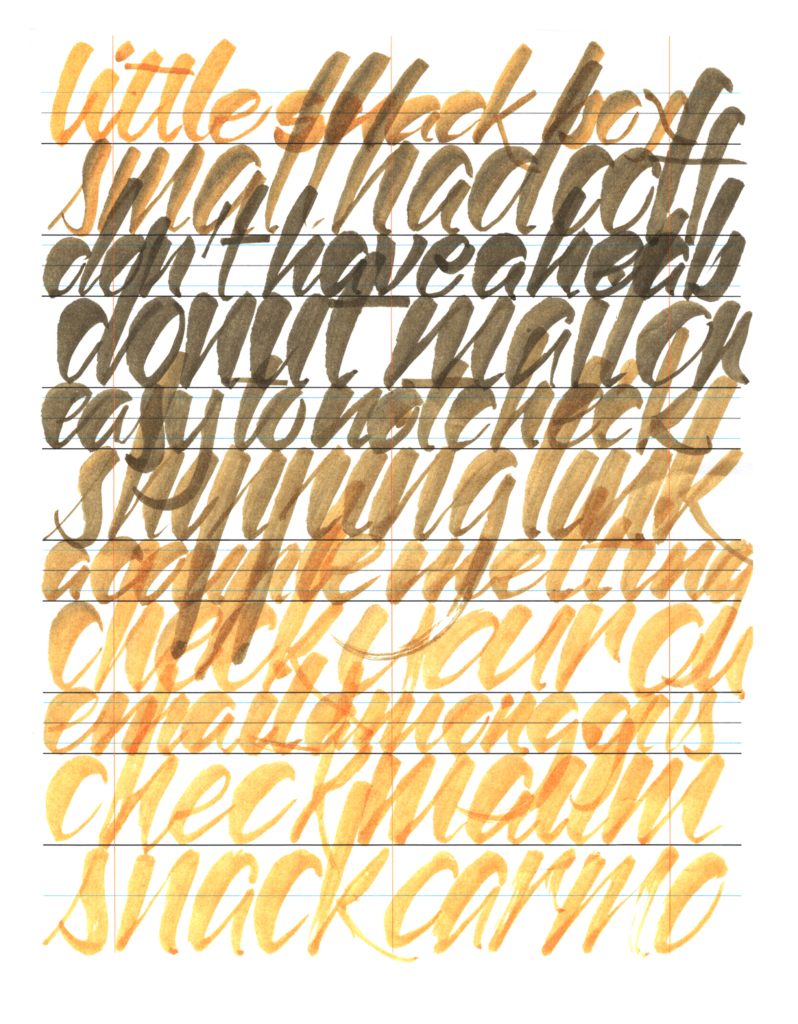
1/24
The next morning I made the “aquarius” 5WP (above), which had more black sneaking out (every other line was made with that black-mango ink, the other lines were made with the former mango pen, now filled with a pinkish ink).
Funny how these things play. The joy of the real world!
It’s fun to revisit old 5WP’s in these compilations. Some of them far back enough that I’ve forgotten that I made them!
,
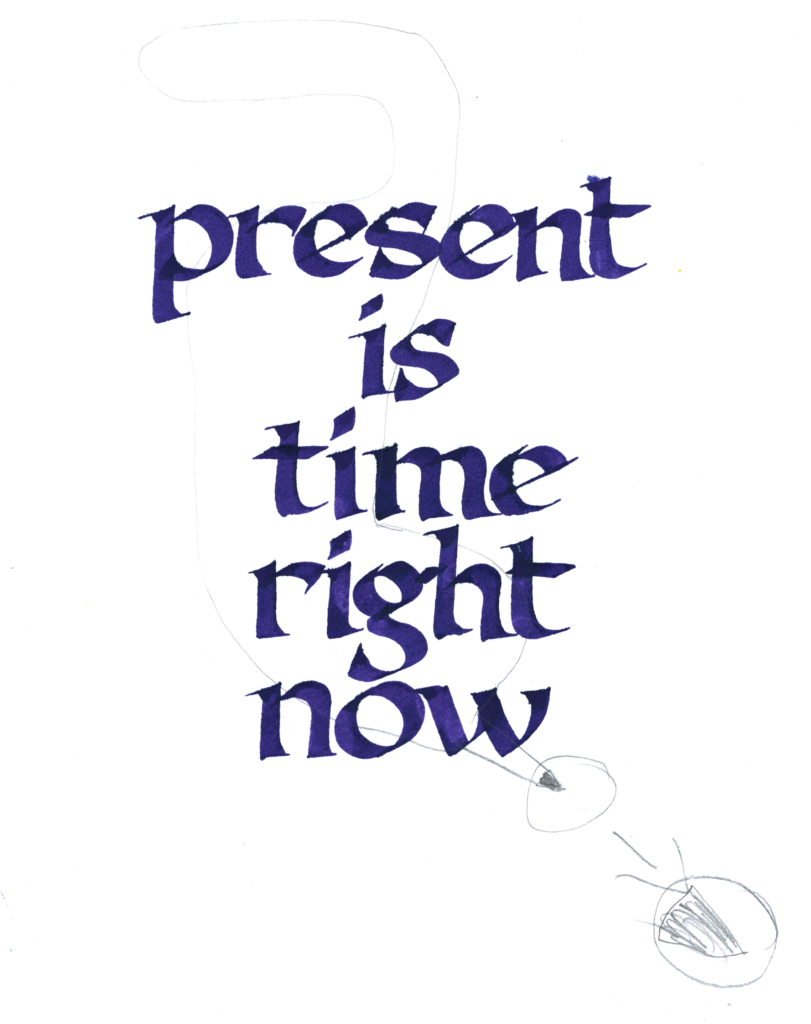
1/14
present is time right now
Decades ago, I watched Mike Ditka spout “Yesterday is history. Tomorrow is a mystery. Today is a gift—that’s why they call it the Present.” I usually quote it ironically, but I can’t deny that it stuck.
,
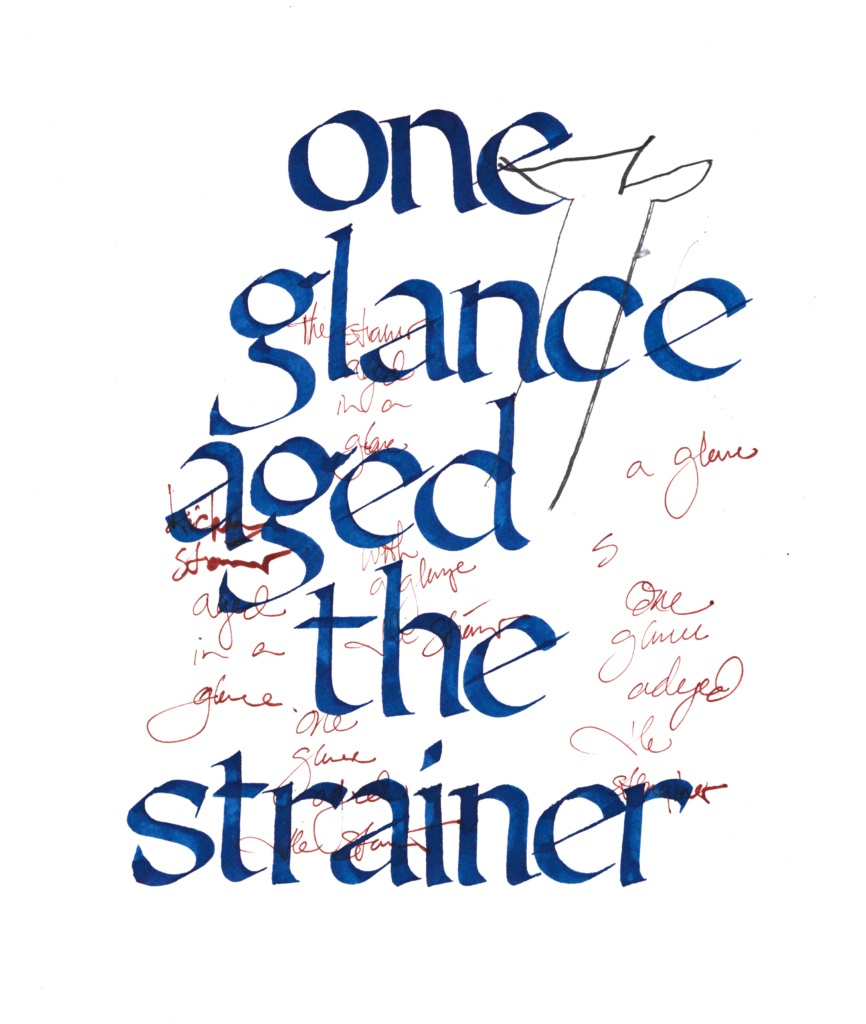
1/16
one glance aged the strainer
One afternoon, I looked at our metal kitchen strainer and realized that it had been thoroughly beat up over its years of service. I never noticed the kinks and divots in the frame, and I’m back to being blind to it. The power of the thing overwhelms the thing of the thing.
,
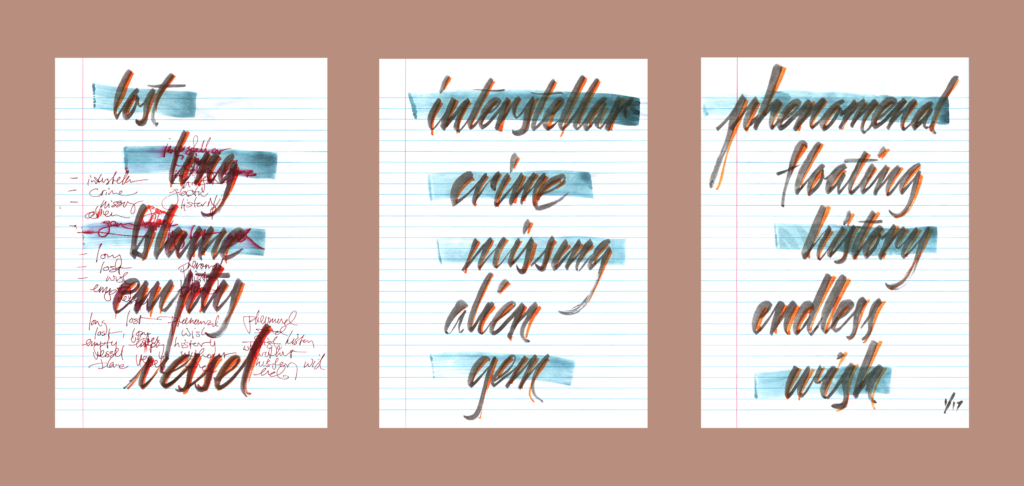
1/19
lost long blame empty vessel
interstellar crime missing alien gem
phenomenal floating history endless wish
More fun with the pointed brush cursive and the Artstack Poetry Haul challenges. Between February (italics) and January (pointed brush) it seems that it takes about two weeks of practice to get confident in running a new script on the 5WPs.
,
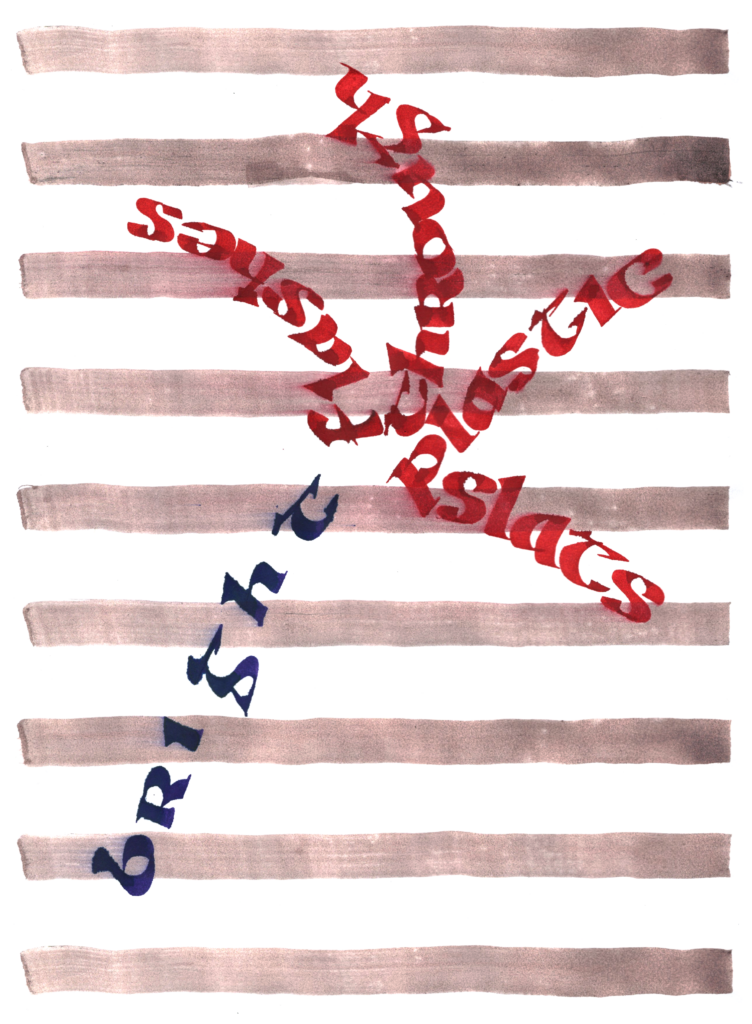
1/21
bright flashes through plastic slats
Las Vegas lights up with illegal fireworks on July 4th and New Years Eve. This 5WP was surprisingly tricky. I tried a few arrangements that fell flat, including this one. It was rescued by my old axiom “when in doubt, add noise” with the wash lines for slats.
,
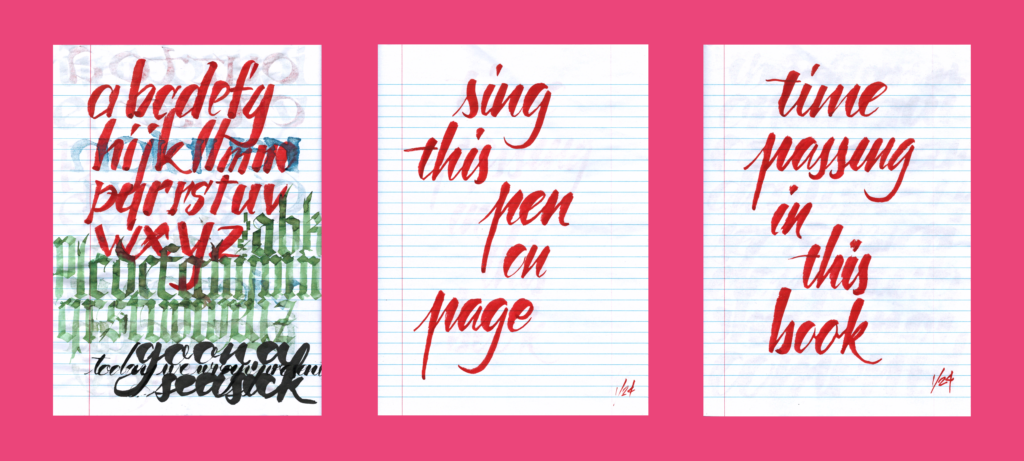
sing this pen on page
time passing in this book
I finished another notebook on 1/24/2025 (started 10/14/2024).Turns out that bound composition books are not fun to graph on, especially at the end when everything feels wrinkled.One day I’ll find at good use for the ones still at home. Until then, I’m sticking to spiral notebooks for quickly graphed 5WPs.
For this psuedo-triptych, I included the back page of the journal where I had started practicing with the brush around November. I’m really happy with the refinement that happened over three weeks of daily practice.
It wasn’t fun to start with the pointed brush, so it’s a nice reminder to get uncomfortable because that’s where the new growth is hiding.
,
I am finally finishing my Alphabet Magic series. The sketches were completed in 2023, but the publishing of those sketches and photos has dragged on (the calligraphy detour didn’t help!)
Last week, I made a big push to edit the images. I had been annoyed by the Windows photo editor but I’m super happy after using GIMP (which I learned due to the calligraphy detour.) Plus these posts pair great with new and ancient drafts of those Penny Delight poem-proses.
It’s awesome to close out a long unfinished project. I am a firm believer in just pushing stuff out there. In the process of publishing, synchronicity swoops in and creates connections that can’t be planned in advance.
Keep exploring and cya next time!
,
PS-The Wisdom Books, Robert Alter
As part of my wisdom kick, I picked up a copy of Robert Alter’s translation of Job, Proverbs, and Qoholet (Ecclesiastes).
Job is an enigma. A good dude gets crushed, argues about whether he deserved it, and God pops in to yell at everybody.
In a world with a human-ish diety, it reads weird. This book makes more sense for an atheist. We might have some agency, but we’re buffeted by the whims of grand forces beyond our control—society, fate, nature. We don’t matter. We’re fleas on the tiger, hopefully it takes us to a good place, but there ain’t no guarantees.
Arguing about fault is fruitless. The competing monologues between Job and his accusers are just Tweet-storms between opponents talking past each other.
I respect canon and the filter of time. Anything from the ancients that made it to the present must have something worth reading, even if I reserve the right to pick and chose what to believe from the good book. One day, I should read the rest of the Bible without god. I wonder if I will enjoy it more.
Robert Alter’s introduction and commentary helps make sense of an otherwise befuddling text. I really enjoy his opinions on the development of the text. It’s hard to kick the reflexive perspective of hardcore divine inspiration, so it’s nice to have someone say, “yeah the text is corrupt here.” The confusion isn’t all on me as a puny reader. At a practical level, the formatting (using the main text over footnotes on the same page) is superb, the information is always immediately at hand.
~
Unlike Job, Proverbs did not hold up, in spite of fond memories reading this book many times as a kid.
It did not utterly bore me as the “Wisdom of Solomon” (all sizzle and no steak), but there was more noise to signal than I had remembered. The memorable images are still there (the lazy man rolling back and forth on his bed like a door), but I had forgotten all the chaff that came with this book. It burns pages selling the beauties of wisdom. Bro, I wouldn’t be here if I didn’t already buy in!
This time, I was struck by it’s optimism—do good and good stuff will happen. Maybe that was a better fit three decades ago, with America as the global hegemon and an apparently principled Christian conservatism on the rise. But such sunny optimism doesn’t feel right in the wake of two failed wars, a mismanaged epidemic, bipartisan ineptitude in federal power, and the flagrant cruelty of the evangelical church.
I suspect the reception of these ancient works are intimately tied to current events. Maybe I’ll find more resonance in old testament prophets, demanding repentance and a return to righteousness….maybe Proverb’s calls to wisdom weren’t misplaced after all.
~
Ecclesiastes is beautiful.
I never noticed this before, maybe because this book demands that you age into its reading.
Robert Alter’s prose certainly helps, as well as the formatting of the page as a true prose essay. However, I checked my King James Bible and noticed that it read great as well, even though the copy was chopped into verses and was full of anachronisms breaking up the flow.
Growing up, I primarily read Proverbs. That might be right for a young mind, keeping them on the search for wisdom and avoiding laziness. But after hitting a certain place, it’s impossible to avoid the bigger things in the world. It’s not so sunny out there.
If wisdom is the way, how do we explain this insanity?
Strangely enough, the gentle hedonism of this book is one way through. Pursue the wisdom, but don’t expect it to work out. Enjoy the fruits of your labor if it comes, but don’t kick yourself if it don’t.
Years after reading the bible, I did not expect to have a fully aesthetic moment in reading this book. Other parts of the Bible must hit such heights. Maybe the Sermon in the Mount. Is it hiding in the minor prophets?
Time to start digging.
,
PPS—Nothing deep here, just messing around with the banjo and recording it for giggles (January 13).
,
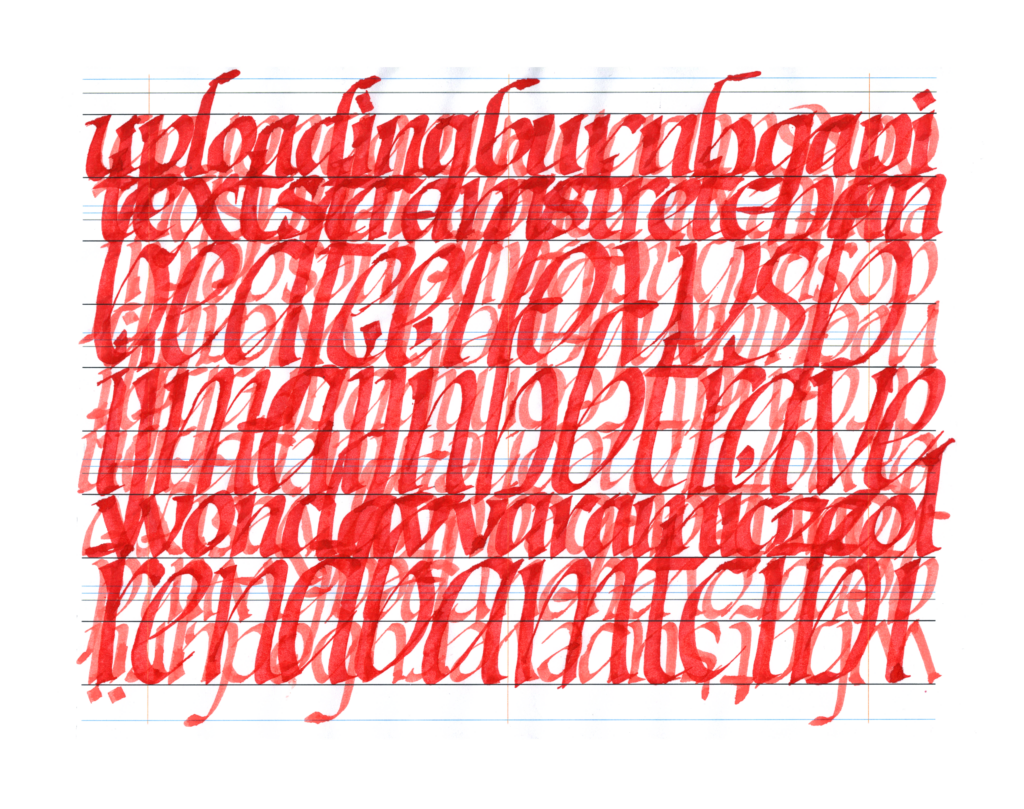
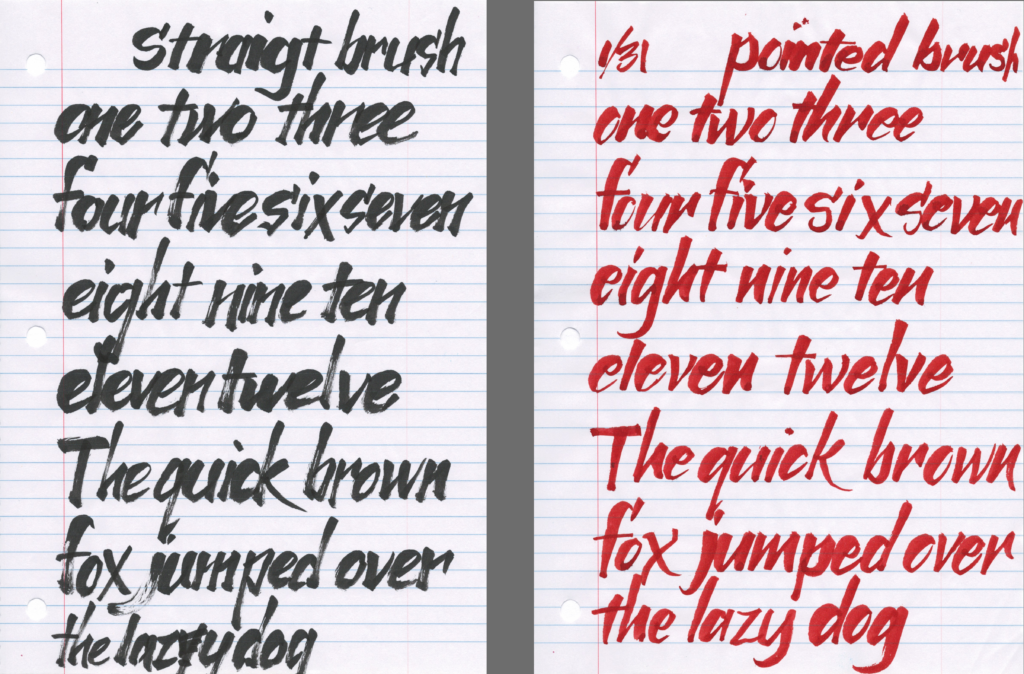
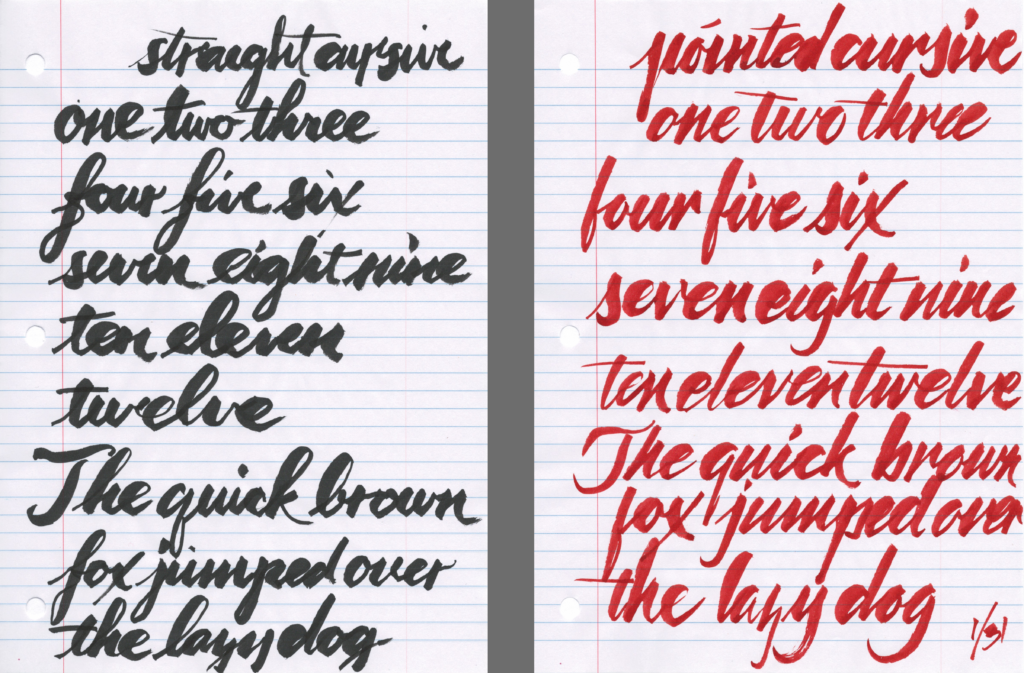
PPPS-Pointed Brush Progress (February)
At the start of the year, I went through all my scripts and put them in a book (black ink). After January, I ran the pointed brush to see how it improved (red ink).
I don’t think the printed text improved much, but that’s because I got totally sidetracked into the cursive, which I adore. I don’t think my pointed brush cursive here was the best, but I guess it’s good to have an “average” example.
That said, there is no greater feeling of flow than graphing with the brush pen while feeling the “edge”.
Before end of the year, I pushed out a few 5WP’s there were trapped in my phone. And starting with the new year, I’ve jumped into the “Poetry Haul” challenge by ARTSTACK.
,
1/7
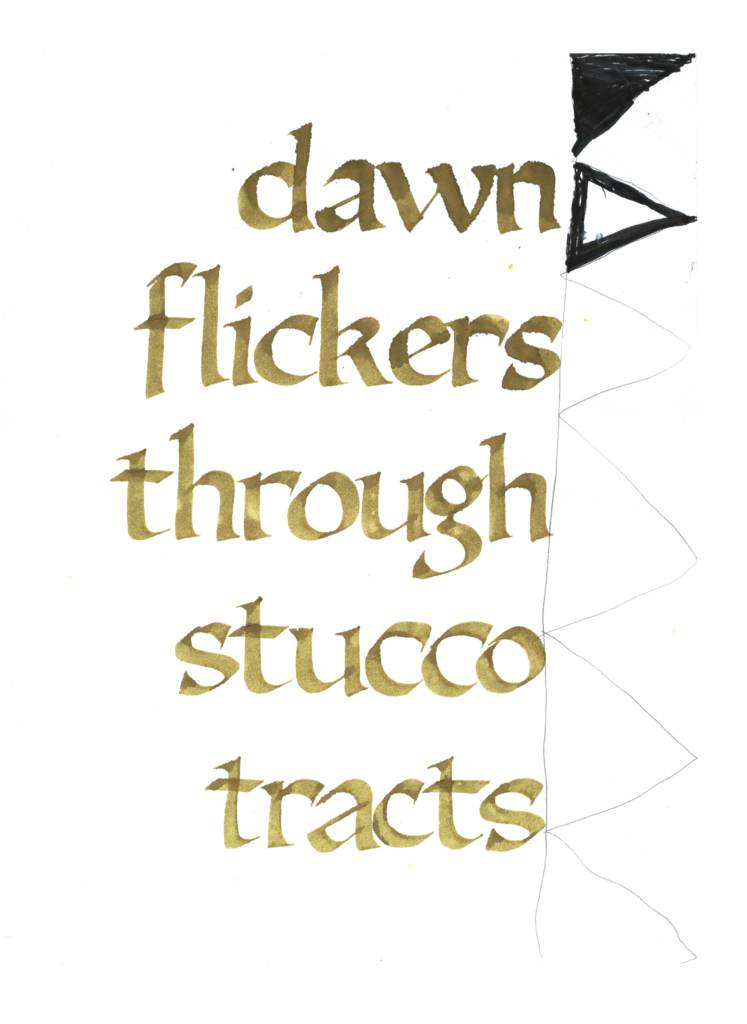
dawn flickers through stucco tracts
Morning sun is always inspiring, even through banal suburban neighborhoods on the way to work.
,
1/8
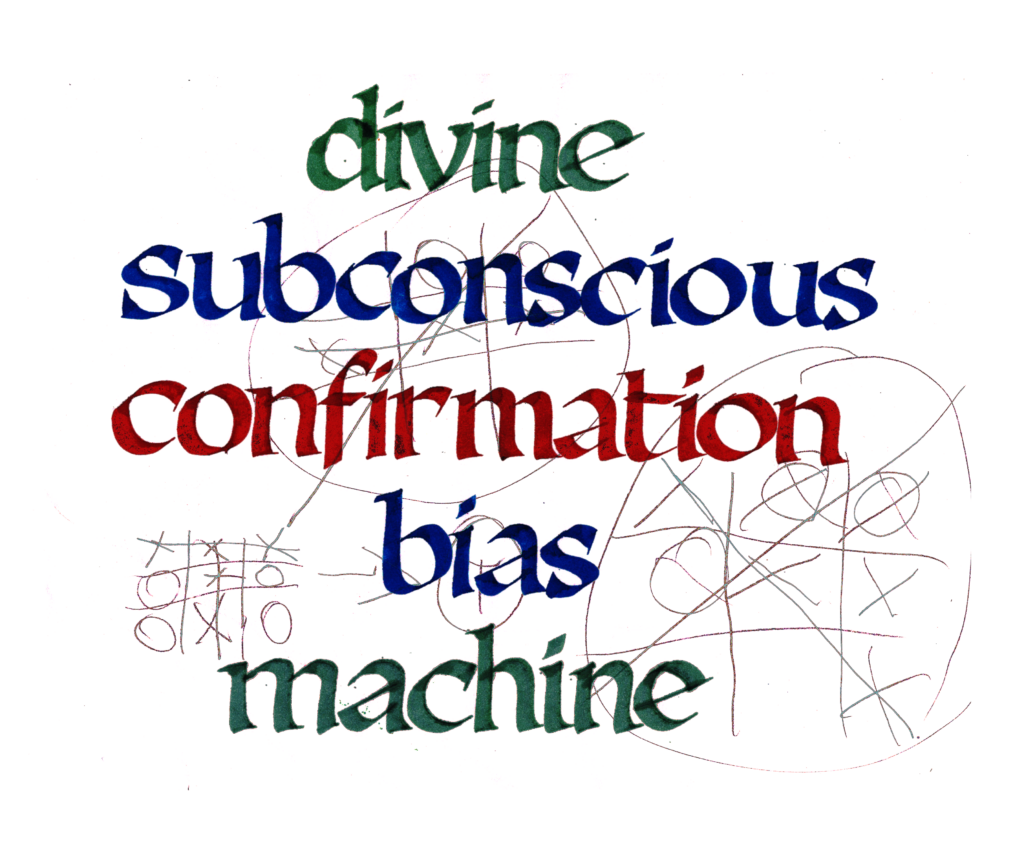
divine subconscious confirmation bias machine
Using the I Ching and Tarot, I occasionally indulge in randomness for self insight, even though I don’t subscribe to new age woo. I treat these practices as public-domain versions of Brian Eno and Peter Schmidt’s “Oblique Strategies“.
Even without the woo, divination must be treated with the proper respect. Consulting the unpredictable is a powerful way to recontextualize the moment. It’s also the perfect way to tell yourself whatever you subconsciously wanted to hear, a dangerous game.
,
1/9
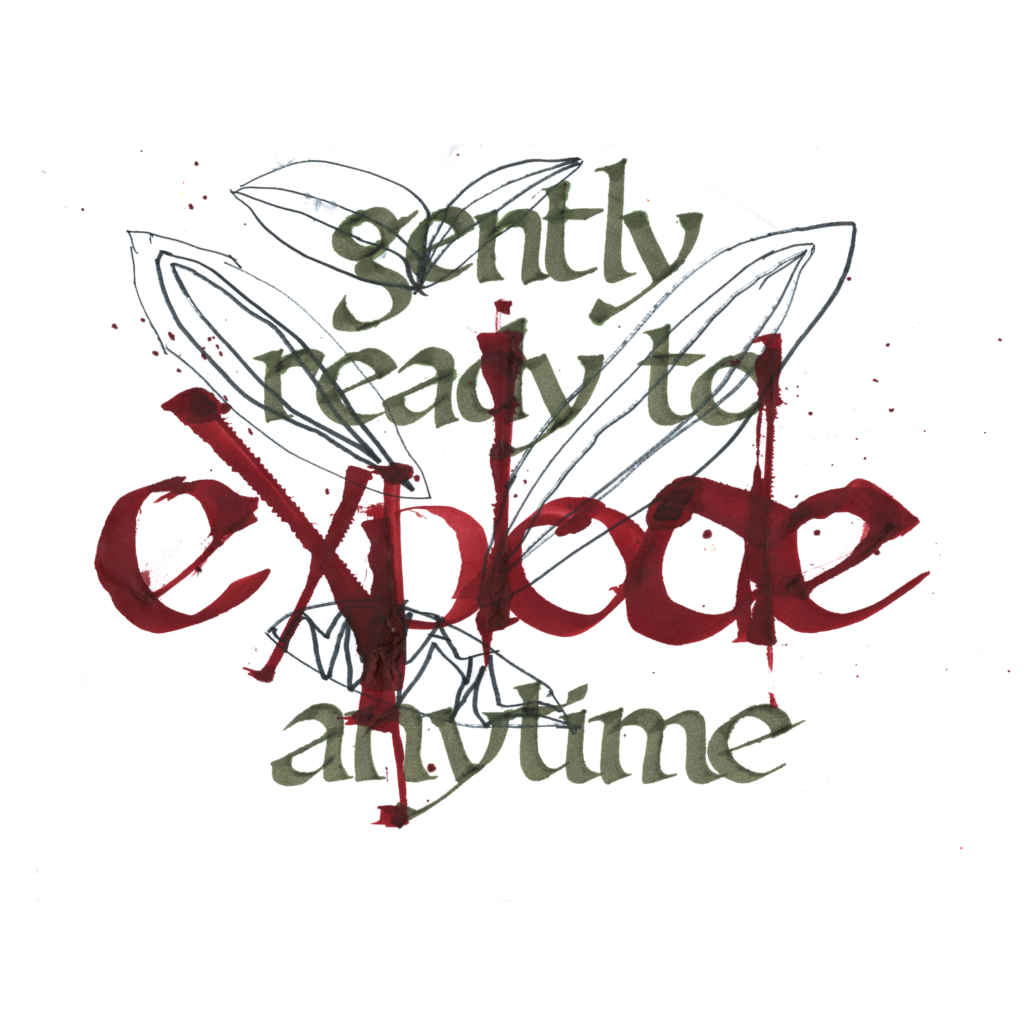
gently ready to explode anytime
As far as I know, I’m well liked as a Project Manager. If that is true, it’s because I try to be gentle and kind with my consultants. On the other hand, I also make it clear that we have standards which need to be met.
It’s a weird dichotomy, partly from my own personality. I’m really nice until I suddenly flip out. That second part ain’t great, but I’ve been getting better at avoiding rabid foaming mouth moments as I continue to grow up.
,
1/10
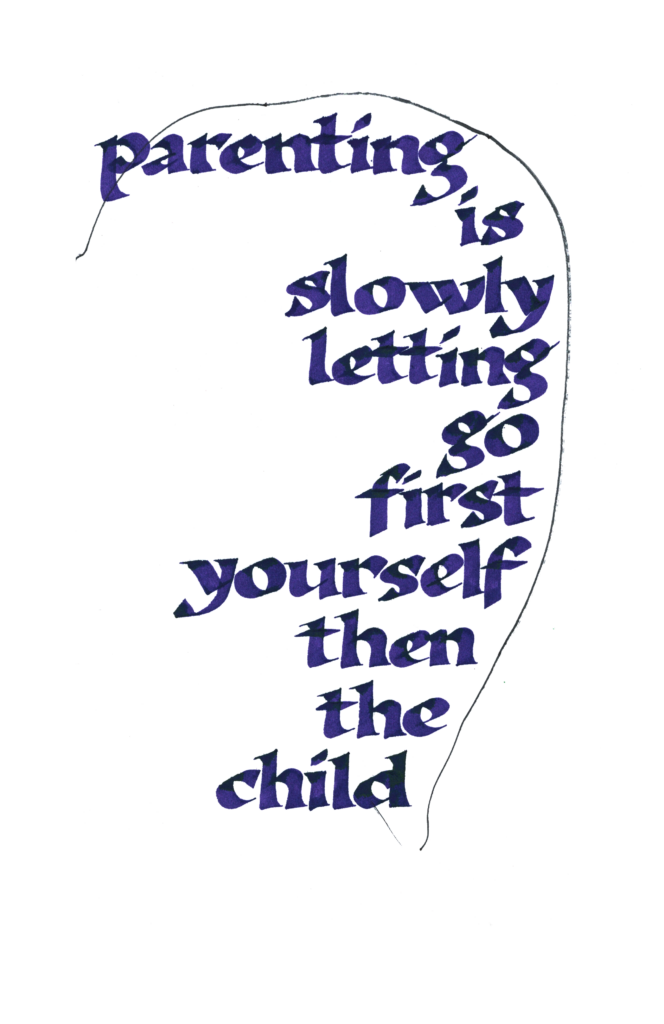
parenting is slowly letting go, first yourself, then the child
I’m certain older parents have a more perceptive opinion of this wild aspect of being human. But this is what I got as a dad of two kiddos.
,
1/11
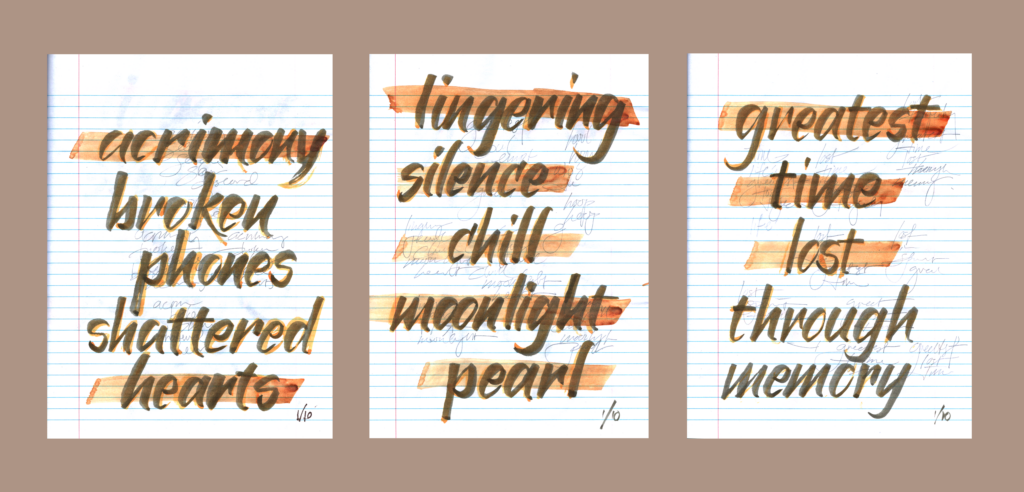
acrimony broken phones shattered hearts
lingering silence chill moonlight pearl
greatest time lost through memory
Artstack started posting a poetry challenge sharing ten words for a week. Add five extra words and we got a triptych of 5WPs!
,
With my recent focus on dip pen copperplate and straight brush calligraphy, the Pilot Parallels have been neglected.
I could feel the rust in my fingers while running these Foundational Hand letters. But I’m super happy with how the brush has progressed, so I guess it was a worthy tradeoff.
I’ve kept my interest in calligraphy so far by keeping things fresh. Normally, I don’t have a ton of patience for refinement. Maybe one day I’ll hyper-focus on greatness at one detail. In the meantime, I’m happy with getting pretty good at something before tackling another challenge.
Cya next time!
,
PS—Scratch 3.0, MIT Lifelong Kindergarten Lab, 2019
My friend’s boy was taking a class in Scratch. I thought, this might be interesting. And a weekend in 2021 disappeared.
Scratch is a magnificent simple block programming system designed for kids. It was easy to jump into and my daughter and I were having fun drawing and programming a sprawling game with multiple minigames.
That might not be the right way to create a long term habit, but it got our feet wet.
With our (still incomplete game) I took over the reins of the programming, letting her do the drawings. The next step was to unleash her on the computer, so I borrowed a couple of books for a more structured training that lasted a month before we lost interest.
Inadvertently I had stumbled into “paired programming”, where two programmers share a computer. This novel technique is said to increase collaboration and concentration. For a few weeks, it turned out to be surprisingly effective. We collaborated and learned together, pushing ideas back and forth and a live example of by stumbling through the modern instruction manual—YouTube.
The part that really makes Scratch tick is its social aspect. Given the dark side of Facebook and Twitter (now “X”), it is not something I compliment lightly. Every Scratch program allows you to “see inside” giving you a resource to cut through frustration.
But like many moments in childhood, the early interest faded quickly. We pushed out a couple small games and that was that. The boy is now old enough to play with Scratch, but the little rascal prefers sneaking off to play games.
Still, it’s a great resource, kudos to MIT, even if we haven’t used it to its full potential. Yet.
,
PPS—ODDADA, Sven Ahlgrimm, Mathilde Hoffmann, Bastian Clausdorff, 2024
I found out about this game on Friday with this excellent review on Good Game Lobby. Slept on it overnight, and bought it on Saturday. They played it all afternoon. He also played it most of Sunday until we dragged away from the computer to read books.
Obviously, this is “composing” on “easy” mode, but twenty songs in and we’re still having fun with more variety to explore.
The sweet spot for a computer game “enjoyable but not addictive”. I’ve spent too many hours on Civilization which is why I’ve avoided that narcotic after the first version. Hopefully sandbox games like this will find a proper balance.
Six months later, I have to admit that we rarely play this game. There is only so many things to do, and composing music isn’t their thing. That said, he saw me looking up ODDADA on the computer and asked to play it after dinner. So he still likes it.
Still highly recommend.
,
PPPS-Practice
1/16
.
PPPPS-Happy Trails
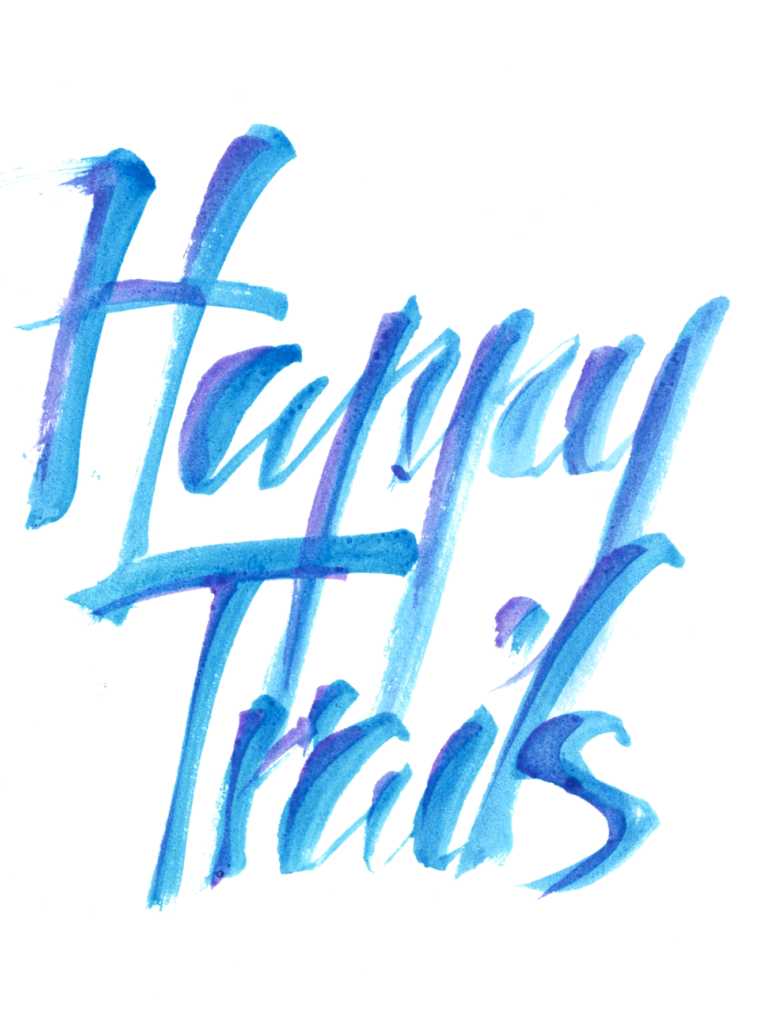
In January, the IT pro at SPWD left for an awesome opportunity. She happened to be in town so I ran a card over to her. While graphing it out, I ended up with a second card, which I just gave to the guy who instituted the GIS system at our airport, apparently one of the most sophisticated airport systems in the nation.
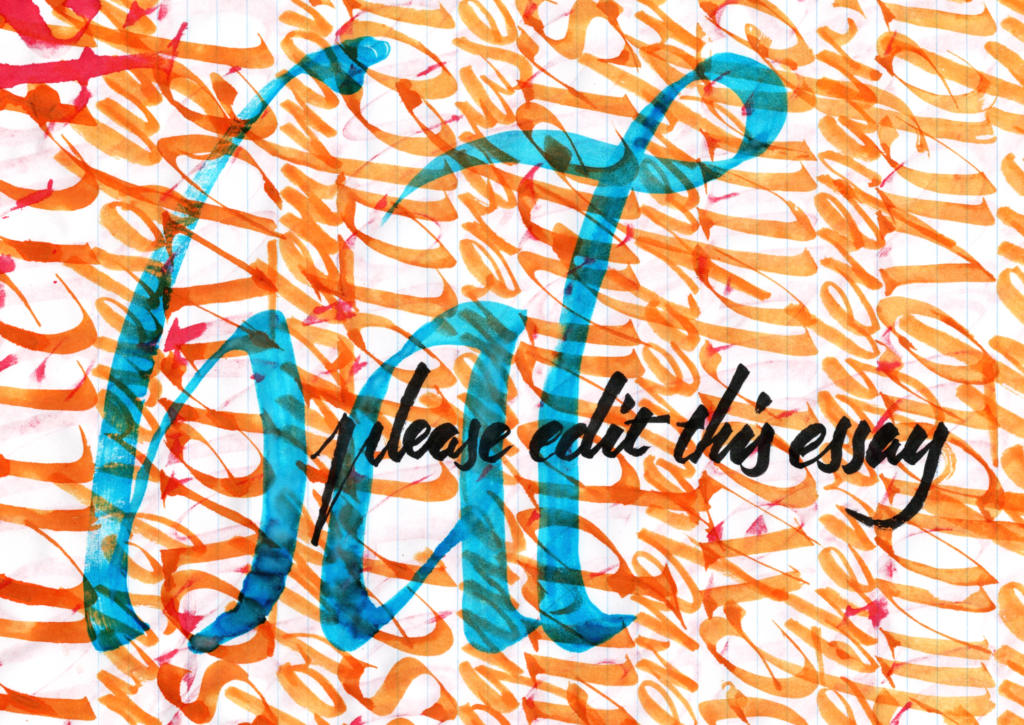
With the recent talk about AI, I threw Wednesday’s post into ChatGPT to see what it would suggest. I had tried to craft a decent newsletter, but still felt there was room for improvement on this one.
,
I spent the month of April 2021 reading and listening to all the books in the library about the Bhagavad Gita. I thought about doing a series of separate posts, but I’m not sure I have that much to say, so listicle time!
In April 2021, I dedicated the month to reading and listening to every book in the library about the Bhagavad Gita. I thought about writing a series of separate posts, but I wasn’t sure I had enough to say, so here’s a listicle instead!
I’m toying with a cheeky tone. AI made it blandly cheery.
,
Let’s start with a free copy, translated by Sir Edwin Arnold. As with all public domain books, the language is dated, but nothing beyond the King James Version of the Bible. It doesn’t come with commentaries, which are essential for understanding what’s going on—especially for us from the West where Hinduism is an exotic oriental religion, but the price is right for a decent introduction to the Gita.
Let’s start with a free version, translated by Sir Edwin Arnold. Like all public domain books, the language is somewhat dated, but it’s no more difficult than the King James Bible. This version doesn’t include commentaries, which are essential for understanding the Gita—especially for those of us from the West, where Hinduism often feels like an exotic, mysterious tradition. Still, for a decent introduction, the price (free) can’t be beat.
Interesting that AI replaced “oriental” with “mysterious”—PC-ness run amok. The use of this inflammatory term was specifically chosen for contrast.
Also, adding “(free)” to the last sentence was just blunt force trauma on the point.
,
I listened to Jack Hawley’s Bhagavad Gita, A Walkthrough for Westerners which is a translation where the commentary is mixed into the writing, resulting in a version that is three times as long as the original poem. It’s an interesting concept that reminds me of the Living Bible paraphrase of the Bible published in the 1970’s. But I was reading the original at the same time as listening to this book, so it felt strange to have Hawley’s parentheticals inserted into the flow of the text. And it was unsettling to never be sure what was textual and what was explanatory. I don’t think it’s a horrible idea, but I prefer the streamlined punch of the original.
I also listened to Bhagavad Gita: A Walkthrough for Westerners by Jack Hawley. This translation includes commentary woven directly into the text, making it three times as long as the original. While it’s an interesting approach, it reminded me of the Living Bible paraphrase from the 1970s. I read the original at the same time, so it felt strange to have Hawley’s parenthetical explanations inserted into the flow of the text. It was often unclear which parts were textual and which were commentary. While I don’t think this format is terrible, I prefer the streamlined power of the original Gita.
I’ll give it to AI, “woven” is better than “mixed”. I’ll also respect its valiant attempts to avoid starting sentences with conjunctions. I don’t like it myself, but ridding the conjunctions requires structural renovations, not mere massaging. This is not a great paragraph, but AI didn’t make it better.
,
I also listened to Ram Dass’s book Paths to God which takes the opposite tack from Jack Hawley. This is a series of lectures nominally around the Gita, but really about Hinduism and spirituality in general. I first came across Ram Dass in the documentary Fierce Grace (as part of a double header with Winged Migration in a movie theater that was about to be demolished). I’ve always been skeptical about white dudes who are into eastern spirituality, but I could sense a good spirit in the film. One interesting aspect of this book is that Ram Dass effortlessly utilizes the language of the 60’s (freak, trip, etc) in a way that makes one understand how that vocabulary came about. Of course it has become a caricature through the intervening decades, but the body of language met a need that was lacking in standard English. In all, I really liked this book.
Next, I listened to Paths to God by Ram Dass, which takes the opposite approach from Hawley. Rather than focusing directly on the Gita, it’s a series of lectures about Hinduism and spirituality in general. I first encountered Ram Dass in the documentary Fierce Grace, which I saw as part of a double feature with Winged Migration in a theater set to be demolished. I’ve always been skeptical of white people exploring Eastern spirituality, but I could sense a genuine spirit in his teachings. One notable aspect of Paths to God is how effortlessly Ram Dass uses 1960s vernacular (terms like “freak” and “trip”), giving insight into how that language came about. While these terms have become caricatures over time, they filled a linguistic gap in standard English. I really enjoyed the book overall.
Another mediocre paragraph that wasn’t vastly improved by AI. I find it annoying that they polish away the personality by smoothing out the language, such as “dudes” into “people”.
Even though some of the suggested revisions are decent, the ultimate weakness of this paragraph is its blandness, and AI only pushes towards further blandness. For example, I should have leaned into the 60’s terminology by closing with “I really dug this book”, not turned “liked” into “enjoyed”.
Many times, it seems that AI is paid by the syllable.
,
The library has a straight audiobook reading of the Gita translated by Barbara Stoler-Miller. The reader, Jacob Needleman, has a copy of the audio posted on his own website. The free version online is of inferior audio quality to the version on Overdrive, but it is free.
The library also has an audiobook of the Gita, translated by Barbara Stoler-Miller, read by Jacob Needleman. Needleman also has a version available on his website. The free online version has inferior audio quality compared to the Overdrive version, but it’s still free.
Eknath Easwaran has a popular translation, but he relies a bit too much on sanskrit terms which makes it hard to follow at times.
Eknath Easwaran’s popular translation is another option, though I found it hard to follow at times due to his heavy reliance on Sanskrit terms.
I could take or leave the edits on these two short paragraphs.
,
When Love Comes to Light, by Richard Freeman & Mary Taylor is a two part book, with an extended ten chapter commentary of the Gita followed by a translation of the book in the second part. Having read and listened to a few books about the Gita, I’m at that point where I’m no longer a complete stranger to the work, but I am still such a novice I can’t really judge the quality of the commentary. Nothing seems out of line with what other people say about the Gita. One nice feature about this commentary is that it generally follows the flow of the Gita. While the essays don’t shy from pulling quotes from the entire book, the flow of the ten chapters covers the themes in the order that they were presented in the original. As such, it may be a good introduction to the Gita.
When Love Comes to Light by Richard Freeman and Mary Taylor is a two-part book, with a lengthy ten-chapter commentary on the Gita followed by a translation of the text. Having read and listened to several books on the Gita, I now feel like I’m not a complete stranger to it. But I’m still a novice, so I can’t really judge the quality of the commentary. It generally seems in line with what others say about the Gita. One nice feature of this commentary is that it follows the flow of the original text, covering the themes in the same order. As such, it might be a good introduction to the Gita for beginners.
I needed to take a chainsaw to the original paragraph. AI didn’t go far enough in condensing the text, but it did better than me.
,
The Great Work of Your Life: A Guide for the Journey to Your True Calling, by Stephen Cope is a self help book based around the Gita. Like any self help book it is digested in to four digestible “pillars”:
Look to your Dharma
Do it Full Out!
Let Go of the Fruits
Turn it Over to God.
I enjoyed being introduced to the biographies of the great individuals who were discussed in the book, but the criticism on Amazon that the author never dealt with the the conundrum of familial obligations is absolutely on point. The Gita is all about following your duty, which is an easy concept if one has only one single overarching dharma. But what if you have multiple obligations? This book falls short for us normies. I understand why Cope streamlined the biographies to focus on their pursuits of their dharma, but this reduced applicability of these stories for our messy lives. I get that the greats are great because they are different, but if the author doesn’t draw a connection between their lives and our reality, then their biographies become irrelevant. As such, the book is simultaneously too long and too short.
The Great Work of Your Life: A Guide for the Journey to Your True Calling by Stephen Cope is a self-help book based on the Gita. Like any self-help book, it’s broken down into four digestible “pillars”:
Look to your Dharma
Do it Full Out!
Let Go of the Fruits
Turn it Over to God
I enjoyed the biographies of the great individuals discussed in the book. However, an Amazon review’s criticism about Cope’s failure to address the conundrum of familial obligations is spot on. The Gita is all about following your duty, which is an easy concept if you have a single, clear dharma. But what if you have multiple obligations? This book falls short for people who don’t have a singular calling. While I understand why Cope focused on the great figures’ pursuit of their dharma, he doesn’t draw meaningful connections to our more complex, everyday lives. As a result, the book feels both too long and too short.
Another long paragraph that AI slightly tightened when it needed drastic cuts. I’m gonna call this a draw because it misread one of my points. Then again, that’s my fault cause it wasn’t written clearly.
,
I read the Stephen Mitchell translation, which is in Modern English. Unfortunately I can’t remember anything about this translation. Stephen Mitchell has translated so many different texts, I’m always a little worried about whether he has the expertise to do it right whenever it comes to a specific book.
I also read Stephen Mitchell’s modern English translation, though I can’t remember much about it. Mitchell has translated so many texts that I sometimes question whether he has the depth of expertise required for specific works like the Gita.
AI was straight up better, but I noticed that my voice is missing. If keeping my voice is important, then I need to tighten up my writing myself.
,
I’ve ultimately settled on Laurie Patton’s translation. I enjoy her tight structure, capturing a poetic pithiness of the original that the other translations don’t. I read this after my initial explorations, so having some of the concepts telegraphed is not a problem.
Ultimately, I’ve settled on Laurie Patton’s translation. I appreciate how she captures the original’s poetic essence with tight, concise language that other translations lack. By the time I read this version, I had already explored the Gita’s concepts, so the occasional telegraphing of ideas didn’t bother me.
AI polished too much again. There are slight awkwardness in some of my wording, but nothing I would change in favor of AI. In a shorter paragraph, a little awkwardness is fine.
,
Given that I’ve read more about this text than any other text from the last twenty years you could say I dig the book. Its appeal to duty resonates with the cultural Confucianism of my upbringing and my intellect is tickled by the exotic foreign spirituality in the rest of the book.
Given that I’ve studied this text more than any other over the past twenty years, you could say I’m a big fan. The Gita’s emphasis on duty resonates deeply with the Confucian values of my upbringing, while its spiritual insights continue to intrigue my intellect.
AI nuked “exotic” and “foreign“. It really hates toying with otherness.
,
Naturally, the Gita has ended up in the top tier of wisdom literature that I would like to revisit for the rest of my life, along with the Daodejing, Analects, Havamal, Zhuangzi, and the book of Ecclesiastes.
Naturally, the Gita has become one of the top texts I’d like to revisit throughout my life, alongside the Daodejing, Analects, Hávamál, Zhuangzi, and the Book of Ecclesiastes.
Hey, AI got the accents for the Havamal!
,
In 2023, I briefly messed with ChatGPT. I was underwhelmed. The hallucinations made it useless for research and it short circuited my process when I used it for synonyms (as opposed to using an online thesaurus).
Two years later, I have been stunned at its search improvements (or Google SEO’d blog posts have become that much worse). But this exercise shows that AI isn’t ready as a writing assistant (unless you’re just pushing bland-ass corporate bullshit).
Revisiting ChatGPT after a few years, I was amazed at how much it has improved for research—though I can’t help but wonder if Google SEO-optimized blog posts have just gotten that much worse. However, this exercise demonstrates that AI still isn’t quite ready to be a go-to writing assistant—unless, of course, you’re aiming to produce generic corporate content.
Editing isn’t always fun. Especially on the Nth pass through a piece that you desperately need to get out of your life. But hard editing forges a piece that is uniquely yours. AI is no shortcut. Indeed, it’s a detriment, fostering complacency that will further drown your voice in the hurricane of content.
In a couple of years, FOMO will grab me again and I’ll check it out. Until then, the shortcut to better editing remains just taking a damn nap.
Catching up with old Inktober52 challenges from 2024.
,
1/20 Inktober 52 (2024), week 22
duck paddling into murky secrets
ducks paddle over dark secrets
I uploaded the one on top, but was not happy with how it looked. I messed around a little in GIMP, adding a duo-tone background and then changing the opacity to multiply. Now I’m really happy with both versions!
,
1/23 Inktober 52 (2024), week 27
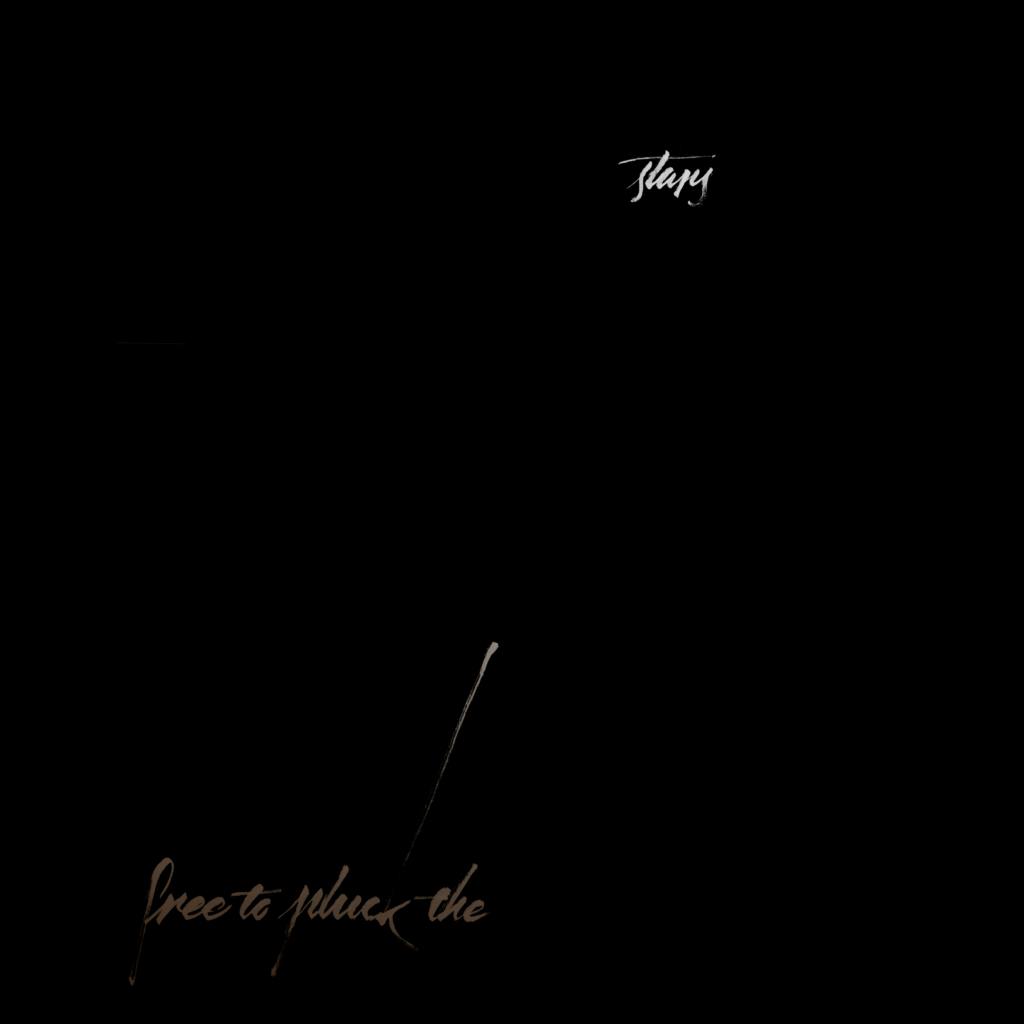
free to pluck the stars
This was inspired by Ann Collin’s post with collage artist Duane Toops, a beautiful pairing of poetry and collage. Check it out!
Their collaboration was bouncing in my head as I tried to fall back asleep while also mentally imaging the Inktober52 prompt “free”. This line slid into my half asleep mind and I snapped awake.
The original graph was black ink on white paper. In the computer, I inverted the color, pulled “stars” way up into the sky, and added a little brown to emphasize the earthiness of the starting line.
Even though I don’t prefer relying upon the computer, I do it when it makes sense. At the very least, rightsizing the white space around conventional pieces. And sometimes it’s nice to envision a piece and hit it out of the box.
,
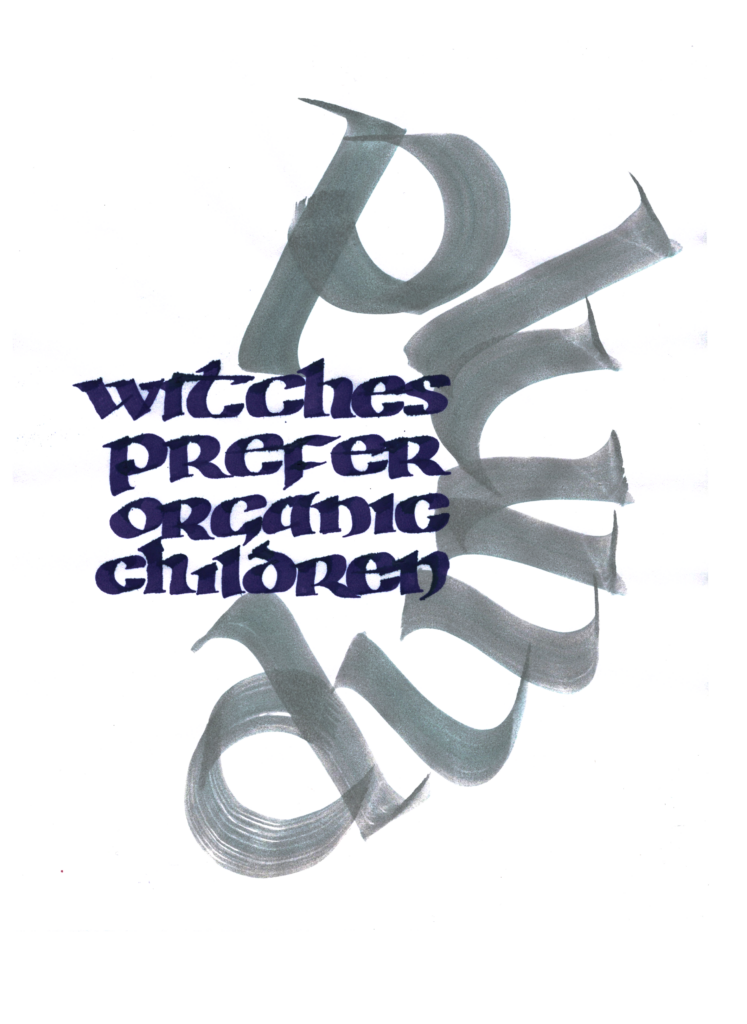
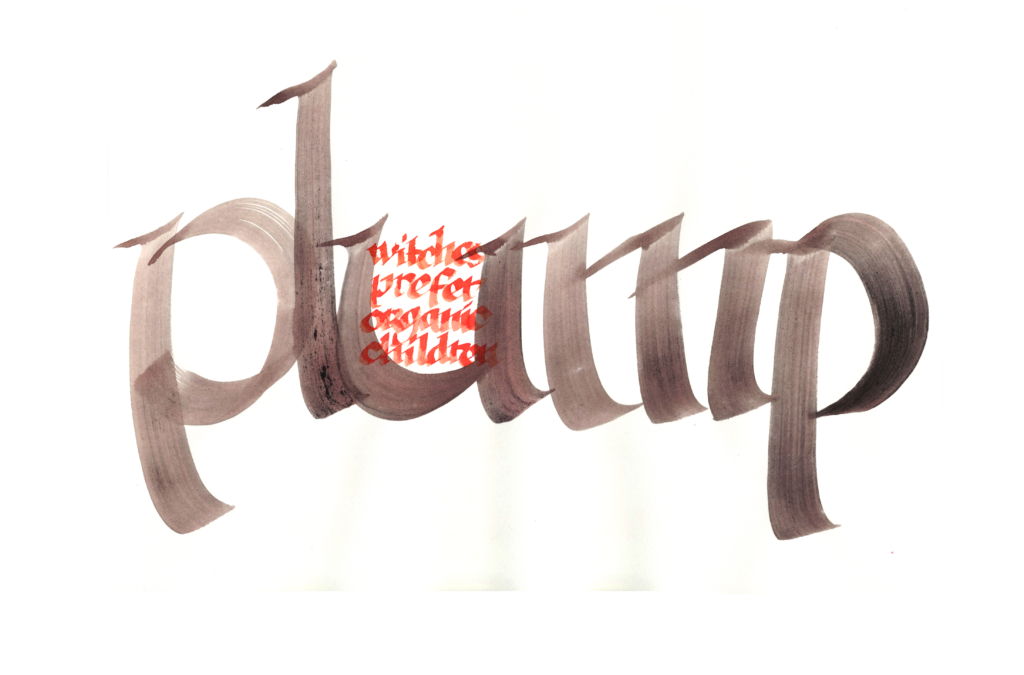
1/28 Inktober 52 (2023), week 42
plump witches prefer organic children
This one turned out to be wicked hard. Even though I envisioned both of these concepts fairly easily, they both took multiple attempts and I’m not happy with any of them.
Sometimes you just throw your hands up and say “this is all I got with today’s skillz!” And move on.
,
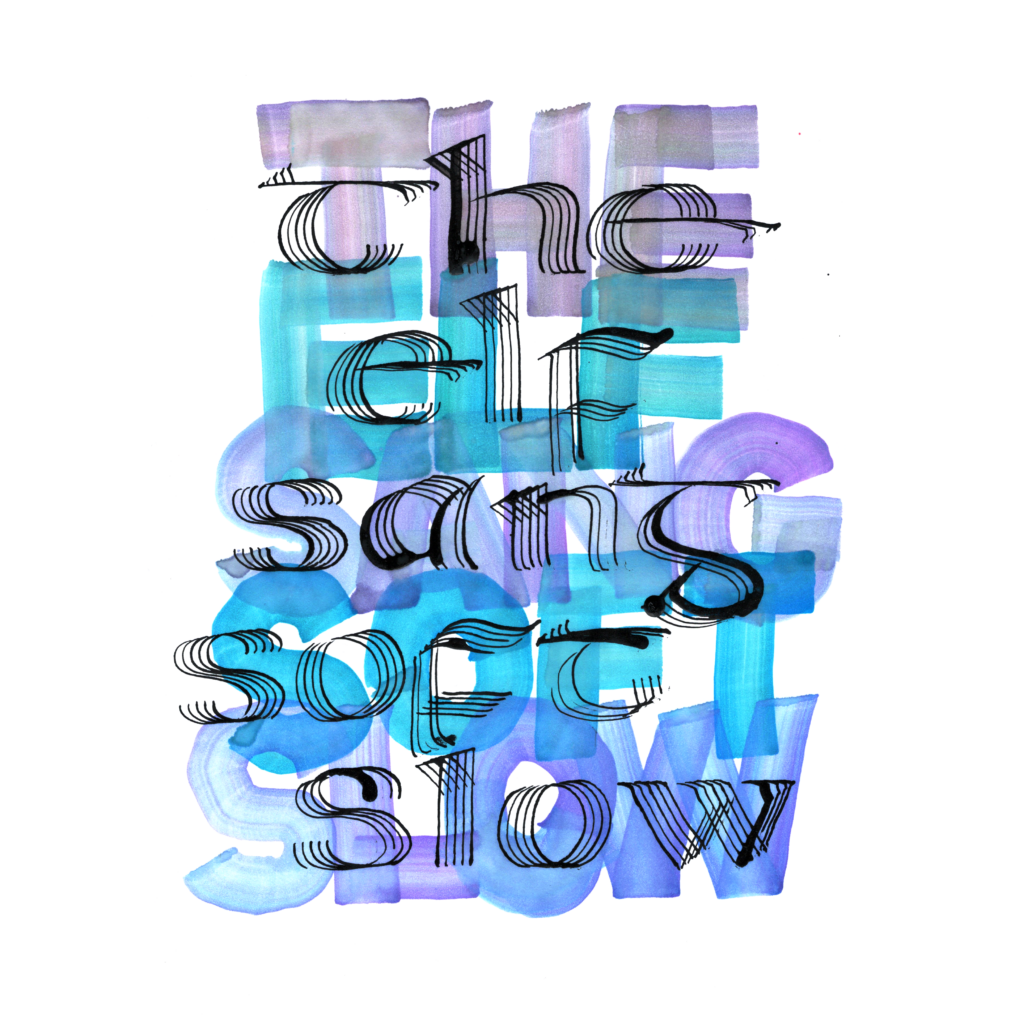
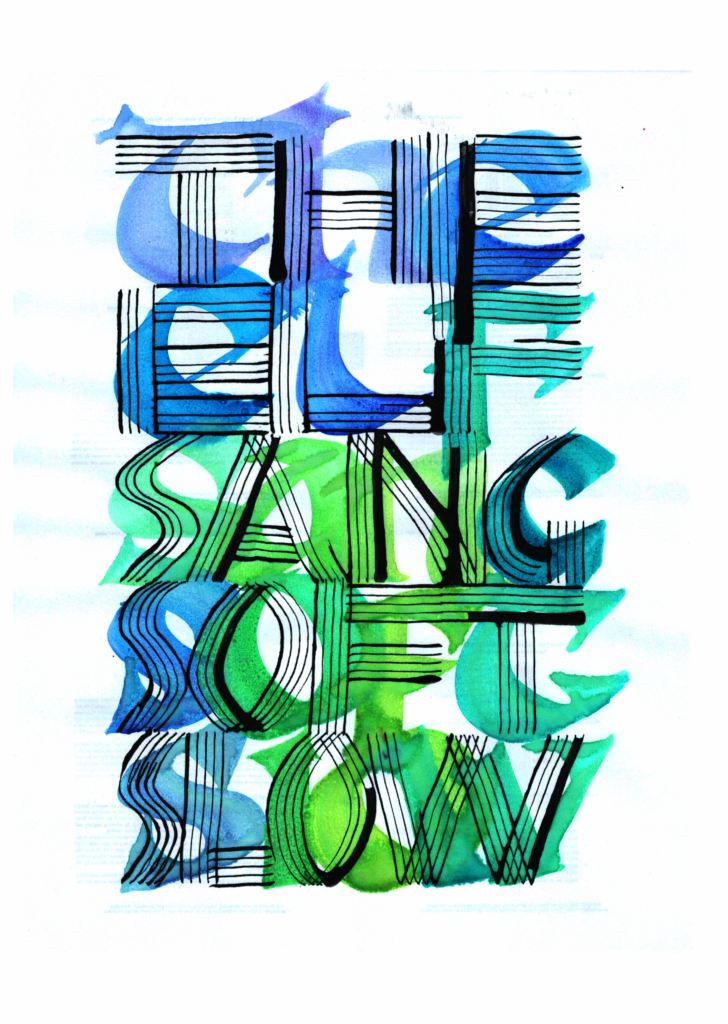
1/29 Inktober 52 (2023), week 51
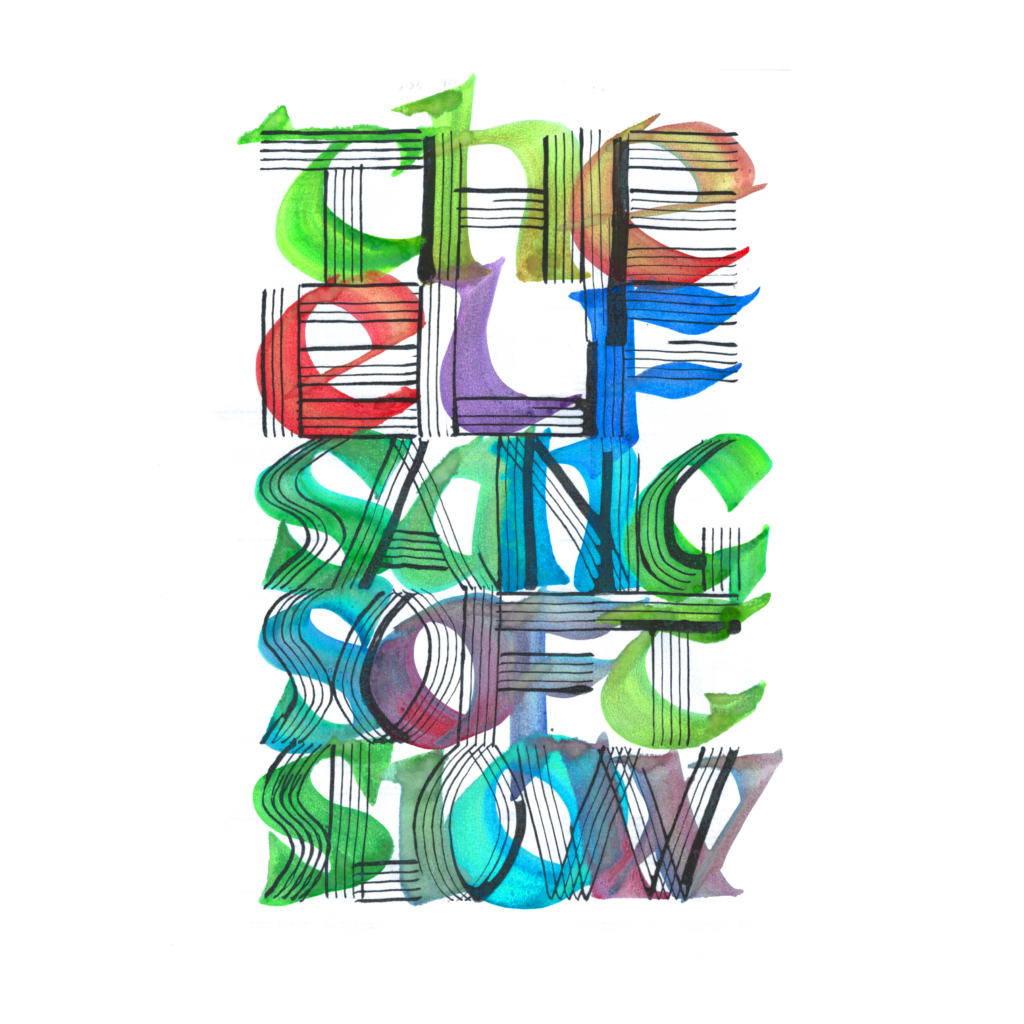
the elf sang soft slow
I’m still figuring out how to use that music nib. This was inspired by a glorious piece by totemspoems on Instagram.
,
2/3 Inktober 52 (2021), week 30
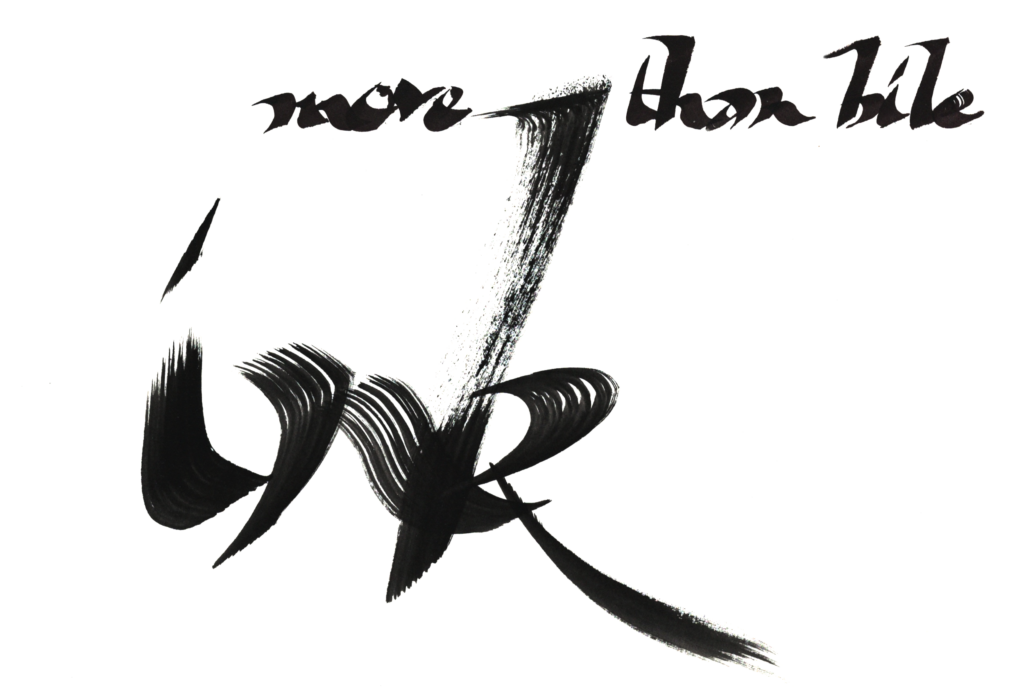
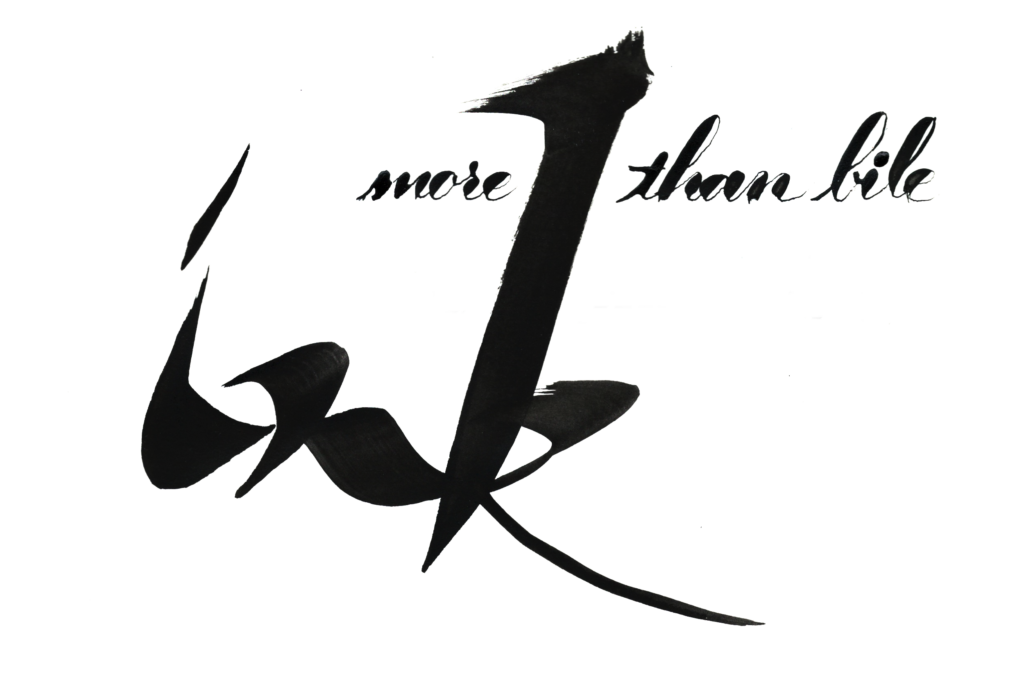
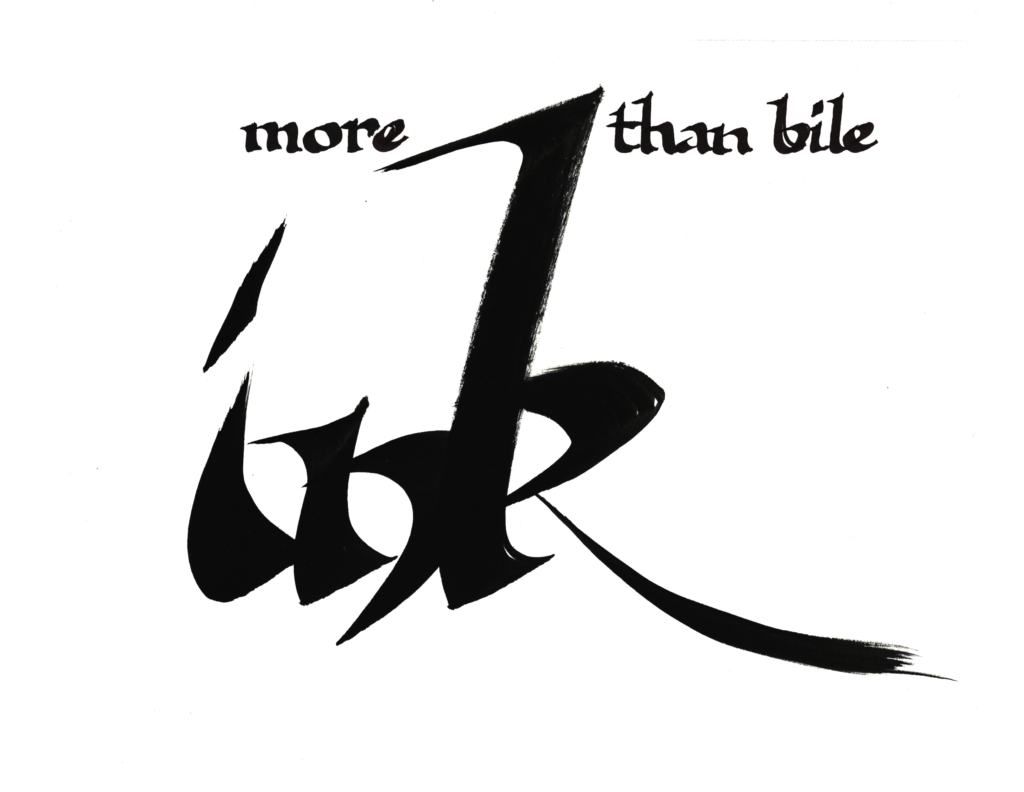
ink more black than bile
A lot of times I’m using greys, washes, or watercolor. It was fun to just use a pure black india ink.
,
At the start of February, I showed my wife some awesome calligraphraphers on Instagram. She was reasonably nice about my work too =).
But we agreed that the borders was limiting the punch on the 5WPs.
So they’re gone.
As an architect, there are some perks to being married to another architect.
Cya next time!
,
PS-Bhagavad Gita
I spent the month of April 2021 reading and listening to all the books in the library about the Bhagavad Gita. I thought about doing a series of separate posts, but I’m not sure I have that much to say, so listicle time!
Let’s start with a free copy, translated by Sir Edwin Arnold. As with all public domain books, the language is dated, but nothing beyond the King James Version of the Bible. It doesn’t come with commentaries, which are essential for understanding what’s going on—especially for us from the West where Hinduism is an exotic oriental religion, but the price is right for a decent introduction to the Gita.
I listened to Jack Hawley’s Bhagavad Gita, A Walkthrough for Westerners which is a translation where the commentary is mixed into the writing, resulting in a version that is three times as long as the original poem. It’s an interesting concept that reminds me of the Living Bible paraphrase of the Bible published in the 1970’s. But I was reading the original at the same time as listening to this book, so it felt strange to have Hawley’s parentheticals inserted into the flow of the text. And it was unsettling to never be sure what was textual and what was explanatory. I don’t think it’s a horrible idea, but I prefer the streamlined punch of the original.
I also listened to Ram Dass’s book Paths to God which takes the opposite tack from Jack Hawley. This is a series of lectures nominally around the Gita, but really about Hinduism and spirituality in general. I first came across Ram Dass in the documentary Fierce Grace (as part of a double header with Winged Migration in a movie theater that was about to be demolished). I’ve always been skeptical about white dudes who are into eastern spirituality, but I could sense a good spirit in the film. One interesting aspect of this book is that Ram Dass effortlessly utilizes the language of the 60’s (freak, trip, etc) in a way that makes one understand how that vocabulary came about. Of course it has become a caricature through the intervening decades, but the body of language met a need that was lacking in standard English. In all, I really liked this book.
The library has a straight audiobook reading of the Gita translated by Barbara Stoler-Miller. The reader, Jacob Needleman, has a copy of the audio posted on his own website. The free version online is of inferior audio quality to the version on Overdrive, but it is free.
Eknath Easwaran has a popular translation, but he relies a bit too much on sanskrit terms which makes it hard to follow at times.
When Love Comes to Light, by Richard Freeman & Mary Taylor is a two part book, with an extended ten chapter commentary of the Gita followed by a translation of the book in the second part. Having read and listened to a few books about the Gita, I’m at that point where I’m no longer a complete stranger to the work, but I am still such a novice I can’t really judge the quality of the commentary. Nothing seems out of line with what other people say about the Gita. One nice feature about this commentary is that it generally follows the flow of the Gita. While the essays don’t shy from pulling quotes from the entire book, the flow of the ten chapters covers the themes in the order that they were presented in the original. As such, it may be a good introduction to the Gita.
The Great Work of Your Life: A Guide for the Journey to Your True Calling, by Stephen Cope is a self help book based around the Gita. Like any self help book it is digested in to four digestible “pillars”:
Look to your Dharma
Do it Full Out!
Let Go of the Fruits
Turn it Over to God.
I enjoyed being introduced to the biographies of the great individuals who were discussed in the book, but the criticism on Amazon that the author never dealt with the the conundrum of familial obligations is absolutely on point. The Gita is all about following your duty, which is an easy concept if one has only one single overarching dharma. But what if you have multiple obligations? This book falls short for us normies. I understand why Cope streamlined the biographies to focus on their pursuits of their dharma, but this reduced applicability of these stories for our messy lives. I get that the greats are great because they are different, but if the author doesn’t draw a connection between their lives and our reality, then their biographies become irrelevant. As such, the book is simultaneously too long and too short.
I read the Stephen Mitchell translation, which is in Modern English. Unfortunately I can’t remember anything about this translation. Stephen Mitchell has translated so many different texts, I’m always a little worried about whether he has the expertise to do it right whenever it comes to a specific book.
I’ve ultimately settled on Laurie Patton’s translation. I enjoy her tight structure, capturing a poetic pithiness of the original that the other translations don’t. I read this after my initial explorations, so having some of the concepts telegraphed is not a problem.
Given that I’ve read more about this text than any other text from the last twenty years you could say I dig the book. Its appeal to duty resonates with the cultural Confucianism of my upbringing and my intellect is tickled by the exotic foreign spirituality in the rest of the book.
Naturally, the Gita has ended up in the top tier of wisdom literature that I would like to revisit for the rest of my life, along with the Daodejing, Analects, Havamal, Zhuangzi, and the book of Ecclesiastes.