A very short review of Sum by David Eagleman, 2009.
(I think I came up with that line myself, but I can’t be sure I did.)
GRIZZLY PEAR
A very short review of Sum by David Eagleman, 2009.
(I think I came up with that line myself, but I can’t be sure I did.)
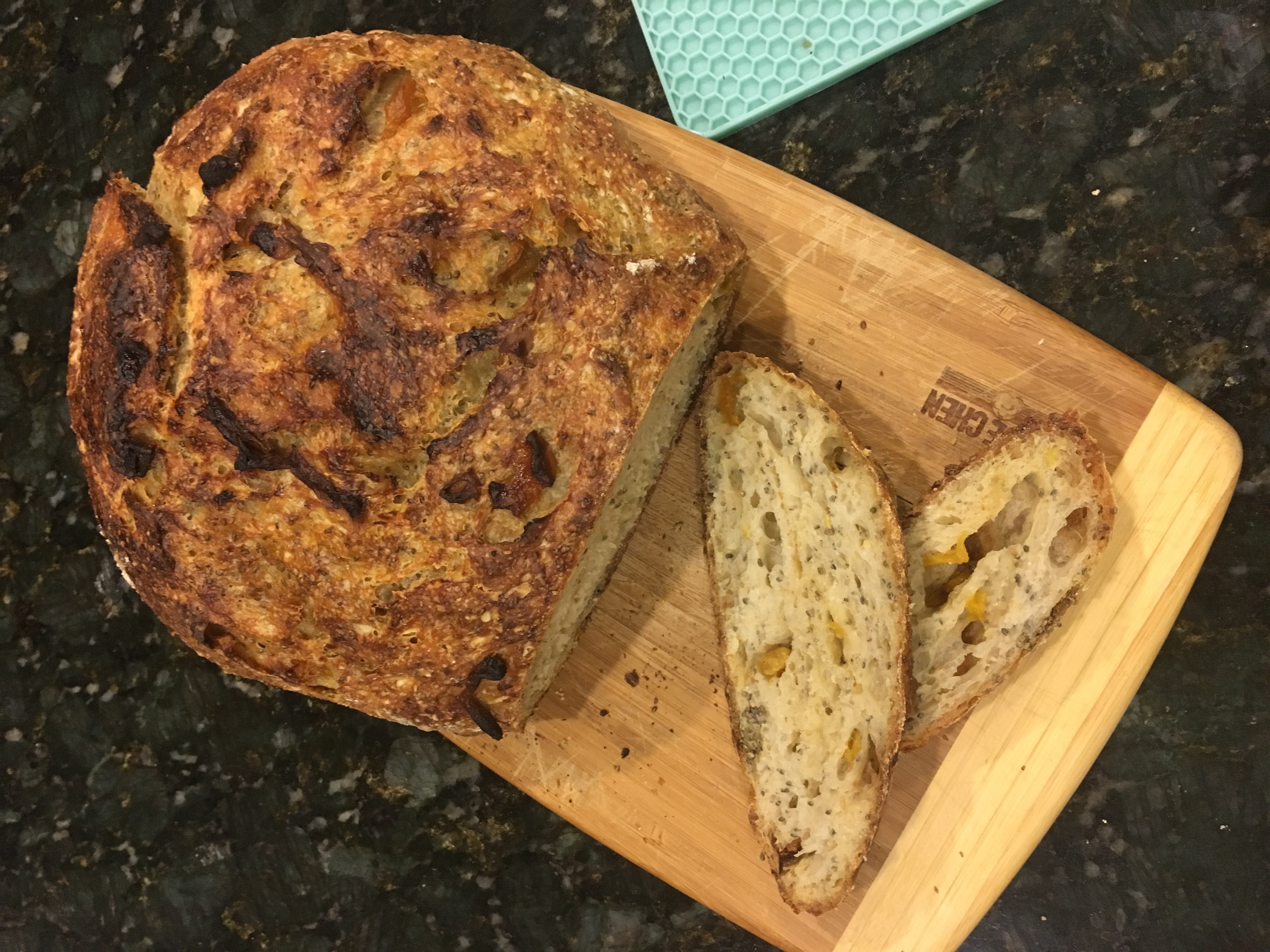
Nothing particularly special about this bread. It is very similar to last week’s bread, except that I used the starter straight out of the fridge (my usual process) and now that the dried figs and apricots are gone, we opened up a giant bag of dried mangoes, to the great delight of our daughter!
400g flour
300g water
100g starter (the usual 50/50 mix)
10g salt
60g rehydrated mangos
40g chia seeds, soaked in 60g water
40g flaxseed meal, soaked in 80g water
Since the starter came out cold from the fridge, the proof started slow which was further retarded because the dough went into the fridge so we could attend Winnie the Pooh at the Rainbow Company Youth Theater. The show was was great fun even I don’t think our daughter quite follow the story.
On Monday evening, I put the dough in the oven’s proof function and it rose high enough to bake. Like the previous couple weeks, the dough was still cool to the touch when I shaped it, but for once it wasn’t overproofed. Per my new standard operating procedure, the oven temperature was held at 450f, and only the pot was preheated without the lid. I tried using silicone pot holders instead of oven mitts for the first time. It worked perfectly well and meant I didn’t have to fully dry off my hands after washing off any dough from the final shaping.
The bread came out nicely, with a lighter crumb than the last couple weeks. I am generally satisfied with the flavor my loaves, even if I don’t push the limits of proofing my bread. Ken Forkish recommends pushing the proof as long as possible, but given the downsides of overdoing it, I really need to get his voice out of my head. I’m certain he is giving good advice for competitive bakers, but it really isn’t the hassle for someone like me.
As for the mangoes, I can’t tell the difference between this and the previous loaves. Next week, I’ll just leave out the dried fruit and spare us the added sugar.
Last week, we started an assessment of one of the larger office buildings in our portfolio. The very first step of the exercise was to figure out the proper points of contact for each of the multiple departments in the building. The maintenance team pinpointed some potential targets, but ultimately someone had to sit down and find out.
I spent half of Monday calling up and down the building, and then I burned up Tuesday morning blasting out email introductions between the departments and the architect. I joked with a colleague that I spent the first half of this week cold calling and spamming state employees. It was a glorified version of a high schooler’s first job search working their way down the yellow pages.
As the client, I could have forced the architect handle this task, but I wanted to send a signal that I respect them as professionals, reserving their labors for executing the actual data collection and analysis that they were really hired to do. This grunt work was a gray area in the contract, and I felt that pulling a power play so early in the relationship would ultimately cost the project in reduced quality in the final delivered assessment.
Maybe I was just played for a patsy by my own consultant, but I think true leadership is earned via service to those you are leading. Authority comes with my job title, but the true job is to motivate my team to deliver their best work, which is done the hard way.
Last night we wanted to go out, but with an infant, it can be as tiring as making your own meal. We had tomatoes, defrosted ground beef, roasted beets in the toaster oven, and veggies in the fridge. So after a few minutes of indecision we decided to make our own pasta and just eat at home.
Ever since learning the Michael Ruhlman’s simple 3 : 2 ratio (flour to egg in weight) it’s been quite easy for us to make pasta, especially now that we have the kitchenaid roller attachment.
To mix things up, I tried a 2 : 1 ratio, with 200g flour and 100g egg. That did not work well, especially since I also tried mixing it on a thirsty wood cutting board instead of the usual metal bowl. Eventually I had to add another 15g of water just to get the dough to form up.
As always we let it set for 15 minutes before rolling it out. I divided the dough into 60g balls and then rolled them all out on the widest 1 setting. This process took some time since the original kneading was not very thorough since the mix was so stiff. Each ball had to be run it through the roller multiple times to get the right smooth texture. However, the extended rolling meant that it gave the dough some more time to rest.
Once all the balls were rolled out, I then rolled out each slab up to the 7 setting and then let it rest for a few minutes again. We got a pot of water started, so we could immediately cook the pasta once it was completed.
I finally ran each of these sections through the thinnest 8 setting twice. It was relatively uneventful until the inevitable goof on the last one where the dough got misaligned and tore itself up halfway through on the second run. While annoying it wasn’t catastrophic since it just left me with two short halves which I could still turn into noodles. We then took out the fettuccine cutter and cut all the noodles and immediately cooked it up in the pot of water.
This whole time my wife was making a tomato sauce with the beef so it was ready to eat when the pasta was cooked. The last thing to do was cook the kale in the old pasta water. With that, we had a colorful meal, a yellow orange beef sauce, bright magenta and yellow roasted beet slices, and the deep dark green of the boiled kale.
Ultimately, the pasta came out ok, but I’m going back to the original 3:2 ratio. If I had to save on eggs, I suspect the 2:1 would work if I didn’t try to work on a dry wood cutting board, but it’s just not the right luxurious fresh egg pasta chewy texture that you can’t even get in a restaurant.
I had feared that something would be lost when we got the pasta roller for the kitchenaid, but rolling out the dough is by far the most laborious task of the process and while I slightly miss uneven texture of hand rolled dough and the chance to work it with our girl, it is more than made up for in the effort saved. Maybe next time I’ll try to fake it by rolling out the dough to level 5, and then hand rolling the rest, and I can get my daughter involved in the process again.
One of things I did not anticipate about new job was how much joy I would feel when I find anachronisms in project specification books. It is so refreshing to stumble across non-ironic, un-nostalgic references to old technology.
I just hope that I’m not missing out on the really big whoppers while I revel in catching these minnows.
I was thinking about sending an email to a colleague. It was going to be about how distinctly short a time we have with our babies so we should try to make the most of it.
And then I spent the evening working and surfing the political drama of the day. Drama that is way, way, way out of my circle of influence.
I then woke up early this morning, and then got derailed for an hour, catching up on the all the nothing that has happened over the short night.
Work and the internet is one helluva drug. Can’t live without either, but both can really take you out of the present.
Being present is really hard. Who knows, with all its current hotness, maybe it’s overrated. But it’s gotta be better than this.
A few thoughts:
1) Your still lifes are old fashioned. That IS their charm to me. The fact they are incredibly well crafted shows that you care. These photographss are not just some quick and crappy imitation, but a true exploration of this genre. I think you should embrace it.
2) This goes back to a critique I had in college of Art majors. As an Architecture student, I was instilled with a level of rigour and craft that they did not enforce at the Art department. I always felt it a to see so many Art students spending all their energy trying to be new and different but because of a lack of care, the result was a bunch of badly made crappy work.
3) “I feel I lack that certain creativity that allows me to come up with something original something clean and new” To be doubly clear – you have the clean part down pat. So the hard part for you seems to be “original” and “new”. (For me it would all three items!)
4) I think one way to get to “original/new” is to push past the focusing on the pretty composition and interrogate what you are trying to say about the world of things around us. What is your stance on things? How do you say it within the constraints of a classical still life? Do you say it subtly (a flower and crib)? Or do you say it brashly (a dildo and diaper)?
5) Or more specific to image above. Its clear from the image you had chosen items from and books about the the American West, (with a nuance towards Native American artifacts). How would you shape this still life to actually say something about it? Yes, they are just objects, but don’t just take them at face value. You could explore the “appropriation of misused objects” – a jug shaped to hold a light bulb, a rock and skull used as paint canvases – there is a certain level of absurdity to that! Or explore cultural appropriation, an englishman talking about America, a blanket that seems to have never been used to warm someone up, the portraits of aged weatherworn other people. Or if want to go neutrally abstract, the idea of old and new – the weather worn jug versus the seemingly never actually used jug, the old atlases and the new hat.
6) A potentially fruitful avenue forward would be to take the composition beyond a collection of themed objects, to a collection of objects selected around an idea. Go up a level in abstraction and start pushing the ideas. For example, if your idea is American West – how about throwing some artifacts of the modern west, such as a Macbook (designed in Cupertino) and a toy Truck? If it’s cultural appropriation of native americans, how about a DVD of Dances with wolves and a Redskins jersey? If it’s about ancient artifacts, why not throw in some modern artifacts that already seem dated – the old 386 desktop collecting dust in your garage and a Thriller LP.
7) American expansion (how about modern empire)? American exceptionalism (what’s the human cost)? Nostalgia (old and modern)? Otherness of different cultures (how are we strange)?
8) I know this can seem to be a horrific navel gazing approach, but I don’t think it has to be. Play with it in an iterative way, take multiple stabs that build upon each other. From example above –
Step 1: Start with your photo above.
Step 2: Then explore the American West by adding a Apple Macintosh and Toy Truck.
Step 3: Then turn on the Mac, and have the monitor show a still image of Dances with Wolves and the toy truck positioned to look like its about to be swallowed by a horse.
Step 4: Then ….
Let each step inform the next iteration, either due to different shades of nuance to theme that you are exploring (in this case, different ways to juxtapose the old and modern American West) or the new compositional possibilities due to the new elements inserted into the still life (the computer screen can be used to display other images otherwise not possible to include in a still life).
9) I am a huge proponent for your espoused never-stop-moving approach “So ill keep nibbling away hoping one day lightning will strike and I’ll get that aha moment!” But I also believe that any endeavor involves periods of expansion and contraction. Sometimes you have to “just do it!” But sometimes I think one should take a breather and analyze what has already been produced. Print out a full series to date (such as the still lifes, dancers, or beach portraits), pin them all up on a wall and step back. I’m serious, get yourself all the way across the room so the wall looks like a page of contact sheets. Look at the totality of the whole series and interrogate yourself. Are there threads of commonality there? See if your unconscious has pushing you in a particular direction. And now having seen your unconscious, maybe push that direction to 11 (or actively decide to fight and go in a different direction)
10) Like I said at the top, I’m skeptical that something “new” can just “pop out” of nothing. It isn’t the blank sheet that is new and original; it’s the collection of marks on the sheet that creates the drawing. More accurately, its the collected sequence of making a mark and then another and another … pushing and prodding, building upon previous creations that lead you down a path.
11) I love your work. The craft is impeccable. I have much respect for the wide variety that you explore (still lifes, street, portrait) – and all well done to boot! Don’t lose sight of the path you’ve already travelled.
12) Enjoy the process.
Las weekend, we had a fantastic dish at Cafe Luhera so I thought it was time to update my list of favorite food offerings in this city.
The main list:
On a provisional basis, here are two dishes (one old one new):
And here are a few things that we’ve been hunting for with little success:
I looked at my daughter in the rearview mirror. It was a ghosted image, a secondary reflection. She was momentarily quiet, looking down towards the right. I could only see the top of her head, the two pigtails bound with fluorescent pink ties. What is she thinking? Where were we headed?
I dreamt of an asian pear.
Stamped with the image of a watermelon.
Red flesh, black seeds, green rind.
A juicy bulbous slice.