November and December 2025 turned into a crash course on estimating budgets and schedule.
Having gone through the crucible of three CIP seasons with the State of Nevada, I can quickly slam out numbers, but with multiple mega-projects on the horizon at the airport, I wanted to standardize our contingencies and develop a transparent process for turning a construction cost estimate into a project cost estimate.
A while ago, I had pondered the question about desired accuracy for a project estimate. With a little research, I found a professional society who studied that exact problem—the Association for the Advancement of Cost Engineering (AACE). In their rubric, the roughest estimates are categorized “Class 5” with an 80% confidence of landing between -30% to +50% for construction projects (AACE 56R-08, adopted in ASTM E2516).
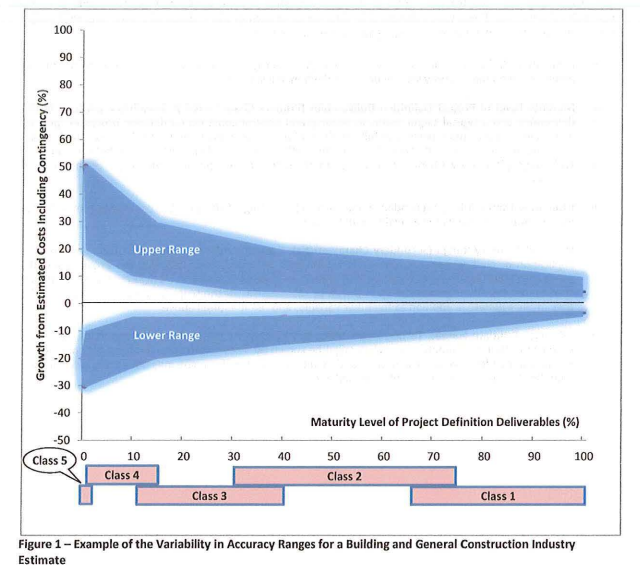
This range worked aligned with recommendations from our planning consultant for early cost markups. More specifically, we added a 20% Design Evolution markup to the Direct Construction Cost. This marked up cost became the basis of all the other costs in the project estimate, including a 20% Construction Contingency and a 10% Owner’s Allowance (because there are always changes after bid!)
Over the course of a project, the Design Evolution would drop to 0% when issued for Bid, while Construction Contingency should drop to about 5% as conditions in the field are investigated, but holding a bit for bid risk when bids are opened. The Owner’s Allowance would stay steady at 10%, but could shift if management was unwilling to allocate so much budget for post-bid changes.
As with all rules of thumb, the estimator is still responsible to account for the specific project needs, but having suggested defaults frees me to focus on unique conditions that require special consideration.
While it might be more technically accurate to stagger the cost of escalation over the course of time, we structured the estimate to provide a subtotal of the entire project cost and then add escalation as overall markup. Hopefully this will clearly highlight the cost of waiting to approve these major projects. While fools may rush in, analysis paralysis is not free—a few percent a year adds up fast!
So how to estimate a schedule? Unlike cost estimating, I was not prepared to tackle this question because I was always shoehorning dates to fit the State’s two-year legislative cycle. But the internet is a wonderful place, now that I have the freedom to recommend schedules that best fit our project needs.
Again, there is no need to re-invent the wheel—the Navy dealt with this problem in the 1950’s, creating the “Program Evaluation and Review Technique (PERT)”, where an estimator develops three schedules resulting in an Expected schedule. Since I’m intimately familiar with each step of the process, it’s easy to develop an Optimistic Schedule. My estimating spreadsheet combines these small steps into larger phases (design, permitting, construction, etc.) which makes it simple to take some broad guesses to develop the the Most-Likely and Pessimistic Schedules.
The spreadsheet then averages the estimated schedules to calculate an Expected Schedule. This schedule is considered to be a 50% confidence level estimate—half of projects will be delivered after the completion date. To bring the schedule back up to an 80% confidence level, the spreadsheet does some simple statistics to calculate a Schedule Contingency, which is shown as a final line item to determine the opening date.
As such, the schedule sheet is structured similar to the cost estimate (with the esclation added at the end). The Expected Schedule keeps the project team held to a tight process, while the additional contingency gives management a date they can confidently share with the public. This is similar to the US Army Corps of Engineer’s guidance that Congress is typically presented with an 80% confidence schedule while internal schedules are presented at 50% Confidence (USACE CSRA).
With a schedule in hand, we can now calculate escalation to the midpoint of construction. Since the cost estimate targets an 80% confidence level, we include the entire schedule contingency before the midpoint of construction.
How much annual inflation should to assume? The US Federal Reserve targets 2%, but the 2020’s have been rough, seeing 7-8% annual jumps. Things have settled down, but given recent experience, we are still assuming 4% annually. Call me in 2036 to see if that was anywhere near correct.
With that, the cost and schedule has been estimated. If you wanted to be fancy, you could build some s-curve spending projections. However, for the scale of my projects, I’ve only been asked for annual estimates, so I just use the even linear spending tracker calculated in Microsoft Project.
(Microsoft Project is a whole other thing I learned these past two months. It’s too much to cover but a few concepts that some figuring were task dependencies, hammock tasks, assigning costs to the tasks, and using flags to add color to the Gantt chart. YouTube is a great tutor, as well as AI—LLM’s are only semi-reliable, but used carefully, it was critical in working through both big picture questions and navigating software quirks.)
With this information, we can hold a jury to vet the project. Since the Construction and Design Division will be tasked with delivering the approved budget and schedule, we owe them an opportunity to critique the estimate. We also invite key operational staff for extra eyes to challenge assumptions and catch what’s missing.
And with that, we can finish the estimate with a cover letter to memorialize the basis of estimate to provide context around numbers:
- Project Description (what will this do; where is it?)
- Project Justification (why is this needed; who is served?)
- Key Assumptions (when (schedule) and how the project will be delivered)
- Base Documents (percentage of design complete, and often referencing a 3rd party estimate)
- Confirmation (or not) that an internal jury vetted the project.
- List of attachments (additional diagram, cost estimate backup, etc.)
After a couple initial tests, this template is working well. I can smash out a draft estimate in half a day, though I’d prefer a few days to do it right. Beyond half a week, I suspect that extra effort would be minimally helpful—I’ve often claimed that I can spend three hours or three weeks to end up equally wrong.
With that, I’m happy that I was given the time to develop a project estimate template that shares the work, from the basis of estimate to the final budget and schedule. Critically, this a transparent document, showing the assumptions with a clean line of logic so that decision makers can evaluate the staff’s technical opinion on the proposed project.
And with that, it’s on them.
~
Some Links
For some reason I don’t have much patience for live action films, but I gladly watch animation all the time with the kids. Here are three standouts from the last three years.
Puss in Boots: the Last Wish is the stunning sequel to the lackluster spinoff from the Shrek franchise. It was shockingly great with a tight, rich story paired with gorgeous animation. I guess DreamWorks was impressed by Sony Animation’s revolutionary Spiderverse and upped its game!
Robot Dreams is a cute, yearning story of a dog and his robot, lovingly set in in 1980’s New York City. We just watched the movie, so it might be recency bias, but it should have won the 2023 Oscar over Studio Ghibli’s The Boy and the Heron.
Flow was the worthy Oscar winner for 2024, a surreal tale of a cat weathering a sudden flood in the valley. As a wordless film, I was worried that the kids wouldn’t dig it, but they both loved it. Gints Zilbalodis is an auteur who has the courage to finish what Pixar started in that epic that first half of Wall-E. Zilbalodis’ 2019 full length film Away (included in the Criterion Collection DVD) was also well worth the watch.
Bonus! We just re-watched Ernst and Celestine now that they’re now old enough to enjoy the sweet tale and gorgeous watercolor animation. It might come from a children’s book series, but it’s absolutely enjoyable for adults as well.
~

~
Thanks for reading!
Justus Pang, RA